
The Real Authorship Question

The Authorship Question is a lot bigger than just who wrote the Shakespeare canon.  Bigger, wider, broader, and deeper.  The problem isn’t just who wrote the works of Shakespeare, it’s more like who wrote everything that qualifies as fiction during the English Literary Renaissance?  We have half a dozen genuine candidates for the role of Shakespeare, what about them?  They can’t all have been Shakespeare.

Forget about the group theory, that is, any idea that a group of writers worked together on the plays the way they do today on screenplays.  That’s nonsense.  No great and unique work of literature every got written that way.  That’s just as idiotic as the idea that Marlowe came back from the dead or that a 16th-century woman wrote Shakespeare.  Let’s be serious.

And what about the other writers who have biographies just as weak as William’s?  What about Robert Greene, whose later works sound so much like early Shakespeare, yet who has almost nothing in the way of a biography?  Why should we know so much about Ben Jonson and nothing about Greene, whose career was only a little shorter than Jonson’s?  What about Edmund Spenser who somehow managed to escape Marlowe’s fate despite his transparently anti-establishment beast fables?  Or Thomas Nashe, who simply vanished after the Isle of Dogs disaster, unlike his co-authors who both wound up in jail?

What about John Lyly, who despite the popularity of his plays and Euphues novels, never published or produced another thing for the last 18 years of his life?  Or Francis Bacon, who published nothing for the first 36 years of his life?  What about the playwright John Webster, who has absolutely nothing in his documented biography to suggest that he was anything but the son of a coachmaker?  What about George Gascoigne, Thomas Lodge, Barnabe Riche, George Pettie, Thomas Kyd, and all the other authors with dodgy or nonexistent writer’s bios?  And this is only the merest glance at the true size and scope of a question in which Shakespeare’s role is only one small factor, however large it’s loomed over time.

Since it seems the English Lit folks won’t, or can’t, make sense of this, it’s time to have a go at it from the History side.  Fitting together personalities, biographies, dates and locations, I’ve pieced together a broad overview that explains this mess, one that fills in the gaping anomalies and creates a scenario that accounts for almost all the problems that the authorship scholars denote, be they Oxfordians, Stratfordians, Baconians, or Marlovians.

But first it’s necessary to understand why it happened the way it did.

The nature of the Reformation

It always boils down to terminology, to words.  Much as they avoided the truth about the 20 years of war that tore the English society apart in the 17th century by calling it, or part of it, The Interregum, English historians have sugar-coated what should be called the English Revolution by calling it the Reformation. Yes, it was the English version of the Reform movement that was sweeping northern Europe at that time, but it was also, perhaps even more so, a political revolution.  And although it didn’t reach the chaotic depths of the French or Russian Revolutions in later centuries, for those who were most at risk, it was just as devastating.

Hundreds of English families were torn apart, sons fled to the continent, parents imprisoned, their properties confiscated.  Hundreds were burnt at the stake, or hanged, drawn and quartered, for the crime of wishing to pursue the religion of their fathers, or of attempting to create a new one with only minor differences from that chosen by the State, or for assisting friends and family members who were in trouble.

Church properties were given away, churches and other religious buildings were torn down, their stone used to build houses for the reformers and their friends.  Law were passed, taking away the rights and prerogatives of those who refused to join the revolution, penalizing them with heavy fines, rewarding those who turned them in to authorities, thus opening the way for blackguards to destroy their neighbors and take their properties through false accusations.  Where is there a difference here between what happened during the Elizabethan era and what happened in France and Russia and is still happening in places like Somalia, Burma, and East Timor?

What happens to important writers during times like these?  Consider the atmosphere in 1775 when the members of the Continental Congress gathered in Philadelphia to sign the Declaration of Independence, the witticisms that accompanied the signing of what many believed would be their death warrant.  Others who believed in the new nation refused to sign out of fear of British vengeance, of what it would do to their families were they to fail.  Consider the fates of writer Alexander Solzenitzen and playwright Mikhail Bulgakov during the Stalin years, of playwright Vaclav Hamel during the Russian attack on the Czech Republic, of Chinese writers under Chairman Mao.  Consider the fates of Rousseau, Ovid, Cicero, the list goes on.  Why would England during its great revolution be any different?

Revolutions make changes in many other arenas than politics or religion.  Consider how the French called each other “Citizen” during the Revolution, how the Russians called each other “Comrade”; how Stalin banned all art but the monumental worker style, or the Nazis burned the paintings of the “decadent” German expressionists, allowing only a cheap calendar style based on German folk sentiment; how they allowed only works by “Aryan” composers to be played at concerts.

When Oxford began writing, the atmosphere wasn’t all that different from the attitudes of the German “reformers” of the 1930s and ’40s towards anything but sentimental folk art.  Fear of self-expression is evident in the works of Reformation pedagogues like Sir Thomas Elyot and Roger Ascham.  The standards during Oxford’s youth were different, but they were equally low––C.S. Lewis calls it the “drab era.”  That Oxford used his status to create an opening for Renaissance ideals and ideas, not only for himself, but for other younger writers in whom he saw talent, is demonstrated in the prefaces he wrote for Clerke’s Latin translation of The Courtier and Bedingfield’s translation of Jerome Cardan.  He knew from early on that he would have to dissociate himself and his name from the works he published.  He simply had no choice.  And thank God he did, or the English we speak today would be a different language.

Oxford used an age-old trick, publishing his and others’ works (chiefly Bacon’s though perhaps others as well) as though by someone who was not in any position to know the persons they were satirizing or the issues they were addressing.  Those in a similar position who came after him used the same tactic, Bacon until the late 1590s and Mary Sidney until 1621.  There may have been others as well.  This continued for a relatively brief period, beginning with the earliest publications in the 1560s, and ending at about the time the First Folio was published.

Which is not to say that no one ever used this ruse again, or that no one during the period ever published under their own names.  However, once the pattern is revealed, it becomes clear that those writers who wrote creative, original fiction, poetry, plays, pamphlets, novellas, and who stood to suffer if their identities were known, used pseudonyms or the names of persons they paid to act as proxies.  Those who refused to conform, either to a style that the government would accept or to the use of phony names, were doomed to suffer, as witness Christopher Marlowe and to a lesser extent, Ben Jonson.

This, then, is the reason for the mares nest that is the literary history of the English Literary Renaissance, and nothing that the adherents of the Stratford story have to say will make a particle of sense until they begin to accept this as the background to the creation and publication of the works of Shakespeare, Robert Greene, John Lyly, Edmund Spenser, Thomas Nashe, and a dozen others with similar problems.
Oxford and Bacon

Many Oxfordians try to ignore Francis Bacon, probably out of rivalry for the Shakespeare crown, but there’s no way he can be dismissed.  He was certainly a genius with words, as all of Europe but the English still recognize, and the second most famous English writer of the Reformation period, up there with Shakespeare on a pinnacle that far exceeds any others of their time.  Given that the writing community was small, that they were cousins and neighbors in youth, only 11 years apart in age, Bacon is not only a big part of the story of the English Literary Renaissance, he’s got to be part of Oxford’s story too.  The question is, how much and in what way?

As the first anti-Stratfordians, the Baconians did a lot of important preliminary work on the Authorship Question.  They were the first to strip William’s biography of its fantasy trappings and the first to question the anomalies that have stumped orthodoxy ever since.  They were wrong about Shakespeare (most of this research took place before Looney’s book on Oxford), but they were right about just about everything else, including Bacon’s authorship of at least two other canons that he, and only he, could possibly have written.

The 1910 book by Sir Edwin Durning-Lawrence, Bacon was Shake-speare, gives the major arguments both against Stratford and for Bacon.  Durning-Lawrence provides a short list of the leading lights he knew of then who scorned the Stratford authorship, among them Prince Bismark, who found it unlikely that someone of William’s background would have known, as Bismark himself certainly knew––and as he could see that Shakespeare knew––what life was really like at the Court of a Prince, not something that anyone, genius or otherwise, could possibly pick up from books or conversations in pubs. Durning-Lawrence discusses the paltry evidence for William’s presence in London, the six signatures, the damning (to William) preface to the 1609 publication of Troilus and Cressida, and other key points in the anti-Stratfordian argument.

Some of the most obvious anomalies in the Stratford story Baconians could explain via Sir Francis.  Unlike William, Bacon was a courtier and had every reason to hide his identity.  Unlike William, he had the kind of education that explained the Bard’s erudition.  They could explain Shakespeare’s knowledge of France by Bacon’s two years in Paris in his teens.  He was responsible for the Court’s entertainment at Gray’s Inn in 1595 where a version of A Comedy of Errors was performed, as he was also responsible, all or in part, for several Court masques under King James.  Certain intriguing manuscript documents have survived that connect him with Shakespeare, more directly through the Northumberland MSS, less directly though also intriguingly through his notebook, Promus.  Most significant is his comment in a letter to poet John Davies, on his way north to connect with King James VI, soon to be King of England, in which Bacon hopes that James will be kind to “concealed poets.” (Stratfordians quibble over his intentions, but fail to explain why else he would bother with this in a letter that was obviously meant to promote himself.)  Luckily there’s no need to prove wrong most of the arguments on either side.

One of the most obvious things about Francis Bacon is his intellectual energy.  From 1596 on he turned out a cornucopia of written works, some in English, some in Latin, some published, many not.  He seems determined to put England on the world map, not only of literature, but of jurisprudence, science and philosophy as well.  To rest content with the idea that this intellectual dynamo spent his youth doing nothing of note is more absurd than anything the Stratfordians have ever conjured up about William.  Most geniuses begin their careers in their youth, many in their childhood or teen years; most people are at their peak of energy in their twenties and thirties.  What was Bacon doing between 18 when he arrived back in England and 35, when he finally got a Court position?  Absence of information hardly means he was doing nothing!  Not Francis Bacon!

My scenario

Putting all the pieces together, both literary and historical dates, their shared high level of literary genius, their similar educations in Greek literature, English law and biblical studies, their family connection (Bacon was Oxford’s wife’s first cousin), their attitudes towards Essex and Southampton, Oxford’s passing reference to his “cousin Bacon” in a letter to Robert Cecil, plus a number of other clues from my own research that I intend to detail in later blogs and pages.  Through these I hope to show how close they were at times, and how involved with each other’s lives and fates.

By combining Oxford’s data with Bacon’s, we hear, once again, the swish of Ockham’s razor, simplifying, simplifying, simplifying, leaving us with two cousins, one, the elder, the leader, the other, his student and amanuensis who began his own great career by trying his hand at every form of writing that was the great adventure of the reading class in his time, in poetry, plays, and pamphlets.  This he did partly to impress his Court community, partly just for the fun of it and to extend his wings, but the forms used and the subjects chosen were chiefly to impress the “King of the Paper Stage.”  During this process of learning and development, how could he help but adopt in any number of instances, the language of his brilliant older cousin?

I believe that we can see where Bacon enters into both the literary history of the time, though under assumed names, and also where he appears in the plays, put there, not by himself, but by his cousin.  Most enlightening of all are the exhilarating exchanges published under cover of their adopted pamphlet identities in the late ’80s and early ’90s, a virtual feast of “Pickle Herring” that continued well into the mid-’90s, when finally, with Oxford silenced by his loss of credit and Bacon finally able to begin working his way into what he felt was his true calling, the retooling of the English legal system, their literary partnership came to an end.

Forced into ever deeper cover, Oxford would continue to fulfill his own unique literary destiny via the London Stage, using it to create and disseminate a modernized English language while Bacon continued his climb to high office.  Someday, further study may suggest one final “collaboration” in 1622-’23 when the Earl of Pembroke, following his mother Mary’s death and Bacon’s fall from grace, gave Francis the task of editing those remaining Shakespeare plays that required the master’s touch before they could be set in type.  If in so doing the weary wordsmith tucked in a few subtle references to himself it was as much for love and reverence of their author as his own battered ego.

Keep in mind that this is my scenario only (though borrowing much from the Baconians), and that I make no claims for it, other than the same one I keep making, which is that, whether true or not, my version accounts for most of the anomalies in four arenas:  Shakespeare, the Stratford biography, Bacon’s biography, and the Nashe Harvey pamphlet war, along with a myriad of lesser confusions in the general history of the times, both political and literary.  Unfortunately, Oxford and Bacon are being portrayed today more as opponents in the struggle for the Shakespeare Crown than as the partners and teammates that they actually were in putting English at the forefront of world literatures.

The smoking canon

We hear all the time from both sides that we have no firm proof of Oxford’s hand in Shakespeare’s plays, no “smoking guns.”  The fact is that we have dozens, scores, hundreds of perfectly acceptable facts, the kind that in a less controversial inquiry would never be questioned.  Some are more obvious than others, but when they’re all connected they provide a perfectly understandable picture of Oxford’s creation, not only of the plays and poems of Shakespeare, but of the London Stage and the English periodical press that bore them.   The problem is not finding answers, we have the answers, it’s getting the media to pay attention.  Hey, this guy created you!  Aren’t you curious?

Lacking direct evidence, we turn, as does every historian working earlier than printing, with proximity, timing, identification, anomalous absence or a combination of these.  Here are a few of our “smoking guns”:

Proximity and identification: Shakespeare’s metaphors reflect all the special interests of Oxford’s tutor, Sir Thomas Smith, with whom he lived and studied from age four to twelve.  The Law, Greek and Latin literature, English history, horticulture, distilling, medicine, astrology/astronomy, falconry, have all been noted by scholars as areas in which Shakespeare showed an unusual level of knowledge.

Proximity and identification: Shakespeare’s primary sources reflect titles in Oxford’s tutor’s library list.  Even some of the more arcane sources are to be found there.

Proximity and identification: Half of Shakespeare’s plays take place in the towns in Italy that Oxford visited in 1575, a personal experience reflected in the numerous references to things that only someone who had been to those towns at that time could possibly have known.  (Oxfordian scholars have provided all the evidence for this that anyone could ever require; hopefully some day some of it will be available in hardback).

Proximity and timing: The London commercial Stage, the venue in which Shakespeare’s genius took form, was created within months of Oxford’s return from Italy in 1576. It came to life in two locations, the small private indoor theater for the wealthy in the Liberty of Blackfriars, which Oxford must have known from his documented involvement in Court entertainments in the 1560s and early ’70s; and at Burbage’s big public theater, located on land still largely controlled by his companion from Cecil House days, the Earl of Rutland.

Proximity and timing: The innovative round wooden theater built by Burbage in Norton Folgate in 1576 was based on a design by the ancient Roman architect Vitruvius (as shown by mainstream scholar Frances Yates).  During Oxford’s childhood with Smith he was privy to a Latin edition of this ancient work that he could easily have researched again on his return from Italy.  In a visit to Siena he may even have seen such a round wooden theater in action, built by the Italian architect Andrea Palladio as a dry run for his great marble indoor Teatro Olimpico, built a few years later on the same Vitruvian principles of sound amplification.  The Italians were immersed at the time in creating the most beautifully resonant wooden stringed instruments ever made.

Identification: Shakespeare’s plays reflect events in Oxford’s life, most notably seven that focus on a situation that reflects the breakup with his wife that took place on his return from Italy in 1576.  Pericles, Cymbeline, All’s Well, Much Ado, A Winter’s Tale, and Othello, all involve a villain who breaks up a marriage or engagement by suggesting to a highly suggestible man that his wife has been unfaithful.  There’s even a hint of this scenario in Measure for Measure (Angelo’s cruelty towards Mariana) and in Hamlet (his otherwise mysterious harassment of Ophelia).  In Oxford’s life this villain was his cousin, Ld Henry Howard.

Identification and anomalous absence: Several early history plays that are commonly regarded as sources for Shakespeare’s history plays, feature Oxford’s antecedents in speaking roles: The True Tragedy of Richard the Second features the 9th Earl, The Famous Victories of Henry the Fifth features the 11th, and The True Tragedy of Richard the Third features the 13th; all of them playing, to a greater or lesser extent, the roles they actually played in history. While rewriting these plays in the 1590s As Richard II, Henry V, and Richard III, the author kept the characters based on the ancestors of other well-born patrons of the London Stage like the Stanleys (Ld Strange’s Men, Derby’s Men), the Pembrokes (Pembroke’s Men), and Howards (Ld Admiral’s Men).  He eliminated all the speaking roles for the ancestors of only one of these patrons, the Earl of Oxford.

Proximity: After returning from Italy in 1576, Oxford left his former residences in the West End and Central London, moving north and east to Bishopsgate where he renovated a manor walking distance from all four of the commercial theaters then in operation in London, to the south, the two City theater inns, the Bull and the Cross Keyes, to the north in Norton Folgate, Burbage’s big outdoor Theatre and the smaller Curtain.

Proximity and timing: By 1580, when Oxford set up housekeeping at Fisher’s Folly in the theater district of Shoreditch, he happened to be located one door from where 14-year-old Edward Alleyn lived and worked at his parent’s Inn, the Pye (later known as the Dolphin).  Later, as the lead in Marlowe’s Tamburlaine, Alleyn would become the first superstar of the London Stage.

Proximity, timing, and identification: In the 1580s, during his early years at Fisher’s Folly, Oxford’s secretaries included the authors of poetry, plays and novellas Anthony Munday (author of Zelauto, dedicated to Oxford), John Lyly (author of plays for Paul’s Boys), Thomas Watson (author of Hekatompathia, A Passionate Century of Love), and George Peele (author of The Arraignment of Paris) all known by historians as members of what they term the “University Wits.”  Other members of this group can be connected to the Fisher’s Folly group though less obviously, among them Thomas Lodge (author of Rosalynde, the source for As You Like It), Robert Greene (author of Pandosto, the source for The Winter’s Tale), Thomas Kyd (whose Spanish Tragedy has a close relation to Hamlet) and Christopher Marlowe, whose plays contain a number of shared tropes with Shakespeare.

Proximity and identification: All the other candidates for Shakespeare that one hears bruited about were individuals closely connected to Oxford in some way.  Francis Bacon was his cousin and his neighbor during his teen years; the Earl of Derby was his son-in-law; Mary Sidney was his youngest daughter’s mother-in-law; Emilia Bassano was his neighbor in her childhood and was raised and educated by his sister-in-law.  With Oxford as Shakespeare, all of these, most notably including Marlowe, can be even more closely connected.

Identification: The one identification that most mainstream scholars is that Ld Burghley, the Queen’s Lord Treasurer, was the model for Polonius in Hamlet. They fail to mention that he was also Oxford’s guardian and father-in-law, which suggests that his daughter, Oxford’s wife, was the model for Ophelia, that Queen Elizabeth was the model for Gertrude, and the Earl of Leicester was the model for the murderous Claudius.  Would you eager that everyone know that you had written something accusing one of the most powerful men in England of murdering a rival, or the Queen of complicity?  And these are only one example of other identifications of important Court figures that can easily be made if Oxford is seen as the author.

Timing and identification: The first seventeen of Shakespeare’s Sonnets are known as the “marriage sonnets” because they urge the “Fair Youth” to marry.  That the Fair Youth was the young Earl of Southampton has been agreed upon by enough scholars to accept it as fact.  These seventeen sonnets have been dated (by scholars unknown to each other) to the early 1590s at a time when the teenaged Southampton was being pressured by his guardian, Ld Burghley, to marry Oxford’s daughter.

Identification: Emilia Bassano, whose profile perfectly fits that of the Dark Lady of the Sonnets, grew up near Fisher’s Folly.  In her teens she lived with and was educated by the Countess of Kent, Oxford’s sister-in-law.  In her late teens and early twenties she was the mistress of Ld Hunsdon, the Lord Chamberlain who founded The Lord Chamberlain’s Men, the acting company that grew rich on Shakespeare’s plays.  That the Lord Chamberlain’s Men could also be seen as the company of the Lord Great Chamberlain is the kind of double meaning that Shakespeare was so fond of.  There are a number of contemporary documents in which the Lord Great Chamberlain is referred to simply as “the Lord Chamberlain.

All the world of London knew Oxford as the Lord Great Chamberlain, a title he was born to, one that represented 17 generations of support for the English Crown.  They knew he’d been the Queen’s ward, that he was the son-in-law of the Queen’s Lord Treasurer, that he’d had the temerity to break off with his wife, Burghley’s daughter, and that he’d gotten one of the Queen’s maids of honor with child for which he’d been banished from the Court for three years.  All of London knew this about him.  So let’s consider how the Queen, Burghley, and the many other Court figures he portrayed, many in a less than kindly light, some as out and out villains, might have felt about all of London knowing that it was the Lord Great Chamberlain himself who, as Shakespeare’s Cleopatra put it, had thus “boyed” them on stage for all the world to hiss or laugh at.

Really now, how much more smoke do we need?

Why I didn’t review Shapiro

I didn’t review Shapiro because I didn’t read his book.

I used to pay attention to Stratfordians.  I’d argue with them, pointing out the holes in their logic, pointing to the facts, the “smoking guns,” that require a courtier, a more sensible dating scheme, an explanation for the gaping anomalies in the Stratford biography.  When they ridiculed the Shakespeare authorship question I got serious.  When they purposely misinterpreted facts I got angry.  When they refused to listen I got sad.

Round and round I went on SHAKSPER with the postdocs and pseudo-scholars as they tirelessly repeated the mantras instilled in them by their professors.  When finally they began beating the drum for the notion that great fiction doesn’t have to arise from personal experience, I should have realized that it was an exercise in futility, but I soldiered on, thinking that there might be lurkers whose minds were less closed to reality.  If so I never saw any hint of it.

Then of course there was HLAS, created in part by Oxfordians Bill Boyle and Marty Hyatt as a forum for an open online discussion, which soon turned into a verbal Fight Club, with the Shakespeare authorship question nothing more than a focal point for the verbal art of ad hominem vilification.  If HLAS (humanities.lit.authors.shakespeare) is still in operation I’d be very much surprised to hear that it’s changed.  Fighting is always so much more exciting than reasoning.

When they said Oxford’s poetry was terrible I demonstrated how different it was even then from the morose tone of the poetry being written at the time and known to literary historians as “the drab era.”  If any of them had ever bothered to read this stuff, to actually compare Oxford’s poetry with Turberville or Churchyard, they never uttered a peep.

When they brushed off Oxford as dying before The Tempest was written I pointed to the obvious factors that link that play to the 1595 marriage of his daughter to the Earl of Derby (since then Stritmatter and Kositsky have shown even earlier origins); to the fact that back in the 1570s it was his tutor, Sir Thomas Smith, whose plan for colonizing Ireland is considered by historians today to be the starting point for all subsequent plans to colonize America (Quinn 103, Armitage xx), including Jamestown, where the ship was headed that was wrecked in Bermuda, the supposed source of the 1611 Strachey letter; to the fact that Smith’s family were close friends with the Stracheys in their hometown of Saffron Walden, Essex (it was their grandson who wrote the famous letter); and so on.  It hasn’t changed a thing.  We continue to hear, ad infinitum, how The Tempest and any number of other plays (never enumerated) were written too late to be by Oxford.

When they claim that knowing nothing about Shakespeare is perfectly understandable––since so little is known about writers like Robert Greene, Thomas Nashe, or John Webster, why should we know any more about Shakespeare than we do about them?––I never dared to explain how Greene was early Shakespeare,  Nashe was early Francis Bacon, and Webster Mary Sidney.  I may be willing to stick my chin out now and then, but I’m not insane.

How they love to ridicule the fact that there are so many candidates.  Francis Bacon?  No way.  Christopher Marlowe?  Un-uh.  Mary Sidney?  C’est ridicule!  Yet the historic picture based on the fact that there is no evidence that these writers even knew each other never raises a single eyebrow.  Do they actually know any great writers personally?  Have they ever researched the lives of other great writers in the kind of depth that would cause them to wonder why this group was so different?  No, because to a left-brainer, the only reality is the one written down on paper.  To admit that there might be something else is to open a can of really evil, dangerous right-brain worms.  Run away!  Run away!

Their favorite tactic of course is to call us “snobs” for thinking that only an earl could have had the kind of education revealed by Shakespeare’s works.  There’s really no rejoinder to the stupidity of this, except to point out that if in fact William of Stratford had had such an education, we’d surely know about it, just as we know about the educations of Christopher Marlowe and Ben Jonson, neither one of them earls or even close.

The major problem, as I have come to realize, is that students of literature never attempt to relate what they know of the history of the period (not so much nowadays it would appear) to its literature, its writers,  their publishers and printers, nor do they think to relate the mysteries of an earlier period with similar situations closer to us in time.  This disconnect begins in school where, in history class, sound-bytes on the Protestant Reformation and the Catholic counter-reformation, the Inquisition, the burning of witches (i.e. women) in France and heretics (i.e. scientists) in Italy and Spain, are forgotten the day after the quiz, while in English class they learn that Shakespeare was “above” writing about current events or using his life as a background to his works.  Two little boxes, side by side on a mental shelf, one labelled History, one Literature––never the twain to meet.

I used to think this was more or less purposeful, that “none are so blind as those who will not see,” but now I think it’s not so much that they won’t see than that they simply can’t.  Raised from childhood on multiple choice questions and term papers that rarely require anything more than regurgitating a teacher’s favorite ideas, most academics become so immersed in a left brain approach to everything they deal with that by the time they write their dissertations and their introductions to new editions of Shakespeare, their right brains have pretty much dried up and blown away.  This is bad news for the culture at large, as nature clearly intended the left brain to function as the servant to the right brain.  It’s a killer for those questions that require cross-disciplinary thinking.  It’s interesting that current studies suggest that animals use their left brains mostly for locating food, their right brains for warning of the approach of predators.  Substitute tenured professorships for food and the Beatles’s apple bonkers for predators, and you have a nice little metaphor for our present predicament.

Luckily, now that we have google and the internet, we can simply ignore them.  Already Shapiro’s book is fading from view.  Google alerts hasn’t turned up a new review in a couple of weeks.  No biggie, for the left-brainers will have a new one out in no time, written by and for the academics and their admirers, as they continue to reassure themselves that the Shakespeare authorship question is only for the lunatic fringe.

I respect the efforts of the Oxfordians who continue to take them on.  More power to them, though I doubt that it will make a dent in their thinking or in the thinking of those who lay out good money for their books.  The French Impressionists did not take the art world by storm by meeting the Royal academicians on their own turf.  No revolution, whether bloody or merely intellectual, ever began by playing footsie with the establishment, and the revolution we call the English Literary Renaissance was both intellectual and bloody.  And a hell of a lot more interesting than either the Stratford story or the hyperbole of its proponents.

“Awfully decent of him”: Sobran reviews Shapiro

As defenses of the Stratford biography continue to arrive in bookstores in a mainstream effort to stem the tide of authorship inquiry, hyped by other academics and other left-brainers in online reviews, I can’t help but think I should join the debate.  I could get a review copy and add my two cents––so why don’t I?  For one thing, since I’m still mostly preaching to the choir here, I think it’s more useful to promote the Oxfordians who who can get their reviews published in mainstream journals.  I hardly have time to read the books stacked and waiting, books with the kind of information that’s truly useful, as more Stratfordian groupthink is not.

But basically, it’s just a matter of “been there done that.”  I’ve argued in private and in print with Ward Elliott and in public with Alan Nelson.  I went at it with the coneheads on SHAKSPER.  I watched Beauclerk debate Louis Marder and Stritmatter debate Terry Ross and have read David Kathman at length.  I finally realized that these folks aren’t being stubborn in the face of reality.  It’s not that they won’t see it, it’s that they can’t.

Most academics are herd animals, they follow the leader, usually the head of the English Department at their university.  If she tells them that William’s the man, it never occurs to them that she might be wrong (and if it does, he’s better off elsewhere, for there he’ll never prosper).  For over a century believing in William has been the English Lit ticket to preferment, to tenure, to getting published, to getting the juicy stuff, what there is of it.  It took 200 years before they would even allow the plays to be performed at Cambridge or Oxford, longer before they began teaching him.  They scoffed at the idea that there was anything of value in Shakespeare, like some scoff today at classes in film or popular music.

Academics are good with details, with focussing in on a small area and putting it in order, one reason why we have so much good material to work with.  But they’re no good at putting the bits together.  It seems never to occur to them to check how or if these chunks of scholarship fit together.  Not only can’t they see the forest for the trees, they don’t even know there’s a forest.  They’re good thinkers or they wouldn’t have gotten where they are, but they can’t think outside the box they were handed along with their diplomas.  Most of them have been inside the left-brain academic box since they were six years old and so they don’t even know there’s a great multi-dimensional world outside it.

Authorship scholars have a fully functioning right brain, which warns them when gaps appear in the record; academics don’t.  They can follow a trail of published facts, but if it takes them off into some empty wilderness it seems never to occur to them that something might be wrong.  Unable to imagine that anyone who knows the facts could be so blind, we accuse them of bad faith, but the truth is that, they simply can’t see the big picture.  Like the vain glamour girls in the days before contact lenses who refused to wear glasses, everything farther away than fifteen inches is a blur.  They refuse to talk about anything but the little facts they can see up close, not the big ones that are so obvious to anyone who bothers to dig a little deeper .

It never seems to strike them how very peculiar it is that we know so much about Shakespeare’s fellow playwrights Ben Jonson and Christopher Marlowe and so little (that makes sense) about their far more important contemporary.   We can track Marlowe from a childhood at the Canterbury School to teen years at Cambridge to his twenties at the Rose Theater and Tamburlaine to his death in Deptford.  We can track Jonson from the Westminster school to the lowlands army to acting, then writing, for the London companies, then to his long association with the Lord Chamberlain’s-King’s Men and the Pembrokes.   In both of these the events of their lives, their known associations, and the plays they created all fit together like pieces of a puzzle to produce a believable scenario.  How is it that the academics  don’t see the difference between these two genuine stories and the Stratford fairy tale?

Nevertheless, although I can’t take the time myself, it’s still a delight to hear our side of the debate articulated by someone with the skills of Joe Sobran as in his recent review of Shapiro’s Contested Will.*  There’s no point in throwing facts at defenders of the Stratford faith, they bounce right off.  Why not take it easy on them, as Joe does with Shapiro.  After all, as should be clear, their time is coming to an end.  And we have much to thank them for.

*Many thanks to Sam Robrin for supplying the link to Sobran’s review.

That darn name!

Who was Shakespeare?

If we anti-Stratfordians are ever successful at raising the issue, the question will someday be opened where it belongs, in the Halls of Academe; academe, a word that the true author took from Greek, knowledge of which he had acquired in childhood from his tutor, the man who put Homeric Greek on the curriculum at Cambridge university in the 1540s.

Meanwhile we can work to unravel the Gordian knot that prevents so much discourse from taking place, that the author’s protectors so cleverly left in the way of discovery.  Because the name means different things to different people, we never get past the first confusion.  To me and others who have realized that William of Stratford simply could not possibly have written the works of Shakespeare, the name Shakespeare has come to mean the author of the works, so we are agreed that the name does not mean the man who was born with it, it refers to the man who made it famous, whoever he turns out to be.

“I thought Shakespeare wrote Shakespeare.”

Shakespeare is, and always has been, less a person than a body of work.  We refer to Shakespeare as we refer to Mark Twain or Lewis Carroll.  When we speak of Lewis Carroll, we don’t mean Charles Lutwidge Dodson, the stammering Oxford math professor, or to Mark Twain as Samuel Langhorne Clemens, the quondam steamship tyro and printer’s apprentice, or Ellery Queen as the Brooklyn cousins who made up the name for their author cum fictional detective; we mean their works, their books, their stories.  Just so, when most of us speak of Shakespeare we don’t mean either William of Stratford, deer poacher,  butcher’s apprentice, or Edward de Vere, rascally Earl of Oxford––we mean the plays and the poems that continue to delight us.

It’s the name Shakespeare that brings on the confusion over the authorship, so if we’re to understand each other, if we’re to sort out the confusion caused by the name, we need to define what we mean by it.  When I began writing about Shakespeare I stuck the name Hopkins (that of a revered ancestor) in between my given and my family name for this very reason, to distinguish me from the 13 other women named Stephanie Hughes I found when I googled my name.  (By now there would probably be 113!)

We need names in order to communicate with each other.  And, although, as the Bard himself put it, a rose by any other name would smell as sweet; conversely, to call a daisy a rose would cause confusion.  Just so, when it comes to dissecting the authorship problem, since  it is his name that has been the primary cause of confusion, it is to eliminate that confusion that I refer to William Shakespeare of Stratford as William of Stratford––as English a name as ever was.

Where there is cause to write his family name, I spell it Shakspere, one of the more common spellings used by the clerks in his home town and before the world followed the version used by the London acting company on the various title pages and documents that ever since have constituted the paper trail meant to demonstrate authorship.  Since we would never have known or cared anything about William of Stratford had it not been for the great writer who used his surname, I believe it’s the writer who made the name famous who deserves it, not the man who traded it for a big house, a coat of arms, a monument in his local church, and the right to call himself “Gent.”  William’s defenders should be satisfied by this decision, for clearly the man was well-paid for its use, and so far as we know, he never complained.

In any case, it’s far from clear that the name as we know it from the title pages and legal documents was the same name, either as spelled or as pronounced, by William and his family and their Stratford neighbors. Spelling, of course, was all over the map in those days, and Shakspere was a rather unusual name.  Although there were other Shakespeares in England at the time, they were not numerous, and most of them lived in Warwickshire where it was spelled in almost as many different ways as there were clerks and scriveners to inscribe it in the town record books, where the variety of spellings reflects their interpretations of how they heard it.  We have no spelling of the name by any of the Shakspere family, since none of them could write their names, including, obviously, William himself.

Some of these spellings strongly suggest that the name was not pronounced as we pronounce it today.  Spellings that begin with “Shaks,” “Shacks,” “Shax,” or “Shags” suggest that, for William’s family and neighbors, the first syllable ended, not after the e, giving the a a long sound (as in bake or rake), but after the s, giving it a short sound (as in axe or sacks).  In addition, the occasional spelling of the second syllable as “pyere” or “pyeer” suggests that this part of the name was similar to the French pronunciation of the name Pierre.

In our view, the most likely derivation of the name was an anglicization of the French given name, Jacques-Pierre, which was, and still is, pronounced “Shax-pyair,” or, “Shak-es-pyair.” (The French pronunciation has some soft g in it, but is really closer to sh.)  As French for James PeterJacques-Pierre was a favorite with French Catholics, as it combines the names of two of the Galilean apostles, James and (Simon) Peter.

The French have always liked double names; there are a handful of Jacques Pierres on google.com. (I’m particularly taken with the California vintner: Jacques Pierre Schlumberger.)  Since we can finally accept  the evidence that the Shakspere family were Catholics, it’s a good bet that, on his father’s side, William was descended from a French workman or bond servant (of the sort often known only by their given names) who imigrated to England at some point during the Norman diaspora that followed the Conquest in 1066.

Among scores of other possible spellings that have been accumulated by scholars from the scrolls and ledgers that constitute what remains of Stratford town records, the modern spelling, S-h-a-k-e-s-p-e-a-r-e, does occur, but it was not the predominant spelling until the 17th century when the title pages of his plays and published references derived from them had made the long a spelling famous.  As for the pronunciation, surely it was pronounced as we do today by those who bought the published plays in London, while in Stratford the pronunciation continued as it had always been.  Thus over time, as the fame of the canon spread, the pronunciation changed from from the Stratford “Shax-pyair” (accent on the second syllable), to today’s “Shake-spear” (accent on the first).  Why the change?  Because the second spelling and the pronunciation it evokes, creates a pun.

The name’s the game

I believe that William Shakespeare was chosen as stand-in or proxy for the nation’s leading playwright primarily because of his name.  He had other virtues, for instance that he was located far enough away that London gossip would not reach his community of wool dealers and ale brewers anytime soon.  That he was illiterate was also a boon, because he would not try, as did Anthony Munday, to palm off his own work on printers as that of his famous boss.  As a member of a well-known Catholic family, in that cruelly prejudiced time, he knew how to keep a low profile, and as a man with a large family to care for and no great skills of his own, the money was most welcome.

But his real selling point was none of these, for these could be found in hundreds of Williams throughout the land.  It was the addition of his wonderful surname that won him the great windfall, because although spelled William Shakespeare, a name that could be proven to be the real name of a real person, it also holds a magnificent anagram, one that could not possibly be an accident: Will I am shake spear. “I am Will” who “will shake [a] spear!”

This punning anagram, sailing past the heads of the hoi polloi (and today’s academics) signaled to the inner circles of his audience––those with an ear for puns––that the author himself was a fictional being like his own Doll Tear-sheet.  If they were among that elite minority who could read the Greek philosophers and dramatists in their own language and liked to refer to themselves as Athenians, they would catch the reference to Athena, patron goddess of Athens, always portrayed with a spear in one hand and a helmet of invisibility on her head.  And should  anyone tried to publish their own stuff under that name, or otherwise cause the hidden author grief, he would shake his spear at them.  Though but a little spear, the kind one dips into an inkwell, it drew blood all right, so much so that to stay alive and keep on writing, the Athenian who shook it on the London Stage had to keep his helmet of invisibility on at all times.

I believe that it was in this manner that an anglicized French name that had no connection with shaking a spear became, through a slight modification in spelling and pronunciation, the pen name of England’s greatest and most famous writer.  And it was also in this manner that William, son of John, husband of Anne, father of three, acquired the biggest house in Stratford, and was able to give his wool-dealer father the social elevation he craved, providing him with a family coat-of-arms and a monument in the local church, himself acquiring enough money to invest locally in land and in buildings in London, hoard grain in time of famine, and take his Warwickshire neighbors to court over a handful of silver.

Anti-Stratfordians should never sneer or laugh at William, for it’s largely due to his ability to keep his mouth shut over two long decades that “the grand possessors” were finally able to get the First Folio published.  One scholar’s term for William, “prudent,” seems particularly apt, and though his great silence was no doubt based on self-interest (and perhaps a bit on his suspicion of neighbors out to bring grief to recusant Catholics), it has worked worked well for us, for the true author and his actors, and for the wider worlds of the Theater and English letters.

Shakespeare for snobs?

I pay attention to the blogs that mention the authorship question.  Those that rail against or make fun of it have two points they make consistently (and only two, repeating, like parrots, what they’ve heard from others), that Oxford died before “some of Shakespeare’s plays were written,” and that we’re snobs to think that only a nobleman could have the education.  Well, the first isn’t true, if they’d bother to do some easy research (like read this blog), and the second is true, as they would know if any of them knew anything at all about 16th-century England or the facts, the genuine facts, about William of Stratford.

Shakespeare is so much a part of our lives, only those who spend a lot of time reading or hearing his words realize how often the words and phrases in newspaper headlines, television interviews, and ordinary conversation are his. Reach for a phrase to express the highest thought, and it will usually be his.   He was the great flower of the English Renaissance, and our language and thinking is still permeated with the perfume of his poetic thought. Steeped in the aphorisms of the Greeks and Romans, he turned them into English, beautiful English, the kind only a poet can craft, and made them accessible to those who speak English for as long as English is spoken.

This kind of immersion in the literature of ancient wisdom and the beauties of poetry and rhetoric can’t be picked up in books along the way, even today.   It arises out of high level dinner table conversation with adults steeped in the subject, out of continual application to books that are ready to hand, by stimulating conversation with others who know and love poetry, by hearing beautiful prose and poetry read aloud, and it has to begin early.   In Shakespeare’s case it began with the removal of little Edward de Vere to the home of the great Greek scholar and statesman, Sir Thomas Smith, in 1554, with whom he would study Greek and Latin literature and history and English history for 8 years.

Smith didn’t care for music, so it wasn’t until de Vere came to live with William Cecil in London and was involved in Court activities that he heard live music by professional musicians on a regular basis and acquired training in and keyboard and stringed instruments himself.   Since later he was acclaimed as having enough musical skill to be considered a professional, it may be that Shakepeare’s poetry was the product of one who was at heart a musician, who, as a child was not yet able to make music with instruments, so made it instead replacing the sounds of music with the sound of words, through rhymes, alliteration, and meter.

In his dedication to Shakespeare’s Collected Works, Ben Jonson compared Shakespeare to a smith who must sweat to work the metal at white heat, hammering it into shape.   Those who take the craft of writing seriously know that it takes hours of thought to create prose that’s pleasing to both mind and ear, and although great poetry is sometimes born all of a piece (as was Robert Frost’s Stopping by Woods on a Snowy Evening or Coleridge’s Kubla Khan), it can only come from a mind continually steeped in poetic thought.

If there’s one thing that unites the Stratfordians who call us snobs (besides their ignorance), it’s their prejudice against aristocrats.   If it turned out that Shakespeare was a black African, would they call us anti-white?   Do they have some image of Bertie Wooster in mind, helpless without Jeeves?   What about the great aristocrats?  Henry V?  Or Oxford’s own ancestor, the 13th Earl, patron of the arts, the indefatigable warrior who survived an ignominious defeat, the execution of his heir, and imprisonment for ten years to defeat Richard III in battle, handing over the English throne to the Tudors?   What about Lord Byron, the immensely popular poet who sacrificed his life for the cause of Greek freedom?   What about Alexander the Great, son of King Philip of Macedon, who brought Greek civilization to half the world?  What about the painter, Henri de Toulouse-Lautrec?  What about Prince Siddhartha, the Buddha?

Oxford was only half aristocrat, anyway.  Although it’s true that his father was the direct descendant of a Norman aristocrat dubbed Earl by William the Conqueror, his mother was simple entry, while Smith, his surrogate father, was the son of a local farmer.   As an artist, Oxford was, in many ways, an outcast from his own tribe who preferred the company of other artists to members of his own class.   There are more reasons than one why his identity as Shakespeare was hidden, but surely the major reason was the way he portayed his aristocratic friends and relatives as characters in his plays, some with cruel satire.  He could satirize them because he knew them! And because they knew it, they would not, could not, allow his identity to be revealed.  Did this “torture” him, as some Oxfordians have held?  It may have caused him moments of frustration, but given the choice between continuing to write, or not, he chose to continue writing.

There was another potentially great poet, one from Oxford’s own class (though on a lower level) who, seeing what it meant to get a reputation as a poet, did choose to stop writing, or at least, to stop using his own name: Thomas Sackville, Ld Buckhurst.  His was the first voice that had anything like the sound that would later transform the language.  He wrote several of the scenes in the first modern play, Gorboduc, produced at Court in 1561, a year before de Vere came to London.  Had Sackville continued, it might have been he who won the glories reserved for Shakespeare (the Poet), but Sackville retired from the poetry arena early, explaining in a poem, Sackville’s Old Age, that such toys were not for him.  Did this have anything to do with Elizabeth’s willingness to promote him, lavishing him with promotions and perquisites that ended by raising him, as the Earl of Dorset, to Oxford’s level, allowing (some might say forcing) Oxford to slide into bankruptcy, giving him almost nothing he ever asked for?

Did the Lord Chamberlain’s Men choose to hide their playwright’s identity behind someone else’s name have anything to do with the fact that only months earlier the only other playwright close to his level, Christopher Marlowe, had been assassinated by government agents?

What do you think?

Once more into the breach, dear friends

Those of us who have spent enough time researching the authorship question to realize that it’s simply not possible that William of Stratford wrote the Shakespeare canon need to remember, when arguing the question with his defenders, that old saw: a good offense is the best defence.  Keep moving the argument back to the anomalies, back to the facts, back to the fact of the anomalies.

For instance, does it make sense that the most innovative writer of all time chose to rewrite the works of lesser writers rather than come up with his own unique plots?  Who else did that?  Not Milton.  Not Byron.  Not Keats, Shelley, Blake, none of them!  Not even other playwrights from Shakespeare’s own time.  Yet orthodox scholars have him copying Marlowe’s style, borrowing entire plots, characters and all, from Thomas Lodge and Robert Greene, stealing tropes from Samuel Daniel, one indigestible anomaly after another that, as per the White Queen’s advice to Alice, we’re to swallow without demur.  “Open wide!  Say ahhh!”

With Oxford, on the other hand, the only thing we have to swallow is the not nearly so absurd idea that he chose to hide his identity.  Taken with a few spoonfuls of literary history such as the exile of Ovid, the martydom of Cicero, the burning of Tyndale, the fatwa that kept Salmon Rushdie in hiding for years, one might conclude that hiding his identity during the repressive regime of the early English Reformation might have been a rather clever maneuver, one that kept him going well into his fifties while Marlowe never made it past his twenties.

Whenever they raise the issue of his dying before The Tempest was produced,  Roger Stritmatter and Lynne Kositsky now have their evidence of its early composition online, available to all to read, recommend, and pass along in emails to interested friends, including the rather amusing tale of how the Shakespeare establishment has been fighting to keep The Tempest in its little tiny teapot.  S&K have got a book on this at the publisher’s.  Hammer away at it, friends!  Don’t let it drop!

When they raise the issue of Oxford’s lack of obvious involvement in the Stage, relegating it to the brief appearances of companies like Lord Rich’s players or Lord Berkeley’s Men, point out the fact that, however minor his connections appear in the record, and however brief, they cover a longer period than any other patron or playwright except Ben Jonson.  Note how every momentous development in the history of the Stage seems to happen under the Earl of Oxford’s nose.  This, along with the published statements of his abilities in The Arte of English Poesie and Meres’s Wits Treasury, should be more than enough.  That is, it’s more than enough when taken together with the theory that he hid his identity!  Don’t let them divide and conquer by arguing the one issue without the other!  The reason why his name appears so infrequently is the same reason as his use of another man’s name!  They are part and parcel of the same argument.

Don’t let them use dating schemes like that put forth by E.K. Chambers, on which so many Stratfordian conjectures rely, all based on late dates like publication and the time constraints of the Stratford biography, or the one brought forth by Elliott and Valenza’s Claremont Clinic, in which we learn––quelle surprise!––that Shakespeare wrote Shakespeare (astonishing!).  The fact is, these word studies can’t possibly work in Shakespeare’s case.  Why?  First: because he rewrote so many of the plays, some more than once, over many years, so what date should we use?  And second: because his writing style changed so radically over the years, as did styles in general.  Every time they raise the issue of dates, hammer it home why there’s simply no way to date these plays.  That is, there’s no way unless we use Oxford’s biography.  For an example of how the biography, plus the history of the Court community, can help with dating, see Hamlet and The Spanish Tragedy and Dating the Shrew.

“I will find where truth is hid, though it were hid within the centre”!

“A golden mind stoops not to shows of dross”!

“Once more into the breach . . . “!

The Authorship: the Big Picture

What are we to think about Shakespeare?  Is he who he said he was, who Ben Jonson and the academics say he was, or was he someone else?  Have we been diddled by Jonson all these centuries, and if so, why?  And does it really matter?

Maybe it doesn’t matter, but then what does?  Does it matter who won Olympic gold this year, or who gets appointed to the Supreme Court?  How many people care about these things?  What percentage of the population gives a damn about almost any question you can think of, including who killed Jack Kennedy?

It’s said that when George Mallory was asked why he wanted to climb Mt. Everest, he replied, “Because it’s there”––actually another authorship question since some think that a journalist made it up, but no matter who actually said it, it’s a good answer and it works for Shakespeare too.  For Shakespeare looms as large in the history of English letters as Everest looms on the Himalayan horizon.  Why do we want to know  the answer to the question of who actually created the language we speak?   Because it’s there.

Why “the big picture”?

If we knew who wrote the works we wouldn’t need anything but a little background along the edges, but not knowing, not knowing for sure, we must go to the background, for the truth leaves clues wherever it occurs.  As I got deeper into the story it began to expand, from the works themselves to the life of the supposed author to the lives of other English authors and their works, both those with writer’s biographies and those without, to the lives of the patrons and of the Queen they served, their politics, alliances, relationships and beliefs.

It spread to the story of the Continental poets and playwrights, to the history of the Reformation and beyond that of the European Renaissance.  From the works it spread to their sources (which, it turned out, were often in languages other than English), to the kind of education available to the writers, to the ancient and Continental works that inspired them,  and on to the realities of literature itself, how it gets created and by what kind of artist.  And finally to questions of freedom of speech and freedom of enterprise.  A big picture indeed.

Ultimately we’ll never be able to tell Shakespeare’s story in a convincing way without telling the whole story, if only in bits and pieces, from the historical and psychological angles as well as the literary.  Not only will the big picture bring illumination to the history of the period, it may help to bring understanding to something that’s in danger of being lost, the important and true purposes of Art, the nature of artists––as different from other human creatures as are butterflies from bees.

To put it as simply as possible, Shakespeare’s identity got hidden because he was so closely involved with the history of his time and with its movers and shakers, those in a position to hide the things they wanted hidden, that his identity became one of those things.

Evidence for Oxford’s childhood with Smith

Sometimes a single fact can become the key to an entire period in history.  Oxford’s childhood with Sir Thomas Smith is that sort of key, not just to complete our picture of Oxford’s life, but to complete the picture of Oxford as Shakespeare, and beyond that, of Shakespeare as central to the history of England during what may well have been the most crucial period in her history and absolutely the most crucial period in her literary history and the history of the London Stage.

By establishing Smith as Oxford’s surrogate father, the Aristotle to his Alexander, the Plato to his Aristotle, the Leopold Mozart to his Amadeus, we have the riches of Smith’s library where dozens of titles provide the sources for some of Shakespeare’s most valued works.  We have, through Smith, the source of Shakespeare’s legal and distilling metaphors, his ascetic attitude towards food, his lack of religious bias, his Platonic philosophy.  Through his years at Ankerwycke we have the source of his river, gardening, and hawking metaphors (as noted by Caroline Spurgeon), his sympathy for animals, the forest’s deer, the meadow’s rabbits and birds, the garden’s caterpillars and snails.  In Smith, we have four of Shakespeare’s most vital characters, Holofernes from Love’s Labour’s Lost, Thomas of Woodstock from Richard II Part One, Gonzalo from The Tempest, and, greatest of all, Friar Lawrence from Romeo and Juliet.

We also have a number of smaller though tighter connections, such as the metaphor of a haggard hawk for a wayward woman, something Smith touches on twice in the few quotes provided by his biographers, or, in the advice Polonius gives Laertes, the advice to noblemen written by Smith during the period that Edward was living with him (Strype 53-5).  With all of this securely in place, ipso facto: Oxford was Shakespeare––evidence that comes later is simply icing on the cake.  And with Oxford confirmed as Shakespeare we can also complete our puzzle of the entire period, of all of the missing literary history, and even much of the mainstream history, for Shakespeare and his works are as central to the history of the Elizabethan era as is Elizabeth herself, or Burghley, Bacon, Raleigh, or Drake.  Thus while Smith is the biggest missing piece of the Shakespeare puzzle, Oxford is the biggest missing piece of the Elizabethan Court puzzle.

This is what makes it crucial that we ground our view of Oxford’s childhood with Smith in provable facts.  It was largely my purpose when, driven by an offhand remark by Mary Dewar in her biography of Smith, I spent six weeks in England in 2004 (funded by a fellowship raised by Dr. Daniel Wright of Concordia University) to see three of Smith’s notebooks for myself.  These, two in the library at Queens’ College Cambridge and one in the archives at the Essex Record Office in Chelmsford, seemed at first to offer nothing.  I didn’t realize until later that one did in fact hold one of the clues that I was seeking.  Not all clues are of equal weight, but as it happens, this one’s a pip.

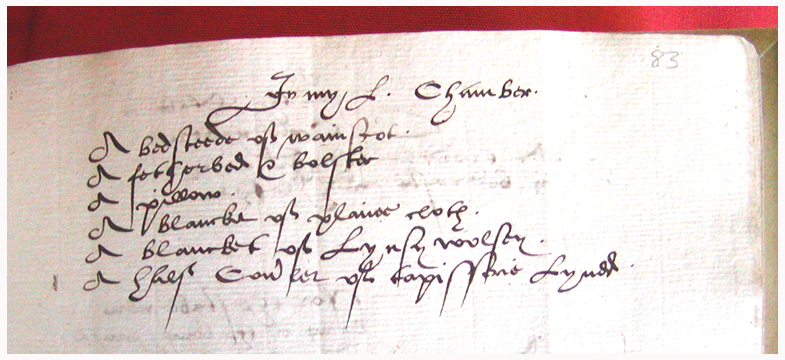
In each of the two notebooks at Queens’ College are inventories, the same except in minor wording, one written in 1561, one in 1569, in which he notes the 20 rooms at Ankerwycke, listing the contents of each.  In the first, #49, a room on the upper floor between his father’s room and the maid’s chamber is labeled “In my L. Chambre.”  In the 1569 inventory in notebook #83, page 123, a similar list is headed with the words: “In my Lorde’s Chambre.”

1561 inventory of Ankerwycke rooms, “In my L’s Chambre”

By “My Lorde” Smith must have meant de Vere, who, born “Viscount Bulbeck,” was considered a “lord” from birth.  Smith was punctilious about terminology, particularly where social distinctions were concerned, so he would never have made a mistake by called somebody a lord who was not, in fact, a lord.  Strype “supposes” that by “my Lorde” Smith meant the Duke of Somerset (170), but that’s impossible since Ankerwycke wasn’t finished until 1553, by which time Somerset was dead, nor would someone as self-righteous as Smith have wished to memorialize a master with whom he had had such profound differences.  It could not be Cecil, since from 1550 until Elizabeth’s accession Cecil kept his own household at The Parsonage at Wimbledon not far from Ankerwycke, nor did Cecil become a lord until 1571, long after Smith had drawn up these inventories.  Other than these, there is simply no lord other than de Vere who could possibly have had his own room in Smith’s home.

When we add this evidence to the phrase “brought up in my house” from the 1576 letter to Cecil, we should have enough to place Oxford with Smith for the better part of eight years, and in so doing, add to his story the riches of experience he gained as a child in a traditional country manor with all that that implies, as I’ve detailed in a number of blogs, pages, lectures, and articles.  Among many other puzzle fits, this scenario provides a reason for de Vere’s placement at Queens’ College for five months in his ninth year, Queens’ being Smith’s alma mater, and Smith needing that time to assist Cecil with preparations for Elizabeth’s accession, a hard fact for which we have more than enough evidence.

De Vere was still with Smith when the first list was written.  As for the 1569 inventory, although Oxford was no longer a member of Smith’s household, that Smith would continue to use his name for the room is seen by how he continued to call the room next to de Vere’s “my father’s chambre,” although Smith’s father died the summer of 1557.

By examining an actual document, its visual appearance can add to what its text and authorship have to tell us.  For instance, in the letter in which Smith finally turns to the issue of Oxford’s treatment of Burghley upon his return from Italy, that Smith was more emotional at the end than he was anywhere else in the letter is obvious from the condition of the paper at this point.  The pen was pressed so hard on the paper that the ink is darker here and the stroke thicker than anywhere else in the letter, so hard that the acid in the ink had eaten away the paper at that spot to a degree that it threatened to render a few of the words unintelligible.  I showed it to the librarian in the Manuscript Room at the British Library, suggesting they do something to preserve it before it crumbles completely.