Did Oxford translate some of Plutarch’s Lives?

Can the crossovers between North’s Plutarch and Shakespeare’s Coriolanus be explained by Oxford translating this section of North’s book?

It’s a set piece of literary history that for the Greek and Roman plays, Timon of Athens, Julius Caesar, Antony and Cleopatra, and Coriolanus, Shakespeare’s main source was Sir Thomas North’s English translation of Amyot’s French version of Plutarch’s Greek Lives of the Noble Greeks and Romans.  Having found similar repetitions in other supposed sources and apocryphal works where the likelihood is that Shakespeare, i.e., Oxford, was not stealing, but was simply repeating what he himself had written earlier, when years ago I read that in certain places, Shakespeare repeated North’s language word for word, it struck me that he might have prepared himself to write these plays by reading and translating Amyot’s Plutarch into English, then publishing it as someone else’s who could use the money.

We know from Burghley’s records that Oxford owned a copy of Amyot’s French translation since it’s one of the books he bought from Seres in 1569. He would have been well-acquainted with Plutarch even then, from eight years with his tutor’s library where it’s listed in both the original Greek and Latin translation.  In all probability, Smith followed standard procedure by using Plutarch to teach young de Vere good language use and ancient history.  Himself a Platonist, Plutarch’s Platonism would have been another plus for Smith.  Geoffrey Bullough, in his chapter on Coriolanus, includes the ancient Titus Livius and Dionysius of Halicarnasus as possible sources, both on Smith’s library list: Livy in the original Latin and Dionysius in the original Greek as well as Latin translation.  Because there was no English version of the latter in Shakespeare’s time, Bullough has to dismiss it as a direct source except as it influenced Plutarch, though he does include it, I suppose for that reason.  He attributes Shakespeare’s knowledge of Livy to a 1600 translation by Philemon Holland.

Plutarch was one of the major voices for the European Renaissance.  As the Encyclopedia Britannica puts it:

His Lives of the Noble Grecians and Romanes, translated in 1579 from Jacques Amyot’s French version of Plutarch’s Parallel Lives, has been described as one of the earliest masterpieces of English prose.   Shakespeare borrowed from North’s Lives for his Roman plays—Antony and Cleopatra, Julius Caesar, Timon of Athens, and Coriolanus—and, in fact, he put some of North’s prose directly into blank verse, with only minor changes.  (2006)

And as North’s ODNB biographer puts it:

North’s fame, since Samuel Johnson’s contention that Shakespeare had read Plutarch in North’s translation . . . has rested in the dramatist’s having, among very much else, thrown “the very words of North into blank verse.”  Shakespeare’s acquaintance with North’s translation probably derived from the printing house of Richard Field, whose presses may have been at work on a 1595 edition of [North’s] Plutarch at the same time that they were printing Shakespeare’s Lucrece in 1594 . . . . North’s translation influenced profoundly not only the larger narrative structures of Shakespeare’s Roman plays but innumerable local shapings of their language . . . .

Jacques Amyot’s 1559 translation of Plutarch came from studying manuscripts in the Vatican.  North’s English translation, published by Vautrollier in 1579, was based on Amyot’s third edition, published in 1574.  Richard Field, Vautrollier’s former apprentice, published the second edition of North’s verson in 1595, and a third in 1603.  As we know, it was Field, whose print shop was spitting distance from Oxford’s Blackfriars theater school, who, two years earlier, had published Venus and Adonis, the first published work to bear the Shakespeare name.

Nothing directly connecting Oxford with North has come readily to light (although it’s clear the author of his ODNB bio found their names linked in a 1591 document with that of Sir Julius Caesar).  The younger brother of the first Baron North, Thomas North (his knighthood came later) appears to have struggled throughout his life with that bane of a second son, poverty, which is not to say that he wasn’t a genuine translator, though according to the author of his ODNB bio, his influential 1557 English translation of de Guevara’s Diall of Princes did have some authorship issues:

It seems likely, . . . from comments made by North in the second, revised, edition of The Diall (1568), that the first edition was not altogether well received for more literary reasons: “detracting tongues,” he wrote, had given out that the translation “was no work of mine, but the fruit of others’ labor.” (Lockwood)

If North was not the real  or sole translator of Diall of Princes, published in 1557, the real author could not have been Oxford, who at age seven was still living with Smith in Buckinghamshire.  (If nothing else this comment shows the kind of suspicions that were rampant at that time about the authorship of so much literature of the imagination.)  During the period that the Diall of Princes was translated, North was enrolled at Lincoln’s Inn, where he remained until sometime before 1568, where, like so many other Inns of Court gents, he may have crossed paths with Milord during Oxford’s years at Cecil House (1562-68).  Oxford’s senior by 15 years; North’s nephew, Lord North’s son John, was Oxford’s contemporary, but he died before his father so the title passed to his son, North’s grandson, in 1600.

Lord North was a client of Leicester’s, and therefore not likely to have been particularly concerned with the young Earl of Oxford’s interests or welfare, but that’s not to say that his relations followed suit.  His grandson, Dudley, 2nd Baron North, was a member of the literary circle surrounding Prince Henry.  It’s worth mentioning that, during the Elizabethan era, Lord North owned the most gorgeous of all Chaucer manuscripts, the Ellesmere Chaucer, created in the 14th century as a gift for the 12th Earl of Oxford.

Shakespeare and Coriolanus

One of the Plutarch biographies from which Shakespeare borrowed most heavily, Coriolanus was probably written originally for the winter holidays, late 1582 to early 1583, the period when Walsingham and Sussex were engineering Oxford’s return to Court.  This required that he make amends to the Queen and his in-laws, for which the story of Coriolanus must have seemed ideal, providing a graceful mea culpa for the Court while for the public it functioned as a moral tale addressing the current civil unrest over rising food prices and the increasingly harsh punishments being meted out to followers of the Old Faith.

This would not be the first time Oxford had used Plutarch.  Following his return from Italy in 1576, freaked out by the realization of just how much trouble he was in financially, he had turned to Plutarch’s biography of Timon of Athens, pouring his bitter disillusionment with the Court and his fair-weather courtier friends into the earliest version of what someday would be known as “Shake-spear’s” most angry protagonist.  Then, following his banishment, aware that some were still contented to believe he was a two-faced traitor, he turned again to Plutarch to explain himself via Coriolanus.

Because Oxford’s enemies wanted him seen as a traitor, they promoted the story that he had been planning to run away and fight for Spain.  Coriolanus is evidence that this may be true, or at least, that he had talked rather recklessly about doing it.  Recall that following the untimely birth of his son, he was stopped on the road to Dover in an obvious attempt to flee the country.  To Spain, they said, where he intended to take advantage of an offer to lead a contingent of the Spanish army.  Though not in exactly the same situation as Coriolanus, he too was being charged with treason, something that, unlike the ancient Roman general, he had no means of confronting openly.  Like Hamlet and Hieronymo in The Spanish Tragedy (both first written about the same time) a play was his way of explaining himself to the Court and his West End community, with the onstage murder of the protagonist in the final act a form of symbolic suicide.

In the inevitable effort to place Coriolanus as late as possible, Bullough tries to connect public unrest in Republican Rome with that of 17th-century England, not all that convincing, public unrest having been endemic throughout the reigns of both Elizabeth and James.  Because the time period he’s chosen, 1605, falls just when England finally made peace with Spain, Bullough makes no effort to make the most obvious connection, namely the similarity of the threat to England from Spain  throughout the 1580s and ’90s to the fears of the ancient Roman authorities over the threat from the Volscians.  He also ignores the startling relevance of the martyrdom of the aristocratic Coriolanus at the hands of the hoi polloi to the calls for more freedom of speech from puritan members of Parliament.  The skewed dating forced on historians by William’s biography won’t permit even the most logical and obvious questions to be given consideration.

It struck me long ago that the role of Menenius could easily be one of Oxford’s more benign depictions of Burghley, while the realistic family scenes with Volumnia and Virgilia just might be snapshots of life at Cecil House.  If the militant Volumnia was meant to represent Mildred Burghley, it reinforces Peter Moore’s take on Oxford’s relationship with his mother-in-law.  Perhaps she represents a combination of all four of the Cooke sisters, including the ferocious Elizabeth Russell, whose proximity to the little Blackfriars theater school gave Lady Russell the power to torment Oxford during the period he was fighting to keep the little stage going, the same period when this play was probably written.

All of this is just the most cursory glance at what seems to me to be an important area of inquiry.  Has some scholar compared North’s biographies with each other to see if they display the same high level throughout?  Are some better than others, those perchance that were the ones used by Shakespeare?  Has anyone capable of the French involved compared the French of Amyot with the English of North to see how much North’s skill depends on Amyot, and how much was his alone?  We’re told the 1595 edition varies in some respects from the 1579 original.  In what way ?  What has been added, and to which of the biographies?  Shakespeare refers to incidents in a number of the Lives in his works, but only these four were the basis for individual plays.

Finally, there are two prefaces to North’s Plutarch, both signed Thomas North, January 1579, one dedicating it to the Queen, the other the traditional letter “To the Reader.”  Both sound for all the world like Oxford’s dedicatory letters, the one in English to Bedingfield’s 1573 translation of Cardanus Comforte, and the one in Latin for Bartholomew Clerke’s Latin translation of  Castiglione’s The Courtier.  The same kind of points are made, the same opinions about what is important in literature, even his daring use of the word love.  I’ve read an awful lot from this time––in my opinion, no one else writes like this:

To the Reader

The profit of stories and the praise of the Author are sufficiently declared by Amyot in his epistle to the reader, so that I shall not need to make many words thereof.  And indeed, if you will supply the defects of this translation with your own diligence and good understanding, you shall not need to trust him; you may prove yourselves, that there is no profane study better than Plutarch.  All other learning is private, fitter for universities than cities, fuller of contemplation than experience, more commendable in students themselves than profitable unto others.  Whereas stories are fit for every place, reach to all persons, serve for all times, teach the living, revive the dead, so far excelling all other books as it is better to see learning in noblemen’s lives than to read it in philosopher’s writings.  Now, for the author, I will not deny but love may deceive me, for I must needs love him with whom I have taken so much pain, but I believe I might be bold to affirm that he hath written the profitablest story of all authors.  For all other were fain to take their matter as the fortune of the countries where they wrote fell out; but this man, being excellent in wit, in learning, and experience, hath chosen the special acts of the best persons, of the famousest nations of the world.  But I will leave the judgement to yourselves.  My only purpose is to desire you to excuse the faults of my translation with your own gentleness, and with the opinion of my diligence and good intent.  And so I wish you all the profit of the book.  Fare ye well.  The four and twentieth day of January, 1579.

To the Most High and Mighty Princess Elizabeth
By the Grace of God, of England, France and Ireland
Queen, Defender of the Faith, etc.

Under hope of Your Highness’ gracious and accustomed favor, I have presumed to present here unto Your Majesty, Plutarch’s Lives translated, as a book fit to be protected by Your Highness and mete to be set forth in English.  For who is fitter to give countenance to so many great states than such an high and mighty Princess?  Who is fitter to revive the dead memory of their fame than she that beareth the lively image of their virtues?  Who is fitter to authorize a work of so great learning and wisdom than she whom all do honor as the muse of the world?  Therefore I humbly beseech Your Majesty to suffer the simpleness of my translation to be covered under the ampleness of Your Highness’ protection.  For, most gracious Sovereign, though this book be no book for Your Majesty’s self, who are meeter to be the chief story than a student therein, and can better understand it in Greek than any man can make it English, yet I hope the common sort of your subjects shall not only profit themselves hereby but also be animated to the bettter service of Your Majesty.  For among all the profane books that are in reputation at this day there is none (Your Highness best knows) that teacheth so much honor, love, obedience, reverence, zeal and devotion to princes as these Lives of Plutarch do.  How many examples shall your subjects read here, of several persons and whole armies, of noble and base, of young and old, that both by sea and land, at home and abroad, have strained their wits, not regarded their states, ventured their pesons, cast away their lives, not only for the honor and safety, but also for the pleasure of their princes.

Then well may the readers think, if they have done this for heathen kings, what should we do for Christian princes?  If they have done this for glory, what should we do for religion?  If they have done this without hope of heaven, what should we do that look for immortality?  And so adding the encouragement of these examples to the forwardness of their dispositons, what service is there in war, what honor in peace, which they will not be ready to do for their worthy Queen?

And therefore that Your Highness may give grace to the book and the book may do his service to Your Majesty, I have translated it out of French and do here most humbly present the same unto Your Highness, beseeching Your Majesty with all humility, not to reject the good meaning but to pardon the errors of your most humble and obedient subject and servant, who prayeth God long to multiply all graces and blessings upon Your Majesty.

Written the sixteenth day of January, 1579.
Your Majesty’s most humble and obedient servant,
Thomas North.

The Murder of Shakespeare’s Identity: Act IV

Academics are wrong in thinking that Shakespeare’s career went from comedies at first to tragedies toward the end (with, they imagine, an utterly absurd return at the very end to the pastorals of the 1560s), for his pattern from the start was to alternate between the two genres, as can be seen from those he wrote to entertain the West End in 1567, The Supposes and Jocaste, the first a comedy, the second a tragedy.  However wrong in specifics, yet somehow they’ve grasped the general curve of a career that began as holiday larks and ended in a showdown just as tragically brutal as the mutilation of Lavinia or the suicide of Mark Antony.

However it happened, Oxford was to some extent both a product and a victim of the Cecil family.  Whether by luck or design, eight of the leading noble youths of his time, himself and seven others, were, by the early deaths of their fathers, brought under the advising arm of Sir William Cecil through his office as Master of the Court of Wards.  Whether by luck or design, the raising of these important social leaders by Cecil was a major move in the fight to turn the nation from Catholic to Protestant, from allegience to Rome to allegience to the English Crown.  As the first of Burghley’s wards, Oxford became to some extent the leader of a faction that saw the Cecils as upstarts and political manipulators (“a politician did it”), out to take away their power and destroy their class.  By his marriage to Burghley’s daughter, Oxford was also the most thoroughly embedded into their faction, a 16th century version of “Sleeping with the Enemy.”

Any society as small, closed, tightly-woven and barricaded against change as the power center of Elizabeth’s Court develops excruciating tensions that only increase over time, often continuing on past the deaths of the principals, who pass their rivalries and hatreds on to their heirs.  This was the case with Lord Burghley and the Earl of Leicester, whose rivalry got passed on to their heirs, Robert Cecil and the Earl of Essex, just as Burghley’s efforts to control the life and behavior of his son-in-law, the Earl of Oxford, and his nephew, Francis Bacon, got passed on to his son and their cousin, Robert Cecil.

Thus, as one by one, Robert inherited his father’s offices, he also inherited the tensions and hatreds that went with them.   At a Court that worshipped height, shortened and twisted by scoliosis, he hated the men who looked down on him, the tall, handsome men prefered by the Queen, men like Sir Walter Raleigh and the Earl of Essex.  So when he came to power, one by one, he either destroyed them or began setting things up so that they would eventually destroy themselves.  Most of all he detested his brother-in-law, the handsome, witty Earl of Oxford.  Partly because Oxford outranked him, partly because he was just as crafty in his own way as Cecil, and perhaps also out of some smidgeon of family loyalty to his nieces, Oxford’s daughters, it seems Robert drew the line at murder.  Whichever was the overriding factor, ultimately both were stuck with a stalemate.

Robert hated his brother-in-law for many reasons: because he had everything that he lacked, because he was admired by the Court for his social prestige, his good looks and his talent, but mostly because of the rude disdain with which he treated his father’s and his sister’s love.  Although Court protocols and family solidarity required that they maintain a pretense of cordiality, as soon as the death of Walsingham in 1590 placed the reins of power in his hands, Robert began planning how to destroy the man who had broken his sister’s heart and, in his view, sent her to an early grave.

Oxford’s louche behavior, his pamphlet wars, his staged satires, were bad enough, but what alarmed Burghley and gave Robert the green light to bring him down was his creation of the London Stage, that monstrous instrument of anti-Reformation rhetoric, of lewd sexuality, of dangerous political commentary, that threatened the social calm by drawing crowds of unstable young apprentices into groups that all too easily, on occasions like May Day or Midsummer’s Eve, turned excitement to riot and destruction.  If Oxford had nothing to do with the current trouble caused by Marlowe’s plays in Southwark, he had everything to do with creating the circumstances that allowed such things to occur.  If Oxford could do nothing to put a stop to Marlowe’s antics, Robert, arrived at power, could––and did.

Shortly after Anne’s death in 1588, Burghley, as Master of the Court of Wards, had moved to have Oxford’s debts to the Court called in.  This was less of an immediate threat to Oxford himself, who was already broke, than to the patrons who had backed his loans, and whose own estates were now threatened.  What it did destroy of Oxford’s was his credit, that is, his ability to use the perquisites of his title to raise cash.  Without credit he could no longer pay actors and musicians, stagehands and costumers.  The Queen saw to it that as a peer of the realm he was saved from the humiliation of complete bankruptcy by arranging his marriage to an heiress in 1592, but apart from a few donations, most notably from the young Earl of Southampton, Milord was pretty much silenced.

Theater of Blood

In attempting to explain what happened to Marlowe during the plague of 1593, biographer Charles Nicholl resorts to a metaphor by which he compares the way governmental sting operations to plays.  According to Nicholl, poets find spying an easy step because they live in the fantasy world of The Theater.  This is absurd; would Kurt Weil have spied for the nazis?  Would Vaclav Havel have spied for the StB?  An artist of surpassing power and reckless honesty, Christopher Marlowe did not, could not, have agreed, or been forced, to spy for the Crown he detested.  But the metaphor works if placed where it belongs, with Robert Cecil, for the plot with which he brought down the dangerous playwright in May of 1593 was just as creative as anything Marlowe himself ever designed for the stage.

While a play succeeds if it moves an audience, a sting’s success is based on whether or not it works, and also, whether or not it works without drawing attention to the projector.  Although plenty at the time would have understood quite well who was behind Marlowe’s sudden demise, they were not about to tell, and as a result, no one today, including his biographers, has ever managed to put 2 and 2 together with regard to the sudden and brutal end to Marlowe’s promising career.  (Nicholl did, and almost came up with 4, but by failing to put the finger on the most obvious culprit, came up with 5 instead.)

For Cecil, the removal of Marlowe, whether by murder or transportation, and without any blame attached to himself, was a magnificent coup, and for those who knew the truth, which must have been pretty much the entire Privy Council and London theater community, brought him another great benefit, the respect he needed to move with confidence in the brutal world of Elizabethan politics.  It also had the salubrious effect, salubrious to the Cecils, that is, of throwing the London Stage into a chaos from which they had every hope that it couldn’t recover, at least, not in its current form.

How then did Burghley respond a few months later when his fellow councillors, Lord Hunsdon and his son-in-law, Lord Admiral Charles, persuaded the Queen to let them revive the Stage by putting the actors from Marlowe’s company back to work as the Lord Chamberlain’s Men?  (Cecil was not yet on the Council.)  We can only guess what promises were made that this would be a new era of oversight, one in which no more enormities like Tamburlaine or the Massacre at Paris would be allowed to distress the Crown.   And more, we can only guess what if anything this plan to revive Marlowe’s company in June had to do with the murder of their patron, Lord Strange, in April.

History, with its almost total disinterest in Literature, makes no connection, though it reports that gossip at the time blamed Burghley for his murder because, it was said, with Stanley out of the way, Burghley’s granddaughter (Oxford’s daughter) could marry Stanley’s younger brother, who, as the sixth Earl of Derby, could, should Elizabeth Vere produce a boy, provide entry for a Cecil into the upper peerage (the alliance with Oxford having produced only girls).  It also reminds us that had Lord Strange lived, he would have had one of the better claims to the throne that still––since the Queen was obviously never going to produce a son––was without a strong English claimant, and although Stanley was himself a Protestant, with so many Catholic family members of high rank, Lord Strange on the throne would be a disaster for the Cecils.

In reconstituting Stanley’s company, Hunsdon, who had been involved in the creation of the London Stage from the beginning, having been appointed by Sussex as his vice-chamberlain back in 1572, may have had a less altruistic motive than just a desire to see Oxford and the London Stage back in business.  His son, George Carey, was Stanley’s brother-in-law.  In a letter from Carey to his wife (still surprisingly extant) we learn that Stanley’s sudden death at age 35 was murder.  If Hunsdon, knowing of Robert Cecil’s role in the death of Marlowe, was among those who suspected he also had a part in his son George Carey’s brother-in-law’s murder, there may have been an element of revenge in his and Howard’s move to resusitate the Stage, or at least to use it as best they could to check the rise of Robert Cecil’s power.

The showdown

This is best summarized with a timeline:

  • May 1593:  Marlowe’s murder (or transportation)
  • April 1594:  The registration of dozens of plays by Shakespeare and others signaling the beginning of the move by Hunsdon and the Lord Admiral to create two new royally sanctioned companies out of the wreckage of Lord Strange’s.
  • Apr 4 1594:  The murder of Lord Strange by arsenic poisoning.  Did the original plan see him continuing as patron of Marlowe’s company?  Was it only with his death that the company came under the control of the Lord Admiral?
  • June 1594:  The date historians give as the official beginning of the two royally licensed companies, what Gurr calls “the duopoly” that had the only official license to play within the City of London, and that from that winter season on, were the only ones to provide entertainment at Court for the holidays.
  • February 4, 1596:  The purchase of the Blackfriars Parliament Chamber by James Burbage, located next door to the apartments owned by Lord Hunsdon and his son, George Carey and its renovation by Burbage in preparation for the holiday season of 1596-97 and entertaining the influential West End.
  • July 5, 1596:  The official appointment of Robert Cecil to the office of Secretary of State, in effect making him the head of the Privy Council.  Two weeks later . . .
  • Jul 23, 1596:  The death of Lord Hunsdon and his replacement by the Queen with William Brooke, Lord Cobham, Robert Cecil’s father-in-law, also a resident of Blackfriars and a close neighbor to the theater and the Hunsdons.  Four months later . . .
  • November 1596:  The petition to the Privy Council from various Blackfriars residents demanding that the use of the theater by the Lord Chamberlain’s Men be prevented, to which the Council, now without Hunsdon and headed by Robert Cecil, acceded.  Two months later . . .
  • January 1597:  The death of James Burbage, owner of the Blackfriars theater and head of the Lord Chamberlain’s Men.   Four months later . . .
  • July 28, 1597:  The order by the Privy Council that all the theaters in London be “plucked down.” Either immediately before or after . . .
  • July/August 1597:  The production of The Isle of Dogs at the Swan on Bankside by Pembroke’s Men, and the subsequent closing by Cecil of all the theaters and jailing of three of the actors, among them Ben Jonson and Robert Spencer.  The LCMen took to the road.  Two months later . . .
  • October 1597:  The opening of Elizabeth’s fifth Parliament with the consequent gathering in the West End of the most influential audience in the nation.  Immediately before or shortly after . . .

. . .  came the publication of a new version of  the anonymous play Richard III in which the evil king is described in terms that clearly identify him with Robert Cecil.  This sold out so fast that it was only a few weeks before a second edition was in the bookstalls, this time with the name William Shake-speare on the title page, the first time it had appeared on a play.

With their patrons dead and their theaters shut down, it’s not known where the actors performed Richard III that winter, but that they did somewhere seems certain by Richard Burbage’s subsequent identification with the leading role, the one that tradition ascribes to the dawn of his reputation as the greatest actor of his time.  Fired with fury by the suspicious deaths of his father James Burbage and his company’s patron Lord Hunsdon, we can only imagine the electrifying nature of those first performances in 1597 and ’98.

Although the rest of the theaters reopened in the fall of 1597, both the Swan and Burbage’s Shoreditch stage remained closed, leaving the Lord Chamberlain’s Men without a public venue.  Although the Swan would reopen later, Burbage’s Theatre remained closed until it was torn down by the actors and transferred to Bankside the following year.

This chain of events suggests a bloody behind-stairs struggle for control of the London Stage.  Whether or not Robert Cecil was responsible, via the “projectors” he’d inherited from Walsingham, for the deaths of leading members of the Stage community––from Marlowe to his patron Lord Strange, to the “sporting” Thomas Kyd, to the grand-daddy of the Lonson Stage, James Burbage, to his patron Lord Hunsdon––is less important to our story than the actors’ suspicions that he was responsible.  It should be our suspicion as well, based on how the Master Secretary would go on to entrap and destroy other leading members of Court society, the Earl of Essex, his own brother-in-law Henry Cobham lord Brooke, and his former friend Sir Walter Raleigh.   The level of hatred and fear engendered by Cecil in his years of power under King James is clear from the stream of slanders and nasty epigrams that deluged the bookstalls following his death in 1612.

It should also be the clincher to the argument why Oxford hid his identity.  Had anyone during the first decade of James’s reign––anyone beyond the inner circles of the Court and Stage community, that is––made public who it was who wrote the 1597 version of Richard III, Oxford would have been as dead as Marlowe, Kyd, Stanley, Burbage and Hunsdon.  As it was, since the playwright was, as he kept reminding Cecil in his letters, a member of Cecil’s family, father of his nieces, etc., he escaped, both with his life and with his papers––not an easy task, but one facilitated by the accession to power in 1603 of King James and his fondness for Philip Herbert, and his brother the Earl of Pembroke, who would see to it that Oxford’s works, and the Stage he created, be secured from harm.

The stalemate

If Cecil, his reputation permanently blackened by the play, dared do nothing to stop the flood of revised editions, what he could do as the controlling voice on the Privy Council (along with Henry Howard, Oxford’s other mortal enemy) was see to it that the company had no use of their gorgeous West End theater with its proximity to the West End audience.  In 1600, this was handed over to a new company of boys, the “little eyases” of Hamlet’s complaint.  No longer connected in any way with the Court Chapel, they were simply talented young actors and musicians of the sort that Elizabeth had always preferred for her holiday “solace.”  1610, when the company was allowed to take the theater back, saw the beginning of its rise to a level of success never before seen by a theater company, and rarely since.

These are only the most salient points in the story of this final showdown.  The thread presented here, the string of deaths, theater closings, constant publication of revised versions of Richard III (eight in all, over the years), the fact that it was the first play to be published under the name Shake-speare, must be correlated to several other threads, if all taken together, make a subject worthy of a full-length book.  What part did Essex play?  Bacon?  The Queen?  The printers?  George Carey, Hunsdon’s heir and the Lord Chamberlain during the final years of Elizabeth’s reign?  Where does the revision and publication of Richard II that accompanied the publication of Richard III fit in?

But even this is not the final act, the one that follows Oxford’s death.  For that we must wait to hear the story of the making of the First Folio, and of William of Stratford’s illegitimate son, Sir William Davenant, inheritor of his father’s phony fame and the primary engine of his investiture as the world greatest playwright.

For the first three acts of this drama: The murder of Shakespeare’s Identity

The Murder of Shakespeare’s Identity: Acts I through III

One of the reasons why it’s been so hard to convince the world that the Stratford story is a sham is that no one’s ever come up with a single strong reason why the true author’s identity had to be hidden.  Those who first drew the public’s attention to the subject in the 19th century pointed to his obvious knowledge of Court life, claiming that courtiers of stature would have hidden their involvement in the then déclassé public stage.  Certainly this is true, but for most it doesn’t explain why the cover-up had to continue so long after the author’s death.  Sir Philip Sidney’s work was in print, over his name, six years after his death.  Oxford’s uncle, the “Poet Earl” of Surrey, was similarly published over his within ten years of his death.  So why not Oxford’s?

Most of the bigger things in life occur for more than one reason.  If you look at your own life, you’ll see that you went to college for more than one reason, that you picked a particular college for more than one reason, that you married a particular person for more than one reason, changed jobs, bought a house, divorced, always for more than one reason.  Nations go to war for more than one reason, and resist going to war for more than one reason.  Just so, the Shakespeare authorship got hidden for more than one reason.

Had this not been the case, had it not been first to one person’s advantage (his own), then his tutor’s advantage, then to his guardian’s advantage, then to an entire community’s advantage, and ultimately to the advantage of the company he started, one that initiated an industry that has come to be seen as the fourth branch of government, the voice of the people, the truth would surely have been revealed somewhere.  But it wasn’t, it didn’t, and some of these reasons have not faded with time.  For the fact is, that there never was, during Oxford’s lifetime, any advantage to him, to his family, to the theater companies he created and those who profitted by them on into succeeding centuries, for the truth to be revealed to the public; never any advantage to any of these, and plenty of disadvantages.

Not everyone who knew the secret knew it in its entirety, that is, some knew one thing, some another, but the likelihood is that no one knew all that he was writing, or later, all that he had written.  Even to this day there is disagreement over what was his and what was by some other writer or editor.  The committee that produced the First Folio could collect versions of the plays from the various friends, actors, and printers who held them, but how sure could they be of what was and wasn’t his?   Nothing was signed, and because like most men of his class, he dictated to secretaries, nothing was in his own handwriting.

Certainly the Queen knew that particular plays were his, at least since 1598, when the Meres book was published, at least of those plays named by Meres and most likely a dozen more, but it is very likely that of the 38 accepted plays and the 15 to 20 suggested early plays, there were some that she knew nothing about, and those she knew may very well have differed from the versions we know, because it was not advisable that she know the versions played for the West End audience, or on the road, or for a particular private gathering.

As Secretary of State, Oxford’s guardian (then his father-in-law) William Cecil/Ld Burghley had oversight over the press, so he knew all  about using both the stage and the press for propaganda; it’s a fact that he made use of both in his early years as Elizabeth’s first Secretary of State.  Burghley was instrumental in bringing printers over from the Continent to publish those works he considered essential to a reformation education.  Though unfortunately his biographer, Conyers Read, does not elaborate, he refers to the press as “the weapon Cecil knew best.”  Since Oxford lived with Cecil during the years he first began to publish, years when Cecil was doing his own propaganda, it was from him that he learned how to publish on the sly.  Knowing him as well as he did, he also learned how to work around him.

ACT I: Hidden in plain sight

When he first began to write, no one, including the boy himself, had any idea where it would take him or how important his work would turn out to be.  In fact the field in which he would flourish so luxuriously, English literature, hardly existed before he began transforming it.  Given the intense, bustling environment at Cecil House, surrounded by poets and translators in that important age group for a young artist, six to ten years his seniors; then in his late teens at Court, with a ready-made audience hungry for sophisticated, educated entertainment; what would end as the most important body of work since Chaucer two and a half centuries earlier began simply as a lark, a folie, a bit of “pickle herring,” something to entertain the lads at Cecil House, then the ladies at Court.

The authorship issue was never about writing anyway, it was always about publication.  So long as he wrote just for the Court community via the traditonal handwritten manuscript exchange there was no problem.  But creating hundreds of printed copies for sale to all comers meant making public what the Court saw as its own private pleasure, making it available, if to a far smaller public than today’s where almost everyone can read, yet it meant revealing it to the same 15 to 20 percent of the population most eager to pry into Court secrets.  And it was publishing that interested Oxford.

Writing was no big deal, everyone he knew did it.  It was creating books that fascinated him; books, those magical vehicles of culture, that could carry a man’s life and reputation for hundreds, thousands of years into the future so that readers would come to know someone like Alexander the Great, or even the mythical Achilles, as though they had lived with him; knowing him better in some ways than they knew their own families. Publishing was also the best means of hiding his identity as author.  While handwritten manuscripts could be traced back, if not to directly to himself, then to someone who knew who wrote it, typeset print was anonymous.  All that identified the author was the name on the title page, or registered with the Stationers, and that could be faked a lot more easily than handwriting.

Taking advantage of the traditions of his class as patrons of the arts, Oxford began a long career of publishing what he regarded as important works, some by  his friends, some his own, some translations of famous foreign works, , some about science, or music, or psychology, or  but mostly works of the imagination, stories and poems.

In this he was also following in his guardian’s footsteps, although most of what he considered worth publishing differed considerably from Burghley’s view of what was important.  Reformation ideologues, William Cecil and his in-laws occupied the legal and social center of a deadly serious, extremely repressive Reformation culture that saw adherence to Protestant beliefs as paramount.  They also saw sex as filthy and satire as rebellion.  So Oxford’s first step in what would become the long and complex process of hiding his authorship began by persuading pals like George Gascoigne and his uncle Arthur Golding to let him use their names so he could get his plays and poems published without Burghley’s permission, possibly even without his knowledge of their source.

Though not aware of everything Oxford wrote, William Cecil must have been aware of his ward’s talent.  That would have been impossible to hide, and, as a propagandist himself, he probably saw the boy’s gifts as something he might put to future use.  The ward, however, was destined to take a different path in life, one he wanted his guardian, and his guardian’s wife, and her family (and perhaps even his own wife), to know as little about as possible.  In his teens, his writing was just a lark, something to entertain his friends before settling down to––as he would often term it––“a graver labour.”

By his late teens, when he was more or less on his own at Court, there was no need to hide from the other members of the Court things like his madrigals and interludes written for holiday performance.  On the other hand, satires or poems that touched dangerously on intimate matters, however discreetly distributed within his own circle, must inevitably have spread further, raising eyebrows along with the question of their authorship.  So long as none of this escaped the confines of the Court community there was no real harm in it.  But when, just before taking off for a year on the Continent, in a first of many anthologies, he published along with love poems by himself and his friends, a “tale” that dwelt too obviously on the sex lives of certain courtiers, it released a firestorm of furious retribution.  This did nothing to prevent him from publishing, but it did help to make him more cautious about what and how he published.

ACT II: Birth of a professional

Then in 1572, when the Earl of Sussex came on board as Lord Chamberlain of the Royal Household, what had begun as a lark began turning serious.  At that time it was still the Earl of Leicester who ran the Court Stage, but Sussex, who hated Leicester, was determined to get the oversight of Court entertainment back where it had been for centuries, in the Lord Chamberlain’s hands, that is, under his own control.  And unlike Leicester, whose taste ran to more old-fashioned stuff, Sussex understood how important the Court Stage could be in winning hearts and minds, not only at Court, but with the influential West End community that lived and worked within walking distance of Whitehall.  Quickly bored by the constraints of what he could and could not produce at Court, it was this audience he was most eager to reach.  Thus it was that the choristers at Paul’s Cathedral, known to theater history as Paul’s Boys, began performing Oxford’s plays, first at Court, then for a week or two after, at the little theater connected to the Cathedral.

If a professional is defined as someone who works to a schedule, who provides for a public demand, who competes successfuly with others in the same line, as opposed to someone who merely hangs out a shingle, frames a certificate, and earns a living wage, then by age 25 Oxford was functioning as a professional dramatist.  Not that that was his ambition; not at all.  His ambition from childhood had been to follow his ancestors as his nation’s foremost military leader.  Fate, however, had other plans.  The times were not right for someone of his station to risk his life in dubious battle––not while the British Media was straining to be born.  Paul’s Boys were only one of a number of companies that sprang into being at that time, foremost among them the men who wore Leicester’s livery, but who were free to play for anyone who could pay.

As competition for space at the theater inns became intense, trouble with the City officials increased.  For them it was one thing to deal with the rowdy holiday crowds for a few weeks in December and January,  a tradition too old and too ingrained to stop, even for determined Reformation puritans, which is what most London mayors were at that time––but to allow it to continue on into the spring and summer was, so far as they were concerned, simply out of the question.  Their escalating demands to “pluck down” the theaters drove the Privy Council to seek solutions.  Thus it may well have been Sussex who persuaded Burghley and the Queen to finally let Oxford have his much desired tour of the Continent, particularly to Italy where he could see at first hand how the Italians did it.

To Sussex and his relatives on the Council, Lord Hunsdon and Lord Charles Howard, the Stage as a factor in English society was obviously not going to be suppressed.  Rather than fight it, they must join it, regulate it, and use it to promote Crown policy.  That this was in any way the motivation for Oxford’s trip would have to be kept to themselves, since any sign to the City or the Clergy that the Council’s interest in the burgeoning London theater went beyond the Queen’s right to her “solace” would cause even more trouble than was already the case.  For Burghley this may have seemed like a way to keep his wayward son-in-law in the fold.  For enemies like Leicester and Hatton it meant getting him out of the way, at least for awhile.

Oxford had a lot of reasons for wanting to visit Italy.  Not only was it the source of the Italian Renaissance, of the western world’s most dazzling art and architecture, home to painters like Titian, scholars like Jerome Cardan and poets like Tasso, it was also where the immensely popular comedia dell’arte troupes were performing on the streets and in the halls of princes, and where the great architect Andrea Palladio was constructing experimental theaters of the sort that he and Sussex and Hunsdon thought might be the answer to their greatest need.  They had the actors, with Oxford they had the scripts, they certainly had the audiences, and in James Burbage they had both an actor and a builder who had already built one public theater that, unfortunately, had failed.  What they needed were better locations and better theater designs.   It may be that while Oxford was in Italy, they were already at work on plans for these.

That this was one of the most important reasons for Oxford’s trip seems obvious by how the first two commercially successful, yearround, purpose-built stages in England (possibly in all of Europe) began taking shape within weeks of his return.  With two theaters, several adult companies and three companies of boy choristers hungry for scripts, Oxford was now a fully fledged theater professional, duty bound to keep them satisfied, and desperately in need of assistance.  This came with his acquisition of the manor known as Fisher’s Folly located in the heart of the theater district.  With the financial assistence of patrons like the Italian banker Benedict Spinola, the music of artists like the Italian Bassano brothers, and the transcription skills of secretaries like John Lyly, Anthony Munday, Thomas Watson, Thomas Kyd, and eventually Francis Bacon, Oxford was off and running.

It’s hard to see where he found time to write the first two novels in English history, Zelautoand Euphues, the Anatomy of Wit.  With these he performed the first of his great upward leaps in style.  What we call euphuism may already have been a fad at Court by the time that he both raised it to an art form and dealt it its death blow, for having taken it to its peak, there was nothing left but to turn it to satire, some of it his own.  It does give us an idea of what some of his plays from this period were like.  In any case, now that he had secretaries he no longer had to beg the use of their names from friends or family members.  And since no one at that time saw any point in publishing playscripts, the issue of their official authorship had yet to appear.

ACT III: Banished: The second leap

Court life was never easy for Oxford.  He tended to drink more than was healthy and spend more on clothes and luxuries than was wise.  He got caught up in dangerous intrigues and overreacted to the rivalries that surrounded him.  Young and handsome, the temptations of sex and the hungers of his heart got him involved with too many women, none of them his wife.   His Catholic cousins played on his sympathies and on his bitterness towards Burghley and Leicester for their use and misuse of his estates.  Believing himself to be in love with one of the Queen’s Maids of Honor, he dreamed of escaping with her to Spain where he’d been promised military action and a decent income.  It all came crashing down when the dishonored Maid gave birth to his bastard in the Queen’s chamber, and he found himself in the Tower for two months, then banished from Court indefinitely.

However wounded his pride, exile gave him the space he’d been craving and rage gave him the impetus to take the second of the three great quantum leaps in self expression that would ultimately place him in the pantheon of the world’s top creators.  No longer bound to produce lighthearted comedies for the Court, he turned to writing tragedies for the West End, both the classic Greek and bloody Senecan varieties.  With Sussex dead and Walsingham pressing for history plays for the newly formed Queen’s Men, he took refuge in the familiar preoccupations of his childhood, studying the papers that Richard Field and others were preparing to publish in Holinshed’s name, some of which came from his old tutor Smith.  Reading and translating Roman poets and Greek plays, his style deepened.  Trimmed of euphuistic artificialities, the old fourteeners replaced by iambic pentameter, the most natural rhythm for English, he spoke more simply, directly, and powerfully to the audience he cared most about.

Although by June of 1583 he’d been accepted back at Court and had returned at least to the appearance of living with his wife, he was by then too deep in the production of the works that meant something to him, and to the lifestyle that allowed him to produce them, to ever go back to full attendance on the Queen.  She craved a return to the early days when he was always around, dancing attendance and producing the kind of entertainment he’d taught her to prefer, but there was no privacy at Court, and he had to have privacy to write.  So there developed a neverending tug of war between them, him straining for freedom, which she would continue to dangle before him but with no intention of giving him anything that might mean losing him.  He was the goose that laid the golden eggs that made her Court so popular, and at so little cost to herself.

Restless, seeking new outlets, it was during this period (1582-92) that Oxford launched the English periodical press with the series of pamphlets he published as by Robert Greene.  After 1589, when Bacon joined him with their joint attacks, first on Martin Mar-prelate, then on Marlowe and Alleyn, they kept the fun going with a phony pamphlet war in which Bacon’s fictional persona, Thomas Nashe, and Oxford’s fictional version of poor Gabriel Harvey (very much alive but in no position to do any kicking), taunted each other with hilarious abandon, thus establishing the first audience for what would evenually become the British tabloid press.  Unfortunately for the lads, neither the Cecils nor the Bishops saw the humor in this, and with Robert Cecil approaching an age where he could enter the fray, the stage was set for the final act in the birth of the English Stage, the creation of the fictional author, William Shake-speare, poet, playwright, actor and sharer.

Coming:  Act IV: Shakespeare: The third and final quantum leap

Theatrical birth pangs: 1776 to 1584

Early in April 1576, following a year of exciting adventures on the Continent, the Earl of Oxford arrived back in England to a sea of troubles.  During his final days in Paris, someone from home had prepared him for the gossip he’d encounter on his return.  Rumor had it that his daughter, born during his time away, was another man’s child.  Worse, it was even rumored that that other man was his wife’s own father, Lord Burghley, who, concerned that after five years of marriage there was still no Cecil heir to the Oxford earldom, had taken matters into his own hands.

This of course was nothing more than foulest, cruelest rumor, and Oxford would have cause to work different versions of the dreadful story into six plays over the years, but in his hot youth, when touched where he was most vulnerable, he was all too easily roused to unthinking fury.  Brooding on this and other worries, his mood was hardly improved when the ship that carried him accross the Channel was boarded by pirates and all he had with him was lost.  Ignoring his well-intntioned brother-in-law, Thomas Cecil, who had come to meet him at Dover, he returned to London with one of the “lewd friends” that Burghley so disliked.  Refusing to have anything to do with either his wife or her father, he rented rooms at the Savoy and turned his attention to plans already in progress to create the suburban theaters that he and Sussex and Burbage agreed were the only way to accommodate the burgeoning London theater audience in a way that would stop the constant interference by the Mayor and other London officials.

Once Oxford calmed down, the truth about his daughter must have been obvious, but by then he also realized how important it was that he break off as completely as he could with Burghley, whose habit of prying into everything he did or said was driving him mad.  He was not in love with Anne, never had been, and although he was sorry for her, stuck as she was between her husband and her father, he had his life to live.  If Burghley wouldn’t let her go, then let him keep her, “for there, “ he wrote, “as your daughter or her mother’s, more than my wife, you may take comfort of her, and I rid of the cumber thereby.”  The future Shakespeare was never one to mince words when he was sore.

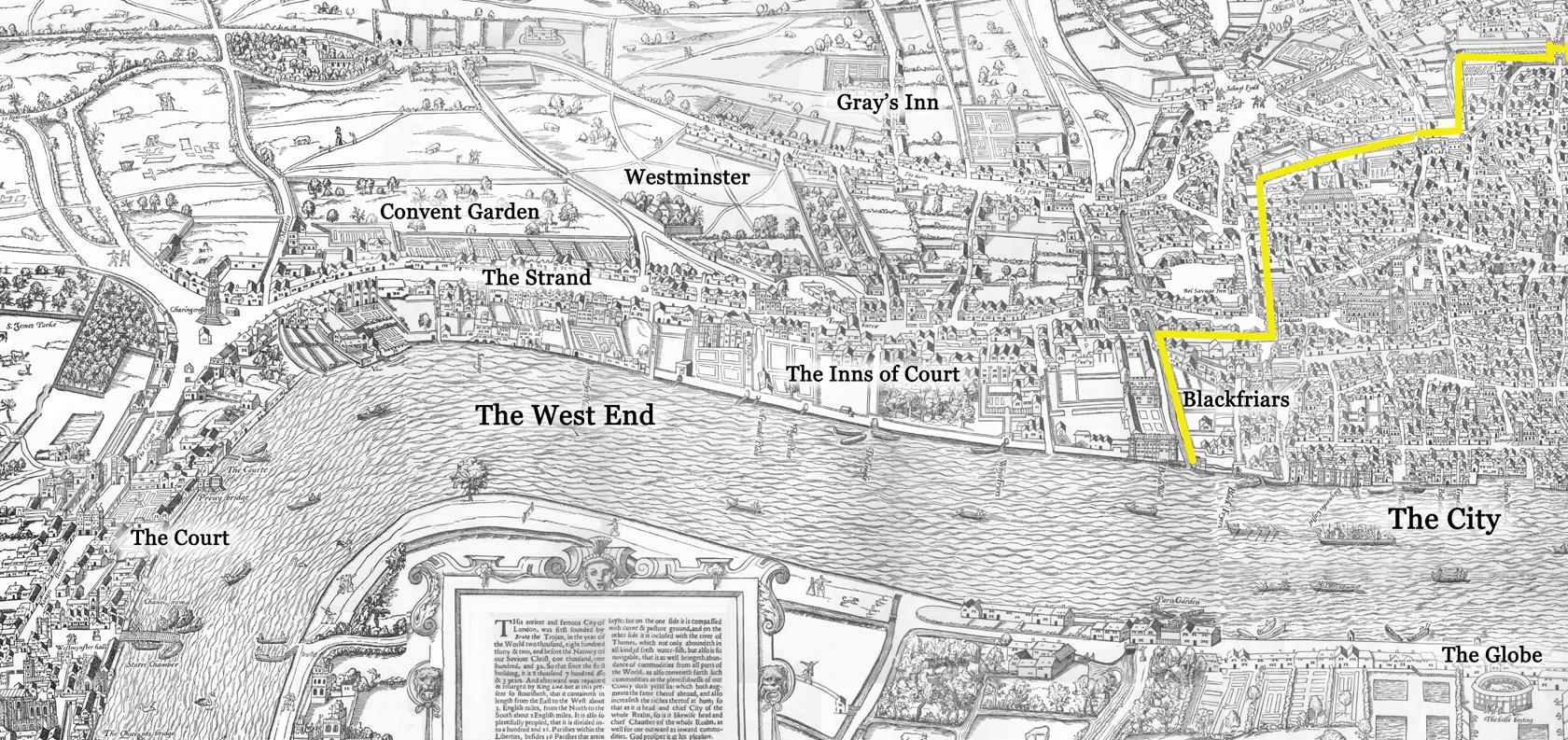
Within days of his return a huge new theater began taking shape in the outskirts of northeast London.  Based on temporary stages he had seen in Siena built by Palladio and on plans for theaters in the ancient Latin tract on architecture he borrowed from his tutor, the innovative yearround theater, the first of its kind in England (and possibly in all of Europe) was built to hold somewhere between two and  three thousand paying customers at a time.  Meanwhile plans were in progress to turn one of the apartments in the Revels section of the Blackfriars compound on the Thames into a school for the Queen’s boy choristers, where the little stage meant for their rehearsals could be used from time to time to entertain the audience that meant the most to Sussex and his vice Chamberlains, the lawyers, scribes, and parliamentarians of Westminster.

The summer of 1576 saw audiences flock to the big round public theater in the East End, where herds of apprentices and tradesmen and their wives and sweethearts were eager to pay their pennies to see plays they were told had been performed for the Queen.  Burbage and his crew grew bold as they collected the money that had always escaped them at the theater inns, where they could only pass the hat at intermission.  That winter those residents of the West End who could afford it were charmed by the boys at the little stage at Blackfriars where they paid a substantial fee to see, by candlelight, richly furnished early versions of A Comedy of Errors, Titus Andronicus, and Timon of Athens.

The residents surrounding the new theaters were not so thrilled by the litter, the noisy crowds and late hours––but with powerful privy councillors like the Earl of Sussex and Lord Hunsdon as patrons (Hunsdon now living next door to the little theater), and the Earl of Rutland, whose City manor stood a few yards from Burbage’s stage on land that until recently had been his family’s heritage, and where he still held rights––there was little the neighbors could do, at least, not right away.

For six years, all went relatively smoothly for the newborn London Stage and its patrons. Then in 1581 Oxford got himself bounced from Court for impregnating a Queen’s Maid of Honor.  Furious at how he was being treated by the Queen and the Court; fearful for his life and the life of his retainers at the hands of his mistress’s angry relatives; bitter at his mistress for what he saw as her willingness to drop him for a better prospect––he refused to continue to write for the Court and began turning out plays filled with personal passion and aimed at the West End audience.  This probably meant using the little theater at the Blackfriars school, probably with adult actors from Burbage’s and Worcester’s Men, and probably fairly late into the night.

These were not the kind of plays that he could have written for the Court.  Angry at Ann Vavasor for what he believed was her perfidy in taking up with another man, he rewrote one he’d written earlier about the Trojan war, lavishing it with irony, and pouring all his pain over his mistress into the plot and characters in Troilus and Cressida.  Furious at his cousins for accusing him publicly of treason, he dramatized the assassination of Julius Caesar, with Brutus in a situation similar to his own, and Cassius, whose “lean and hungry look” identified him as his cousin Henry Howard.  Frightened by the determination of his mistress’s male relatives to kill him, he wrote another in which he portrayed himself as already dead, observing from above as an imaginary father takes bloody revenge on his killers by means of a play within a play (The Spanish Tragedy).  Then, with the discovery that his mistress still loved him, he poured his lonely heart into a blazing new version of Romeo and Juliet.  Finally, as his patron and surrogate father, the Earl of Sussex, sickened and died, he accused the Earl of Leicester of poisoning him by drawing parallels between him and King Claudius and between Elizabeth and Queen Gertrude in a first version of Hamlet.

Since the Blackfriars theater was cheek by jowl with the City manors of Lady Russell, Mildred Burghley’s termigant younger sister, and of Sir William Brooke Ld Cobham, longtime supporter of Ld Burghley and Robert Cecil’s future father-in-law, that it wasn’t long before they became aware of what sort of plays were now taking place next door should go without saying, as should the probable fact that this was the real reason why the Blackfriars landlord, Sir William More, began petitioning the privy council to shut down the school, for Sir William, determined to rise at Court, would never have taken on councillors as powerful as Sussex and Hunsdon had he not had some hefty backing of his own.

The War with Spain and the rise of the Stage

As the threat of attack from Spain took center stage at Whitehall, Secretary of State Francis Walsingham moved quietly ahead of Burghley, Sussex, and Leicester as Privy Councillor with the most important duties.  Then, as Lord Chamberlain Sussex’s health began to fail, Walsingham moved, again quietly, to take his place as major patron of the Court Stage.  Although not in his job description, the Secretary, whose shoulders bore the responsibility of preparing for the inevitable attack from Catholic Spain, had a vision whereby a Crown company made up of the leading actors from Burbage’s and other companies could bring the kind of plays that Oxford was capable of writing to the hinterlands, plays that mixed entertainment with English history and anti-Spanish propaganda.

Himself a student of history, Walsingham understood that nothing binds a people together like a shared past.  What past was being shared then by his largely uneducated countrymen were stories from the middle east, told in the Bible.  Rouse their emotions with English stories, whether proud or bitter, and they’d be British first, Catholics second.  That this was clearly the mandate for the creation of the Queen’s Men can be seen by their travel itineraries for the years 1582 through 1588.  These show that the company spent more road time than anywhere else in towns along the southeastern and western coasts where the Spanish were most likely to attack (McMillin 175-78).

It should be clear that plays like The Famous Victories of Henry V and Edmond Ironside were written for the same reason that, during WWII, when little was being filmed in England due to the stringent economies forced on the British by the war, the government made it possible for Laurence Olivier’s Henry V to be lavishly costumed and filmed in expensive color.  During the war the American military did the same thing, enrolling director Frank Capra and others to produce propaganda films, while giving movie stars like Humphrey Bogart and Paul Heinreid deferments so they could continue to play roles in anti-Nazi films like Casablanca.

As a close friend and colleague of Oxford’s tutor, the former Secretary of State, Sir Thomas Smith, Walsingham understood that Smith’s former student badly needed something useful to do, something to keep him from continuing to cause trouble for the Court.  Writing for the Queen’s Men would keep him busy in a worthy cause.  It also made use of his knowledge of English history, knowledge stored in the papers and manuscripts he inherited from his father, passed down from one earl of Oxford to the next, papers that he kept closely guarded, allowing only those closest to him to know what they were.  No one was in a better position to turn the story of England’s past into exciting drama, an argument that helped him get the majority of the Privy Council behind the Queen’s Men, and finally, to get the Queen to fund Oxford’s crew at Fisher’s Folly, as neither he nor the improvident earl could continue to fund the stage on their own for much longer, now that Sussex and his wealth were gone.

For the adult actors this was a major step forward.  In previous years they had to share the Court stage with the children’s companies.  More recently they suffered from the heavy competition from the other companies that were springing up like mushrooms to meet the public demand for more plays.  So although they couldn’t have been pleased by the prospect of so much travelling, the fact that they were guaranteed first place at Court with fees, props and costumes supplied, was a terrific boost.  Also, when in London, no longer to be confined to the little school stage at Blackfriars, but as the Queen’s own company, to be guaranteed the Belle Sauvage Inn as their primary winter venue meant they were guaranteed London’s best holiday audience, the gentlemen of the Inns of Court.

Since Francis Bacon, too, was without a job, and since he too was a gifted writer who was already successfully entertaining the Court with installments of his Faerie Queene, Walsingham put him to work writing the holiday comedies for the choristers that Oxford no longer cared to bother with.  These had to be written by a courtier steeped in Court gossip, one who knew how to amuse without offending the great ones in the audience, how to tease without wounding their equally great and touchy egos.   It was this last factor that Walsingham failed to consider well enough when he brought young Christopher Marlowe on board as an apprentice to Oxford and Bacon.  Talented he certainly was, and a quick learner, but, to everyone’s grief, including his own, Marlowe turned out to have a very different agenda than what Walsingham and Oxford had in mind for him.

Shortly before the beginning of this turbulent period (December 1580), Richard Farrant, the school master in charge of the children’s school at Blackfriars, died, leaving his wife with the boys to care for, and nowhere near enough money for them or her own family.  As More continued to press for the power to close down the Blackfriars theater through 1581, ’82, and ’83, its lease got passed around, from Farrant’s widow to Henry Evans, assistant master in charge of the boys; then from Evans to Oxford, who by then was back at Court; from Oxford to his secretary, John Lyly; and from Lyly to Lord Hunsdon, who joined with Walsingham to keep the school, or the theater at least, from going under.

Officially the school came to an end in April 1584 when the court decided in favor of the landlord, though proxy data suggests that the little stage may have been allowed to operate as a private theater until Hunsdon’s leases were up in 1590.   It’s hard to believe that this important space, which for most of its existence over the past fifty years had been used to rehearse or store props for Court revels, would have continued to stand silent and empty for the first six of the ten most important years in the birth of the London Stage: from 1584 to 1590, most particularly from November 1584 to March 1585, when the West End was crammed with important men from all over England, gathered for Elizabeth’s fifth Parliament.  Oxford, Hunsdun, Charles Howard, Rutland, Bacon, Beale, and Raleigh, were all present and took part, as is shown by the journals of the houses of Lords and Commons in the records online. (Comes Oxon. Magnus Camererius, means Earl of Oxford, Lord Great Chamberlain.)

Parliament’s holiday break that year lasted from Dec 21 to Feb 4.  This would have been the ideal time for plays aimed at the visiting members to receive their greatest attendance.  The Revels accounts show that the Queen’s Men produced four plays at Court that winter, so we would assume that these were performed later at the Belle Sauvage.  Oxford’s name is unusually prominent in the Revels account for this holiday season,  along with the traditonal “activities” (acrobatics), he’s listed as patron for two plays, one by his “servants,” the other by his “boys,” who produced, on St. John’s Day, December 27th, a play titled The History of Agamemnon and Ulysses, which E.T. Clarke suggests was probably an early version of Troilus and Cressida.

These, or others not appropriate for the Court, would, like the plays performed by the Queen’s men, have been performed somewhere handy to the West End during the same time period.  That “somewhere” would either have been the little stage at Blackfriars, or in a hall in one of the waterfront mansions on the Thames, the most likely being Somerset House.  Then the primary London residence of Lord Hunsdon, it was located directly across the Strand from Cecil House.

“King of Shadows”

Like the anthropologist who spends thousands of hours sifting through tons of rubble beneath a cliff-side, seeking bits of bone no bigger than the end of a thumb that she hopes will fit the skeleton she’s piecing together of a proto-human aboriginal, so we sift through the texts of the period and, at second hand, through modern critical texts, seeking evidence of things that we have no other means of accessing as we strive to piece together the truth about a great artist.  The bits of bone we seek are often no more than a single word, one that bears a particular significance.  In our search for the truth about Shakespeare, one such word is shadow.

The word shadow meant more things in the sixteenth century than it does today.   Besides a term for the patch of darkness created by blocking the sun’s rays, or a slang term for someone who sticks too close to someone else, or a 1930s Hollywood verb for a spy technique, in Shakespeare’s time it was a metaphor for any kind of reflection.  You saw your shadow in a mirror; painters created shadows on canvas: in his 1579 diatribe School of Abuses, Stephen Gosson wrote: “Cooks did never show more craft in their junkets [desserts] to vanquish the taste, nor painters in shadows to allure the eye, than poets in theaters to wound the conscience.”  Some uses may reflect Plato’s vision of human beings as mere shadows on the wall of a cave, reflections of multi-dimensional spiritual realities in a three-dimensional world.

Shakespeare used the word shadow for all of these; the account in Schmidt’s lexicon of the specific uses in his works fills well over a full page in very small type.  He was especially fond of the biblical phrase shadow vs. substance, which for him expressed a world of meaning.  In A Midsummer Night’s Dream he uses shadow several times to refer to plays or actors.  Replying to Hippolyta’s description of Pyramus and Thisbe as “the silliest stuff that ever I heard,” Theseus opines: “The best [plays] are but shadows, and the worst are no worse if imagination amend them.” When Puck bids adieu to the audience after the last act he uses the term to refer to the characters created by the actors: “If we shadows have offended, think but this and all is mended, that you have but slumbered here while these visions did appear. . . .”  Twice Puck calls Oberon, “King of Shadows.”  Years earlier, the True Tragedy of Richard III, the first version of Shakespeare’s play, opens with:

Enter Truth and Poetry. To them appears the ghost of George, Duke of Clarence.
POETRY:    Truth well met.
TRUTH:     Thanks, Poetry; what makes thou upon a stage?
POETRY:    Shadows.
TRUTH:     Then will I add bodies to the shadows.  Therefore depart, ………………and give Truth leave
 to show her pageant.

In his prefatory letter to Thomas Bedingfield’s 1573 translation of Cardanus Comforte, Oxford uses the word to mean the reflection of a patron or friend if mentioned in a work of literature that lives for generations long after the friend himself is departed.

Again we see, if our friends be dead we cannot show or declare our affection more than by erecting them of tombs, whereby when they be dead indeed, yet make we them live as it were again through their monument.  But with me it happenth far better,  for in your lifetime you shall see how noble a shadow of your virtuous life shall hereafter remain when you are dead and gone.

“That shadow of thine”

One of the thousand and one smoking guns provided by authorship forensics is the handwritten note in the Cecil papers from one Thomas Vavasor to the Earl of Oxford, insulting him and taunting him to a duel.  Dated January 19, 1585, it’s the final piece in the record of assaults on Oxford and his men by members of the Howard, Vavasor, and Knyvett circle in retaliation for Oxford having “ruined” their cousin, sister, niece and former Queen’s Maid of Honor, Ann Vavasor, who, in March 1581, gave birth to Oxford’s illegitimate son in one of the royal bedchambers.

Following two months in the Tower and many more under house arrest, Oxford and his retainers were subjected to a year of attacks in the streets of London by Ann’s uncle, Thomas Knyvett, and his men.  There were four of these “frays” that reached the record, the first March 3, 1582, the final February 21, 1583, three months before Oxford’s reinstatement at Court.  Several on both sides were killed, and Oxford himself was seriously wounded in the first.  There may have been other lesser incidents that escaped the record, but once milord was back in the Queen’s favor it’s unlikely the Knyvett faction would have dared to continue their vendetta.

The note, now in the Lansdowne collection in the British Library, was found among Burghley’s papers.  If the date added (in Burghley’s hand), January 1585, is anywhere near the date it was written, this puts it almost two years after the last recorded street fight and Oxford’s reinstatement at Court.  But in fact it could have been written at any point from 1582 on, having come into his possession at any time after that.  Perhaps the answer can be found in the note itself.  Here’s the text (spelling modernized) as reproduced by Alan Nelson in his fact-filled if negative biography:

If thy body had been as deformed as thy mind is dishonorable, my house had been yet unspotted and thyself remained with thy cowardice unknown.  I speak this [because] I fear thou are so much wedded to that shadow of thine that nothing can have force to awake thy base and sleepy spirits.  Is not the revenge already taken of thy vileness sufficient but wilt thou yet use unworthy instruments to provoke my unwitting mind?  Or dost thou fear [for] thyself and therefore hast sent thy forlorn kindred whom as thou hast left nothing to inherit so thou dost thrust them violently into thy shameful quarrels?  If it be so (as I too much [suspect]) then stay at home thyself and send my abusers.  But if there be yet left any spark of honor in thee or jot of regard [for] thy decayed reputation, use not thy birth for an excuse, for I am a gentleman, but meet me thyself alone and thy lackey to hold thy horse.  For the weapons, I leave them to thy choice, [since] I challenge, and the place to be appointed by us both at our meeting, which I think may conveniently at Newington or else where thyself shall send me word by this bearer, by whom I expect an answer. (Nelson’s brackets, 295)

Let’s have a close look at what Vavasor is saying:

If thy body had been as deformed as thy mind is dishonorable, my house had been yet unspotted and thyself remained with thy cowardice unknown.

According to Vavasor, if Oxford’s looks were as bad as his morals, his sister would never have been seduced; one more bit of evidence that he was considered good-looking; also testimony that he was not an instigator of the street brawls.

I speak this [because] I fear thou are so much wedded to that shadow of thine that nothing can have force to awake thy base and sleepy spirits.

In Vavasor’s view, Oxford is “base and sleepy” (cowardly and unresponsive) because he is “wedded” to (totally involved with) something he calls “that shadow of thine” that prevents him from doing his chivalrous duty as a nobleman and answering Vavasor’s challenge.  Nelson states as fact that by “that shadow of thine” this he means “an unnamed male relative of Oxford’s,” as he scrambles among the names mentioned in connection with Oxford for one that might fit.  This is a possibility because the use of shadow then did include such a use.  However, that he was unable to come up with a name suggests there wasn’t any such person in Oxford’s life at that time.  Having just recovered from two years of banishment and so most likely exhibiting extreme caution with regard to unseemly companions, “that shadow of thine” must be something else.

Is not the revenge already taken of thy vileness sufficient but wilt thou yet use unworthy instruments to provoke my unwitting [unknowing] mind?

The “revenge” taken of Oxford’s “vileness” must refer to the wound dealt him by Thomas Knyvett during the first recorded brawl three years earlier.  However unwilling to engage in street fights, Oxford has done something to provoke the “unwitting” Vavasor.  What might he mean by “unworthy instruments”?  Since this sentence follows directly on the reference to “that shadow of thine,” it seems most likely that the shadow and the unworthy instruments are connected.

Or dost thou fear [for] thyself and therefore hast sent thy forlorn kindred whom as thou hast left nothing to inherit so thou dost thrust them violently into thy shameful quarrels?  If it be so (as I too much [suspect]) then stay at home thyself and send my abusers.

This must refer to one of the recorded “frays” in which only Oxford’s retainers were involved, or to some other for which there is no record.  This also shows that his financial straits were already a matter of Court gossip.

But if there be yet left any spark of honor in thee or jot of regard [for] thy decayed reputation, use not thy birth for an excuse, for I am a gentleman, but meet me thyself alone and thy lackey to hold thy horse.  For the weapons, I leave them to thy choice, [since] I challenge, and the place to be appointed by us both at our meeting, which I think may conveniently at Newington or else where thyself shall send me word by this bearer, by whom I expect an answer.

It’s unlikely there ever was an answer.  Either Oxford handed over the threat to Burghley, as Nelson suggests, or more likely, whoever was supposed to deliver it thought better of it, and gave it directly to Burghley, either immediately or after holding on to it for some time.

What “unworthy instruments”?

If, as we believe, based on a great deal of evidence provided here and in other locations, that during the mid-1580s, Oxford was not only the playwright who in later life would publish under the name William Shakespeare, he was the primary creator of the London Stage, the author of most of the plays then being performed by the Queen’s Men, as well as the comedies performed by Paul’s Boys at Court in the 1570s, then what Vavasor meant by “that shadow of thine” must be the stage, which was certainly considered an “unworthy instrument” by many of their contemporaries, particularly by those who’d been publicly skewered by one of milord’s satires.

As for the more recent provocation mentioned by Vavasor, I believe this was the original production of Romeo and Juliet.  Written (I believe) during a rush of feeling following the realization that the silence and lack of response from his lover following her release from the Tower was not due to the perfidious change of heart he so angrily depicts in Troilus and Cressida, the first version of which (I believe) he wrote during the early days of his house arrest, as soon as he was back at Fisher’s Folly with his staff, musicians, and actors.

Most likely the play was ready for production by late 1584 for the audience then gathering in Westminster for the Parliament that would run until the following March.  With the 18-year-old Edward Alleyn as Romeo and the 16-year-old Richard Burbage as Juliet, the play would have been performed at the original Blackfriars Theater, located just above the fencing academy where Oxford and his friends were given to practising the routines demonstrated in the play (Richard Tarleton was reputed to be a genuine fencing master).  Impelled by the added passion of relief and a deep desire to make amends to Ann for having portraying her as Cressida, Romeo and Juliet expresses the love that got them both into so much  trouble, not so fatal as what doomed the Veronese lovers, but trouble nonetheless.  Such were the emotions contributing their force to what has been described as the “lyric rapture and youthful ecstasy” of one of the most loved plays in all the literature of drama.

Hardly anyone who writes about the close connections between Oxford’s biography and the plots of Shakespeare’s plays fails to connect the street brawls between the Oxford and Knyvett/Vavasor crews and that between the Montagues and the Capulets, or Oxford’s wound with Mecutio’s death.  The strong resemblance between Friar Lawrence and Oxford’s tutor, Sir Thomas Smith, is another important link.  Less strong but still relevant are others such as the fact that Arthur Brooke, author of the narrative poem that served as a basis for Shakespeare’s play,was a nephew of George Brooke, Lord Cobham, Burghley’s close friend and his neighbor during Oxford’s years at Cecil House in the 1560s.  Unlike Romeo and Juliet, neither Edward nor Ann died, they were not married, and Ann was pregnant as Juliet was not (or she died too soon to know), in any case, these unromantic differences aside, there’s too much that’s similar between the play and the events of 1581-’85 to brush off the similiarities as mere coincidence.

As for Ann, exactly where she was at this time we don’t know, but following her release from the Tower, the most likely place, based on what usually happened in such cases, would have been to stay with an older, dependable relative, closely connected to the Court, where she would be under surveillance (as her poem reports) until the Queen could decide what should be done with her.   At some point she ended up with Sir Henry Lee, the Queen’s champion, perhaps as a sort of prize for his years of service.

For Ann’s view of the situation, we have her poem, written to explain why she was behaving as she was.  Other interpretations and attributions have been placed on this poem, but why not follow the most natural?  Poetry is always the quickest path to the heart of a poet, and in those days, it was the path most often taken in matters of the heart, even by those who would have done better to stick to prose.  Oxford’s later attachment to another female poet, Emilia Bassano, the Dark Lady of the Sonnets, plus the witty female characters he created as Shakespeare, suggests that a clever tongue in a woman had a great attraction for him.

That the play was written for some other audience than the Court should be obvious, for there were lines in it that would have infuriated the Queen, had she heard them.  Or, if it was at some point produced for the Court, lines that remained in the First Folio, such as Juliet’s in Act II Scene 1, “O swear not by the moon, the inconstant moon,” or Romeo’s a little later:

But, soft! what light through yonder window breaks?
It is the east, and Juliet is the sun.
Arise, fair sun, and kill the envious moon,
Who is already sick and pale with grief,
That thou her maid art far more fair than she:
Be not her maid, since she is envious;
Her vestal livery is but sick and green
And none but fools do wear it; cast it off.

Elizabeth’s colors, as everyone knew, were green and white.  Words like these would have been cut for a Court performance.  Oxford was reckless at times, but he was not insane.

Oxford’s three audiences

Modern readers of Shakespeare come to the plays through the First Folio, the versions of the 36 plays published in 1623 by the patrons of his company, known by then as the King’s Men.  Publication then, and ever since, has performed a cleansing process on the plays, providing texts without any of the baggage, attitudes or complications that history attaches to important works of the past.

In Shakespeare’s case, partly because they were written so long ago (though, as it turns out, not entirely) it’s been next to impossible to place the plays in history in any meaningful way.  Roughly half had previous publication in quarto format, the other half were never published until the First Folio.  Some were registered with the stationers, others not.  Some were mentioned in letters or publications by contemporaries, most were not.

Although we have a few holographs (handwritten versions) of other plays from around that time, none are by Shakespeare.  Unlike their sister company, the Lord Admiral’s Men (later Prince Henry’s Men) documented by the diary of theater owner Philip Henslowe and other papers retained at Dulwich College by his stage manager Edward Alleyn, if anyone in Shakespeare’s company ever kept any records, they didn’t survive.  The only records to survive are mid-17th century court cases over ownership of the by then lucrative company shares.  Whoever or whatever we mean by Shakespeare, he or it created one of the most successful businesses of the period, at least for those who ran it in London.

One result of this has been that even those who should know better tend to approach the plays as though they were more or less all written under the same impulse, to make money for both the writer and his actors, and for the same public audience––the only issue being when.  Because the Stratford biography forces them all into a decades late 15-year time-frame, efforts to see genuine connections to current issues and events have failed, creating a Shakespeare who plucked his subjects more or less out of thin air, and all for the same audience, an amazingly well-read  public, with the Court little more than an adjunct, as it is today.

With Oxford as author, all of this changes; the process becomes at once much more complicated and also much more interesting.  The unspoken assumption that everything that Shakespeare wrote could have been seen by anyone in his time who came to London or who had a penny to spare falls by the wayside.  The fact is that different audiences saw very different kinds of plays, even in some cases, different versions of the same play.  The illusion given by the First Folio, that all the plays share a sort of equality of presence, fails as well.  As with the works of every other great artist, each play has a history of its own, and all are closely connected to events in the life of the author and of the communities, the nation, and the world in which he lived alongside his fellows.

With a solid historical framework in place, it shouldn’t be nearly so difficult to place each play within a relatively narrow and realistic time-frame, even in some cases down almost to the very day.  In attempting to set dates for a particular play, it helps to determine for which of his three audiences did he write it originally:  the Court, the Inns of Court, or the public?  Eventually all of his plays ended up as public entertainment, but few (if any) were written originally with only the public in mind.

His Court audience

As a member of the Court from probably around age 17 until he was banished at 31, Oxford’s energies were chiefly directed towards entertaining his own community.  He was not unique in this, or rather, he was unique only in the quality of his work, for all of the upwards of 40 or 50 individuals who formed the core of the permanent Court community, those who had suites of rooms at Court where they lived yearround, were expected to contribute their particular skills for the support and/or pleasure of the group.  As the crème de la crème of English society, they were expected to sight read music notation, to sing complicated vocal arrangements, play the lute or the virginals, and perform the latest dances.

Oxford’s dancing was obviously admired by the Queen; of the handful of his poems that come down to us, many, perhaps most, are song lyrics (madrigal lyrics often sound like complicated poems), while in later years he was praised by a fellow composer as being as accomplished musically as any professional.  So we can assume, based on what evidence remains, that he quickly rose in the Court’s estimation for his contributions to musical and dramatic events.

His writing for the Court may have begun with interludes, witty dialogues exchanged by two or three of the boy choristers, interspersed with musical offerings by the boys, the Court’s permanent staff of musicians, or courtiers with pretentions to expertise.  These interludes soon expanded into full length plays like Love’s Labor’s Lost, that were made up of a series of comic or romantic interludes interspersed with songs and sometimes dances, even, as in The Tempest, with the company taking time in the middle of the show for a feast served by the cast.  E.T. Clark has identified several of these from their early listings in the Revels records.

Most of the plays termed comedies in the First Folio began as entertainments for the Court community.  Over time, some of these became standard entertainments, revised every few years by adding new topical material and characters, or revising old material to fit new situations.  In this way a character like Armado in Love’s Labours Lost represented a different Court figure when the play was first written than he does in the 1623 version, in which he represents Antonio Perez, whose presence at Court can be easily assigned to a few years in the mid-90s.  This has confused scholars who would otherwise place the play as early as the late 1570s when Elizabeth was contemplating marriage to the duc d’Alençon.   It may be that the play was originally very early, but once it became a favorite at Court, he would update it every few years for the winter holidays.  How many versions survived, and what dicing and splicing the First Folio editors may have done with them we can only guess.

When writing for the Court Oxford was of course always aware that the core of his audience were the Queen and her entourage of ladies, the wives and daughters of leading Court officials.  In writing to please them he learned early that what entertains men is not always appreciated by women, particularly the sort of well-bred, educated women who were welcomed by Elizabeth into her private circle.  That this was Oxford’s primary Court audience can be seen from his early published works (attributed to Petti, Lyly or Greene) that were specifically targeted toward female readers.

Although there’s much to suggest that Oxford preferred to write for the West End, he never ceased to entertain his home community, providing plays for Court weddings until his final days.  Among his final revisions were those produced for the 1604 wedding of his youngest daughter, Susan Vere, to the Earl of Montgomery.  The Folio version of The Tempest comes largely from the 1595 version he wrote for the marriage of his oldest daughter, Elizabeth, to the Earl of Derby, which he further revised as The Spanish Maze for Susan’s wedding.  The Folio version of A Midsummer Night’s Dream was written for the wedding of his old flame, Mary Browne, Countess of Southampton, to Sir Thomas Heneage in 1594.  Taming of the Shrew was written originally as a wedding roast for the 1579 marriage of Lord Strange to Alice Spencer.

His West End audience

Outraged at his banishment from Court and by the way he and his men were being threatened by his lover’s relatives as Elizabeth sat by and did nothing, Oxford wrote nothing for the Court for the two years that he was ostracized (1581-’83), turning instead to his favorite audience, the “gentlemen of the Inns of Court.”  For them he could unfurl the full power of his rhetoric on the kind of issues that would never have passed the Court censors.  The West End (more accurately the city of Westminster) was where the legal colleges, the Inns of Court, were located.  Further west, between the Strand and the Thames, stood the great City mansions where the most prestigious courtiers and government officials lived.

For Oxford and his patrons, this was the most important audience in London, particularly during the relatively infrequent moments when Parliament gathered to vote on a subsidy for the Queen.  Once we can begin to focus on details, it will be helpful to use these times as moments when he was most intent on reaching this audience with plays relevant to current issues, for it was then that the most influential men in England gathered together at one time and in one place.  Plays that deal with national issues, like treason (Julius Caesar), colonization (The Tempest), or the Law (Merchant of Venice) are most likely to have been first written for this audience, and the only possible stage where they would have produced these plays was at the little stage in the chorister’s school at Blackfriars.   The big public theaters were located in suburbs far from Westminster, while the Blackfriars stage was a mere hop and a skip to the west along Fleet Street, or, if coming by water from one of the mansions on the Strand, just footsteps from the elegant old Blackfriars watergate.

Happy finally to be writing for adult actors (no more little eyeases!) I believe that it was for this audience that he produced the first version of  Timon of Athens, the first version of Troilus and Cressida (written before he discovered that Ann Vavasor was not the Cressida he had so unkindly assumed), of Romeo and Juliet (after discovering that she still loved him), of Julius Caesar and Coriolanus (written to explain his urge to desert England and fight for Spain), and of The Spanish Tragedy and Hamlet (written out of anguish at the death of his patron, the Earl of Sussex, and suspicion that he’d been poisoned by his enemy, the Earl of Leicester).  The only one of these that we have today in anywhere near the original version is The Spanish Tragedy (attributed to Thomas Kyd); all the others were rewritten for the Lord Chamberlain’s/King’s Men during Oxford’s final Shakespeare period (1593-1608).

The public plays

Last, and in many ways least, at least so far as his personal interest was concerned, there was the public audience that, through their far greater numbers would make his works “popular” as neither the Court nor the Inns of Court ever could, something that gave a great deal of power to the company that produced them.  When Oxford first began producing plays at Court in the late 1560s and early ’70s, the various children’s companies that performed them were allowed to supplement their sparce Court stipends by performing the plays they’d rehearsed for the Court a few times at the little theater at Paul’s Cathedral school for choristers.  These early comedies migrated rapidly to both the public and private theaters.  Because their subjects were popular and easily understood and no deep knowledge of history or philosophy was required to enjoy them, they pleased the public, and because any satires of known Court personalities would be lost on a public audience, there was no reason for the Privy Council to get in the way.

By 1583, with the creation of the Crown company known as the Queen’s Men, Oxford found himself writing for the provincial audiences that, as McMillin and Maclean show, were the new company’s primary focus.  It’s possible to see in these early plays, most of them termed as “apocryphal,” his attempts to deal with local or at least popular issues as in Arden of Faversham, Friar Bacon and Friar Bungay, The Birth of Merlin, James IV and Edmond Ironside.  Responding to Walsingham’s desire to teach the provincials something about their history, he also wrote the early versions of what, as Shakespeare, he would turn into the great history plays: The Famous Victiories turning into Henry V, the Contention between York and Lancaster into the Henry VI series, and so forth.

Early in James’s reign, towards the end of the Shakespeare period, perhaps in exchange for stewardship of the Forest of Waltham, Oxford consented as his share of the bargain to provide updated versions of what early Court plays remained for the now royally established King’s Men, versions that would make them one of the most successful commercial enterprises of the Stuart period.  It seems he was embarrassed about this.  Feeling called upon to explain to his community why he was turning plays that they regarded as theirs into public works,  he produced at a great welcoming get-together for King James at Wilton or Salisbury the summer of  1603 a new version of As You Like It in which, as Touchstone, he explains his need to marry the provincial and unpoetic public audience he personalizes as Audrey (audire, Latin for to listen).  A man must marry and a playwright must have an audience.

Of course many plays migrated across these boundaries and although not everyone could see a play at Court nor could a poor apprentice afford one of the expensive indoor private theaters, members of the first two audiences could always see a play at one of the public theaters should they wish, and probably did quite often––all but the Queen, that is. It’s so unlikely as to be impossible that she ever ventured outside her Court confines for any purpose; every venture from one arena to another was in the nature of a state occasion.  Her dignity could not be impeached by being seen in anything less, and her person had to be protected from the lunatics and drunks that were constantly threatening to do her in.  In Tudor and Stuart times, the theater came to the monarch, not the monarch to the theater.

This of course was a boon for Oxford and his patrons, for they could trust that some of the material would never reach her ears.  We know what happened a few times when that occurred.  She would never come to them, and no one in his or her right mind would tell her things that might stir her anger enough to allow the theater’s many and determined enemies to “pluck it down.”  It also made it easy for him to hide from her how much of what came from his literary circle came directly from him.  Those darn secretaries, always publishing things behind his back!

The authorship scenario in a nutshell

For those who may be new to the authorship question or who haven’t been able to piece together a full scenario from the hodge podge of my necessarily brief posts and pages, here’s a quick overview (well, as quick as possible) of the structure behind, not just the Shakespeare authorship issue, but my view of the entire English Literary Renaissance.  For more on each point, follow the links.

1550: The true author of the Shakespeare canon was born into a dysfunctional aristocratic English family in northwest Essex at almost the exact midpoint of the 16th century.  Four years later, due to the unstable political conditions surrounding the transfer of power from the first Reformation government under Edward VI to the Catholic government of his sister Mary Tudor, those who were concerned about the safety of the heir to the great Oxford earldom arranged for him to be transferred to the care of the nation’s leading statesmen and Greek scholar, Sir Thomas Smith.

At the time that de Vere came to live and study with him, Smith was living at Ankerwycke, a renovated priory on the northern bank of the Thames, a stone’s throw from today’s Heathrow airport.  Smith and his recently married second wife had no children, nor is there evidence of any other child raised in their household, suggesting that de Vere had a solitary childhood in terms of relationships with children his own age and of his rank.  Like other isolated children, he found companions in the heroes whose adventures he read about in books in Smith’s library, many appearing later in plays by Shakespeare.

During the five years of “Bloody Mary’s” Catholic reign, Smith and the other Reformation activists from Edward’s reign who stayed in England kept quietly to themselves.  Though it’s very possible that along with Smith and his wife, de Vere attended holiday festivities at nearby Windsor Castle where he would have seen plays and concerts and spent time with his parents and other members of the large family into which he was born, it’s unlikely that, except for five months at Cambridge in his ninth year, he spent much time away from Ankerwycke during the years when  Reformers like Smith, among them his former colleagues, John Cheke of Cambridge and Archbishop Thomas Cranmer , were being rounded up, imprisoned, tortured and executed.

1558-9: Queens’ College Cambridge

With the death of Mary in 1558, eight-year-old de Vere was shuffled off to his tutor’s college so Smith could take part in preparations for Elizabeth’s coronation.  When it became clear that he would not be getting the appointment to the Privy Council that he expected, Smith returned to his new estate, Hill Hall in Essex, to which de Vere too then returned.  Two years later, when his father’s death handed his fate over to the Crown and the Court of Wards, the now twelve-year-old Earl of Oxford came to to live with Smith’s former student, Sir William Cecil, now Queen Elizabeth’s Principal Secretary and Master of the Court of Wards, at his new mansion in London’s West End.  There he studied ancient Anglo Saxon poetry and law under Laurence Nowell and the arts of the courtier under various masters of dancing, music, fencing, horsemanship and French pronunciation.

As a member of the household, de Vere formed a brotherly relationship with Cecil’s six-year-old daughter Anne and came to know their relatives, the Bacons, who lived up the road at York House: Anne Bacon, Mildred Cecil’s younger sister, her husband Sir Nicholas Bacon, William Cecil’s colleague on the Privy Council, and their small sons, toddlers Anthony and Francis, who, with their mother as instructor, could already babble charmingly in Latin.  Later the following year the Cecil’s only son, Robert, was born, and shortly after that Oxford’s first close friend, Edward Manners, Earl of Rutland, joined the household as the second ward of the Crown to come under Cecil’s care.  There they made friends with the young translators who congregated at Cecil House, most of them six to ten years their seniors.

Although the evidence is slim, it’s possible that from 1564 to 1566, under the name “Richard Vere,” the 14-to-16-year-old Oxford studied at Christ’s Church Oxford under the care of Canon Thomas Bernard, where he wrote and directed the play Palamon and Arcite for the 1566 commencement (later revised by John Fletcher as Two Noble Kinsmen).  Earlier he did the same for the 1564 commencement at Cambridge, writing and directing the (extremely juvenile) play Damon and Pythias.  Both plays reflect his friendship for Rutland (both were attributed at the time to Richard Edwards, master of the Children of the Queen’s Chapel).  In February 1567 Cecil had him enrolled at Gray’s Inn in Westminster, signalling his return to London, Cecil House, and the Court.

By 1565 Oxford had written two plays for the West End community performed at Christmas at Gray’s Inn: one a translation of the comedy I Suppositi by Ariosto, the other Jocaste, a loose translation of a Sophocles tragedy.  Also in 1565 he published the first four books of his translation of Ovid’s The Metamorphoses, published as by his uncle Arthur Golding; an anthology of tales translated by himself and his friends at Cecil House from numerous ancient and Continental authors (most of them found in Smith’s library) titled Painter’s Palace of Pleasure; and a collection of poems (Eclogues) by his friend Barnabe Googe.

1567: Court and literary patronage

By seventeen Oxford was living and travelling with the Royal Court and involved with the production of Court entertainments.  Like many other underage peers, he was forced to borrow from money-lenders to maintain his image as a Court dandy and patron of writers, musicians and companions.  These last included his cousin Henry Howard, who introduced him to Catholicism.  Though drawn by the Catholic panoply of art and music, so absent from the Reformation culture that had surrounded him since early childhood, yet the ancient belief system instill in him by Smith remained that of a Greek cycnic.  Among those he employed were several of his father’s retainers that, following his death, Cecil had taken into his own employ, among them the son of one  John Lyly.  He may also have sponsored the actors from his father’s old company.

As he approached and then passed his 21st birthday he continued his publishing ventures by putting into print Bartholomew Clerke’s Latin translation of Castiglione’s The Courtier and his friend Tom Bedingfield’s Cardanus Comforte, a translation from Latin of Gerolamo Cardano’s popular de Consolatione.  In 1574 he published the first of the early anthologies, One Hundreth Sundrie Flowres, a collection of his own poems plus some by his friends, the plays he produced at Gray’s Inn, and a tale in prose, “The Adventures of Master FI,” the first of the sort of pastoral novella he would later publish in series as by Robert Greene, the name of one of his copyholders in Essex.

1571-75: Marriage and Italy

At twenty-one, yielding to tradition (and fiscal necessity), he allowed himself to be married to his guardian’s daughter, poor Anne Cecil, who got caught right away in the tension between her husband and her parents.  By 1575, he was finally allowed to take the traditional finale to a peer’s education, a tour of European capitals, and he set off for Italy, visiting in turn every locale in France and Italy portrayed later by Shakespeare.

While Oxford was away, issues arose around his indebtedness to money-lenders and those members of his family to whom his father had granted large innuities.  He staved these off by demanding that Cecil, who had charge of his estates, sell enough to pay his debts, something that the tight-fisted Cecil, whose eye was on the future of his daughter and her progeny, stalled on doing so that the interest continued to mount. It was as much out of fury at this situation as at the rumors that Anne had been unfaithful that Oxford broke off with her and her father upon his return from Italy.  This meant that she and their daughter continued to suffer for years from ugly rumors that the child was the product of an illicit affair, a tragic ploy that would haunt him for the rest of his life and that would form the plot or subplot of at least six of the Shakespeare plays.

1576: Birth of the London Stage 

In the weeks following Oxford’s return, the first of the first two successful commercial theaters in England sprang to life, the big public theater built by James Burbage for Hunsdon’s Men in the Liberty of Norton Folgate in Shoreditch, a short distance on the Bishopsgate road leading north out of Central London.  Five months after his return, the second successful commercial theater opened its doors, this one the small private stage created as a rehearsal space for the Children of the Queen’s Chapel in the old Revels building in the Liberty of Blackfriars.  The first served the public of the East End, the other the posh community of peers and educated parliamentarians of the West End.  Titles of all but one of the anonymous plays performed at Court that winter by both the adult companies and the boys suggest Oxford’s authorship.

By 1580 Oxford was living at Fisher’s Folly, a manor just outside the City Wall, roughly halfway between the City theater inns and Burbage’s public stage.  That Christmas he felt compelled to reveal to the Queen and leading members of the Court the fact that he’d found himself drawn by his cousin, Henry Howard, into a Catholic conspiracy that seemed to pose a threat to her life.  He was forgiven, while Howard and his cohort Charles Arundel landed in prison, which caused them to launch a series of scurilous counter charges against Oxford that stuck with many members of the Court community and that have damaged his reputation with historians ever since.  Having escaped the immediate consequences of their libels, he proceeded to get caught in a sexual liason with one of the Queen’s maids of honor.  This sent him to the Tower for two months (March through May), at which point he was released to house arrest.

Banished from Court indefinitely, he turned his skills towards writing more personally satisfying plays for the adult companies to perform at the little Blackfriars theater school for his favorite audience, the West End community.  This did not go well with the residents of Blackfriars, and soon the teachers who ran the school and their patrons, himself included, found themselves threatened with the loss of the stage that gave them access to the Westminster audience.  Although the choristers school was forced to merge with the one at Paul’s Cathedral in 1584, the stage itself probably continued to function on a less public basis for another six years.  There Burbage’s adult company was able to perform early versions of plays like Romeo and Juliet, Merchant of Venice, Julius Caesar and Hamlet for the West End community, plays they could never have performed at Court.

When Sir Thomas Smith died in 1577, his friend and colleague Sir Francis Walsingham took over as Secretary of State.  Six years later, when Lord Chamberlain Sussex died, Walsingham took over as patron of the Court stage, which, through Oxford’s activities and those of his patrons and actors, was in the process of developing into the London commercial stage.  Walsingham, who lived just around the corner from Fisher’s Folly, and who was under pressure to prepare for war with Spain, saw in Oxford’s household of secretaries and musicians a sort of unofficial propaganda office.

Funding it at first from his own pocket, then persuading the Queen to kick in, he had Oxford providing the newly-formed Royal touring company, the Queen’s Men, with plays to perform in the shires, plays that dramatized for the provincial English some notable moments in their history.  This it was hoped would raise their national pride to a level that those who still saw themselves as Catholics would decline, when the Spanish attacked, to sell out for religious reasons.  Out of this came the early versions of Henry V, Richard II, Richard III, and the three Henry VI plays, plus all the plays now assigned to Robert Greene and most of the Shakespeare Apocrypha.

1580s: Francis Bacon and the birth of the periodical press

During his banishment, Oxford took a step towards providing the reading public with some of the tales he had written in the ’60s and ’70s to amuse the Court, but it wasn’t until he was back in 1583 that he followed through, publishing the pamphlet Mamillia as by Robert Greene, the name of one of his Essex copyholders.  Its almost immediate popularity spurred him to publish others, and soon, perhaps to his surprise, he found himself with an enthusiastic and expanding reading audience.  Through the dedications to these Greek romance-like stories he found a convenient way to acknowledge Court figures that, for one reason or another, he thought deserved recognition, or who could reward the bearer of a complimentary copy (one of his secretaries?)  with a sizable donation.

Thus was Oxford not only Shakespeare, not only the intitiator of the London Stage, he was also the initiator of the English periodical press, a phenomenon that spread rapidly, developing in later centuries into regular newsletters, then newspapers and magazines.

In 1578, 18-year-old Francis Bacon had arrived back in England for his father’s funeral.  Unable to return to Paris for lack of funds (his father died before providing him with a living), and with nothing more important to do, Bacon hooked up with Oxford, falling quickly into the role of Puck to his Oberon.  Oxford returned the favor by getting him connected with printers who would publish his poems, anonymously at first, then, with Sir Walter Raleigh’s help, as Edmund Spenser.  With the real Spenser far off in the wilds of southern Ireland, and with Raleigh willing to see to it that he got a regular stipend for the use of his name, Bacon was encouraged to publish a wide variety of his writings, including such divergent works as The Faerie Queene, written to entertain the Queen and her ladies, and Mother Hubberd’s Cupboard, an opening shot in his lifelong pushback against his uncle Burghley.

Lacking a paying Court position, Bacon was forced to provide for himself by working as a high level secretary to Court figures in need of politically sensitive, well-worded letters and official documents.  First among these was Sir Francis Walsingham, who, when Oxford refused to write for the Court in 1581, urged him to step in with plays for the boys to perform in a style that came as close as he could manage to the euphuism that the Queen enjoyed and that were directed and staged by Oxford’s secretary John Lyly.  By the end of the decade there were eight of these, which, like Oxford’s Euphues novels, were later published as by Lyly.

1587-88: Marlowe and Martin rock the boat

In 1584, 20-year-old Christopher Marlowe began showing up for training sessions with Oxford and Bacon, sessions intended to prepare the talented young poet to provide plays for the Queen’s Men.  These sessions took place for a few weeks each year until his graduation from Cambridge in 1587, at which point, rather than follow up on his promise to provide plays for the Court, he absconded with the fledgling actor, Edward Alleyn and the scribe Thomas Kyd to set up at Philip Henslowe’s new theater on Bankside where they entertained members of their own class with the dangerously anti-establishment play Tamburlaine.  Razzed by Oxford (Greene) and Bacon (Nashe) in Greene’s Perimedes and Menaphon, Marlowe responded by adding a nose-thumbing prologue that referred to the Queen’s Men as “jigging . . . mother-wits.”

The following year the world of pamphlet publishing was rocked by the publication of the anonymous “Martin Mar-prelate” anti-cleric satires.  The bishops were furious, but their efforts to defend the newborn Anglican establishment only made them look pathetic.  In desperation they enlisted Oxford and Bacon to mount a counterattack.  Oxford’s lacked fire (probably because he found Martin hilarious), but Bacon, who had been struggling for years to find a genuine voice of his own, saw the light!  Adapting Martin’s slangy rant to his own purposes, he lashed out at Martin, fighting fire with fire with delirious abandon.

Martin was ultimately silenced by Cecil’s hounds, but Bacon had found his voice.  In 1589, using the name Thomas Nashe, he turned from the awkward pseudo-euphuism of An Anatomy of Absurdity to frolic in this new voice in a long preface to Greene’s latest pamphlet, Menaphon (another swipe at Tamburlaine).  From then on until 1596 when he finally got the respectable Court job he’d been yearning for, Francis published one work of comic genius after another.  Like Greene (in French, vert) or Shake-spear, Nashe was a pun on this wild new teeth-gnashing style. (The real Thomas Nashe had been a sizar at Cambridge, who, like William of Stratford and Edmund Spenser, got a stipend for the use of his name.)

1593: Marlowe’s death, Sidney’s sonnets, Shakespeare’s name

As the 1580s wore on, the impending threat of attack by Spain had brought a level of power to Secretary of State Walsingham that did not sit well with Lord Burghley, who by the Armada showdown had begun to see his former protégé as more of a rival than the obsequious junior he would have preferred.  With Walsingham’s death in early 1590 came the opportunity he’d been waiting for.   While he himself moved quickly to take over the public side of the Secretary’s office, he turned over Walsingham’s secret service agencies to his son, 27-year-old Robert Cecil.

Eager to show the Court in general and his frolicsome cousins in particular that he was a force to be reckoned with, Cecil created a sting that culminated in January 1592 whereby Marlowe could have been jailed under suspicion of coining, to be followed no doubt by the usual tribunal and execution.  When that failed to pan out, the next opportunity appeared a few months later when early signs of plague appeared.  Centuries of experience had taught the English that it would hit with full force the following spring, giving Cecil time to create another virtually flawless sting operation, which did in fact go off without a hitch.  Marlowe was caught, trapped, and either executed or transported overseas, with a corpse from another recent execution substitued in his place.

That Oxford had been warned in advance that trouble was on its way seems clear from the way that at the first warning of the plague in the summer of 1592 he rid himself of his Robert Greene persona.  That he included in Greene’s final “deathbed” pamphlet a warning that Marlowe was headed for trouble makes it almost a certainty.  That Bacon was frightened by Marlowe’s murder is evident from the fact that the book that he had ready to publish, the larky Jack Wilton, got set aside as he rushed to print instead the morose Christ’s Teares over Jerusalem.  A few months later, having recovered his nerve, he published that masterpiece of English satire, Piers (Purse) Penniless, in which he descants with stunning wit on his irksome poverty and the human devils that it forces him to deal with.

Burghley had already taken steps in 1588 (following his daughter’s death) to shut down Oxford’s operation by allowing his debts to the Court of Wards to be called in, forcing him to rid himself of anything that could be confiscated by the Crown or his other creditors, including Fisher’s Folly.  With bankruptcy hanging over him, Oxford found himself for the first time utterly unable to continue to support his staff (note the story of the grasshopper and the ant in Greene’s Groatsworth) or to raise any cash at all.  In fact, it seems that at one point he fell so low that he had to turn to his former retainers for handouts.

Feeling deserted and at a loss, when a young nobleman offered financial support for his new play (a revised Romeo and Juliet?), Oxford felt a gratitude that blossomed into love.  Now in his forties, his wife dead and with no heir to carry on his ancient name, his oldest and dearest friend gone, drenched with remorse over his treatment of his wife and his affair with his patron’s mistress, his heart went out to this handsome young peer.  In hopes of seeing him wed to his daughter, in 1590 he wrote 17 sonnets for the boy’s 17th birthday and gave them to him bound in velvet.  The youth’s response sent him into raptures of sonneteering.  Using the sonnet form created by his great uncle the Earl of Surrey, in verse after verse, a new voice began to appear.  Chasing the youth, chasing this new and powerful voice, he kept on writing.   As always in times of trouble, writing was his tonic, his escape.

Mary comes to town

November 1588 had seen the arrival on the London scene of 27-year-old Mary Sidney, Philip’s sister, who ended her two years of mourning for her brother by arriving at the Armada victory celebration in full Countess regalia and in a coach painted in Sidney colors.  Having produced the requisite heirs for her husband, the Earl of Pembroke, Mary was out to live life the way she wanted.  Quickly involving herself in writing (anonymously) for the stage, probably for Henslowe, whose theater was a short ferry ride from the Pembroke’s City residence, when Francis, determined to get the English Literary Renaissance moving no matter whom it upset,  published an unauthorized version of Sidney’s sonnet cycle, Astrophil and Stella, in 1591, she quickly saw to it that the book was recalled, edited her brother’s poems to suit her notions of what would pass for respectable, and had it republished  (minus the Oxford sonnet)––the first time in the Elizabethan era that a courtier poet of Philip’s standing was published under his own name.  That he was dead made it all right, but it still represented a crack in the monolithic taboo against courtiers publishing their own works.  More important, it forced Oxford to surpass everything he’d done up to then, and in so doing, find the voice we know as Shakespeare.

The appearance of Sidney’s wryly sweet and witty sonnets created an instant sensation with a reading public that, due to Greene (Oxford) and Nashe (Bacon), had grown by 1591 to sizable proportions.  Already adored as England’s warrior martyr, Sidney was now seen by Oxford’s reading audience as the greatest English poet since Chaucer.  Annoyed at being blind-sided by Bacon and Mary and, once again, upstaged by Sidney, Oxford, bent on taking back the preeminence he cared about the most, outdid himself.  By the end of the Elizabethan era it was clear that Venus and Adonis was far and away the most popular work published during that period.   How interesting that it was just at this moment, when his world was under attack, that Oxford finally found the voice that would spread the English culture to the ends of the world.

Bacon responded to Oxford’s crisis by publishing mournful ditties as Nashe to “Slumbering Euphues in his Melancholy Cell at Silexedra” and as Spenser to: “Our pleasant Willy” who is “dead of late.”  Along with his brother Anthony, who had returned from France in 1592, Francis opened his doors to what remained of the disbanded University Wits, he and his brother continuing their secretarial service out of their rooms at Gray’s Inn.  Mary helped by creating a new acting company in her husband’s name so that actors could continue to find work.  But Marlowe’s murder in 1593, followed by the murder of his patron, Lord Strange, in 1594, sent the dire message throughout London’s little theater and publishing world that the good times were over.   Matthew Roydon disappeared; Thomas Watson “died”; Thomas Lodge went to France to study medicine; George Peele went to work for the Mayor; and Lyly began his lifetime of begging, unheard, for another Court job.

However low Oxford might fall it seems someone or something always came along to rescue him.  By 1592 the Queen had stepped in and arranged a second marriage with an heiress, Elizabeth Trentham, whose brothers were in a position to take over his shaky finances while his new Countess arranged for the purchase of a manor in the northern suburbs suitable for a person of his (and now her) rank.

In 1594 the ranking Privy Council patrons, Lord Hunsdon and his son-in-law the Lord Admiral stepped in to create out of the wreckage of the Queen’s Men and the Lord Strange’s Men, two new companies.  The Royal company, with Hunsdon as patron, would have the advantage of Oxford’s playbook and the northern theaters, while the other, patronized by the Lord Admiral, would have some of his lesser plays, Henslowe’s theater on Bankside, and the advantage of Edward Alleyn as lead actor.  Oxford would be free to write for new audiences, in particular the gentlemen of the Inns of Court in Westminster who would soon be entertained in style in the grand new theater planned by Burbage and Hunsdon for the great Parliament Chamber at Blackfriars.

But this was not to be, for Robert Cecil, having acquired the wide-ranging powers of the Secretary of State in 1596, was not about to allow Oxford’s company access to the Westminster community.  As the winter holiday season approached and Burbage prepared the new theater for use, Cecil saw to it that the Privy Council honored a petition signed by the residents of Blackfriars requesting that the theater be prevented from opening.  This,  plus the loss of their old public stage in Shoreditch, plus the death in July of their patron Lord Hunsdon (two weeks after Cecil became Secretary of State), plus the death of James Burbage the following February, left the Lord Chamberlain’s Men in a very sorry state.

Bacon, with the help of Ben Jonson and perhaps also Oxford, fought back with a play produced at the new Swan theater on Bankside.  The response suggests that it dealt roughly with Cecil, whose recent appointment as Secretary of State tipped the balance of power on the Privy Council too heavily towards the Cecil faction for many at Court.  Concerned for his reputation with the Parliament due to convene in October, Cecil retaliated by closing all the theaters in London, which sent all the actors, including the Lord Chamberlain’s Men, on the road.  When they returned, it was to publish the Shakespeare version of Richard III, in which comparisons were so clearly drawn between the wicked king and Robert Cecil that, as history records, Cecil’s reputation was permanently blackened.  From then on he was stuck with the comparison, which sunk more deeply into the public psyche every time a new edition of the play was published, which occured with unusual frequency, eight editions in all, five of them before and a sixth joining the herd of libels that followed his death in 1612.

1598: The cover-up is launched

The uproar caused by the publication and production of Richard III in 1597 intensified the need by the scribbling rascality of the West End to discover who wrote it, which in turn forced the Lord Chamberlain’s Men to put a name on the second edition, published the following year.   No other options having presented  themselves, they were forced to use the same name that Oxford had used four years earlier when he published Venus and Adonis, the name of one of printer Richard Field’s hometown neighbors.  That this cost the Lord Chamberlain’s Men, or their patrons, something seems clear from the fact that it was at this same time that Field’s neighbor was suddenly able to afford one of the biggest houses in his hometown and to purchase the family crest that his dad had tried and failed to get twenty years earlier.

1604: Oxford escapes to the Forest

The troubles launched by the Cecils’ takeover of Walsingham’s office and the deaths of so many of his literary and theatrical colleagues, plus perhaps his own poor health, caused Oxford to begin planning his escape from Court.  As early as 1593 he was once again petitioning the Queen to return to him his inherited rights to the stewardship of the Forest of Waltham and the keepership of Havering palace.  Doubtless aware of her playwright’s intentions, the Queen continued to refuse it, but following her death in 1603, Mary’s sons, now the third Earl of Pembroke and his younger brother, found the new King easily persuaded to let the old poet have what he wanted.  Shortly after, Oxford invited his friends to a secret celebration to be held in the Forest on Midsummer’s Eve.  The following day, June 24th, 1604, word went out that he was dead.

With no reason to disbelieve the report, Cecil sent his agents to arrest the Earl of Southampton on the usual charge, suspicion of plotting to kill the King.  Finding none of Oxford’s papers, Cecil was forced to release Southampton.  He soon learned that Oxford wasn’t really dead, but by then there was nothing he could do but go along with a fabrication that was countenanced by the King.  When arrangements were made to wed Oxford’s youngest daughter Susan to the Earl of Pembroke’s younger brother, Cecil did what he could to prevent it, but again was overridden by the King, who liked nothing better than a wedding that seemed to bring together two Court factions.  Oxford spent the rest of 1604 revising eight of his plays for the wedding that took place that Christmas, four of them attributed by a Court scribe to “Shaxberd.”

1609: The song is ended, but the melody lingers on

He continued to live for another four years, polishing and revising his favorites for the King’s Men, among them Hamlet, King Lear, As You Like It, and Romeo and Juliet.  That he was dead by 1609 seems evident from the works published that year, among them Pericles and Shake-speare’s Sonnets, probably produced by Bacon.  Fascinated as he was by anagrams and codes, Francis is the most likely creator of the strangely worded dedication in which the name of Shakespeare’s Fair Youth, Henry Wriothesley, (Earl of Southampton) is spelled out through a particular arrangement of the printer’s type.  Cost and authorization were probably provided by the Earl of Pembroke––William Herbert––who was honored in the tradition of such publishing methods by being named as dedicatee: “Mr. W.H.”

With the author no longer around to provide more plays, the King’s Men turned some of his early pastorals over to Mary Sidney and John Fletcher to revise for audiences nostalgic for the “innocent” days of Elizabeth’s youth.  An uneasy alliance was formed among those who agreed that it was important to publish his collected works in a format that would guarantee their survival.  That this took a long time is understandable considering how controversial were some of the plays during Oxford’s lifetime, the concerns of his daughters who had their Cecil relatives to consider, friends of Oxford’s who may have held the best originals and who needed coaxing or payment, and booksellers who held the rights to some of the plays.  By the time the book was finally published well over a decade later, all were gone who might have caused serious problems.  Henry Howard and Robert Cecil were both long dead as was William of Stratford, although his wife was still alive until a mere two months before the book was available for purchase.

At about this same time, the monument to John Shakspere in Trinity Church acquired a plaque that explains in the kind of convoluted verse that was Ben Jonson’s forte that the subject was known for his wit.  It’s unlikely that either this or Jonson’s equally evasive wording in his dedicatory Ode to the 1623 Folio succeeded in quashing the authorship inquiry.  It seems the same concerns that dictated Jonson’s Ode continued to dictate the front material in both the 1633 and 1640 editions of his works, in which poets reiterated Jonson’s suggestion that room had been made for Shakespeare in Poet’s Corner.  The replacement of the bust of William’s father by a more writerly figure, with the woolsack evolving into a pillow and a pen, suggests that the paternal woolsack was presenting a problem.  Thus was initiated the series of renovations that has led to the present figure whose face Mark Twain felt resembled a “bladder.”

Among the fairly small community of art-lovers and aristocrats to which Oxford and his patrons belonged, his authorship must have been an open secret for two or three generations.  Then, as those who knew the truth for certain died, and their children died, fact faded to the level of a rumor, until the 19th century when a passion for delving into primary causes (Darwin, Marx, Freud) swept the culture at the same time that a renewed interest in his works turned Shakespeare into a cultural icon.  However, if one follows the chain of connections over the years from poet to poet and patron to patron,  it’s possible that the truth was known to the group that placed the statue in Poet’s Corner in 1741.

With Oxford so utterly lost to history, enthusiasts turned first to Francis, whose writing skills, interests and education seemed to qualify him.  The effort put into proving that Bacon was Shakespeare was the true beginning of authorship scholarship, as the Baconians published evidence showing how impossible it was that such a man as William of Stratford, with no education, no presence at Court, no legal training and no means of travelling to Italy, could possibly have written the works of Shakespeare.  They also located in the works of Robert Greene the missing Shakespeare juvenilia and made the connection between Bacon and the works of Spenser and Thomas Nashe.  Yet still the central truth, the existence of the Earl of Oxford, continued to elude them.

This was finally supplied in the years just following World War I when a British schoolteacher realized that someone so unknown to literary history must have been equally unknown as the playwright during his own time.  By creating a list of characteristics that Shakespeare reveals about himself in his works, and seeking in the right place, poetry anthologies, he found the Earl of Oxford, who fit the 18 characteristics in every respect.

Thus arrived the situation as it remains today.  Because historians and the left-brainers who run Wikipedia, based on what records the Cecils chose to leave us, continue to see Oxford as the kind of louche ne’er-do-weel the Cecils detested and did their best to destroy, we’re stuck with William, or Bacon, or Marlowe, or Mary, or (God help us) Edmund Campion, or almost anyone but the guy who actually did it!

But refusing to deal with the facts about Oxford vs. William may not be the root cause of the problem, which is the utter refusal on the part of English historians to see the Elizabethan reign as a repressive regime dedicated to stamping out any glimmer of intellectual freedom.  Until the historians are willing to accept that as a given, we’ll continue to get nowhere with Oxford, for they will simply continue to ask why on earth should he, or Bacon, or Mary, any of the other writers, wish to hide their identities?

None are so blind as those who will not see.

Blogging or slogging?

If I’ve been slow with blogging lately, it’s because I’ve been slowly slogging through the histories of the period seeking patterns in events and dates to complete the puzzle of when and why the authorship question first arose.  Now that I have it, I have to find a way to present it as a narrative, which is a thing that takes time and a lot of thought.  Rather than hold off any longer, I’ve decided to post as pages what I’ve come up with so far.  This means I will risk contradicting or repeating myself, but if I don’t, life being what it is, I may never get around to it at all.

There’s no hard evidence for the story I’m at pains to tell, but then there wouldn’t be.  First, they didn’t keep evidence of this sort of thing back then; no one who was close enough to the action to know the truth would have mentioned it openly either in a letter or a published work.  Second, this was the very thing that, once he had control of the national archives, was erased from the record by the man who made the coverup necessary.  Obsessed with making it go away, he made it appear that the English Literary Renaissance had never happened.  If it weren’t for the hundreds of published works that were beyond recalling or burning, he would have gotten away with it.  He did get away with erasing all evidence of how it came to be.

Literary historians like E.A.J. Honigman, Andrew Gurr and Scott McMillin have seen the truth.  McMillin and Mary Beth Maclean, for instance, see the truth about Walsingham, unlike their mainstream  colleagues who still see the great Secretary as little more than the Queen’s spymaster.  But without the chief protagonists it’s all just a collection of shadows on a wall.  Without the authorship question and the answers it provides about the principals, there’s no dynamic, no thrust; it’s Yalta without Churchill or Stalin.

For years I’ve felt that it was impossible that no one seriously questioned Shakespeare’s identity until the mid-19th century.  If there was a problem with revealing it, and if William of Stratford was hired to stand in for the real playwright to resolve this problem, then it must be because at some point the question of who was writing the plays demanded an immediate response.

A man who created something so popular as the plays that made the Lord Chamberlain-King’s Men the most successful acting company of its day and perhaps of all time, would not have gone unnoticed, unrecorded, without commentary, in London or in his own home town as Ramon Jiménez has so clearly and succinctly shown was in fact the case.  That there is so little, really next to nothing, in the record about the author as a person, not just a name, cries out for an explanation and this cry would not have waited until the late 19th century.  It would have been immediate.

In fact, it was immediate, as Andrew Gurr shows in his studies of the creation of the Lord Chamberlain’s Men, though he can’t get to the heart of it without knowing the principals and the stakes involved.   No doubt questions were asked throughout the 1580s, but the author wasn’t quite Shakespeare yet.  Not until the 1590s, with his quantum leap in style from “Robert Greene” to “Shakespeare,” would theater buffs begin asking with increasing emphasis: “Who is writing this stuff?”  (Of course there were theater buffs then as there are now and always have been, particularly when the commercial Stage was so new. )

Although they didn’t use the name Shakespeare right away, the company must have purchased it from William at some point in 1594-95.  The first (and only) appearance of the name William Shakespeare on a Court warrant as payee for the Lord Chamberlain’s Men is dated March 1595, so the deal must have been done by then.  Why then was the name not used on any of the 15 Shakespeare plays published between 1594 and some point in 1598?  It would seem that not everyone in a position to make policy was enthusiastic about using a standin, or at least, not William.  Were they waiting for a better solution?  And what was it that caused them to begin using it in 1598?

As we might have suspected, as in Hamlet, “the play was the thing” that caused the question of the author’s identity to rise to such a pitch that a response had to be forthcoming and as soon as possible.

That play was Richard III.

Stay tuned.

Was John Shakspere a dissident nonconformist?

In a book titled Shakespeare, Puritan and Recusant, published in 1897, author Thomas Carter makes a convincing argument that the apparent troubles brought on the Shakspere family beginning around 1576 were due neither to Catholicism nor debt, but to John Shakspere’s adherence to the radical Protestant line.  In other words, John Shakspere was what in the 1590s would be described as nonconformist or dissident.  In other words, he was the opposite of what we’ve been told.  Although this may leave a few problems unresolved, it makes a lot more sense than the Catholic theory.

Certain that Shakspere’s son was the great playwright, Carter also believes that John must have been literate, and even holds that certain fees paid him were to send him to London to observe a session of Parliament.  We needn’t go this far; greater certainty would lie with evidence from other towns of the literacy of men like Shakspere Sr. during this period of rapid change in levels of literacy.  The most likely may be the middle view, that the glover’s mark he used as a signature was an artisan’s tradition, not a symptom of illiteracy, so that Shakspere Sr. could read enough to manage his affairs, something according to Carter he did well enough throughout.  As for John’s son William, it’s evident that, whether or not he could read at any level, he was unable to write his own signature with ease, which would seem to put him out of the running as the author of Hamlet.

From the beginning, John Shakspere’s career path followed that of the rise of Protestantism and fell with the rise of government anti-Puritanism.  He came to Stratford in 1551, possibly on a wave of Protestantism when John Dudley, Earl of Warwick, Warwickshire’s Protestant overlord, came to supreme national power.  Dudley lost it when the Catholics came back in in 1553, but then in 1558, with the pendulum of power swinging back to the reformers, came Shakspere Sr.’s first steps up in Stratford town government.  His lifelong friend Adrian Quiney was the town’s first Bailiff under Elizabeth, while in 1564 “Chamberlains” Shakspere and friend Robert Wheler were paid to rid the town chapel of its Catholic symbols, the cross, the rood screen, and the images and pictures of the saints (69).

For twenty years John Shakespeare and his friends continued to serve in one capacity or another as leaders in the Stratford Council until the mid ’70s when it appears he lost interest in civic service, either from debt or recusancy.  Although his recusancy is a matter of record, Carter shows that Shakspere was neither bankrupt nor was he even in serious debt.  The land transaction that scholars have interpreted as a sale by a desperate bankrupt were, as Carter explains, standard moves made by recusants to shift ownership of land to a friend or family member to avoid having their property confiscated should they be condemned by the Ecclesiastical High Commission (94-106).

The word recusant is usually taken to mean Catholics who refused to conform, but in fact it simply means one who abstains from attending church out of protest.  It’s true that the majority of recusants were Catholic, but right from the start it was clear that for the Queen and many others, the complaint was less with the Catholic service than it was with Catholic politics.  As for religion, once the Armada was defeated and the Crown was no longer so worried about Spain, Elizabeth’s attention turned to the English dissidents who, if anything, were even more offensive to her personally in their demands, whether for a reformed Church or the freedom to worship as they pleased.

Having been made the Head of the Church by the actions of her father, Elizabeth took seriously the Act of Uniformity passed by Parliament shortly after her coronation that demanded allegiance to the (once again) reformed Service and Book of Common Prayer.  Seeing the empty churches as a personal affront, she put her “little black husband” Archbishop Whitgift in charge of forcing them back to church and the machinery of repression under the High Commission swung around toward the dissidents.  Thus was the Church of England born.  Shorn by the Star Chamber of opposition at both ends of the religious spectrum, it settled into what the proto-Presbyterians, Methodists, Quakers, etc., saw as a Catholic service in every respect but that Latin was replaced by English and the clergy were allowed to marry.

Carter sees this wave of repression, sparked by the uproar caused by the Queen’s threat to marry the Catholic French prince and her brutal treatment of John Stubbes for writing against it, as sweeping through Stratford in 1579, bringing strict reprisals from Westminster and forcing Shakspere Sr. and his reformist friends to retreat from the kind of involvement in civic affairs that could lead to serious trouble for them and their families.  As the records show, John was willing (and apparently able) to pay a heavy fine for not taking Episcopalian communion (118).  That John Shakspere retired from public life for twenty years, not because he was a Catholic, but because he was a dissident, makes a good deal of sense in almost every respect.

One issue that it doesn’t resolve is the matter of the Catholic handbook found by roofers in the eaves of the Henley Street house in 1757 (Schoenbaum 41).   This has been taken as evidence that John was a devout Catholic who hid the book out of concern that it might be found by some delegation of church commissioners.  Surely we can let go of this one.  It doesn’t affect the authorship thesis in any direct way.  Anyone could have hidden the book, such as an apprentice with rooms in the attic, concerned that his Master find him with such a dangerous item.  Another issue is the reason why William’s daughter Susannah was listed in 1606 by an ecclesiastical commission as a recusant (234-5) which Schoenbaum attributes to her being “popishly affected,” though it can just as easily be interpreted as an attempt to keep track of persons who failed to show up for communion so that they could be fined.

It does resolve other things.  There’s the problem of why John Shakspere’s neighbor, tanner Henry Field, clearly a staunch Protestant (having placed his son as an apprentice with the Huguenot printer Thomas Vautrollier), would name a devout Catholic in his will to act as his executor.  When seen as fellow Protestants, Shakspere and Field’s relationship makes better sense (even if John did take Henry to court once over a debt).

But the best proof comes from the plays, where advocates of a Catholic Shakespeare have a hard row to hoe.  Some of Shakespeare’s many Biblical references could have come from any Bible, but the prevalence of quotations, some almost word for word, from the 1560 Geneva Bible far outnumber them.  The very fact that there are so many Biblical quotes in Shakespeare while the Inquisition taught that it was a sin for a layman, not just to read the Bible, any bible, but even to own one, should be enough to quash the Catholic Shakespeare theory.  (The ability of theorists to cling to a notion, no matter how utterly it’s been proven false, never ceases to amaze.)

This prevalance in Shakespeare of quotations from the Puritan Bible, as Carter calls it, helps him with his Puritan Shakespeare theory, but not nearly so much as it helps Oxfordians with ours, for the Earl of Oxford spent the first eight years of his school career being tutored by one of England’s leading reform theologians, one who helped to create the also frequently quoted Book of Common Prayer, while the very Geneva Bible that Oxford purchased when he was nineteen, when presumably he was off on his own and no longer reliant on the books in his guardian’s library, is still to be found in the Folger Shakespeare Library in Washington D.C.

The origins of Hamlet

By 1559, the dawn of the Elizabethan era, nine-year-old Edward de Vere had probably already absorbed much of the philosophy of the English Reformation from one who had helped to create it, his tutor, Sir Thomas Smith.  He would have learned very early that Wittenberg in Germany was the ultimate Reformation university, the place where it all began.  He would have learned about Amleth, the Danish prince who went mad, or pretended to go mad, from his tutor’s copy of the Gesta Danorum  (Danish Histories), by Saxo Grammaticus, lodged on the shelves of Smith’s library at Hill Hall in Essex, just north of the forest of Waltham.

Smith may have introduced the future Great Lord Chamberlain to this bit of Danish history as an example of leadership gone awry, or the boy himself may have stumbled across the well-known tale in in his pursuit of some understanding of the class he was born into but with which he had never yet spent much time.  During what appears to have been a solitary childhood in the country near the Forest of Windsor, Oxford would have entertained himself as best he could with the books in his tutor’s library.  Through these he was introduced to the heroes and villains of English history, many of whom played a part in his own family history.  Besides these there were as well the heroes and villains of Roman history and, beyond them, the Greek and Trojan gods and warriors of Homer and Euripides, all available in his tutor’s library.  He spent hours with these heroes, brought to life by his imagination and his tutor’s recitation in Greek and Latin.

This life of solitary study came to an abrupt end with the death of his father when he was twelve.  Transferred to Cecil House in London, he was soon immersed in the hurly-burly of life at the center of a Renaissance Court.  Befriended by the young translators from the legal colleges that surrounded Cecil House, he fell quickly into the role of patron, and began using his education with Smith to do his share of translating and to create works of poetry and drama to entertain his friends, most of them older than himself by some six to ten years.  Following the rubrics of noble behavior as prescribed by Smith and ancient tradition, while promoting his friends, he kept his own authorship more or less a secret.

At some point during the nine years that Oxford spent as a ward of the Crown it would have come clear to him that his estates were being used, and abused, by the Queen’s favorite, the Earl of Leicester.  Because it was accepted policy that the Crown had the use of an underage peer’s estates, there wasn’t much he could do about it except wait until he turned twenty-one.  By then, with his mother and stepfather both dead and Leicester at the height of his power at Court, it seemed best to ignore this offense as water under the bridge, or at least pretend to do so.  Patronized by Leicester’s bitter enemy, the Earl of Sussex, Oxford rose rapidly at Court, due partly to his lordly largesse, which was getting him into financial trouble, and also no doubt to his wit and his talent for entertaining.

Then, just as he turned thirty, the bottom fell out.  Forced by his conscience and perhaps a sudden fear of potential consequences, he turned on his Catholic friends in the Howard circle, revealing before the members of the Queen’s Presence Chamber during the winter holidays of 1580/81 that he had been involved with them in some rather dangerous plotting against the regime.  The Queen forgave him (a mark of his popularity).  Then, when one of her maids gave birth to his child in her chamber in March 15, she went totally berserk, had the offenders, baby included, thrown in the Tower, where she left Oxford for two months, then banished him from Court.  Adding insult to injury, she found it expedient to sooth the offended members of the ruined maid’s family by raising their prospects at Court and turning a blind eye to their vicious attacks on milord and his men.

Oxford in the early 1580s

Released from the Tower in June, Oxford retreated to Fisher’s Folly, his manor just outside the City Wall in Bishopsgate, where, burning with rage and humiliation, he refused to continue to write for the Court.  Rejected by those who fawned on him during his days of glory, barred from most of the pastimes that had filled his life until then, and unable to travel about freely due to the danger of running into his lover’s relatives, he turned to the Stage to plead his case before the audience he trusted most, the lawyers and students of the Inns of Court.

A decade of creating Court entertainments, plus a year abroad observing the vital theater traditions of Italy, had honed his writing to the level of a skilled professional, far beyond what anyone else in England was capable of at that time, most still mired in the dull style of the “drab era.”  No longer bound to amuse the Queen with yet another witty comedy for the little boys, or another variation on the Petrarchan sonnet or Italian madrigal, he was finally free to write as he pleased.  The result was a barrage of serious plays for the adult actors.  Filled with the energy of an arrow finally loosed from a long-held bow, some of these were destined to evolve into masterpieces.

A good test to decide which of the Shakespeare plays originated at this time of intense creativity is whether and how it deals with the subject of treason.  Divorced from Court society, Oxford was in no position to defend himself in any other way against the charges being spread about by his cousin Henry Howard that he was a blackguard and a traitor.  As a form of special pleading, they were also a way for him to work through his questions about himself.  Was he a hero or a villain?  When he looked at his behavior from the point of view  of his patrons, he saw someone stupidly heading for disaster while from Howard’s point of view he was, if not a traitor to the Queen, then certainly a traitor to his friends.  Was he stupid or wicked?––neither was pleasant to consider.

Bored, used to writing, he turned to pen and ink, or rather to the secretaries who took his dictation.  Characters from his early reading returned to save him from his artistic and moral dilemma.  Historic figures like Richard II, Bolingbroke, Brutus, Coriolanus, and Amleth, recalled from his years with Smith, were brought back to life with his busy pen.  Also present was the brilliant mathematician and astrologer, Jerome Cardan, whose book about the death of his son, translated by his friend Thomas Bedingfield, Oxford had published in 1573.   Out of this mix came, more or less in chronological order, “The Play of Sir Thomas More,” The Spanish Tragedy, Coriolanus, Julius Caesar, Richard II, and Hamlet (among others).

He had been comparing himself to Richard II for some time, largely due to Richard’s reputation as a spendthrift.  The recent close call with treason awakened him to a further resemblance, the ease with which he had fallen into bad company.  That it was Oxford’s own predecessor, Robert de Vere, ninth Earl of Oxford, who was the villain of Richard’s story, the seducer who destroyed the nation by taking the King’s focus off his duties as monarch and onto his own villanous self, added weight.  Had he inherited some terrible weakness from this Earl?  Had it come to him though the fourteenth Earl––another lunatic spendthrift?  But how was a man to live up to his duties as a nobleman without spending money?

Oxford’s Coriolanus

Oxford now saw how Plutarch’s military hero could have ended up as a traitor.  (Smith had Plutarch in his library, in three languages!).  Furious at being treated dismissively by the Roman Senate (in Oxford’s case, the Queen and Burghley) the Roman general’s attraction to his enemy caused him to change sides.  In Oxford’s case, this was the already legendary military hero, Don John of Austria, who not all that long ago (1571) had achieved the victory of the age over the Ottoman Turks at Lepanto and for whom Oxford, writing in the early ’80s, still felt a young man’s admiration (Don John died in 1578).

Since Don John (thought by some to be the original of the many Don Juans of literature, due to his famed capacities as a lover) was the illegitimate son of the Holy Roman Emperor Charles V, and the brother of Philip II of Spain, the English tended to downplay his abilities since, to them, he was a dangerous enemy.  In fact, it would have come to light right about the time that Oxford wrote the first version of Coriolanus that the Don had been involved in a conspiracy to conquer England and marry the Queen (reflecting his notion perhaps that no woman was capable of resisting him).

Oxford’s play ends with Coriolanus falling on his own sword, perhaps a demonstration of how ashamed he was of his flirtation with treason (though not ashamed enough to do it himself).  That it was written closer to 1583 than earlier can be seen by his effort to make amends with his in-laws, portraying Burghley as the upright Menenius, Anne Cecil as Virgilia––perhaps our best look at who she was, to Oxford anyway––and less admirably, her mother Mildred as the overbearing Volumnia.  ( It’s possible that Volumnia was actually based on Mildred’s even more overbearing sister, Lady Elizabeth Russell, whom Oxford may already have come to know as an unfriendly neighbor of the little theater in Blackfriars.)  Based on its style, the version that we have of Coriolanus is probably an update from the early 1590s.  Apparently it wasn’t something he considered worth revising during his final period.

The masterpiece amongst these treason plays is Julius Caesar.  We have no earlier versions of Julius Caesar as we have of some of the plays from this period, but I feel certain (for a number of reasons) that the first version was written during this time when issues of treason were uppermost in his mind.  His personal identification would have been with Brutus––”the noblest Roman of them all”––without whose participation the conspiracy against Caesar must have collapsed.  Thus we see Oxford’s Brutus as one who conspires, not out personal ambition, but to defend the Republic  (England) against Caesar’s (Leicester’s) thirst for power.

Other characters are easily identified as his Catholic friends.  His Cassius, who had “a lean and hungry look; he reads too much; such men are dangerous,” is an obvious description of Henry Howard.  Lean certainly, hungry (for income and to have his family honor reinstated), and learnéd (he was the only nobleman in his time to be a fixture at one of the universities), Howard was even more dangerous to those he called brother or friend than he was to his enemies.  For the rest of it, Brutus’s fate is one that Oxford could easily imagine for himself, had he stuck with his cousin’s plot.

So who was Caesar in Oxford’s fantasy?  

The most likely target of conspiracies in her time was certainly the Queen; it’s also certain that the audience––the budding politicians at the Inns of Court––would see her as the potential target of a papist conspiracy.  However, I believe that the truth, known only at the very center of the inner circle of Court politics, was that the conspiracy at which the play hints was not about getting rid of the Queen, but about the planned assassination of the Earl of Leicester.

Henry Howard had good reason to hate the Earl of Leicester, whose father, John Dudley, Duke of Northumberland, had done nothing to save Howard’s father, the poet Earl of Surrey, when Protector Somerset was railroading him to the block.  Also, as Howard and many others saw it, Leicester had assisted in the sting operation that in 1572 brought Howard’s older brother, Thomas, Duke of Norfolk, to the block, first by encouraging him to seek marriage to the Queen of Scots, then blowing the whistle on him to the Queen.  People like Howard liked to believe that Leicester had the Queen bewitched, so that if he were removed, the scales would fall from her eyes and she would begin to see things their way.

That Leicester was the target of the conspiracy revealed by Oxford makes more sense at this angle than any intended harm to the Queen, something that no one in England (but a few rabid papists) would tolerate, while few would mourn the loss of Leicester––or so we’re told by generations of historians following the Cecilian paper trail.  Killing Elizabeth would have meant removing a properly anointed monarch from a long-established position, while the death of Caesar was meant to prevent the creation of such a position, a situation much more comparable to the removal of Leicester, who many believed was looking to make himself king by marrying her.

There were at least two other plays from this period of the early 1580s that would be revised often enough over the years that they would rise to the level of masterpiece, Romeo and Juliet, written (I believe) as a valentine to Ann Vavasor, once he realized that she still cared for him, and Hamlet Prince of Denmark.

Hamlet

There’s no need to go into the literature on Hamlet––no need and certainly nowhere near enough time or space.  That it’s the most revealing of all the plays of its author’s persona is widely accepted (however ignored by the advocates of the Stratford biography, for by no means can William’s background be stretched to connect with either characters or plot).  That this must be the so-called Ur-Hamlet, so called because 1589, when Nashe mentioned the play in Robert Greene’s Menaphon, is simply too early for most historians to credit it to Shakespeare, though some have done so anyway, so compelling is the evidence.

The Spanish Tragedy

In a reverse attribution of the sort that we see so often due to the late dating required by the Stratford biography, a number of important scholars have noted the similarities between Hamlet and The Spanish Tragedy (later ascribed to Thomas Kyd) which suggests to them that Shakespeare was influenced by the Kyd play.

What’s far more likely is that The Spanish Tragedy was something of a dry run for Hamlet.  In a return to the style of Titus Andronicus, Oxford released his fury at the Court in this Senecan style bloodbath.  That Spanish Tragedy is earlier than even the earliest version of Hamlet seems evident in the fact that although the essential relationship in both plays is the bond between father and son, their roles are reversed.  Where in Hamlet it is the son who must avenge the father, in Spanish Tragedy it is the father who must avenge the son.  Thus Spanish Tragedy should date to sometime before the death of Sussex, Oxford’s patron and surrogate father,  in June of 1583.