
Theatrical birth pangs: 1776 to 1584

Early in April 1576, following a year of exciting adventures on the Continent, the Earl of Oxford arrived back in England to a sea of troubles.  During his final days in Paris, someone from home had prepared him for the gossip he’d encounter on his return.  Rumor had it that his daughter, born during his time away, was another man’s child.  Worse, it was even rumored that that other man was his wife’s own father, Lord Burghley, who, concerned that after five years of marriage there was still no Cecil heir to the Oxford earldom, had taken matters into his own hands.

This of course was nothing more than foulest, cruelest rumor, and Oxford would have cause to work different versions of the dreadful story into six plays over the years, but in his hot youth, when touched where he was most vulnerable, he was all too easily roused to unthinking fury.  Brooding on this and other worries, his mood was hardly improved when the ship that carried him accross the Channel was boarded by pirates and all he had with him was lost.  Ignoring his well-intntioned brother-in-law, Thomas Cecil, who had come to meet him at Dover, he returned to London with one of the “lewd friends” that Burghley so disliked.  Refusing to have anything to do with either his wife or her father, he rented rooms at the Savoy and turned his attention to plans already in progress to create the suburban theaters that he and Sussex and Burbage agreed were the only way to accommodate the burgeoning London theater audience in a way that would stop the constant interference by the Mayor and other London officials.

Once Oxford calmed down, the truth about his daughter must have been obvious, but by then he also realized how important it was that he break off as completely as he could with Burghley, whose habit of prying into everything he did or said was driving him mad.  He was not in love with Anne, never had been, and although he was sorry for her, stuck as she was between her husband and her father, he had his life to live.  If Burghley wouldn’t let her go, then let him keep her, “for there, “ he wrote, “as your daughter or her mother’s, more than my wife, you may take comfort of her, and I rid of the cumber thereby.”  The future Shakespeare was never one to mince words when he was sore.

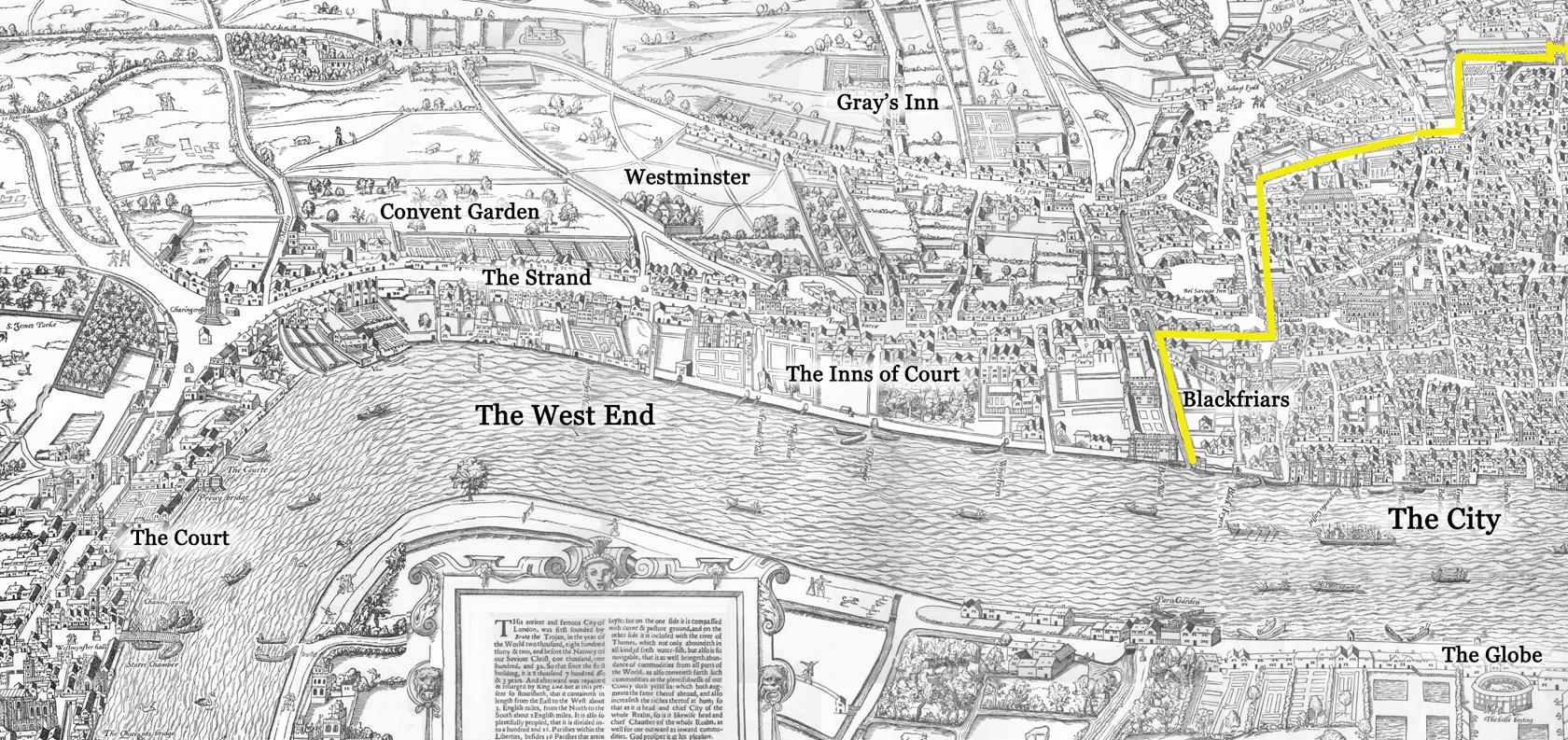
Within days of his return a huge new theater began taking shape in the outskirts of northeast London.  Based on temporary stages he had seen in Siena built by Palladio and on plans for theaters in the ancient Latin tract on architecture he borrowed from his tutor, the innovative yearround theater, the first of its kind in England (and possibly in all of Europe) was built to hold somewhere between two and  three thousand paying customers at a time.  Meanwhile plans were in progress to turn one of the apartments in the Revels section of the Blackfriars compound on the Thames into a school for the Queen’s boy choristers, where the little stage meant for their rehearsals could be used from time to time to entertain the audience that meant the most to Sussex and his vice Chamberlains, the lawyers, scribes, and parliamentarians of Westminster.

The summer of 1576 saw audiences flock to the big round public theater in the East End, where herds of apprentices and tradesmen and their wives and sweethearts were eager to pay their pennies to see plays they were told had been performed for the Queen.  Burbage and his crew grew bold as they collected the money that had always escaped them at the theater inns, where they could only pass the hat at intermission.  That winter those residents of the West End who could afford it were charmed by the boys at the little stage at Blackfriars where they paid a substantial fee to see, by candlelight, richly furnished early versions of A Comedy of Errors, Titus Andronicus, and Timon of Athens.

The residents surrounding the new theaters were not so thrilled by the litter, the noisy crowds and late hours––but with powerful privy councillors like the Earl of Sussex and Lord Hunsdon as patrons (Hunsdon now living next door to the little theater), and the Earl of Rutland, whose City manor stood a few yards from Burbage’s stage on land that until recently had been his family’s heritage, and where he still held rights––there was little the neighbors could do, at least, not right away.

For six years, all went relatively smoothly for the newborn London Stage and its patrons. Then in 1581 Oxford got himself bounced from Court for impregnating a Queen’s Maid of Honor.  Furious at how he was being treated by the Queen and the Court; fearful for his life and the life of his retainers at the hands of his mistress’s angry relatives; bitter at his mistress for what he saw as her willingness to drop him for a better prospect––he refused to continue to write for the Court and began turning out plays filled with personal passion and aimed at the West End audience.  This probably meant using the little theater at the Blackfriars school, probably with adult actors from Burbage’s and Worcester’s Men, and probably fairly late into the night.

These were not the kind of plays that he could have written for the Court.  Angry at Ann Vavasor for what he believed was her perfidy in taking up with another man, he rewrote one he’d written earlier about the Trojan war, lavishing it with irony, and pouring all his pain over his mistress into the plot and characters in Troilus and Cressida.  Furious at his cousins for accusing him publicly of treason, he dramatized the assassination of Julius Caesar, with Brutus in a situation similar to his own, and Cassius, whose “lean and hungry look” identified him as his cousin Henry Howard.  Frightened by the determination of his mistress’s male relatives to kill him, he wrote another in which he portrayed himself as already dead, observing from above as an imaginary father takes bloody revenge on his killers by means of a play within a play (The Spanish Tragedy).  Then, with the discovery that his mistress still loved him, he poured his lonely heart into a blazing new version of Romeo and Juliet.  Finally, as his patron and surrogate father, the Earl of Sussex, sickened and died, he accused the Earl of Leicester of poisoning him by drawing parallels between him and King Claudius and between Elizabeth and Queen Gertrude in a first version of Hamlet.

Since the Blackfriars theater was cheek by jowl with the City manors of Lady Russell, Mildred Burghley’s termigant younger sister, and of Sir William Brooke Ld Cobham, longtime supporter of Ld Burghley and Robert Cecil’s future father-in-law, that it wasn’t long before they became aware of what sort of plays were now taking place next door should go without saying, as should the probable fact that this was the real reason why the Blackfriars landlord, Sir William More, began petitioning the privy council to shut down the school, for Sir William, determined to rise at Court, would never have taken on councillors as powerful as Sussex and Hunsdon had he not had some hefty backing of his own.

The War with Spain and the rise of the Stage

As the threat of attack from Spain took center stage at Whitehall, Secretary of State Francis Walsingham moved quietly ahead of Burghley, Sussex, and Leicester as Privy Councillor with the most important duties.  Then, as Lord Chamberlain Sussex’s health began to fail, Walsingham moved, again quietly, to take his place as major patron of the Court Stage.  Although not in his job description, the Secretary, whose shoulders bore the responsibility of preparing for the inevitable attack from Catholic Spain, had a vision whereby a Crown company made up of the leading actors from Burbage’s and other companies could bring the kind of plays that Oxford was capable of writing to the hinterlands, plays that mixed entertainment with English history and anti-Spanish propaganda.

Himself a student of history, Walsingham understood that nothing binds a people together like a shared past.  What past was being shared then by his largely uneducated countrymen were stories from the middle east, told in the Bible.  Rouse their emotions with English stories, whether proud or bitter, and they’d be British first, Catholics second.  That this was clearly the mandate for the creation of the Queen’s Men can be seen by their travel itineraries for the years 1582 through 1588.  These show that the company spent more road time than anywhere else in towns along the southeastern and western coasts where the Spanish were most likely to attack (McMillin 175-78).

It should be clear that plays like The Famous Victories of Henry V and Edmond Ironside were written for the same reason that, during WWII, when little was being filmed in England due to the stringent economies forced on the British by the war, the government made it possible for Laurence Olivier’s Henry V to be lavishly costumed and filmed in expensive color.  During the war the American military did the same thing, enrolling director Frank Capra and others to produce propaganda films, while giving movie stars like Humphrey Bogart and Paul Heinreid deferments so they could continue to play roles in anti-Nazi films like Casablanca.

As a close friend and colleague of Oxford’s tutor, the former Secretary of State, Sir Thomas Smith, Walsingham understood that Smith’s former student badly needed something useful to do, something to keep him from continuing to cause trouble for the Court.  Writing for the Queen’s Men would keep him busy in a worthy cause.  It also made use of his knowledge of English history, knowledge stored in the papers and manuscripts he inherited from his father, passed down from one earl of Oxford to the next, papers that he kept closely guarded, allowing only those closest to him to know what they were.  No one was in a better position to turn the story of England’s past into exciting drama, an argument that helped him get the majority of the Privy Council behind the Queen’s Men, and finally, to get the Queen to fund Oxford’s crew at Fisher’s Folly, as neither he nor the improvident earl could continue to fund the stage on their own for much longer, now that Sussex and his wealth were gone.

For the adult actors this was a major step forward.  In previous years they had to share the Court stage with the children’s companies.  More recently they suffered from the heavy competition from the other companies that were springing up like mushrooms to meet the public demand for more plays.  So although they couldn’t have been pleased by the prospect of so much travelling, the fact that they were guaranteed first place at Court with fees, props and costumes supplied, was a terrific boost.  Also, when in London, no longer to be confined to the little school stage at Blackfriars, but as the Queen’s own company, to be guaranteed the Belle Sauvage Inn as their primary winter venue meant they were guaranteed London’s best holiday audience, the gentlemen of the Inns of Court.

Since Francis Bacon, too, was without a job, and since he too was a gifted writer who was already successfully entertaining the Court with installments of his Faerie Queene, Walsingham put him to work writing the holiday comedies for the choristers that Oxford no longer cared to bother with.  These had to be written by a courtier steeped in Court gossip, one who knew how to amuse without offending the great ones in the audience, how to tease without wounding their equally great and touchy egos.   It was this last factor that Walsingham failed to consider well enough when he brought young Christopher Marlowe on board as an apprentice to Oxford and Bacon.  Talented he certainly was, and a quick learner, but, to everyone’s grief, including his own, Marlowe turned out to have a very different agenda than what Walsingham and Oxford had in mind for him.

Shortly before the beginning of this turbulent period (December 1580), Richard Farrant, the school master in charge of the children’s school at Blackfriars, died, leaving his wife with the boys to care for, and nowhere near enough money for them or her own family.  As More continued to press for the power to close down the Blackfriars theater through 1581, ’82, and ’83, its lease got passed around, from Farrant’s widow to Henry Evans, assistant master in charge of the boys; then from Evans to Oxford, who by then was back at Court; from Oxford to his secretary, John Lyly; and from Lyly to Lord Hunsdon, who joined with Walsingham to keep the school, or the theater at least, from going under.

Officially the school came to an end in April 1584 when the court decided in favor of the landlord, though proxy data suggests that the little stage may have been allowed to operate as a private theater until Hunsdon’s leases were up in 1590.   It’s hard to believe that this important space, which for most of its existence over the past fifty years had been used to rehearse or store props for Court revels, would have continued to stand silent and empty for the first six of the ten most important years in the birth of the London Stage: from 1584 to 1590, most particularly from November 1584 to March 1585, when the West End was crammed with important men from all over England, gathered for Elizabeth’s fifth Parliament.  Oxford, Hunsdun, Charles Howard, Rutland, Bacon, Beale, and Raleigh, were all present and took part, as is shown by the journals of the houses of Lords and Commons in the records online. (Comes Oxon. Magnus Camererius, means Earl of Oxford, Lord Great Chamberlain.)

Parliament’s holiday break that year lasted from Dec 21 to Feb 4.  This would have been the ideal time for plays aimed at the visiting members to receive their greatest attendance.  The Revels accounts show that the Queen’s Men produced four plays at Court that winter, so we would assume that these were performed later at the Belle Sauvage.  Oxford’s name is unusually prominent in the Revels account for this holiday season,  along with the traditonal “activities” (acrobatics), he’s listed as patron for two plays, one by his “servants,” the other by his “boys,” who produced, on St. John’s Day, December 27th, a play titled The History of Agamemnon and Ulysses, which E.T. Clarke suggests was probably an early version of Troilus and Cressida.

These, or others not appropriate for the Court, would, like the plays performed by the Queen’s men, have been performed somewhere handy to the West End during the same time period.  That “somewhere” would either have been the little stage at Blackfriars, or in a hall in one of the waterfront mansions on the Thames, the most likely being Somerset House.  Then the primary London residence of Lord Hunsdon, it was located directly across the Strand from Cecil House.
“King of Shadows”

Like the anthropologist who spends thousands of hours sifting through tons of rubble beneath a cliff-side, seeking bits of bone no bigger than the end of a thumb that she hopes will fit the skeleton she’s piecing together of a proto-human aboriginal, so we sift through the texts of the period and, at second hand, through modern critical texts, seeking evidence of things that we have no other means of accessing as we strive to piece together the truth about a great artist.  The bits of bone we seek are often no more than a single word, one that bears a particular significance.  In our search for the truth about Shakespeare, one such word is shadow.

The word shadow meant more things in the sixteenth century than it does today.   Besides a term for the patch of darkness created by blocking the sun’s rays, or a slang term for someone who sticks too close to someone else, or a 1930s Hollywood verb for a spy technique, in Shakespeare’s time it was a metaphor for any kind of reflection.  You saw your shadow in a mirror; painters created shadows on canvas: in his 1579 diatribe School of Abuses, Stephen Gosson wrote: “Cooks did never show more craft in their junkets [desserts] to vanquish the taste, nor painters in shadows to allure the eye, than poets in theaters to wound the conscience.”  Some uses may reflect Plato’s vision of human beings as mere shadows on the wall of a cave, reflections of multi-dimensional spiritual realities in a three-dimensional world.

Shakespeare used the word shadow for all of these; the account in Schmidt’s lexicon of the specific uses in his works fills well over a full page in very small type.  He was especially fond of the biblical phrase shadow vs. substance, which for him expressed a world of meaning.  In A Midsummer Night’s Dream he uses shadow several times to refer to plays or actors.  Replying to Hippolyta’s description of Pyramus and Thisbe as “the silliest stuff that ever I heard,” Theseus opines: “The best [plays] are but shadows, and the worst are no worse if imagination amend them.” When Puck bids adieu to the audience after the last act he uses the term to refer to the characters created by the actors: “If we shadows have offended, think but this and all is mended, that you have but slumbered here while these visions did appear. . . .”  Twice Puck calls Oberon, “King of Shadows.”  Years earlier, the True Tragedy of Richard III, the first version of Shakespeare’s play, opens with:

Enter Truth and Poetry. To them appears the ghost of George, Duke of Clarence.
POETRY:    Truth well met.
TRUTH:     Thanks, Poetry; what makes thou upon a stage?
POETRY:    Shadows.
TRUTH:     Then will I add bodies to the shadows.  Therefore depart, ………………and give Truth leave
 to show her pageant.

In his prefatory letter to Thomas Bedingfield’s 1573 translation of Cardanus Comforte, Oxford uses the word to mean the reflection of a patron or friend if mentioned in a work of literature that lives for generations long after the friend himself is departed.

Again we see, if our friends be dead we cannot show or declare our affection more than by erecting them of tombs, whereby when they be dead indeed, yet make we them live as it were again through their monument.  But with me it happenth far better,  for in your lifetime you shall see how noble a shadow of your virtuous life shall hereafter remain when you are dead and gone.

“That shadow of thine”

One of the thousand and one smoking guns provided by authorship forensics is the handwritten note in the Cecil papers from one Thomas Vavasor to the Earl of Oxford, insulting him and taunting him to a duel.  Dated January 19, 1585, it’s the final piece in the record of assaults on Oxford and his men by members of the Howard, Vavasor, and Knyvett circle in retaliation for Oxford having “ruined” their cousin, sister, niece and former Queen’s Maid of Honor, Ann Vavasor, who, in March 1581, gave birth to Oxford’s illegitimate son in one of the royal bedchambers.

Following two months in the Tower and many more under house arrest, Oxford and his retainers were subjected to a year of attacks in the streets of London by Ann’s uncle, Thomas Knyvett, and his men.  There were four of these “frays” that reached the record, the first March 3, 1582, the final February 21, 1583, three months before Oxford’s reinstatement at Court.  Several on both sides were killed, and Oxford himself was seriously wounded in the first.  There may have been other lesser incidents that escaped the record, but once milord was back in the Queen’s favor it’s unlikely the Knyvett faction would have dared to continue their vendetta.

The note, now in the Lansdowne collection in the British Library, was found among Burghley’s papers.  If the date added (in Burghley’s hand), January 1585, is anywhere near the date it was written, this puts it almost two years after the last recorded street fight and Oxford’s reinstatement at Court.  But in fact it could have been written at any point from 1582 on, having come into his possession at any time after that.  Perhaps the answer can be found in the note itself.  Here’s the text (spelling modernized) as reproduced by Alan Nelson in his fact-filled if negative biography:

If thy body had been as deformed as thy mind is dishonorable, my house had been yet unspotted and thyself remained with thy cowardice unknown.  I speak this [because] I fear thou are so much wedded to that shadow of thine that nothing can have force to awake thy base and sleepy spirits.  Is not the revenge already taken of thy vileness sufficient but wilt thou yet use unworthy instruments to provoke my unwitting mind?  Or dost thou fear [for] thyself and therefore hast sent thy forlorn kindred whom as thou hast left nothing to inherit so thou dost thrust them violently into thy shameful quarrels?  If it be so (as I too much [suspect]) then stay at home thyself and send my abusers.  But if there be yet left any spark of honor in thee or jot of regard [for] thy decayed reputation, use not thy birth for an excuse, for I am a gentleman, but meet me thyself alone and thy lackey to hold thy horse.  For the weapons, I leave them to thy choice, [since] I challenge, and the place to be appointed by us both at our meeting, which I think may conveniently at Newington or else where thyself shall send me word by this bearer, by whom I expect an answer. (Nelson’s brackets, 295)

Let’s have a close look at what Vavasor is saying:

If thy body had been as deformed as thy mind is dishonorable, my house had been yet unspotted and thyself remained with thy cowardice unknown.

According to Vavasor, if Oxford’s looks were as bad as his morals, his sister would never have been seduced; one more bit of evidence that he was considered good-looking; also testimony that he was not an instigator of the street brawls.

I speak this [because] I fear thou are so much wedded to that shadow of thine that nothing can have force to awake thy base and sleepy spirits.

In Vavasor’s view, Oxford is “base and sleepy” (cowardly and unresponsive) because he is “wedded” to (totally involved with) something he calls “that shadow of thine” that prevents him from doing his chivalrous duty as a nobleman and answering Vavasor’s challenge.  Nelson states as fact that by “that shadow of thine” this he means “an unnamed male relative of Oxford’s,” as he scrambles among the names mentioned in connection with Oxford for one that might fit.  This is a possibility because the use of shadow then did include such a use.  However, that he was unable to come up with a name suggests there wasn’t any such person in Oxford’s life at that time.  Having just recovered from two years of banishment and so most likely exhibiting extreme caution with regard to unseemly companions, “that shadow of thine” must be something else.

Is not the revenge already taken of thy vileness sufficient but wilt thou yet use unworthy instruments to provoke my unwitting [unknowing] mind?

The “revenge” taken of Oxford’s “vileness” must refer to the wound dealt him by Thomas Knyvett during the first recorded brawl three years earlier.  However unwilling to engage in street fights, Oxford has done something to provoke the “unwitting” Vavasor.  What might he mean by “unworthy instruments”?  Since this sentence follows directly on the reference to “that shadow of thine,” it seems most likely that the shadow and the unworthy instruments are connected.

Or dost thou fear [for] thyself and therefore hast sent thy forlorn kindred whom as thou hast left nothing to inherit so thou dost thrust them violently into thy shameful quarrels?  If it be so (as I too much [suspect]) then stay at home thyself and send my abusers.

This must refer to one of the recorded “frays” in which only Oxford’s retainers were involved, or to some other for which there is no record.  This also shows that his financial straits were already a matter of Court gossip.

But if there be yet left any spark of honor in thee or jot of regard [for] thy decayed reputation, use not thy birth for an excuse, for I am a gentleman, but meet me thyself alone and thy lackey to hold thy horse.  For the weapons, I leave them to thy choice, [since] I challenge, and the place to be appointed by us both at our meeting, which I think may conveniently at Newington or else where thyself shall send me word by this bearer, by whom I expect an answer.

It’s unlikely there ever was an answer.  Either Oxford handed over the threat to Burghley, as Nelson suggests, or more likely, whoever was supposed to deliver it thought better of it, and gave it directly to Burghley, either immediately or after holding on to it for some time.

What “unworthy instruments”?

If, as we believe, based on a great deal of evidence provided here and in other locations, that during the mid-1580s, Oxford was not only the playwright who in later life would publish under the name William Shakespeare, he was the primary creator of the London Stage, the author of most of the plays then being performed by the Queen’s Men, as well as the comedies performed by Paul’s Boys at Court in the 1570s, then what Vavasor meant by “that shadow of thine” must be the stage, which was certainly considered an “unworthy instrument” by many of their contemporaries, particularly by those who’d been publicly skewered by one of milord’s satires.

As for the more recent provocation mentioned by Vavasor, I believe this was the original production of Romeo and Juliet.  Written (I believe) during a rush of feeling following the realization that the silence and lack of response from his lover following her release from the Tower was not due to the perfidious change of heart he so angrily depicts in Troilus and Cressida, the first version of which (I believe) he wrote during the early days of his house arrest, as soon as he was back at Fisher’s Folly with his staff, musicians, and actors.

Most likely the play was ready for production by late 1584 for the audience then gathering in Westminster for the Parliament that would run until the following March.  With the 18-year-old Edward Alleyn as Romeo and the 16-year-old Richard Burbage as Juliet, the play would have been performed at the original Blackfriars Theater, located just above the fencing academy where Oxford and his friends were given to practising the routines demonstrated in the play (Richard Tarleton was reputed to be a genuine fencing master).  Impelled by the added passion of relief and a deep desire to make amends to Ann for having portraying her as Cressida, Romeo and Juliet expresses the love that got them both into so much  trouble, not so fatal as what doomed the Veronese lovers, but trouble nonetheless.  Such were the emotions contributing their force to what has been described as the “lyric rapture and youthful ecstasy” of one of the most loved plays in all the literature of drama.

Hardly anyone who writes about the close connections between Oxford’s biography and the plots of Shakespeare’s plays fails to connect the street brawls between the Oxford and Knyvett/Vavasor crews and that between the Montagues and the Capulets, or Oxford’s wound with Mecutio’s death.  The strong resemblance between Friar Lawrence and Oxford’s tutor, Sir Thomas Smith, is another important link.  Less strong but still relevant are others such as the fact that Arthur Brooke, author of the narrative poem that served as a basis for Shakespeare’s play,was a nephew of George Brooke, Lord Cobham, Burghley’s close friend and his neighbor during Oxford’s years at Cecil House in the 1560s.  Unlike Romeo and Juliet, neither Edward nor Ann died, they were not married, and Ann was pregnant as Juliet was not (or she died too soon to know), in any case, these unromantic differences aside, there’s too much that’s similar between the play and the events of 1581-’85 to brush off the similiarities as mere coincidence.

As for Ann, exactly where she was at this time we don’t know, but following her release from the Tower, the most likely place, based on what usually happened in such cases, would have been to stay with an older, dependable relative, closely connected to the Court, where she would be under surveillance (as her poem reports) until the Queen could decide what should be done with her.   At some point she ended up with Sir Henry Lee, the Queen’s champion, perhaps as a sort of prize for his years of service.

For Ann’s view of the situation, we have her poem, written to explain why she was behaving as she was.  Other interpretations and attributions have been placed on this poem, but why not follow the most natural?  Poetry is always the quickest path to the heart of a poet, and in those days, it was the path most often taken in matters of the heart, even by those who would have done better to stick to prose.  Oxford’s later attachment to another female poet, Emilia Bassano, the Dark Lady of the Sonnets, plus the witty female characters he created as Shakespeare, suggests that a clever tongue in a woman had a great attraction for him.

That the play was written for some other audience than the Court should be obvious, for there were lines in it that would have infuriated the Queen, had she heard them.  Or, if it was at some point produced for the Court, lines that remained in the First Folio, such as Juliet’s in Act II Scene 1, “O swear not by the moon, the inconstant moon,” or Romeo’s a little later:

But, soft! what light through yonder window breaks?
It is the east, and Juliet is the sun.
Arise, fair sun, and kill the envious moon,
Who is already sick and pale with grief,
That thou her maid art far more fair than she:
Be not her maid, since she is envious;
Her vestal livery is but sick and green
And none but fools do wear it; cast it off.

Elizabeth’s colors, as everyone knew, were green and white.  Words like these would have been cut for a Court performance.  Oxford was reckless at times, but he was not insane.

Oxford’s three audiences

Modern readers of Shakespeare come to the plays through the First Folio, the versions of the 36 plays published in 1623 by the patrons of his company, known by then as the King’s Men.  Publication then, and ever since, has performed a cleansing process on the plays, providing texts without any of the baggage, attitudes or complications that history attaches to important works of the past.

In Shakespeare’s case, partly because they were written so long ago (though, as it turns out, not entirely) it’s been next to impossible to place the plays in history in any meaningful way.  Roughly half had previous publication in quarto format, the other half were never published until the First Folio.  Some were registered with the stationers, others not.  Some were mentioned in letters or publications by contemporaries, most were not.

Although we have a few holographs (handwritten versions) of other plays from around that time, none are by Shakespeare.  Unlike their sister company, the Lord Admiral’s Men (later Prince Henry’s Men) documented by the diary of theater owner Philip Henslowe and other papers retained at Dulwich College by his stage manager Edward Alleyn, if anyone in Shakespeare’s company ever kept any records, they didn’t survive.  The only records to survive are mid-17th century court cases over ownership of the by then lucrative company shares.  Whoever or whatever we mean by Shakespeare, he or it created one of the most successful businesses of the period, at least for those who ran it in London.

One result of this has been that even those who should know better tend to approach the plays as though they were more or less all written under the same impulse, to make money for both the writer and his actors, and for the same public audience––the only issue being when.  Because the Stratford biography forces them all into a decades late 15-year time-frame, efforts to see genuine connections to current issues and events have failed, creating a Shakespeare who plucked his subjects more or less out of thin air, and all for the same audience, an amazingly well-read  public, with the Court little more than an adjunct, as it is today.

With Oxford as author, all of this changes; the process becomes at once much more complicated and also much more interesting.  The unspoken assumption that everything that Shakespeare wrote could have been seen by anyone in his time who came to London or who had a penny to spare falls by the wayside.  The fact is that different audiences saw very different kinds of plays, even in some cases, different versions of the same play.  The illusion given by the First Folio, that all the plays share a sort of equality of presence, fails as well.  As with the works of every other great artist, each play has a history of its own, and all are closely connected to events in the life of the author and of the communities, the nation, and the world in which he lived alongside his fellows.

With a solid historical framework in place, it shouldn’t be nearly so difficult to place each play within a relatively narrow and realistic time-frame, even in some cases down almost to the very day.  In attempting to set dates for a particular play, it helps to determine for which of his three audiences did he write it originally:  the Court, the Inns of Court, or the public?  Eventually all of his plays ended up as public entertainment, but few (if any) were written originally with only the public in mind.

His Court audience

As a member of the Court from probably around age 17 until he was banished at 31, Oxford’s energies were chiefly directed towards entertaining his own community.  He was not unique in this, or rather, he was unique only in the quality of his work, for all of the upwards of 40 or 50 individuals who formed the core of the permanent Court community, those who had suites of rooms at Court where they lived yearround, were expected to contribute their particular skills for the support and/or pleasure of the group.  As the crème de la crème of English society, they were expected to sight read music notation, to sing complicated vocal arrangements, play the lute or the virginals, and perform the latest dances.

Oxford’s dancing was obviously admired by the Queen; of the handful of his poems that come down to us, many, perhaps most, are song lyrics (madrigal lyrics often sound like complicated poems), while in later years he was praised by a fellow composer as being as accomplished musically as any professional.  So we can assume, based on what evidence remains, that he quickly rose in the Court’s estimation for his contributions to musical and dramatic events.

His writing for the Court may have begun with interludes, witty dialogues exchanged by two or three of the boy choristers, interspersed with musical offerings by the boys, the Court’s permanent staff of musicians, or courtiers with pretentions to expertise.  These interludes soon expanded into full length plays like Love’s Labor’s Lost, that were made up of a series of comic or romantic interludes interspersed with songs and sometimes dances, even, as in The Tempest, with the company taking time in the middle of the show for a feast served by the cast.  E.T. Clark has identified several of these from their early listings in the Revels records.

Most of the plays termed comedies in the First Folio began as entertainments for the Court community.  Over time, some of these became standard entertainments, revised every few years by adding new topical material and characters, or revising old material to fit new situations.  In this way a character like Armado in Love’s Labours Lost represented a different Court figure when the play was first written than he does in the 1623 version, in which he represents Antonio Perez, whose presence at Court can be easily assigned to a few years in the mid-90s.  This has confused scholars who would otherwise place the play as early as the late 1570s when Elizabeth was contemplating marriage to the duc d’Alençon.   It may be that the play was originally very early, but once it became a favorite at Court, he would update it every few years for the winter holidays.  How many versions survived, and what dicing and splicing the First Folio editors may have done with them we can only guess.

When writing for the Court Oxford was of course always aware that the core of his audience were the Queen and her entourage of ladies, the wives and daughters of leading Court officials.  In writing to please them he learned early that what entertains men is not always appreciated by women, particularly the sort of well-bred, educated women who were welcomed by Elizabeth into her private circle.  That this was Oxford’s primary Court audience can be seen from his early published works (attributed to Petti, Lyly or Greene) that were specifically targeted toward female readers.

Although there’s much to suggest that Oxford preferred to write for the West End, he never ceased to entertain his home community, providing plays for Court weddings until his final days.  Among his final revisions were those produced for the 1604 wedding of his youngest daughter, Susan Vere, to the Earl of Montgomery.  The Folio version of The Tempest comes largely from the 1595 version he wrote for the marriage of his oldest daughter, Elizabeth, to the Earl of Derby, which he further revised as The Spanish Maze for Susan’s wedding.  The Folio version of A Midsummer Night’s Dream was written for the wedding of his old flame, Mary Browne, Countess of Southampton, to Sir Thomas Heneage in 1594.  Taming of the Shrew was written originally as a wedding roast for the 1579 marriage of Lord Strange to Alice Spencer.

His West End audience

Outraged at his banishment from Court and by the way he and his men were being threatened by his lover’s relatives as Elizabeth sat by and did nothing, Oxford wrote nothing for the Court for the two years that he was ostracized (1581-’83), turning instead to his favorite audience, the “gentlemen of the Inns of Court.”  For them he could unfurl the full power of his rhetoric on the kind of issues that would never have passed the Court censors.  The West End (more accurately the city of Westminster) was where the legal colleges, the Inns of Court, were located.  Further west, between the Strand and the Thames, stood the great City mansions where the most prestigious courtiers and government officials lived.

For Oxford and his patrons, this was the most important audience in London, particularly during the relatively infrequent moments when Parliament gathered to vote on a subsidy for the Queen.  Once we can begin to focus on details, it will be helpful to use these times as moments when he was most intent on reaching this audience with plays relevant to current issues, for it was then that the most influential men in England gathered together at one time and in one place.  Plays that deal with national issues, like treason (Julius Caesar), colonization (The Tempest), or the Law (Merchant of Venice) are most likely to have been first written for this audience, and the only possible stage where they would have produced these plays was at the little stage in the chorister’s school at Blackfriars.   The big public theaters were located in suburbs far from Westminster, while the Blackfriars stage was a mere hop and a skip to the west along Fleet Street, or, if coming by water from one of the mansions on the Strand, just footsteps from the elegant old Blackfriars watergate.

Happy finally to be writing for adult actors (no more little eyeases!) I believe that it was for this audience that he produced the first version of  Timon of Athens, the first version of Troilus and Cressida (written before he discovered that Ann Vavasor was not the Cressida he had so unkindly assumed), of Romeo and Juliet (after discovering that she still loved him), of Julius Caesar and Coriolanus (written to explain his urge to desert England and fight for Spain), and of The Spanish Tragedy and Hamlet (written out of anguish at the death of his patron, the Earl of Sussex, and suspicion that he’d been poisoned by his enemy, the Earl of Leicester).  The only one of these that we have today in anywhere near the original version is The Spanish Tragedy (attributed to Thomas Kyd); all the others were rewritten for the Lord Chamberlain’s/King’s Men during Oxford’s final Shakespeare period (1593-1608).

The public plays

Last, and in many ways least, at least so far as his personal interest was concerned, there was the public audience that, through their far greater numbers would make his works “popular” as neither the Court nor the Inns of Court ever could, something that gave a great deal of power to the company that produced them.  When Oxford first began producing plays at Court in the late 1560s and early ’70s, the various children’s companies that performed them were allowed to supplement their sparce Court stipends by performing the plays they’d rehearsed for the Court a few times at the little theater at Paul’s Cathedral school for choristers.  These early comedies migrated rapidly to both the public and private theaters.  Because their subjects were popular and easily understood and no deep knowledge of history or philosophy was required to enjoy them, they pleased the public, and because any satires of known Court personalities would be lost on a public audience, there was no reason for the Privy Council to get in the way.

By 1583, with the creation of the Crown company known as the Queen’s Men, Oxford found himself writing for the provincial audiences that, as McMillin and Maclean show, were the new company’s primary focus.  It’s possible to see in these early plays, most of them termed as “apocryphal,” his attempts to deal with local or at least popular issues as in Arden of Faversham, Friar Bacon and Friar Bungay, The Birth of Merlin, James IV and Edmond Ironside.  Responding to Walsingham’s desire to teach the provincials something about their history, he also wrote the early versions of what, as Shakespeare, he would turn into the great history plays: The Famous Victiories turning into Henry V, the Contention between York and Lancaster into the Henry VI series, and so forth.

Early in James’s reign, towards the end of the Shakespeare period, perhaps in exchange for stewardship of the Forest of Waltham, Oxford consented as his share of the bargain to provide updated versions of what early Court plays remained for the now royally established King’s Men, versions that would make them one of the most successful commercial enterprises of the Stuart period.  It seems he was embarrassed about this.  Feeling called upon to explain to his community why he was turning plays that they regarded as theirs into public works,  he produced at a great welcoming get-together for King James at Wilton or Salisbury the summer of  1603 a new version of As You Like It in which, as Touchstone, he explains his need to marry the provincial and unpoetic public audience he personalizes as Audrey (audire, Latin for to listen).  A man must marry and a playwright must have an audience.

Of course many plays migrated across these boundaries and although not everyone could see a play at Court nor could a poor apprentice afford one of the expensive indoor private theaters, members of the first two audiences could always see a play at one of the public theaters should they wish, and probably did quite often––all but the Queen, that is. It’s so unlikely as to be impossible that she ever ventured outside her Court confines for any purpose; every venture from one arena to another was in the nature of a state occasion.  Her dignity could not be impeached by being seen in anything less, and her person had to be protected from the lunatics and drunks that were constantly threatening to do her in.  In Tudor and Stuart times, the theater came to the monarch, not the monarch to the theater.

This of course was a boon for Oxford and his patrons, for they could trust that some of the material would never reach her ears.  We know what happened a few times when that occurred.  She would never come to them, and no one in his or her right mind would tell her things that might stir her anger enough to allow the theater’s many and determined enemies to “pluck it down.”  It also made it easy for him to hide from her how much of what came from his literary circle came directly from him.  Those darn secretaries, always publishing things behind his back!

Who’s afraid of the Big Bad Boar?

One of the major problems in getting the world to take Oxford seriously as Shakespeare is his bad reputation with historians.  Sure it came from his enemies, Henry Howard and Robert Cecil, who, no matter how notorious they were themselves, managed to make their character assassination stick, largely because, apart from their dirty deeds, their public roles haved tended to supercede the crimes they commited, while Oxford’s public role has remained hidden.  All his money, his imagination and his energy went into creating the London stage and the London periodical press, something he could not take the credit for at the time, something for which his worst enemy, Robert Cecil, made certain that he would never, ever, get the credit.  Even today, the academics who have (ironically) inherited his story, seem determined to hand his accomplishments over to his actors, co-authors, publishers and editors.

So were they wrong about Oxford?  Was he the ungrateful bastard that Alan Nelson loves to flog, or the saint that some would have Shakespeare, gentle, kind and good?  Have they never read the biographies of geniuses of the stage and press?  What about Diagliev or Balanchine, the manipulative obsessives who created the world’s greatest ballet companies, or the world’s greatest dancers, Nijinsky and Michael Jackson?  What about those brilliant bisexuals, Leonard Bernstein and Lord Byron, neither of whom made any effort to hide their sexual relationships with their sisters?  And how about the genius whose level of influence over the world we live in is the only one of any of these that reaches to the level of the man we call Shakespeare––what about Steve Jobs?

Here’s what Malcolm Gladwell says in his recent review in The New Yorker of the book Steve Jobs by Walter Isaacson, who interviewed his friends and associates at length:

“Jobs, we learn, was a bully. ‘He had the uncanny capacity to know exactly what your weak point is, know what will make you feel small, to make you cringe,’ a friend of his tells Isaacson. Jobs gets his girlfriend pregnant, and then denies that the child is his.  He parks in handicapped spaces. He screams at subordinates.  He cries like a small child when he does not get his way.  He gets stopped for driving a hundred miles an hour, honks angrily at the officer for taking too long to write up the ticket, and then resumes his journey at a hundred miles an hour.  He sits in a restaurant and sends his food back three times.  He arrives at his hotel suite in New York for press interviews and decides, at 10 P.M., that the piano needs to be repositioned, the strawberries are inadequate, and the flowers are all wrong: he wanted calla lilies. (When his public-relations assistant returns, at midnight, with the right flowers, he tells her that her suit is “disgusting.”)

“‘Machines and robots were painted and repainted as he compulsively revised his color scheme,’ Isaacson writes, of the factory Jobs built, after founding NeXT, in the late nineteen-eighties. ‘The walls were museum white, as they had been at the Macintosh factory, and there were $20,000 black leather chairs and a custom-made staircase. . . . He insisted that the machinery on the 165-foot assembly line be configured to move the circuit boards from right to left as they got built, so that the process would look better to visitors who watched from the viewing gallery.’

“Isaacson begins with Jobs’s humble origins in Silicon Valley, the early triumph at Apple, and the humiliating ouster from the firm he created.  He then charts the even greater triumphs at Pixar and at a resurgent Apple, when Jobs returns, in the late nineteen-nineties, and our natural expectation is that Jobs will emerge wiser and gentler from his tumultuous journey.  He never does.  In the hospital at the end of his life, he runs through sixty-seven nurses before he finds three he likes.  ‘At one point, the pulmonologist tried to put a mask over his face when he was deeply sedated,’ Isaacson writes: ‘Jobs ripped it off and mumbled that he hated the design and refused to wear it.  Though barely able to speak, he ordered them to bring five different options for the mask and he would pick a design he liked. . . .  He also hated the oxygen monitor they put on his finger. He told them it was ugly and too complex.’”

Now there’s the real McCoy, not the Santa Claus of childish dreams.  And who doesn’t love him?  As a Mac user since 1995 who used his technology to create The Oxfordian and who uses it every day to run this blog, I did, and do, and always will.  And my kids and grandchildren who are addicted to their ipods and iphones do too.  Just as you and I love Shakespeare.

No, Edward de Vere was not a saint.  He used people.  He complained (see his letters).  He was cruel to his wife and to Gabriel Harvey.  He wasted his patrimony on profitless theatrical projects (profitless to himself and his family, though immensely profitable to the Kings Men).  He ratted on his cousin and friends, sending them into confinement.  He created deathless stage portraits of his family members and associates as fools and villains.  That historians have followed his enemies in accusing him of pederasty, plotting to murder his Court rivals, and most foul, ingratitude to his in-laws, well, perhaps it’s no more than such a wretch deserved.

But it’s more than we deserve!  As humans we deserve to know the truth about ourselves.  Surely the geniuses who have given us our greatest art, our greatest advances in science, medicine, and technology, are just as important as all the other things we study.  “Know thyself,” said Socrates.  To know the truth about the great English humanist who, according to one of the academics who knows and loves him most, invented us, is to know ourselves.

Let’s get all this nonsense about other candidates and sick relationships with the Queen and others out of the way and find out all we can about the real human being who created the language we speak.  Surely it’s time.

The real authorship conspiracy

Yes, there was a conspiracy connected with the authorship of the Shakespeare canon, but its major impetus came from a very different source than the author himself or his patrons.

As I keep repeating, one of the important factors to consider while attempting to recreate the missing portions of the history of this period is the very small size of the community we study.  Accustomed as we are today to vast numbers of writers, actors, theater companies, publishers, agents, and so forth, we find it hard to see clearly the truth about a time when the commercial stage consisted of a single public theater, then two, then three; of a single indoor private theater, then two, then none, even, at the very beginning, a single playwright and a mere handful of actors anywhere close to what we mean today by “professional.”

This blindness of historians to the implications of the small size of the theater community and of the “authorities” who fought its inception and growth contributes to the way they miss what may have been the most basic reason for this long struggle for control, which was not merely the fear of sin or epidemics or riots, but the power of the stage to communicate a message to thousands at one sitting, a power the authorities did not want in the hands of unreliable poets and actors.  How new was this power, how astonishing to both those who wielded it and those who feared it, can be seen from the preface to the posthumous pamphlet published under the intitials “B.R.”:

I am the spirit of Robert Greene, not unknown to thee (I am sure) by my name, when my writings, lately privileged on every post, hath given notice of my name unto infinite numbers of people that never knew me by the view of my person.

The printing press was becoming a powerful tool in the hands of those who knew how to use it.  Not only did it give access to “infinite numbers of people,” but by rendering text in an anonymous type, it could obliterate the trail that led to the hand of the author, or his secretary.  At the same time, from a public stage that reached thousands at a sitting, too many for anyone to locate individual listeners, a message could be broadcast with a speed and a volume never known before, and none but a handful of worried officials would have cared who wrote it.

We’ve described how the London Stage came to fill the empty place left by the Reformation’s destruction of the Church calendar, causing the holiday entertainments created for the Court to migrate to the new commercial theaters and acting companies.  We’ve examined the reasons why this was seen as a threat by both the City fathers and the Church authorities, why they tried so hard to stop it from the start, and why they kept trying long after it was obvious that the theaters were there to stay.  But we haven’t seen much to show why and how, in the face of so much opposition, the stage managed to survive.

There were four faces to the English establishment in London: the Crown, the City, the Church, and the People.  The Crown and Privy Council held sway in the then separate community of Westminster; the City fathers ruled within the old walls that defined Central London; and the Church, that is the bishops, chief among them the Archbishop of Canterbury and the Bishop of London, had a voice in both arenas.  As for the people, however disorganized and without representation, they made their needs felt through the threat of riots at the ancient turning points of the year, the traditional moments for feasts, toasts, plays, music, dancing and physical competitions, that is, for the kind of merry-making that led to satires, pranks and, in times of duress, riots.  Since the Reformation had terminated this form of social release, the stage became the focal point for popular discontent.  Any move to close it for anything but the plague was sure to meet with trouble.

From the first appearance of the London commercial stage in 1576, while the Church and the City fathers were against it, the balance remained (precariously) with the actors and the people.  This was due to the influence of certain patrons on the Privy Council whose mandate it was to provide entertainment for the Queen, and who saw the power that the stage was gaining with their suburban constituencies.  (Howard was Lord Lieutenant of Surrey, where the Bankside theaters––the Rose, the Swan, and the Globe––were located.)  During the 1580s, under the patronage of Privy Councillors Secretary of State Walsingham, Lord Chamberlain Henry Hunsdon and Lord Admiral Charles Howard, the commercial press was born while the commercial stage continued to expand by leaps and bounds.  Towards the end of the decade, both stage and press shot beyond what the conservatives on the Privy Council considered safe.  The alarming excitement aroused first by the anti-establishment play Tamburlaine, then by the anti-clerical Mar-prelate pamphlets, threatened their heretofore close to total control of what London, and the nation, saw and read.

Once past the crisis of the confrontation with the Spanish enemy in 1588, the attention of the “authorities” turned to the enemies within, the Catholics, the Protestant dissidents, and the pesky actors and pamphleteers.  With the death of Walsingham in 1590, the aquisition of his agencies by Lord Burghley and his son Robert Cecil put the Cecils in a position to to eliminate these through a series of strikes, that, due to their almost complete control over the record, they were able to portray as unconnected to themselves or to their agenda.  This campaign to eliminate the connection between cause and effect has left the close relationship between the newborn media, the stage and press, and the politics and issues of the day so blurred that historians ever since have failed to see them.

Orthodox historians are fond of mocking our efforts to clear up the history of this period, deriding the questioning of the authorship of the Shakespeare canon as a “conspiracy.”  Yes, there was a conspiracy, but it wasn’t the hiding of the author, it was this campaign by the Cecils, working underground and sometimes “at a distance” via agents, to destroy the genius of Oxford and his actors.  That was the real conspiracy.  Had they left the record intact, the native curiosity of historians would have put together the true scenario long since.

Blogging or slogging?

If I’ve been slow with blogging lately, it’s because I’ve been slowly slogging through the histories of the period seeking patterns in events and dates to complete the puzzle of when and why the authorship question first arose.  Now that I have it, I have to find a way to present it as a narrative, which is a thing that takes time and a lot of thought.  Rather than hold off any longer, I’ve decided to post as pages what I’ve come up with so far.  This means I will risk contradicting or repeating myself, but if I don’t, life being what it is, I may never get around to it at all.

There’s no hard evidence for the story I’m at pains to tell, but then there wouldn’t be.  First, they didn’t keep evidence of this sort of thing back then; no one who was close enough to the action to know the truth would have mentioned it openly either in a letter or a published work.  Second, this was the very thing that, once he had control of the national archives, was erased from the record by the man who made the coverup necessary.  Obsessed with making it go away, he made it appear that the English Literary Renaissance had never happened.  If it weren’t for the hundreds of published works that were beyond recalling or burning, he would have gotten away with it.  He did get away with erasing all evidence of how it came to be.

Literary historians like E.A.J. Honigman, Andrew Gurr and Scott McMillin have seen the truth.  McMillin and Mary Beth Maclean, for instance, see the truth about Walsingham, unlike their mainstream  colleagues who still see the great Secretary as little more than the Queen’s spymaster.  But without the chief protagonists it’s all just a collection of shadows on a wall.  Without the authorship question and the answers it provides about the principals, there’s no dynamic, no thrust; it’s Yalta without Churchill or Stalin.

For years I’ve felt that it was impossible that no one seriously questioned Shakespeare’s identity until the mid-19th century.  If there was a problem with revealing it, and if William of Stratford was hired to stand in for the real playwright to resolve this problem, then it must be because at some point the question of who was writing the plays demanded an immediate response.

A man who created something so popular as the plays that made the Lord Chamberlain-King’s Men the most successful acting company of its day and perhaps of all time, would not have gone unnoticed, unrecorded, without commentary, in London or in his own home town as Ramon Jiménez has so clearly and succinctly shown was in fact the case.  That there is so little, really next to nothing, in the record about the author as a person, not just a name, cries out for an explanation and this cry would not have waited until the late 19th century.  It would have been immediate.

In fact, it was immediate, as Andrew Gurr shows in his studies of the creation of the Lord Chamberlain’s Men, though he can’t get to the heart of it without knowing the principals and the stakes involved.   No doubt questions were asked throughout the 1580s, but the author wasn’t quite Shakespeare yet.  Not until the 1590s, with his quantum leap in style from “Robert Greene” to “Shakespeare,” would theater buffs begin asking with increasing emphasis: “Who is writing this stuff?”  (Of course there were theater buffs then as there are now and always have been, particularly when the commercial Stage was so new. )

Although they didn’t use the name Shakespeare right away, the company must have purchased it from William at some point in 1594-95.  The first (and only) appearance of the name William Shakespeare on a Court warrant as payee for the Lord Chamberlain’s Men is dated March 1595, so the deal must have been done by then.  Why then was the name not used on any of the 15 Shakespeare plays published between 1594 and some point in 1598?  It would seem that not everyone in a position to make policy was enthusiastic about using a standin, or at least, not William.  Were they waiting for a better solution?  And what was it that caused them to begin using it in 1598?

As we might have suspected, as in Hamlet, “the play was the thing” that caused the question of the author’s identity to rise to such a pitch that a response had to be forthcoming and as soon as possible.

That play was Richard III.

Stay tuned.

Oxford and Marlowe

Was Marlowe Shakespeare?

Despite the problem of Marlowe’s well-documented assassination by government agents in 1593, Marlovians cling to this idea largely because of crossovers (direct quotes and similar phrasing) between his works and those of Shakespeare.  It’s easier for them to imagine their hero as escaping the scoundrels who were out to kill him, stowing away on a ship to the Continent, returning shortly after under cover, and somehow managing to continue to write for the Stage under the name Shakespeare without any further cost in blood, freedom or publicity, than it is to face the reality in the facts as they’ve come down to us.

First, Marlowe was a commoner.  This doesn’t mean he couldn’t have been a brilliant writer, for possibly, had he lived and had time to mature, he might well have achieved a level equal to that of the author of the Shakespeare canon.  His brilliance is evident in the works that made him famous in his own right while still in his twenties.  The question raised by his social status should be, how someone from a working class community far from London was able to write late 1590s plays shown to a public audience that, however subtly, point the finger at the most powerful individuals in the nation as wicked murderers, works like Hamlet and Richard III, and continue to do this over a period of time without any apparent repercussions?

So far I see nothing from the Marlovians that deals with this most obvious of questions.  Who protected him?  Who could have protected him from, first Leicester, then Burghley, then Robert Cecil?  The high level lords who we know were his patrons both suffered, most obviously Ferdinando Lord Strange who was poisoned to death a year after Marlowe’s assassination, while Henry Percy Earl of Northumberland, who Marlowe also claimed as his patron (following his arrest in Flushing in 1591 on charges of coining) was imprisoned in the Tower for years on weak charges during Robert Cecil’s years of power.  How then could the commoner who actually wrote the damning works manage to escape when even his patrons could not?

Second, none of the Shakespeare plays reflect anything we can assign to Marlowe’s biography.   While we can easily point to the important incidents and events in the life of the Earl of Oxford as reflected in all but a few of Shakespeare’s plays, there’s nothing in any of them that fits with what we know of Marlowe’s life.  Of those works we can be certain were his, Tamburlaine, Jew of Malta, Faust and The Guise, all are based on history or on recent events known to everyone in his time.

There’s an odd prejudice at work in authorship studies that seeks to attribute everything of value to a single writer.  While literary history should send researchers looking to identify the creators of works of dubious authorship as members of a coterie, all too often they will fasten on one individual and attribute everything to him or her.  In their search for similarities, they fail to examine the sometimes obvious differences.  Yet, if Marlowe wasn’t Shakespeare, what’s the explanation for the many crossovers?

Marlowe as Shakespeare’s predecessor

Stratfordians deal with this by claiming that Shakespeare began his career by imitating Marlowe.  Since Marlowe’s name was the first to be publicized (as the author of Tamburlaine c.1587) while the name Shakespeare wouldn’t appear until 1593 (on Venus and Adonis), ergo to wit: Shakespeare must be the imitator.  Thus Shakespeare, certainly the most influential writer in all of English literature and also one of the most ideosyncratic––outpeculiarizing his most adroit imitators––is forced by the Stratford bio into the role of plagiarist of such minor writers as Anthony Munday and George Chapman.  Have they no sense of the absurd?  Most absurd is the idea that Marlowe invented blank verse, when in fact blank verse was in use by a number of writers, including the Poet Earl of Surrey, long before Marlowe.  Don’t these chaps ever read any further than their primary subject?

In the current issue of Shakespeare Matters, Richard Waugaman’s article on Marlowe offers a good example of the confusion that our lack of understanding of the period can bring even the best of scholars.  Striving to see Marlowe as the Rival Poet of the Sonnets, he interprets the crossovers between Shakespeare’s Sonnet 80 and Marlowe’s Hero and Leander as Shakespeare, i.e. Oxford, imitating Marlowe, his rival for Southampton.

This is an example of the kind of confusion that comes from examining the works of this period as though Shakespeare was the only false name ever to be used on a title page.  In fact, his are only a few of the many works of the period that need a close look with regard to their authorship.  As I’ve shown, though obviously not to everyone’s satisfaction, there were a number of works published during that period under the names of persons who could not possibly have written them, shadowy figures like Robert Greene, Thomas Nashe, and so forth who have weak or nonexistent bios.  Long ago I called for an examination of all the works of the imagination published during that period, not such a rigorous request when we consider how few these actually were in the 1580s and ’90s.  When we begin looking at the works themselves and considering who was the most likely author of a particular work based on the time it was published, its style, and its content, the pieces will begin falling into place.

The Rival Poet

First, Marlowe cannot possibly be the Rival Poet.  Peter Moore has put all other rivals to flight with his cogent, fact-based 1996 essay on the subject.  If Shakespeare is Oxford, and the Fair Youth is Southampton, then the only possible Rival Poet is the man who squelched Oxford’s hopes of becoming Southampton’s father-in-law by stealing the Fair Youth’s heart, namely the Earl of Essex, who certainly considered himself a poet, and was, of course, so considered by his friends and supporters, one of whom was clearly the Earl of Southampton.  It should be obvious that while the naval metaphors in Sonnet 80 are meaningless in reference to Marlowe, they can easily be seen as referring to Essex’s maritime exploits in 1589 and ’91.  This is history.  We ignore it at our peril.

To see Marlowe as the Rival Poet is also to fall into the same error as those who propose George Chapman.  These intimate poems were products of a Court coterie.  They were written, not for publication but to communicate with other members of the inner circle of a high level Court coterie in a tradition passed down from the Courtly Love tradition of the early Middle Ages, and long before it in the educated coteries of ancient Greece and Rome.  In the following generation both Donne and Harington, born into Court society, were members of such a coterie while writers like Chapman, Breton and Florio, mere tutors, were limited to writing eulogies and elegies for their aristocratic masters.  A writer like Marlowe would never be admitted to such an intimate circle, no matter how good his writing or how close he might become with patrons like Lord Strange or Thomas Walsingham.

What Waugaman has actually done with his impressive and important list of comparisons of the language of Sonnet 80 with that of Hero and Leander is to offer substantial evidence that the same individual wrote both poems, and that he wrote them within a fairly short period of time while rereading, and probably translating, Ovid.  Surely that individual was Oxford and that time was the late 1580s and early ’90s, a window of time before the marriages of Oxford to Elizabeth Trentham in 1592 and his daughter to the Earl of Derby in 1595 should by all rules of common sense establish an end point to most if not all the sonnets to the Fair Youth.

Who wrote Hero and Leander?

While we can be fairly certain that Marlowe wrote the versions of the four plays that form the core of his canon, we have no such assurance about the poems that were published over his name after his death.  Hero and Leander was published in 1598 at the same time that Oxford’s plays began to be published as by William Shakespeare.  However exciting and beautiful a poem, Hero and Leander was too tainted with homosexual nuance to publish as by Shakespeare, a name that by then stood for the Privy Council approved company that performed his works.

If we take the four core works as most representative of Marlowe’s writing, we find a number of things about Hero and Leander that simply don’t fit.  While Shakespeare was obsessed with women, sex and passion, mostly male/female with some male/male, Marlowe’s core canon shows very little of either, and what he did write about, and for, his female characters (out of sheer necessity because the story required it) was pretty lame.  Hero and Leander fits quite well with Shakespeare’s other long narrative poems, Venus and Adonis and The Rape of Lucrece; in each the theme of passionate love or lust is given a different scenario, and all three fit neatly into his style of the early 1590s.  We know he knew the story well as he refers to it in a number of his plays.  Nothing else attributed to Marlowe comes close.

In the press to get Oxford published in the late 1590s, if they couldn’t use Shakespeare’s name for Hero and Leander, why not use Marlowe’s, long since tainted by the accusations of homosexual passion and atheism that were published to distract from any concerns over the means by which he was eliminated from any further contact with the public.  With no one to defend him (as Mary Sidney defended her brother when an unauthorized version of his sonnets was published in 1591), why not use it to get this work of one of Oxford’s most intensely creative periods out where it could be judged by posterity?  Over and over we see the confusion that resulted from spur of the moment decisions by Oxford and his team as they confronted issues arising from questions about his authorship that clashed with his personal drive to get them established through publication.

Two other works published over his name at around the same time also fall outside anything else Marlowe ever wrote.  The translation of Ovid’s Amores is nothing like his style as we know it from Tamburlaine, Faust, etc., and has the same problem as Hero and Leander in that it dwells on heterosexual love and desire, a subject either ignored in his plays or weakly portrayed.  Like Hero and Leander, the Amores was far too sexy to be published as by Shakespeare, and as far as the bishops were concerned, far too sexy to be published at all since they ordered both it and Hero and Leander burned that same year along with other troubling texts like the satires by Nashe and pseudo-Harvey.

As Waugaman points out, Shakespeare begins Venus and Adonis with a quote from the Amores.  At a time when the Bard was involved romantically with both a boy and a woman––the Fair Youth and the Dark Lady––it makes sense that he would turn to Ovid’s famous series that, much like Shakespeare’s Sonnets and Sidney’s Astrophil and Stella, are a loose narration in verse depicting the course of a doomed affair.   Inevitably bits from his reading and translation find their way into the poetry he’s writing, poetry that develops the voice that we know today as Shakespeare.  Thus Venus and Adonis and Hero and Leander were both written by Oxford during the brief period that he was writing sonnets to the still girlish Southampton in hopes of binding him to himself through marriage to his daughter.

The translation of Lucan published at the same time as the Amores and also attributed to the long-dead Marlowe, deserves a chapter of its own in any book on Marlowe or the authorship question.  Famous for the teasing dedication to Edward Blount by Thomas Thorpe, who would publish Shakepeare’s Sonnets ten years later with another peculiar dedication, termed by one commentator, a “dank pit in which speculation wallows and founders,” whatever else may be said of it, the style couldn’t be more different from that of Tamburlaine.

My scenario

As I’ve explained elsewhere,  the scenario that makes the most sense to me has Marlowe discovered at Cambridge by someone, perhaps Walsingham, who had family ties in Kent where Marlowe was born and raised.  As an undergraduate at Cambridge, his reputation as a poet and a scholar could have spread fast in the small world of 16th-century literature.  This took place during the period that I believe Walsingham and Oxford were recruiting writers for the propaganda push that Walsingham, with Oxford’s help, hoped would get the nation prepared to fight the Spanish.  McMillin and Maclean trace The Famous Victories of Henry V (later Henry V) to the Queen’s Men during this period, written on purpose to demonstrate to illiterate provincials how the English had succeeded in qwelling a serious threat from the Continent a century before.

Marlowe began his studies at Fisher’s Folly in 1584, just as Oxford was beginning to write for the recently formed Queen’s Men.  The periods when he was absent from Cambridge over the following years until 1587 jibe with the periods when the Folly group (later known to scholars as the University Wits) were preparing and producing new works for the London holiday season.  Thus the crossovers between Marlowe’s language and plays like The Contention between the Houses of York and Lancaster (revised for the Lord Chamberlain’s Men as the Henry VI trilogy), and The True Tragedy (later revised as Richard III), plays that McMillin traces to the Queen’s Men, fit well within the period in question.

When Marlowe and actor Edward Alleyn defected from the Oxford/Burbage/Queen’s Men group in 1587 to produce Tamburlaine with Lord Strange’s company at the Rose, they were admonished by Greene (Oxford) and Nashe (Bacon) in Menaphon (1589), with Marlowe warned by Greene in Groatsworth to be careful (1592).   But Marlowe, on a roll, and urged on perhaps by patrons eager to curtail the Cecils’ rising power, was not deterred.  He continued to write one provocative play after another until the death of Walsingham in 1590 opened the door to Robert Cecil’s takeover of his office as Principal Secretary.  Absorbing Walsingham’s corps of spies and operatives into his own service, Cecil used some of them to rid the London Stage of Marlowe, and others to blacken his reputation so that no one cared that he was dead or how he got that way.  Now it was Robert Cecil who was on a roll.

It’s hard not to see Robert Cecil as the force behind the poisoning of Marlowe’s patron Lord Strange the following year, and the arrest, torture and execution of the influential Catholic poet Robert Southwell the year after that.  For personal reasons as well as political and religious, Cecil hated and feared the English Renaissance writing establishment and set out to destroy it as soon as he got his hands on Walsingham’s office.  These executions mark a turning point in the history of the English Literary Renaissance.  From then on the battle between the idealists and freethinkers and the ideologues and power politicos was deadly serious, threatening not only works of art, but their authors’ lives as well.

Once we begin to see this period in its true light, we will understand a good deal about Shakespeare and his fellow pseudonymous writers that at this time remains mysterious and confusing.

In short

The only possible scenario for the writing of Hero and Leander that fits the history of the period has the Cambridge undergraduate Christopher Marlowe studying playwriting with Oxford at Fisher’s Folly for periods of a few weeks to months from 1584 to 1587.  During this period the brilliant neophyte adopts with genius aptitude Oxford’s style as we know it from The Contention and The True Tragedy.  By making it his own in the superhit Tamburlaine, the Star Wars of its time, Marlowe forces his former tutor to come up with something new.  For a year or two in the early ’90s Oxford enjoyed parodying what was by then known as Marlowe’s style in the mouths of comic characters like Pistol or the suitors in Taming of the Shrew, something that helps to date at least one version of these plays, as it’s unlikely he would have found pleasure in satirizing his former rivals after their suspicious deaths in 1593 and ’94.

Following the publication of Hero and Leander in 1598 (or perhaps ’99), there must have arisen the suspicion that the poem was Shakespeare’s due to its similarity to the other two narrative poems for which he was famous.  This would explain Touchstone’s obscure reference to Marlowe in Act V of As You Like It (that repository of asides on the previous decade of literary history): “Dead shepherd now I find thy saw of might, whoever loved that loved not at first sight,” if not to establish for those who mattered that the overly sexual Hero and Leander was Marlowe’s, not his.  Why on earth would he bother to credit the least important, and least likely character in the play  if not for such a reason?  And why would the editors of the First Folio have left it in, if not for the same reason?

Anonymity through the ages

This “elaborate charade”

It looks like certain elements of the academy may be beginning to pay attention to the authorship question.  John Mullan’s Anonymity: A Secret History of Literature is one hopeful sign (Faber and Faber, 2007).  If he doesn’t exactly open the door to The Question, he does leave the keys on the table by the door.

An English professor at University College London, Mullan is as easy to read as he is informative (not always the case with academics).  Calling anonymity “a phenomenon that has never been plotted or explained,” he goes into anecdotal detail on the vast reality of anonymous or pseudonymous publishing that, however ignored, permeates the entire history of the English book and magazine trade from its very start.

To make his point, he describes Halkett and Laing’s Dictionary of the Anonymous and Pseudononymous Literature of Great Britain in which can be found almost every well-known English author from the 16th through the 20th centuries (before that, just about everything of importance is unattributed).  Begun in the 1850s, the first four volumes finally began getting published over 30 years later.  Today it fills “nine massive volumes” with “originally authorless works that have, since publication, been ‘reliably’ pinned on some particular writer or writers.  Permanently authorless works are not there. . . .”  The operative phrase here is “pinned on,” for like the works we study, many acquired their attributions later––from scholars, not principals.

As Mullan tells us:

Over the centuries the first readers of many famous literary works have been invited to unravel their secret histories.  A good proportion of what is now English Literature consists of works first published, like “The Rape of the Lock,” without their author’s names.  These works are now collected in bookshops or libraries under the names of those who wrote them, but the processes by which they were attributed to their authors are largely forgotten.  It is strange to think of “Joseph Andrews” or “Pride and Prejudice” or “Frankenstein” being read without knowing the identities of their creators, but so they once were. (4)

The first two volumes of Laurence Sterne’s Tristram Shandy were published anonymously.  So was William Blake’s Marriage of Heaven and Hell.  All of Thackeray’s early work was anonymous, followed by a whole battery of pseudonyms.  Samuel Butler’s early books were published as anonymous or under a pseudonym.  Some of Henry Fielding’s works were anonymous or published under a pseudonym.  Byron published his first book anonymously, and considered anonymity for his last.  Sir Walter Scott spent 13 years denying his authorship of the Waverly novels.  Thomas Gray refused to claim his immensely popular “Reflections in a Country Churchyard.”  And so forth and so on.

That so many authors through the centuries had reasons for remaining anonymous should require that such reasons be considered whenever there are questions over authorship.   The phenomenon of anonymity begins with the Elizabethans and the birth of the commercial press (according to the OED, the first use in print of the word anonymous was 1601, when it probably had been in use for some time).  Except for a brief look later in the book at Spenser’s use of the pseudonym Immerito, Mullan starts with the next big burst of literary splendor, the Augustans––the poets, playwrights and novelists of the late 17th to mid-18th centuries, the so-called Age of Reason.  In our efforts to decode the authorship mysteries of the Elizabethans, we can learn a great deal from what he tells us of this later group.

According to Mullan, all of Jonathan Swift’s works first appeared anonymously or under a pseudonym.  He details the elaborate measures that Swift and his friends took to keep secret his authorship of Gullivers’s Travels, which included getting John Gay to write the letter offering the manuscript to the printer so that Swift couldn’t be identified by his handwriting.  Later both Swift and Alexander Pope, together with the perplexed printer, shook their heads over the authorship of the mysterious manuscript, even going so far with the gag as to pretend to be perplexed in letters to each other.  (Can we see them as they share them with other members of their coterie around a table in a coffeehouse, convulsed with amusement over each succeeding paragraph?)  Mullan’s depiction of the community gathered around Swift, Pope, John Gay, John Arbuthnot, Henry Fielding and others, all members of the famous (infamous at the time) Scriblerus Club, not only knew each other, but formed a close-knit community of colleagues whose major interest was entertaining each other, one that saw publishing anonymously, or under a phony name, as a game.

Times change but people don’t.  Surely the “lewd friends” and secretaries that gathered around Oxford at Fisher’s Folly during the 1580s were the very University Wits of literary history.  The element of fun in the Nashe-Greene-Harvey pamphlet duel is the major reason why academics have missed the point, and keep missing it.  Until the death of Marlowe, most of the use of pseudonyms was simply Oxford, Bacon, Mary Sidney and doubtless others still unknown to us (Thomas Sackville?) having fun with each other and sticking it to their enemies––and each other)––a la the wits of the Scriblerus Club a century later.

Handwriting and dictation

About Swift, Mullan adds: “He was in the habit of dictating controversial works to a “prentice who can write in a feigned hand,” sending the finished work to the printer “by a black-guard boy” [a poor boy who ran errands for cash].  Such maneuvers could not have been unknown to the crew at Fisher’s Folly.  Fran Gidley, who in 1999 unlocked the secrets of The Play of Sir Thomas More, shows how Oxford’s method was to dictate to secretaries like Anthony Munday, though with Oxford it was probably less a ruse to escape detection than simply the standard method then for anyone who could afford a secretary­­––or, as we see in the manuscript of Sir Thomas More, four secretaries.

Mullan points out that “in ages before the typewriter,” it was handwriting “that was most likely to betray an incognito” (39).

When Swift wished to make corrections to “Gulliver’s Travels” for its second edition he had them copied and submitted by his friend Charles Ford . . . .  When Charles Dodgson answered letters addressed to him, via his publisher, by his pseudonym, Lewis Carroll, he would have either a friend or the publisher copy out his response so that the admirer would not receive a specimen of his actual handwriting  (39-40).

Which is, of course, why it’s so unlikely that we’ll ever find that much desired “smoking gun”: a letter or manuscript in either Oxford or Bacon’s handwriting that proves to the satisfaction of any and all left-brainers, not only were they involved in such larks, as far as history is concerned (or should be) they invented some of them.

By the time Alexander Pope came along, anonymously published satires, though officially illegal, were all the thing.   By publishing his Essay on Man anonymously he tricked his detractors into praising him.  One of them compared what he called Pope’s “vile” and “most immoral ribaldry” to the work of this new unknown author, who was, he trilled, “above all commendation” (19), surely a source of side-splitting hilarity amongst Pope’s circle as they read the review aloud, sitting around a table at Buttons or one of the other taverns or coffeehouses where the group was wont to meet.  Pope’s most famous work from late in life, the Dunciad, was written to unmask and denounce the various satirists who had attacked him and his friends anonymously in print, a clear case of the biter bit since he was one of the more vicious anonymous satirists himself.  But he was also the best, which is, of course, all that counts.

Oxford’s group of wits would have met at a tavern next door to Fisher’s Folly, where scenes reminiscent of the tavern scenes in Henry IV Part One could well have taken place.  This tavern, The Pye was owned and run by the parents of Edward Alleyn, the great actor, then still in his teens.

Sir Walter Scott was one who thoroughly enjoyed the game.  In Scott’s early days Poetry was still King and novels were seen as something that writers who couldn’t write poetry might turn to.  Having adopted anonymity out of concern that his Waverly novels would damage his reputation as a poet, Scott soon revelled in their popularity, but while happy to be guessed as the author, when questioned directly would always deny it.   He might have continued this way till death had not he been forced to admit the truth when, finding himself in debt, he had to publish an edition of his collected works, for which he would have to use his famous name.  As Mullan tells us: “Scott’s resolute anonymity has many features that we will find again in the stories of anonymity in this book: the elaborate concealment of the author’s handwriting; the initial deception even of publishers and family members; the willingness of the author to lie cordially when identified” (29).

But not all anonymous writers are alike in their reasons.  Swift and Pope were playing games with their readers and critics, games aimed at the the final act when all would be revealed and the book well on its way to popular, and fiscal, security.  But that was not the case with their counterparts of the 1590s, who did not want their authorships made public, not during their lifetimes certainly, and who could hope to escape detection because they were safe in ways that Swift and Pope were not, or at least, they hoped they were.

Like the members of the Scriblerus Club, Oxford and the Wits at Fisher’s Folly must have enjoyed watching outsiders speculate over the authorship of their pseudonymous publications, but any urge to reveal too much probably evaporated with the assassination of Marlowe in ’93.   That Greene “died” when he did in 1592 may have had something to do with his identity being in jeopardy.  It should be noted that, in Greene’s farewell pamphlet Groatsworth, in between death pangs he berates Marlowe for his atheism, warning him: “little dost thou know how in the end thou wilt be visited.”  What fools they are who miss the significance of this, for how on earth would the Robert Greene of literary history, the dissolute and impoverished pal of murderous thugs, come by such deadly inside information?

While masquerading in print as Greene and Nashe, Oxford and Bacon were what we today would consider amateur journalists, the first of their kind in English history.  First to use methods that would soon become a profession, their pamphlets were aimed at a small but growing reading audience, one that knew Greene by his writing, but not by his face––for, as Greene put it “my writings lately privileged on every post hath given notice of my name unto infinite numbers of people that never knew me by the view of my person.”  In other words, the commercial press, still in its infancy, had opened up for the Wits and more dangerous satirists like Martin Marprelate, the possibility of what Burghley was known to refer to as “acting at a distance.”

What energy resonates in that word infinite.  Therein lies the published writer’s eternal temptation, to acquire an audience, not necessarily one that is actually infinite, but, as the word suggests, has the potential for infinite growth and extention.   You can almost hear the surprise in that word––infinite!

The idea of an infinite audience, reinforced by the knowledge of how many readers over the centuries had been reached by the works of Homer and the Greek dramatists, led him eventually, with the help of his friends and patrons, to reach beyond his immediate and often distressingly stupid audience to the infinite audience known as posterity.  (Consider Touchstone’s complaints about the public audience, that unpoetic slut Audrey (audire) whom he must marry, and the mournful comment, When a man’s verses cannot be understood . . . it strikes a man more dead than a great reckoning in a little room.”)

Thus his realization that the audience, once acquired, would return over and over again to buy anything that had Greene’s name on it, was also a revelation of a lesser sort, one that inspired him to keep writing for it throughout the 1580s, with Bacon jumping on board in 1589 with a style borrowed from Martin Mar-Prelate.  The rest is history––or it should be.

Enter the tabloids

Oxford and Bacon were able to escape identification because both their persons and their handwriting were hidden behind the veil of print, but by the time Swift and Pope were writing a century later, a strong publishing establishment had developed, one that included review journals and newspapers.  This meant that in the still quite small publishing circles of their time, anything published anonymously would be immediate questioned in print.  The volume and intensity of the questioning of the authorship of books and articles that had developed by the turn of the 18th century should suggest that such questioning was hardly something new.  It was only the transfer to print of what had been dominating after dinner conversations ever since the birth of the commercial Stage and Press.

Not only were Nashe and Greene the first English journalists, they, or Nashe at least, can be seen as having created the first review journal, for a large part of his reason for publishing was so that in between comedic rants he could promote the writers that he thought worthy of notice––including of course, himself.

Letters to the Reader

One of the primary features of the Elizabethan novel or narrative poem is the “Letter to the Reader” in the front of the book with its convoluted tale of how the printer or publisher managed to acquire the manuscript without the writer being in any way involved.  As Mullan tells us: “In the 17th and 18th centuries, a satirical writer in particular might like to leave the impression that the very act of publication was inadvertent, and the publisher more like the author’s antagonist than his or her collaborator.” ( They were naughty, yes, but naughty in private.  Who isn’t?)  But it wasn’t just the naughty stuff that was considered  infra dig for gentlemen and ladies, it was everything.  The ancient tradition of manuscript publishing, which for centuries had kept such communications safely private within a select coterie, saw commercial or print publishing as revealing things to the commonalty that they had no right to know.

So long as the proletariat remained illiterate and the press remained the fiefdom of nobles and government officials, manuscript publishing was private and secure.  But with the spread of education beyond the confines of the nobility and upper gentry, press piracy from below combined with the excitement from above felt by some members of the Court community about connecting with an “infinite” audience, so that by the late 1570s the dam of separation, though far from burst, was beginning to develop some serious leaks.

Pope, Swift, John Arbuthnot, Jonn Gay, and other members of the Scriblerus Club, would work together to create collective satirical writings which took the form of mock books, attributed to the fictional scholar, Martin Scriblerus, which contained, as Mullan puts it, “peculiar explanations of how their manuscripts found their way into print.”

The social and literary convention of unwillingness to publish was surprisingly resilient.  It was clearly still alive for Sheridan in the late 18th century, when he nicely catches the troublemaking it permits in an exchange in his School for Scandal:

Lady Sneerwell:  I wonder, Sir Benjamin, you never publish anything.

Sir Benjamin Backbite:  To say truth, ma’am, ‘tis very vulgar to print; and as my little productions are mostly satires and lampoons upon particular people, I find they circulate more by giving copies in confidence to the friends of the parties.  (18)

This kind of folie was a bow to the convention that it was déclassé to write for publication.  But of course these men weren’t writing just to earn a living, but to wield power in their communities, the power of the word, the power that came with the ability to ridicule and humiliate whoever caused them aggravation.

Treason doth never prosper . . .

Anonymity was not solely due to the fact that publishing was seen as déclassé, for often it was a response to more serious dangers than a temporary dip in a man’s reputation.  The history of publishing is one long record of men and women being jailed, executed, and assassinated by governments and enemies for what they produced in print or on the stage.  Surely Christopher Marlowe’s assassination by government agents had more to do with the popularity of Tamburlaine than a dispute over a tavern bill.

As Mullan relates, the political philosopher John Locke, author of the influential Two Treatises of Government, was strangely paranoid about allowing his name to be connected with this famous work.   According to Mullan, the seemingly excessive caution that lasted his entire life derived from the dangerous uncertainty of the early days leading up to the so-called Glorious Revolution of 1688, of which Two Treatises, published in 1689, appeared to be a retrospective, but which, in fact, had been written many years earlier in anticipation of it.

In other words, until King James II was ousted, the manuscript was pure and simple sedition.  Had it been discovered then, it would have meant a fate for Locke similar to that of friends like the Earl of Essex (2nd creation), imprisoned in the Tower where he committed suicide, or Algernon Sidney (Philip and Mary’s nephew), whom Judge Jeffreys (known as the “hanging judge”) condemned to death by using Sidney’s own treatise as the required second witness, saying “Scribere est agere,” “to write is to act.”   It seems Locke never felt safe, for how could he be sure that the political pendulum would not swing the other way, as it so often did.

That throughout the years when life was most dangerous Locke hid the deadly manuscript “in plain sight” by titling it “de Morbo Gallico.”  By disguising it as a medical treatise on syphilis, he made it safe from prying eyes (162).   This ruse is not so different from those practised continually in the16th century by publishers of bawdy poems or tales by giving them sober or meaningless titles and filling the front pages with moralistic-sounding nonsense in the form of Letters to the Reader.

Other tricks and dodges

Some authors are simply so private by nature that they see notoriety as a thing to be avoided at all costs.  According to Mullan, it was largely for this reason that Charles Dodgson went to neurotic extremes to prevent the truth about his identity as Lewis Carroll, author of the immensely popular Alice in Wonderland, from being spread any further than his family and close friends, despite the obvious fact that everyone already knew (41-2).  Perhaps he was afraid that if readers knew that the author was an Oxford professor, they would quickly discover the originals of Tweedledum and Tweedledee.

Daniel Defoe, author of Robinson Crusoe, is among the earliest of the Augustans.  One of the first writers who can be described as a realist, Mullan calls him “that addict” of anonymity, who “played dizzying games of self-answering” by which he means responding in a different persona to others that he himself had created––“possible only because of anonymity, and often hardly grasped by biographers and scholars.”

Greene and Nashe did exactly the same thing, both pretending to be Gabriel Harvey at one time or another, recommending their own books, and, in Oxford’s case, dedicating them to himself.  All of which has certainly been “hardly grasped” by their still befuddled biographers and scholars.   As Mullan says of Defoe, that “his very hyperbole” in defying those who wished to attribute to him every satire in print “indicated a kind of pride” which can certainly be said as well of Francis Bacon, who, masquerading as Tom Nashe, delighted in complimenting or sometimes castigating his Spenser persona.  Alexander Pope made the same defense of publishing his famous Rape of the Lock as did Francis Bacon in 1596 when he published his Essays, namely that he was forced to publish them himself to forstall piratical printers from putting out a bad copy.

Mullan points out how hidden authors depended on friends or servants to maintain their distance from their work.  The publisher of Fanny Burney’s Evelina was forced to negotiate by letter with a Mr. King through a local coffeehouse, while receiving the final manuscript from her “heavily disguised” brother.  Sir Walter Scott conducted his negotiations with publishers through his friend and business partner.  Mullan details how George Elliott was finally revealed to her publisher, who then shared “the profound secret.” John Locke’s friend, the philosopher’s chosen emissary or dealing with printers and publishers, was ordered never to mention his name (160).

A special voltage?

Mullan introduces his book by asking: “If we reopen once celebrated cases of anonymity, can we see how, for their first readers, an uncertainty about their authorship could give new and original works of literature a special voltage?” Even more voltage was added where the poem or play revolved around characters that audiences believed were based on authorities or other leading figures.  Such satires have been facets of English merry-making since feudal times, as, via rubber masks of the royals and popular entertainers, they are still to this day.

Just as George Etheridge’s character Dorimant in The Man of Mode was taken to represent the Earl of Rochester (225), so of course Shakespeare’s audience would dissect the leading characters in his plays to discover which living personalities were implied, finding the Queen perhaps in Richard II and Robert Cecil in Richard III.  And just as audiences were eager to decipher who was being satirized by characters like Armado or Aguecheek, so were authors to remain unknown and so protected from the wrath of those they satirized.

With the inauguration of review magazines in the late 17th century, such a mystery would build around a new book until it became the talk of the pubs and coffeehouses, thus ensuring its survival.  If, as with Shakespeare, the mystery remained officially unsolved throughout the author’s lifetime, another phenomenon takes place, that of the select group of insiders who maintain their status with each other by maintaining the secret:

To know what you were reading, especially if it were audacious or abusive, was to belong to a select group.  Inside knowledge, especially of the Court, allowed special kind of deviltry in the late seventeenth and early eighteenth centuries.  A distinct genre of mocking and revealing works called “secret histories” flourished.  They relied a great deal on the mystery, or pseudo-mystery of their authorship.  Such accounts were “secret” because they came from an insider, revealing what was supposed to be concealed.  Naturally, such an author had to stay hidden, though the sense of risk was largely manufactured.  The flourishing of secret histories marks a transition between a truly courtly culture of priviliged readers, and a public of readers relishing the gossip and scandals of a world to which they did not actually belong. (231-2)

Here then is the Authorship Question resolved, for Shakespeare (the poet) was doing the same thing, only his “secret histories” were plays in which the characters were taken from history or folk tales, but their personalities were those of his friends and of certain authority figures that were getting in his way.  Think what an interest this raised among an earlier version of the group Mullan describes.  How can we think that the rise of Shakespeare did not also signal the rise of the Authorship Question?  Of course it did.

In the same breath, Mullan suggests a solution to one of the more pressing side issues of the Authorship Question, how the Lord Chamberlain’s Men and their associates managed to keep their playwright’s authorship a secret for so long.  However particular readers managed to discover the truth, those who did found themselves members of a select group, something they would hardly wish to jeopardize by speaking out of turn.  For those who slipped, or sought revenge for perceived slights, perhaps stronger measures were employed.  We know from many stories of violence and even manslaughter that the actors of that time could be real bully boys if circumstance required.

Anonymity and the Authorship Question

In my view, the Shakespeare Authorship Question arose, not halfway through the 19th century, but immediately––as soon as the plays as we know them today began appearing on the London Stage.  As soon as Oxford began rewriting for the newly formed Lord Chamberlain’s Men the plays he’d written originally for the Court and Inns of Court communities, his audience, or rather that part of the audience that cared about authorship, began questioning their source.  The sublime quality of these plays plus their obvious popularity plus the behavior of later audiences as depicted in Mullan’s book should be all that’s necessary to arrive at this obvious conclusion.

For those who knew the Court, and knew Oxford, answers to the Question weren’t slow in coming, so whenever they appeared to be reaching a level where his identity was threatened, the Lord Chamberlain’s Men, or most specifically their manager, John Hemmings, and their patrons on the Privy Council, moved to distract the questioners through further use of the cover name acquired in 1593 for the publication of Venus and Adonis.  While this kept the question at bay throughout the years that Shakespeare was alive and writing, it left the Company and its patrons in a quandary following his death, for the plays, of course, continued to live and keep the question alive.  Finally with the publication of the First Folio with its engraved portrait of the fictional author and hints pointing to the uneducated William of Stratford, there was a (more or less) definite solution to the problem.

Yet for those closest to the author, or the Stage, this was hardly the end of it.  With the publication of his collected works, dozens of friends and family members were still alive who knew the truth and who doubtless passed it on, always as a secret.  This raises the question of how long it was known as a secret, because it seems clear that by the 19th century, if it remained at all it was only as a rumor among those members of the nobility most closely descended from the principals.

To me it seems very possible that the individuals who created the statue in Poet’s Corner in the mid-18th century knew the truth.  There are many things connecting Oxford and his descendants with the men and women involved in this effort that make it seem likely.  But that’s a subject for another time.

When did The Question first arise?

Watching Book-TV on CSPAN the other night I caught the end of a lecture by Elaine Showalter, author of the recently published The Vintage Book of American Women Writers and professor emerita of English at Princeton University, on the challenges to women writers through the centuries.  She had some interesting things to say about how an audience’s perception of an author influences his or her success or failure.  (Remember Deconstruction and the notion that the author is of no importance?  LOL?)

Briefly she told the story of Alice B. Sheldon, who, raised in a family of intellectuals and writers, turned to writing in her fifties after a career that had included African safaries, two marriages, a stint in Army Intelligence during WWII, several years spying for the CIA in the Middle East, plus a PhD in Experimental Psychology (sounds like a typical writer’s CV).  Alice’s genre of choice was science fiction, where she made a splash under the pseudonym James Tiptree, Jr. In a tough, “masculine” voice, she made quite a name for herself, or rather, himself.  After a decade of hiding her sex, she was finally outed in 1977, but continued to write as Tiptree until 1987 when she died at age 72 in a suicide pact with her 82-year-old husband.

There seems to be a divergence of opinion on the effect the change of perception of who she was had on her audience: Wikipedia says there was none, while Showalter says that once she was identified as a woman, she lost most of her audience.  In any case, whatever the truth, the point I wish to make here is not about how an audience perceives an author or how that affects the success of his or her work, it’s about to what lengths some members of an audience will go to find out what they want to know about an author.  “Deconstruction” to the contrary, it seems that knowing who is writing something is almost as important as the writing itself.

According to Wikipedia:

though it was widely known that “Tiptree” was a pseudonym, it was generally understood that its use was intended to protect the professional reputation of an intelligence community official.  Readers, editors and correspondents were permitted to assume gender, and generally, but not invariably, they assumed “male.”  . . . “Tiptree” never made any public appearances, but she did correspond regularly with fans and other science fiction authors through the mail.  When asked for biographical details, Tiptree/Sheldon was forthcoming in everything but gender. . . .

Wikipedia continues:

After the death of [her mother] in 1976, “Tiptree” mentioned in a letter that his mother, also a writer, had died in Chicago––details that led inquiring fans to find the obituary, with its reference to Alice Sheldon; soon all was revealed.

So “all was revealed” to “inquiring fans.”  Clearly the popularity of Tiptree’s stories had raised a fan base, aka audience, who wanted to know more about who was writing the stories that pleased them.  Told only what she chose to reveal, evidently it wasn’t enough.  Obviously there was a group of Tiptree fans who, having sniffed an evasion, were dedicated enough to track down the facts about him/her through the obits in a Chicago newspaper.

What, where, who, why and when?

One of the questions that dogs the authorship inquiry is: When did it first arise? Stratfordians invariably date it to the latter half of the 19th century when “cranks” like Mark Twain and Walt Whitman began to publicize it.  Long study has left me with the opinion that, however sparse the evidence, the question of who was writing the plays is as old as the plays themselves, that is, it’s as old as the versions produced by the Lord Chamberlain’s Men when they began their rise to success in the late 1590s, the ones that, once they began getting published, bore the name Shakespeare.

I believe that once we begin to examine the emergence of the name Shakespeare while keeping in mind the likelihood that every step forward in its use was forced by the questioning of an audience who were at least as hungry to know whose voice they were hearing from the Stage as were the fans of James Tiptree Jr. to know the truth about him.

Back in the sixties there was a rather sorry weekly TV program based on the old comicbook superhero, The Green Hornet––not something I would normally have bothered to watch.  But one day happening to tune it in while turning on the TV I was captivated by the young guy playing the part of the Green Hornet’s sidekick, Kato.  Most unusually for that time, he was a genuine Asian, and Wow!  was he ever compelling!  I became a regular observer, cursing the directors when I had to sit through a half an hour of the dolt who played the Green Hornet, with no sign of Kato.  Sadly the program lasted only one season, so it was some years before the actor who played Kato, one Bruce Lee, forever changed movie fights, and the after school lives of thousands of American schoolboys, in Enter the Dragon.

I venture to suggest that, in the 1590s, as the London Stage grew from infancy to power, a particular audience grew along with it, one that, even as Broadcasting has overwhelmed most of its original audience, has stuck with it ever since.  Intelligent, thoughtful, appreciative of art, attuned to greatness, this core audience owed no allegiance, no vow of silence, to the Court or the Inns of Court communities.  That there was such an audience, one that reacted to the brilliant swordplay in Hamlet––just as I and millions like me would react someday to Bruce Lee’s fight scenes––should go without saying.  And that this audience, like James Tiptree Jr.’s fans, wanted to know who was doing the writing and was not afraid of asking, should also go without saying.  It’s simple common sense.

Oxford and the Media

It’s always enlightening to examine the conditions that made possible great and lasting enterprises like democracy, the Olympic games, or the internet.  Today the so-called Fourth Estate of government, aka the Media, a vast enterprise encompassing many areas in both print and broadcast, takes as its standard the vox populi, “the voice of the people,” and as its sacred duty informing the millions about the world they live in and what goes on in the higher echelons of power.  Without the Media there would be no democracy, for it takes an informed people to properly govern themselves.

But back when it all began, neither of these, print nor broadcast, had any such purpose in mind.  Both began as little more than spinoffs from the first burst of Renaissance enthusiasm that was taking place at the Court of Queen Elizabeth (1560s to 80s) that was manifesting as entertainment: privately as translations of classical poetry and tales from Latin, French, and Italian, along with some original works masquerading as translations, passed from hand to hand in fair-copied manuscripts, and for the entire Court community, plays for holidays and events like important weddings and visits from foreign dignitaries.

In the late 1570s, several things occured that instigated a leap from the intimacy of the Court to the greatly expanded public arena, first among them the year spent in Italy by the Renaissance-minded Earl of Oxford.  By observing the bold and exciting public theater known as comedia dell’arte and in Venice, the Aldine Press that was driving the high end of the Italian Renaissance through elegant translations of the ancient classics, Oxford learned things that he brought back with him to England.

By 1575 he may have grown bored with the limitations imposed on anyone who entertained the Court.  Having grown up within the confines of what his Reformation tutor thought appropriate, then within what a Court run by an irritable and oversentitive female thought appropriate, the rowdy no-holds-barred enthusiasm of the Italian public audience, the freedom of their exchanges with the actors, offered new vistas for his developing talents.  Besides their tools, pen and paper for writers, brushes and canvas for painters, etc., all artists need an audience to write for, or create for, and all professional artists need one that goes beyond their friends and family members.  By twenty-five, our earl had reached the limits of what he could do to entertain his Court audience.  Bored, he was ready for new fields to conquer.

Within months of his return there were two commercial theaters going in London, and within two years was published the book that would revolutionize print, the novelistic Euphues, the story of a young nobleman’s romantic adventures in Italy published as by his secretary, John Lyly, and written in what the Italians called an alto stilo, a high style.  These were not the first of their kind, but they were the first to remain commercially viable, the theaters suffering if anything from being too popular while the novel would go into 20 editions before the turn of the century. Obviously there was more to the business of creating a successful theater and publishing a successful book than just the building or the printing––methods that Oxford was privy to during his year in Italy.

As the records show, as the 80s approached the ’90s more theaters got built and more books written and published, to a level that meant that two self-sustaining industries were born, what we call the Stage and the Press, both up to then having been little more than the playthings of amateurs. For this to happen a number of other situations had to be factored in, a public hungry for entertainment, politically powerful patrons who saw the advantage of a public forum, and a crew of writers who could create the kind of entertainment that drew them in.  The first was ready and waiting for Oxford’s plan; the second miraculously appeared when needed; while the third describes the crew he assembled at Fisher’s Folly, the one historians refer to as the University Wits.

Nor was it long before this newborn Fourth Estate moved from simple entertainment to the function for which it was destined, public discourse of important issues, with the not surprising result that the authorities quickly launched what would be a never ending battle to control it.  This is a matter of history.  What has escaped history is the extent to which the plays and books that masqueraded as nothing but entertainment during the 1580s and ’90s and beyond were meant to influence public discourse.  Every play, every tale, was chosen with an eye to how it related to some current event or personality.  The writers knew that’s what the audience wanted and what they expected, so they gave it to them, partly because they wanted to, and partly because it’s what sold.

The writers, actors, patrons, and printers during these years walked a fine line between simple story-telling and too openly revealing the editorials they wished to convey to audiences eager to hear and discuss them.  (It they didn’t, if they were too obvious, they suffered the fate of Christopher Marlowe, Ld Strange, and the producers of The Isle of Dogs.)  Book censors, distracted by the Italian names, beast fables, and unknown or unimportant authors, were also distracted by title pages and front material purposely framed to keep them from looking too closely at the text itself.  Plays were easier since speeches and scenes that were inappropriate at Court or other venues could simply be changed or dropped.  When the author and actors ran into trouble in 1580 from the newly appointed censor, Edmund Tilney, with regard to The Play of Sir Thomas More, they may have lost a good play, but they learned how to avoid such trouble from then on.

This is the story that has yet to be told, how the first steps towards functional democracy were taken by one of the most brilliant artists who ever lived, how those steps led to the birth of the modern Media, and how they were then erased by his enemies, along with his reputation.  As Hamlet prophesied, the rest has been “silence.”