
The smoking canon

We hear all the time from both sides that we have no firm proof of Oxford’s hand in Shakespeare’s plays, no “smoking guns.”  The fact is that we have dozens, scores, hundreds of perfectly acceptable facts, the kind that in a less controversial inquiry would never be questioned.  Some are more obvious than others, but when they’re all connected they provide a perfectly understandable picture of Oxford’s creation, not only of the plays and poems of Shakespeare, but of the London Stage and the English periodical press that bore them.   The problem is not finding answers, we have the answers, it’s getting the media to pay attention.  Hey, this guy created you!  Aren’t you curious?

Lacking direct evidence, we turn, as does every historian working earlier than printing, with proximity, timing, identification, anomalous absence or a combination of these.  Here are a few of our “smoking guns”:

Proximity and identification: Shakespeare’s metaphors reflect all the special interests of Oxford’s tutor, Sir Thomas Smith, with whom he lived and studied from age four to twelve.  The Law, Greek and Latin literature, English history, horticulture, distilling, medicine, astrology/astronomy, falconry, have all been noted by scholars as areas in which Shakespeare showed an unusual level of knowledge.

Proximity and identification: Shakespeare’s primary sources reflect titles in Oxford’s tutor’s library list.  Even some of the more arcane sources are to be found there.

Proximity and identification: Half of Shakespeare’s plays take place in the towns in Italy that Oxford visited in 1575, a personal experience reflected in the numerous references to things that only someone who had been to those towns at that time could possibly have known.  (Oxfordian scholars have provided all the evidence for this that anyone could ever require; hopefully some day some of it will be available in hardback).

Proximity and timing: The London commercial Stage, the venue in which Shakespeare’s genius took form, was created within months of Oxford’s return from Italy in 1576. It came to life in two locations, the small private indoor theater for the wealthy in the Liberty of Blackfriars, which Oxford must have known from his documented involvement in Court entertainments in the 1560s and early ’70s; and at Burbage’s big public theater, located on land still largely controlled by his companion from Cecil House days, the Earl of Rutland.

Proximity and timing: The innovative round wooden theater built by Burbage in Norton Folgate in 1576 was based on a design by the ancient Roman architect Vitruvius (as shown by mainstream scholar Frances Yates).  During Oxford’s childhood with Smith he was privy to a Latin edition of this ancient work that he could easily have researched again on his return from Italy.  In a visit to Siena he may even have seen such a round wooden theater in action, built by the Italian architect Andrea Palladio as a dry run for his great marble indoor Teatro Olimpico, built a few years later on the same Vitruvian principles of sound amplification.  The Italians were immersed at the time in creating the most beautifully resonant wooden stringed instruments ever made.

Identification: Shakespeare’s plays reflect events in Oxford’s life, most notably seven that focus on a situation that reflects the breakup with his wife that took place on his return from Italy in 1576.  Pericles, Cymbeline, All’s Well, Much Ado, A Winter’s Tale, and Othello, all involve a villain who breaks up a marriage or engagement by suggesting to a highly suggestible man that his wife has been unfaithful.  There’s even a hint of this scenario in Measure for Measure (Angelo’s cruelty towards Mariana) and in Hamlet (his otherwise mysterious harassment of Ophelia).  In Oxford’s life this villain was his cousin, Ld Henry Howard.

Identification and anomalous absence: Several early history plays that are commonly regarded as sources for Shakespeare’s history plays, feature Oxford’s antecedents in speaking roles: The True Tragedy of Richard the Second features the 9th Earl, The Famous Victories of Henry the Fifth features the 11th, and The True Tragedy of Richard the Third features the 13th; all of them playing, to a greater or lesser extent, the roles they actually played in history. While rewriting these plays in the 1590s As Richard II, Henry V, and Richard III, the author kept the characters based on the ancestors of other well-born patrons of the London Stage like the Stanleys (Ld Strange’s Men, Derby’s Men), the Pembrokes (Pembroke’s Men), and Howards (Ld Admiral’s Men).  He eliminated all the speaking roles for the ancestors of only one of these patrons, the Earl of Oxford.

Proximity: After returning from Italy in 1576, Oxford left his former residences in the West End and Central London, moving north and east to Bishopsgate where he renovated a manor walking distance from all four of the commercial theaters then in operation in London, to the south, the two City theater inns, the Bull and the Cross Keyes, to the north in Norton Folgate, Burbage’s big outdoor Theatre and the smaller Curtain.

Proximity and timing: By 1580, when Oxford set up housekeeping at Fisher’s Folly in the theater district of Shoreditch, he happened to be located one door from where 14-year-old Edward Alleyn lived and worked at his parent’s Inn, the Pye (later known as the Dolphin).  Later, as the lead in Marlowe’s Tamburlaine, Alleyn would become the first superstar of the London Stage.

Proximity, timing, and identification: In the 1580s, during his early years at Fisher’s Folly, Oxford’s secretaries included the authors of poetry, plays and novellas Anthony Munday (author of Zelauto, dedicated to Oxford), John Lyly (author of plays for Paul’s Boys), Thomas Watson (author of Hekatompathia, A Passionate Century of Love), and George Peele (author of The Arraignment of Paris) all known by historians as members of what they term the “University Wits.”  Other members of this group can be connected to the Fisher’s Folly group though less obviously, among them Thomas Lodge (author of Rosalynde, the source for As You Like It), Robert Greene (author of Pandosto, the source for The Winter’s Tale), Thomas Kyd (whose Spanish Tragedy has a close relation to Hamlet) and Christopher Marlowe, whose plays contain a number of shared tropes with Shakespeare.

Proximity and identification: All the other candidates for Shakespeare that one hears bruited about were individuals closely connected to Oxford in some way.  Francis Bacon was his cousin and his neighbor during his teen years; the Earl of Derby was his son-in-law; Mary Sidney was his youngest daughter’s mother-in-law; Emilia Bassano was his neighbor in her childhood and was raised and educated by his sister-in-law.  With Oxford as Shakespeare, all of these, most notably including Marlowe, can be even more closely connected.

Identification: The one identification that most mainstream scholars is that Ld Burghley, the Queen’s Lord Treasurer, was the model for Polonius in Hamlet. They fail to mention that he was also Oxford’s guardian and father-in-law, which suggests that his daughter, Oxford’s wife, was the model for Ophelia, that Queen Elizabeth was the model for Gertrude, and the Earl of Leicester was the model for the murderous Claudius.  Would you eager that everyone know that you had written something accusing one of the most powerful men in England of murdering a rival, or the Queen of complicity?  And these are only one example of other identifications of important Court figures that can easily be made if Oxford is seen as the author.

Timing and identification: The first seventeen of Shakespeare’s Sonnets are known as the “marriage sonnets” because they urge the “Fair Youth” to marry.  That the Fair Youth was the young Earl of Southampton has been agreed upon by enough scholars to accept it as fact.  These seventeen sonnets have been dated (by scholars unknown to each other) to the early 1590s at a time when the teenaged Southampton was being pressured by his guardian, Ld Burghley, to marry Oxford’s daughter.

Identification: Emilia Bassano, whose profile perfectly fits that of the Dark Lady of the Sonnets, grew up near Fisher’s Folly.  In her teens she lived with and was educated by the Countess of Kent, Oxford’s sister-in-law.  In her late teens and early twenties she was the mistress of Ld Hunsdon, the Lord Chamberlain who founded The Lord Chamberlain’s Men, the acting company that grew rich on Shakespeare’s plays.  That the Lord Chamberlain’s Men could also be seen as the company of the Lord Great Chamberlain is the kind of double meaning that Shakespeare was so fond of.  There are a number of contemporary documents in which the Lord Great Chamberlain is referred to simply as “the Lord Chamberlain.

All the world of London knew Oxford as the Lord Great Chamberlain, a title he was born to, one that represented 17 generations of support for the English Crown.  They knew he’d been the Queen’s ward, that he was the son-in-law of the Queen’s Lord Treasurer, that he’d had the temerity to break off with his wife, Burghley’s daughter, and that he’d gotten one of the Queen’s maids of honor with child for which he’d been banished from the Court for three years.  All of London knew this about him.  So let’s consider how the Queen, Burghley, and the many other Court figures he portrayed, many in a less than kindly light, some as out and out villains, might have felt about all of London knowing that it was the Lord Great Chamberlain himself who, as Shakespeare’s Cleopatra put it, had thus “boyed” them on stage for all the world to hiss or laugh at.

Really now, how much more smoke do we need?
They all knew each other

It’s hard for us today to understand why a writer would wish to hide his identity.  We live in a society where, to get ahead in life, one must become known to as many people as possible.  We go to particular colleges where we can meet the right people, we “network,” we get on websites like Facebook and Myspace, we are fascinated by celebrities; magazines and television people make their livings reporting on their lives and showing pictures of their faces.

This is one reason why so many Americans, young ones in particular, are focused on achieving fame.  In a world where there are so many people, such quick turnovers, such constant movement, changes in personnel, entire companies relocating over vast distances, even to foreign countries, a trend that’s been spreading and expanding for generations, more and more there seems to be no other way to feel important or needed than to become world famous, or at least as famous as possible.  For this reason we have a hard time understanding why someone would actually not want to become famous.  In a world where fame seems necessary to establish identity, it seems unnatural that a writer would want to hide his identity to the point where it could get permanently lost.

We need to keep in mind how very small were the communities involved in this question.  If we don’t we’re in danger of being so blinded by today’s world-view that much of what this story is about won’t make sense.  Where today we have thousands, perhaps hundreds of thousands of publishers and published writers, hundreds perhaps thousands of would-be playwrights, far more than any one person can know personally or even that they exist, Elizabethan readers could count the published writers of that time, those they could identify, on the fingers of one hand.

While today we see the world more as an ocean of vast if vague possibilities, dotted here and there by islands of what is known, all of it subject to change, most Elizabethans still saw themselves as members of a handful of small overlapping communities that saw only occasional changes.  Think in terms of a small town, where changes to the population occur only through childbirth, death, and the occasional newcomer out to find better work or escaping from trouble somewhere else. Think in terms of a high school where no one ever graduates, where the football captain and the homecoming queen take those roles with them into old age.

This stable universe was changing; economic pressures and other factors made it seem to many at that time that there was far less stability than their fathers had known, but seen from today’s perspective, it was stable to a degree that most of us no longer expect or even understand.  Unconsciously we always have the sense that there are many unknown people out there just beyond the perimeter of our consciousness.  If we are uncomfortable with the people around us, we can make changes, get divorced, move to a different neighborhood, get a different job.  Their options were far fewer.  Basically they were stuck with each other.

They were also stuck with themselves, that is, everyone they knew knew everything there was to know about them, about their family history, for good or ill, ugly rumors, misbehaviors, plus their own feelings of guilt and oppression.  Until we understand this we won’t understand what the Revels meant to them, those annual moments of emotional release, of social reversal when they could hide their burdensome identities and play at being the Hobby Horse or the Green Man.  Until we understand this we won’t understand what the birth of the London Stage meant to the Elizabethans.

So please try to keep in mind that this story calls for a cast of tens––not thousands, not even hundreds.  There may still be an unknown figure here and there that time will reveal, but for the most part, be assured that every role in this scenario was played by someone well known to the others, and probably well known to history as well.  This in itself should suggest at least one reason for their need for secrecy.  With this and with every other factor, think small town, think small town high school.

The other major factor to keep in mind is dates.  The series of events I propose is based primarily on a time structure of dates that unfold within the reality of the small size of the educated Elizabethan arts community and the necessary conclusion to be drawn from that fact, which is that they all knew each other very well.  Everything good, everything bad.  With this comes some understanding of the author’s power and consequently his need for secrecy.  He was the Hobby Horse of his community, their Martin Mar-Authority figure.  He was their Green Man.

Shakespeare for snobs?

I pay attention to the blogs that mention the authorship question.  Those that rail against or make fun of it have two points they make consistently (and only two, repeating, like parrots, what they’ve heard from others), that Oxford died before “some of Shakespeare’s plays were written,” and that we’re snobs to think that only a nobleman could have the education.  Well, the first isn’t true, if they’d bother to do some easy research (like read this blog), and the second is true, as they would know if any of them knew anything at all about 16th-century England or the facts, the genuine facts, about William of Stratford.

Shakespeare is so much a part of our lives, only those who spend a lot of time reading or hearing his words realize how often the words and phrases in newspaper headlines, television interviews, and ordinary conversation are his. Reach for a phrase to express the highest thought, and it will usually be his.   He was the great flower of the English Renaissance, and our language and thinking is still permeated with the perfume of his poetic thought. Steeped in the aphorisms of the Greeks and Romans, he turned them into English, beautiful English, the kind only a poet can craft, and made them accessible to those who speak English for as long as English is spoken.

This kind of immersion in the literature of ancient wisdom and the beauties of poetry and rhetoric can’t be picked up in books along the way, even today.   It arises out of high level dinner table conversation with adults steeped in the subject, out of continual application to books that are ready to hand, by stimulating conversation with others who know and love poetry, by hearing beautiful prose and poetry read aloud, and it has to begin early.   In Shakespeare’s case it began with the removal of little Edward de Vere to the home of the great Greek scholar and statesman, Sir Thomas Smith, in 1554, with whom he would study Greek and Latin literature and history and English history for 8 years.

Smith didn’t care for music, so it wasn’t until de Vere came to live with William Cecil in London and was involved in Court activities that he heard live music by professional musicians on a regular basis and acquired training in and keyboard and stringed instruments himself.   Since later he was acclaimed as having enough musical skill to be considered a professional, it may be that Shakepeare’s poetry was the product of one who was at heart a musician, who, as a child was not yet able to make music with instruments, so made it instead replacing the sounds of music with the sound of words, through rhymes, alliteration, and meter.

In his dedication to Shakespeare’s Collected Works, Ben Jonson compared Shakespeare to a smith who must sweat to work the metal at white heat, hammering it into shape.   Those who take the craft of writing seriously know that it takes hours of thought to create prose that’s pleasing to both mind and ear, and although great poetry is sometimes born all of a piece (as was Robert Frost’s Stopping by Woods on a Snowy Evening or Coleridge’s Kubla Khan), it can only come from a mind continually steeped in poetic thought.

If there’s one thing that unites the Stratfordians who call us snobs (besides their ignorance), it’s their prejudice against aristocrats.   If it turned out that Shakespeare was a black African, would they call us anti-white?   Do they have some image of Bertie Wooster in mind, helpless without Jeeves?   What about the great aristocrats?  Henry V?  Or Oxford’s own ancestor, the 13th Earl, patron of the arts, the indefatigable warrior who survived an ignominious defeat, the execution of his heir, and imprisonment for ten years to defeat Richard III in battle, handing over the English throne to the Tudors?   What about Lord Byron, the immensely popular poet who sacrificed his life for the cause of Greek freedom?   What about Alexander the Great, son of King Philip of Macedon, who brought Greek civilization to half the world?  What about the painter, Henri de Toulouse-Lautrec?  What about Prince Siddhartha, the Buddha?

Oxford was only half aristocrat, anyway.  Although it’s true that his father was the direct descendant of a Norman aristocrat dubbed Earl by William the Conqueror, his mother was simple entry, while Smith, his surrogate father, was the son of a local farmer.   As an artist, Oxford was, in many ways, an outcast from his own tribe who preferred the company of other artists to members of his own class.   There are more reasons than one why his identity as Shakespeare was hidden, but surely the major reason was the way he portayed his aristocratic friends and relatives as characters in his plays, some with cruel satire.  He could satirize them because he knew them! And because they knew it, they would not, could not, allow his identity to be revealed.  Did this “torture” him, as some Oxfordians have held?  It may have caused him moments of frustration, but given the choice between continuing to write, or not, he chose to continue writing.

There was another potentially great poet, one from Oxford’s own class (though on a lower level) who, seeing what it meant to get a reputation as a poet, did choose to stop writing, or at least, to stop using his own name: Thomas Sackville, Ld Buckhurst.  His was the first voice that had anything like the sound that would later transform the language.  He wrote several of the scenes in the first modern play, Gorboduc, produced at Court in 1561, a year before de Vere came to London.  Had Sackville continued, it might have been he who won the glories reserved for Shakespeare (the Poet), but Sackville retired from the poetry arena early, explaining in a poem, Sackville’s Old Age, that such toys were not for him.  Did this have anything to do with Elizabeth’s willingness to promote him, lavishing him with promotions and perquisites that ended by raising him, as the Earl of Dorset, to Oxford’s level, allowing (some might say forcing) Oxford to slide into bankruptcy, giving him almost nothing he ever asked for?

Did the Lord Chamberlain’s Men choose to hide their playwright’s identity behind someone else’s name have anything to do with the fact that only months earlier the only other playwright close to his level, Christopher Marlowe, had been assassinated by government agents?

What do you think?

The Authorship: the Big Picture

What are we to think about Shakespeare?  Is he who he said he was, who Ben Jonson and the academics say he was, or was he someone else?  Have we been diddled by Jonson all these centuries, and if so, why?  And does it really matter?

Maybe it doesn’t matter, but then what does?  Does it matter who won Olympic gold this year, or who gets appointed to the Supreme Court?  How many people care about these things?  What percentage of the population gives a damn about almost any question you can think of, including who killed Jack Kennedy?

It’s said that when George Mallory was asked why he wanted to climb Mt. Everest, he replied, “Because it’s there”––actually another authorship question since some think that a journalist made it up, but no matter who actually said it, it’s a good answer and it works for Shakespeare too.  For Shakespeare looms as large in the history of English letters as Everest looms on the Himalayan horizon.  Why do we want to know  the answer to the question of who actually created the language we speak?   Because it’s there.

Why “the big picture”?

If we knew who wrote the works we wouldn’t need anything but a little background along the edges, but not knowing, not knowing for sure, we must go to the background, for the truth leaves clues wherever it occurs.  As I got deeper into the story it began to expand, from the works themselves to the life of the supposed author to the lives of other English authors and their works, both those with writer’s biographies and those without, to the lives of the patrons and of the Queen they served, their politics, alliances, relationships and beliefs.

It spread to the story of the Continental poets and playwrights, to the history of the Reformation and beyond that of the European Renaissance.  From the works it spread to their sources (which, it turned out, were often in languages other than English), to the kind of education available to the writers, to the ancient and Continental works that inspired them,  and on to the realities of literature itself, how it gets created and by what kind of artist.  And finally to questions of freedom of speech and freedom of enterprise.  A big picture indeed.

Ultimately we’ll never be able to tell Shakespeare’s story in a convincing way without telling the whole story, if only in bits and pieces, from the historical and psychological angles as well as the literary.  Not only will the big picture bring illumination to the history of the period, it may help to bring understanding to something that’s in danger of being lost, the important and true purposes of Art, the nature of artists––as different from other human creatures as are butterflies from bees.

To put it as simply as possible, Shakespeare’s identity got hidden because he was so closely involved with the history of his time and with its movers and shakers, those in a position to hide the things they wanted hidden, that his identity became one of those things.

Evidence for Oxford’s childhood with Smith

Sometimes a single fact can become the key to an entire period in history.  Oxford’s childhood with Sir Thomas Smith is that sort of key, not just to complete our picture of Oxford’s life, but to complete the picture of Oxford as Shakespeare, and beyond that, of Shakespeare as central to the history of England during what may well have been the most crucial period in her history and absolutely the most crucial period in her literary history and the history of the London Stage.

By establishing Smith as Oxford’s surrogate father, the Aristotle to his Alexander, the Plato to his Aristotle, the Leopold Mozart to his Amadeus, we have the riches of Smith’s library where dozens of titles provide the sources for some of Shakespeare’s most valued works.  We have, through Smith, the source of Shakespeare’s legal and distilling metaphors, his ascetic attitude towards food, his lack of religious bias, his Platonic philosophy.  Through his years at Ankerwycke we have the source of his river, gardening, and hawking metaphors (as noted by Caroline Spurgeon), his sympathy for animals, the forest’s deer, the meadow’s rabbits and birds, the garden’s caterpillars and snails.  In Smith, we have four of Shakespeare’s most vital characters, Holofernes from Love’s Labour’s Lost, Thomas of Woodstock from Richard II Part One, Gonzalo from The Tempest, and, greatest of all, Friar Lawrence from Romeo and Juliet.

We also have a number of smaller though tighter connections, such as the metaphor of a haggard hawk for a wayward woman, something Smith touches on twice in the few quotes provided by his biographers, or, in the advice Polonius gives Laertes, the advice to noblemen written by Smith during the period that Edward was living with him (Strype 53-5).  With all of this securely in place, ipso facto: Oxford was Shakespeare––evidence that comes later is simply icing on the cake.  And with Oxford confirmed as Shakespeare we can also complete our puzzle of the entire period, of all of the missing literary history, and even much of the mainstream history, for Shakespeare and his works are as central to the history of the Elizabethan era as is Elizabeth herself, or Burghley, Bacon, Raleigh, or Drake.  Thus while Smith is the biggest missing piece of the Shakespeare puzzle, Oxford is the biggest missing piece of the Elizabethan Court puzzle.

This is what makes it crucial that we ground our view of Oxford’s childhood with Smith in provable facts.  It was largely my purpose when, driven by an offhand remark by Mary Dewar in her biography of Smith, I spent six weeks in England in 2004 (funded by a fellowship raised by Dr. Daniel Wright of Concordia University) to see three of Smith’s notebooks for myself.  These, two in the library at Queens’ College Cambridge and one in the archives at the Essex Record Office in Chelmsford, seemed at first to offer nothing.  I didn’t realize until later that one did in fact hold one of the clues that I was seeking.  Not all clues are of equal weight, but as it happens, this one’s a pip.

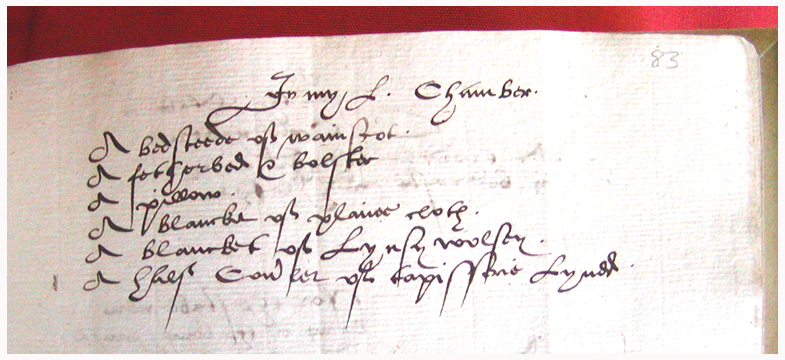
In each of the two notebooks at Queens’ College are inventories, the same except in minor wording, one written in 1561, one in 1569, in which he notes the 20 rooms at Ankerwycke, listing the contents of each.  In the first, #49, a room on the upper floor between his father’s room and the maid’s chamber is labeled “In my L. Chambre.”  In the 1569 inventory in notebook #83, page 123, a similar list is headed with the words: “In my Lorde’s Chambre.”

1561 inventory of Ankerwycke rooms, “In my L’s Chambre”

By “My Lorde” Smith must have meant de Vere, who, born “Viscount Bulbeck,” was considered a “lord” from birth.  Smith was punctilious about terminology, particularly where social distinctions were concerned, so he would never have made a mistake by called somebody a lord who was not, in fact, a lord.  Strype “supposes” that by “my Lorde” Smith meant the Duke of Somerset (170), but that’s impossible since Ankerwycke wasn’t finished until 1553, by which time Somerset was dead, nor would someone as self-righteous as Smith have wished to memorialize a master with whom he had had such profound differences.  It could not be Cecil, since from 1550 until Elizabeth’s accession Cecil kept his own household at The Parsonage at Wimbledon not far from Ankerwycke, nor did Cecil become a lord until 1571, long after Smith had drawn up these inventories.  Other than these, there is simply no lord other than de Vere who could possibly have had his own room in Smith’s home.

When we add this evidence to the phrase “brought up in my house” from the 1576 letter to Cecil, we should have enough to place Oxford with Smith for the better part of eight years, and in so doing, add to his story the riches of experience he gained as a child in a traditional country manor with all that that implies, as I’ve detailed in a number of blogs, pages, lectures, and articles.  Among many other puzzle fits, this scenario provides a reason for de Vere’s placement at Queens’ College for five months in his ninth year, Queens’ being Smith’s alma mater, and Smith needing that time to assist Cecil with preparations for Elizabeth’s accession, a hard fact for which we have more than enough evidence.

De Vere was still with Smith when the first list was written.  As for the 1569 inventory, although Oxford was no longer a member of Smith’s household, that Smith would continue to use his name for the room is seen by how he continued to call the room next to de Vere’s “my father’s chambre,” although Smith’s father died the summer of 1557.

By examining an actual document, its visual appearance can add to what its text and authorship have to tell us.  For instance, in the letter in which Smith finally turns to the issue of Oxford’s treatment of Burghley upon his return from Italy, that Smith was more emotional at the end than he was anywhere else in the letter is obvious from the condition of the paper at this point.  The pen was pressed so hard on the paper that the ink is darker here and the stroke thicker than anywhere else in the letter, so hard that the acid in the ink had eaten away the paper at that spot to a degree that it threatened to render a few of the words unintelligible.  I showed it to the librarian in the Manuscript Room at the British Library, suggesting they do something to preserve it before it crumbles completely.

What, can the Devil speak true?

As you no doubt are aware by now, my scenario for the authorship of the Shakespeare canon is not the standard view.  The standard view is the one most people have grown up with, the one that sees William of Stratford as the author of the works of Shakespeare, the view backed by university academics, even more so by their supporters, the ones who write most of the articles in response to our questions, and most of all by pop biographers, who, lacking anything substantive, garnish theirs with what they hope are zesty details of life in 16th-century Warwickshire and London.

Ours is so much a better story, why won’t they listen?

For the most part, academics are a very different strain from the artists that they study.  If the facts as they are presented don’t add up, they don’t see it because they don’t understand what makes their subject tick.  Focused on the trees,  they hardly know there is such a thing as the forest.  And once having arrived at the pinnacle of Shakespeare studies, the very button on the cap of the Humanities, they are not about to question what lies (pun intended) beneath that pinnacle.   One recent literary “historian” got, so we’re told, a million dollar advance on his glossy version of the Stratford myth.

There’s nothing strange about this.  In every area of human endeavor there are those who more or less blindly follow tradition and its rules without allowing themselves (or anyone else) to question them.  As for Shakespeare, most academics don’t really care who he was; it’s the text that interests them, not the author; as far as they’re concerned, the less about him the better. When, after 300 years of ignoring him, the universities finally accepted his plays as worthy of their attention, they were perfectly happy with the author as presented to posterity by Ben Jonson, the lifeless woolman stuffed into artist clothing, stuck on a pole, his propped arm pointing towards Stratford.

Academics get to the positions of authority they occupy by being well-behaved  all through school, getting good grades by giving their mentors the answers they want to hear, then getting them to sign on as advisors on their dissertation committees so they can get their PhDs and all that goes with it. Once tenured, they produce books in which they dedicate their examination of the symbolism of “eye of newt” to these same mentors.  By the time they’ve reached a point where thinking for themselves is no longer a threat, they’ve forgotten how, that is, if they ever knew.  And if the questions do begin to eat away at the edges of the Stratford myth, they’ve become too committed to Stratford through the books and articles they’ve published to allow them entry.  How ironic that Shakespeare’s “alms for oblivion” got nothing better for him than these latter day Holofernes.

They get away with it by ignoring the big arguments––like why there’s nothing in this supposed great writer’s handwriting but six clumsy legal signatures––while focusing on details. For instance they defend the Stratford story by saying, “contrary to authorship views, there’s more than enough evidence that William Shakespeare wrote the works.”  What they mean by this is that the name Shakespeare is on various title pages, while documents in Stratford testify that someone of that name lived and died there and sued his neighbors.  What they don’t tell you is that there is nothing solid to connect the title pages with the man who lived in Stratford. Or with the man who spent a few months in rented quarters in two different neighborhoods in London.  Or with Jonson’s Sogliardo.  Nothing times a thousand still equals nothing.

The ultimate irony of course is the obvious fact that we need the academics.  Or, perhaps I should say that we need authorship scholars in academia.  The excruciating amount of time, effort, and money it takes to track down documentation in the English libraries and archives requires that this be taken on by professionals, either backed by a university or by patrons who are not seeking some particular result.  How many archived references to the Earl of Oxford have academics ignored since the authorship question first raised its annoying head a century and a half ago?  How many during the century before that, since he was not the focus of their inquiry?  Until the universities open their doors to the question or enough disinterested, deep-pocketed patrons appear, we must struggle along with only our God-given common sense and what facts have slipped past, first the 16th and 17th-century censors, and now the Stratfordian defense.

We also have another sort of adversary.  Almost as much of a barrier as the academic who has no understanding of artists or interest in a realistic biography is the Oxfordian who has no understanding of history.  If we do not honor the truths of history, if we continue to be enchanted by soap opera fantasies that do violence to genuine historical and psychological truth, we will never gain the respect of the History departments, who realistically are the only ones in any position to do the necessary research, since the English departments simply don’t care.

How was it he put it?  “If circumstances lead me, I will find where truth is hid, though it were hid indeed within the center.”

Amen to that.

What? No such thing as Santa Claus?

When we discover  at age six or seven that it isn’t really Santa who provides the toys under the tree, but our parents, questions that were becoming ever sharper to our developing sense of reality––How can he get in when we keep all the doors locked?  Why do they say he comes down the chimney when we’ve got no chimney?  How can he possibly take care of all the children in the world in a single night?  How come his reindeer can fly?––are suddenly resolved.  A world that was becoming ever more mysterious in problematic ways returns to making sense.  And so it is with one myth after another throughout life.  And so it must be, eventually,  with the Stratford biography.

Just as no fat man in a red suit could get himself down a million chimneys in a single night, no son of an impoverished, illiterate yeoman from a beer swilling market town two days ride from London could possibly have revolutionized English letters at a time when 90 percent of the population was illiterate.  And just as Santa’s miracle is created by parents sneaking downstairs when the kids are asleep, so the English Literary Renaissance was (mostly) created by educated courtiers and their patrons working silently behind the scenes to provide a depressed nation with a replacement for the mummings and disguisings, the Church Ales and parades so harshly condemned by the Reformation.

The Renaissance, the rebirth of interest in Art and Science that began in Italy in the 14th century with the rediscovery of ancient texts and artifacts from the ancient  civilizations of the Eastern Mediterranean, was delayed in reaching the northern and western areas of Europe by physical and cultural barriers.  When it finally reached  England in the late 16th century, it only did so because a politically weak monarch who desperately needed some inexpensive glamour to hide the fact that she had no wealth to speak of, was persuaded by some of her councillors to allow it to burst into life, first at Court, then in the public arena.

The English Literary Renaissance was not, uniquely, created by clever members of the working class any more than Christmas mornings are created by Santa’s elves.  It was created by the same social group that created it in most of the southern nations of Europe, members of the Courts of kings, queens, and princes.  In Spain, where a long connection with Islamic culture separated it from the rest of Europe, the “Golden Age” was largely created by men of a class much closer to that of William of Stratford, but this is an exception that can only prove the rule, for, unlike William (or Greene, or Nashe, or Watson, or, or, or), the two greatest Spanish writers of the period, the novelist Cervantes (born two years before Oxford) and the incredibly prolific genius Lope de Vega (born two years after Bacon) both show trustworthy and substantial paper trails that fit well with the dates and themes of their works and de Vega at least was assisted and supported by courtiers.

It’s been a year now since I began outlining this scenario, and although I’m still nowhere near getting even short versions of all the information that needs sorting out, a start has been made.   Now that we are embarked on the great holiday season of the year, the one that started “Shakespeare” on his career, may you all find peace and relaxation in whatever form of “merry-making” brings you pleasure.

Shakespeare’s patrons-who were they?

Born as the crest of two waves, the German Reformation and the Italian Renaissance, crashed into each other, the great poet and playwright blended these two often incompatible energies into the culture that has been England’s ever since.  Under the constraints of the Reformation, the passions that went into painting, sculpture, and architecture in the Southern European Renaissance, in England went into language: a bare stage, good costumes, superb actors, and the great human stories we know as Shakespeare, stories whose sources are to be found in the libraries where the Earl of Oxford spent his childhood.

Oxford’s development and survival as an artist was largely due to his patrons, surely among the best a writer ever had.  He sank low at times, but not so low that he ever had to quit writing, at least, not for long.  One of the most important research projects remaining to be done is on these patrons.  Burghley, Sussex, Walsingham, Hunsdon, Charles Howard, Southampton, the Pembroke brothers, are the leading figures, but there were others as well who contributed to his survival in various ways.  Even when they were disgusted with him, as Hunsdon must have been when the bum took up with his mistress, they kept him afloat because they knew his value.  For the great ministers of that time who had the dreams and aspirations of both Italian and Reformation humanism alive within, he was the great instrument of their policy, though this would be fully realized only when he was gone, as so well expressed by Ben Jonson in his dedicatory Ode in the First Folio.

Historically Oxford’s role in Early Modern theater is as a patron, a role that tends to get lost in the argument over his role as a writer, but his involvement as patron of the arts and sciences went a good deal deeper than what shows on the historical surface.  He patronized musicians and composers as well as other writers, and was praised by them as one of themselves.  When looking for a model for Oxford within our own times, the composer and pianist Leonard Bernstein comes to mind, an entertainment genius of the same all-encompassing nature, only, shall we say, considerably less fearful of recognition.

One question that hasn’t been dealt with yet, so far as I know, has to do with the company maintained by Oxford’s father.  Were they, perchance, the one we know as Leicester’s Men in the 1560s?  When Earl John died in 1562, Elizabeth gave Leicester control of the Oxford estates.   Though there’s no sign of it (so far) in the record, that could mean that he inherited what had been the sixteenth Earl’s acting company?  Unlike our world today, the arts community was very small.  Leicester’s Men were a handful of Court actors, some the same men who later became the core of the company that called themselves Hunsdon’s Men and operated out of Burbage’s Theater, just up the street from Fisher’s Folly.  Were some of these the same men who, decades earlier, had performed John Bale’s King Johan in Ipswich in 1561, just prior to the Queen’s entertainment at Hedingham Castle?  It’s worth considering.

Why we need a scenario

Recent questions have raised the enduring issue of fact vs. fiction.  I’ve been asked to make it (more) clear where I depart from a structure of known fact to fill in missing areas with a scenario in which areas can’t be supported by the kind of cited facts that historians rely upon, or are supposed to rely upon.  I’ve been considering how to deal with this ever since reading Ogburn’s The Mysterious William.  Deluged with facts, what was missing was the story.  Obviously Oxford was the true author, but how to perceive the living being within this mountain of argument and data?

The problem lies with the difference between facts and story, or truth and fiction, as this dichotomy is so often portrayed.  It’s almost impossible to mix them and come up with something that isn’t seen as untrue on the one hand, boring on the other, or both.  One touch of supposition and those interested only in so-called hard evidence toss the whole thing in the waste basket as unsupported theorizing.  Burden it with documentation and those in search of the story lose interest because it lacks drama.  Truth, however, is more than fact.  There’s truth in story that can never get relayed from just the facts alone.  No one knew this better than the author of the Shakespeare history plays.

At a certain point in researching the period it became clear that the lack of facts––not just on Shakespeare but on all the writers and works from that period––wasn’t simply due to entropy, the dictum that “things fall apart,” or any lack of interest in him in his own time.  Facts were missing on purpose, either burned in fireplaces or never exposed to begin with.  Confusion was not always due to missing data, but was often intentional.  The sources of information relied upon by scholars tracking the stories behind the literature of the period, title pages, entries in the Stationers Register, Revels records, etc., were either purposely ambiguous or flat out false.

Asking why, I began to see a pervasively phobic attitude towards literature, i.e. fiction, i.e. storytelling, that infected the entire culture.  Asking why again, it seemed that in rejecting the supersitions and folk tales of medieval Christianity, the reformers in power were doing all they could to throw the baby out with the bath, just as they were doing with the beauties of Renaissance Italian painting out of a Reformation mistrust of Italian sensualism.  Poetry was dangerous––the better, the more beautiful the language, the more dangerous.  And then there was the age-old threat of dissident voices, so often those of the best writers.

Just the facts, M’am.

None of this is new.  All of it has been mentioned, usually in passing, by literary historians, who may question the truth of a title page or two and then go right on repeating the standard account based by earlier historians on those very same title pages!  It’s as though archaeologists who discover the bones of a prehistoric human simply leave them lying in the order in which they find them, never making any effort to arrange them so they reveal the shape of a human being.  As a result, all we have is a pile of facts, no story, no humans struggling to make their way through the difficulties of their lives, loving and hating each other, just a bunch of names without connections to each other or to the stories told by their works.

When I say “not one” has tried to tell the story behind this pile of real and phony facts, that’s not quite true.  Those who’ve tried to make sense of it in human terms (I’m thinking in particular of T.W. Baldwin and Penny McCarthy) have been thrown off by the biggest falsification of all, the substitution of the true author of the primary works of the time with someone of an altogether different, even opposite, nature.

The archeology metaphor works well here, where two bodies having been buried together ages ago, their bones becoming mixed through some earth disturbance so that a pelvis, a set of shoulder blades and bits of both spines have gotten lost.  Later, when scientists attempt to sort them out, the result is a single two-headed monster with two sets of arms and legs which they then attempt to sell to an ignorant world as the missing link.  In Shakespeare’s case, the historians either doll up the monstrous Stratford grain hoarder cum literary genius with anecdotes and conjectures, or they ignore him and describe the flowers that “probably” grew in his garden.

At a certain point intelligent readers became sick of this paper monster and began to look for something a little more real.  They could just manage to make out a shape out there, moving around in the bushes, but it was hard to define. (Francis? Is that you?)  Eventually J.T. Looney gave it a name and Charlton Ogburn a wealth of detail, but we’re still stuck, first with the desire to pin the blame on a group, now with the nonsense that almost anyone alive at the time could have tossed off these erudite masterpieces.

My kingdom for a story!

By blogging there seemed the possiblity, finally, of having it both ways.  I could tell the story I had begun to perceive some time ago, with links to articles that provide the kind of citations that give at least a minimum of support.  With readers able to ask for specifics directly without waiting for an answer to a letter sent through the publisher or finding a booksigning somewhere within driving range, I could finally (I hoped) provide the key to the insight or the missing bit of information that would suddenly (perhaps) bring the scene to life, set the story in motion, for that reader and perhaps others as well.

I’ve only been at this blogging for a few months now and so the story, while complete in my mind, is far from complete here.  I’m still working on background material for the 1580s, the most difficult decade partly because there’s so little documentation, but also because it’s then that the heart of the story, the drama, begins to take shape.  Because I have to conjecture so much for that decade, I need more supportive material than was required for the 1570s or will be for the 1590s.

If it seems that much of what I write is directed to those readers who have already read the biographies (Anderson, Ogburn, Miller, Nelson), it’s because for you I don’t have to repeat so much, simply filling in a few areas that they ignored (chiefly Oxford’s childhood and education). This way I can concentrate on those areas that provide the reasons why he and the actors and their patrons, hid his authorship, reasons of culture, tradition, politics, and religion, and beyond these, the connections to the important figures of his time that he portrayed and satirized in his plays, points that can’t be made without showing why he would do such a thing and how he managed to get away with it.

If I can reach you, then together we can find ways to communicate the Authorship Issue, not just as a series of talking points, arguments, and facts, but as a story that, motivated by the life force that is our common heritage as humans, simply tells itself.  Surrounded as I am by all the stuff I’ve accumulated, it’s hard for me to see the forest for the trees.  By telling it this way in bits and pieces, and by answering your questions, it helps put things in perspective.

So please bear with me, and do ask for clarification of those points that, to you, seem little more than wild surmise.  My idea of support may be somewhat different than those historians who, when the paper is lacking, simply skip over the anomalies, but be assured, nothing I suggest is spun purely from thin air.

Why the cover-up continued after Oxford’s death

John Shahan pushed me hard in his comment on my response to Alex McNeil’s question. Sometimes an exchange that follows a blog gets lost in the drift, but this is too important to let that happen, so I’ll respond here to some of his more pertinent points.  If you missed it in full, it follows Alex’s question.

John: Why was the cover-up maintained after his death?  It’s a separate question that you haven’t answered.  It’s a good question, and one that many people ask when they come to the controversy for the first time.  We should have a good answer at the ready, and providing an explanation of why he would have kept hidden during his lifetime doesn’t cut it.  It sounds evasive to answer a question other than the one that was asked.

I wasn’t being evasive, I was being too general.  His authorship would have been kept a secret after his death for exactly the same reasons that it was kept a secret during his lifetime, the same reasons that all the covers he used throughout his life remained in place, the same reasons that Mary Sidney’s descendents never revealed all she wrote or that Francis Bacon never revealed himself as a “hidden poet.”  And for some of the same reasons that got Christopher Marlowe murdered or transported.

If I got lost providing background it’s because it’s so difficult for people today to understand the realities of Shakespeare’s time.  However, there is one that might stand out a little better than most: namely the fact that so many of his characters satirized respected and high ranking members of the Court community, some portrayed as buffoons, some involved in scandalous love affairs, some even accused of murder!  That they might possibly be identified with these infamous characters would have had these highly status conscious people, their retainers and descendants, in a real tizzy.

As long as William of Stratford was known as the author, the originals of these characters were protected, but had the Pembrokes and the Kings Men revealed the truth about the authorship they would have had an extremely serious situation on their hands.  This is one of the reasons why the publication of Oxford’s collected plays took as long as it did.  It had to wait until the Earl of Pembroke achieved  the Court position where he finally had the power to take the matter of its publication into his own hands, overpassing the wishes of some who would have preferred that everything Oxford ever wrote be destroyed.

Most agree that Polonius was a demeaning portrait of Lord Burghley, something that would certainly have been as obvious to members of the Elizabethan Court community as it is to us today.  If, as I believe, Hamlet, Julius Caesar, Romeo and Juliet, and other of his more serious and philosophical plays were written, not for the Court or the public, but for his Inns of Court audience, it could mean that Elizabeth never saw them, or if she did, not in the versions that we know from the First Folio.  Thus it’s possible that Burghley never saw himself derided as Polonius, or his daughter portrayed as a lunatic and a suicide.  For who would tell him?  There were no newspapers, so there were no reviews.  All publication was tightly controlled.  By whom?  By Lord Burghley.

Were it ever to become public that it was the Earl of Oxford who had created these popular characters––so popular that they made the Lord Chamberlain’s-King’s Men a fortune––how long do you think it would have taken the public audience to connect Oxford’s father-in-law with Polonius, his wife with Ophelia, his political adversary the Earl of Leicester with Claudius, or his Queen with Gertrude?  How long to connect Richard III with Robert Cecil, Mildred Burghley with Volumnia in Coriolanus, Southampton with the Fair Youth, Philip Sidney with Sir Andrew Aguecheek, Emilia Bassano with Cleopatra, and so forth.

Oxford’s own daughters were the daughters of Ophelia, the granddaughters of Polonius. That, plus the fact that his youngest had married a Pembroke, shows that however you look at the cover-up, by 1615 when Pembroke finally got the office of Lord Chamberlain of the Royal Household, putting him officially in charge of the Court Stage and the King’s Men, publication of the First Folio was as much a family affair as it was a literary event.  Pembroke wanted the plays published, but he also wanted to protect his family and his community from scandal and, not least, himself from the odium that would be inevitable were he to allow these connections to be revealed.

If it’s a good talking point you’re after, maybe this will do.  Yet even here we run into the problem of readers not understanding enough about the period to get it.  Again the main problem is our inability to grasp how small were these communities, and how static.  Where our communities today consist of thousands, many of whom are no more to us than names, theirs consisted of a dozen, two dozen names, in positions that may have changed only once or twice over a lifetime.  During Elizabeth’s reign the number of peers went from 60 to 25!  Our communities are in continual flux; as one worker, neighbor, merchant leaves for greener pastures, retirement, or intensive care., another takes their place.  The only way that things changed in Oxford’s time was through death.

We can say these things, but do they sink in?  Do we really understand what it meant to live in what to us would seem intolerable constriction while under the constant threat of death for ourselves, our children, our loved ones, whether by disease (no doctors) or by violence (no police)?  Added to the equation must be their ignorance of science, of medicine, even of their own history––a problem that Oxford’s history plays were intended to address.

The closest thing we have to their peers, their kings, queens, earls and countesses, knights and ladies, are celebrities.  Of these we have so many that, as happened a few days ago, I can see someone introduced to an audience on television, an audience of cheering thousands,  as one who has sold millions of platinum records and received a cartload of important awards, someone I’d never heard of before.  And while their handful of important persons changed only when one died and was replaced by another, ours are continually changing, usually simply by disappearing into anonymity, beauty queens into middle-aged matrons, sports stars into businessmen, some onto the pages of history, a history already jammed with names and faces.

The problem isn’t only of numbers and stasis, it’s one of attitude.  We have no respect for our celebrities.  Largely due to their numbers, their lack of background, the ephemeral nature of their importance, they seem to exist largely as vessels for our scorn.  Their very renown calls forth efforts to bring them down, to expose them, to show the world their weaknesses.  These Elizabethan celebrities had no photographers with telephoto lenses to catch them with their pants down, they were known to their people only from a dignified distance, dressed in crimson, ermine, and gold, or from copies of stately portraits. Descended from the heroes of past glories, they came as close to living gods and goddesses as humans could. Their lessers might hate them and blame them for hard times, but they did not, they simply could not, disrespect them.

When Shakespeare came along and revealed these gods and goddesses as human beings with problems and weaknesses like themselves and their neighbors it was fascinating, yet for all their speculation, they did not know, they could not know, how closely based they were on the real thing.  To have known who among those distant and admired figures were the real models of these fools and villains was simply more information than the culture could bear.  As a general statement, that may be putting it a little too strongly, but not by much.

John: Lots of authors use pseudonyms to conceal their identities during their lifetimes without the cover-up continuing after they die.  So why was Oxford different?

Lots?  Who?  Who of Oxford’s social stature?  Who in his time, or the time before his, or the time after his?  Not all statements have to be substantiated, but this is crucial.  Who else of his status in the Elizabethan era published works of the imagination under his (or her) own name?  I don’t know of a single one.

John: There’s a difference between knowledge and belief, and I think we do ourselves a disservice when we fail to make the distinction. That’s what Stratfordians do.

Having repeated this twice I assume you’re taking me to task for making unsupported statements.  I’ve made it clear from the start that my purpose with this blog is to provide a scenario that accounts for what facts we have, not just a few here and there, clustered around one or two circumstances (such as the writing of the Sonnets), but as many as possible.  I did a lot of substantiating of statements while I was editing The Oxfordian.  That was important, but this, however different, is just as important.

We’ve had most of the facts on Oxford for decades, and where have they gotten us?  Facts are to story as flour, water, salt and yeast are to bread; the ingredients, not the thing itself. We can eat bread, we can’t eat flour, water, salt and yeast.   Creating a story out of facts is like mixing, kneading, and finally, baking.  We are not inventing the bread, what form it takes depends solely on the ingredients.  All we’re doing is assembling them, giving them a thump or two, and letting them rise into a living story.

To be convinced, hearts must be touched as well as minds, something that can’t be be done without characters and a plot.  What’s most real about us are not the facts of our lives, but our stories.  To understand the past, we need more than dates of battles, we need heroes and villains, tyrants and underdogs, damsels in distress.  Without these, the audience leaves at intermission.  No one understood this better than Shakespeare.

There’s another reason for what I’m doing.  The Stratford bio as generated by Ben Jonson and others has sent generations of Shakespeare enthusiasts on an utterly fruitless 400-year-old wild goose chase through the archives in search of something that will reveal a believable Shakespeare story.  While true stories must be based on facts, it’s also the case that the search for facts will go off-track quickly if there isn’t a logical scenario in place directing it where to look.  How do we get such a scenario?  By doing what I’m doing, filling in the blank areas with informed guesswork.

Hopefully there will be some, or at least one, who’s located close enough to the relevant archives who gets sufficiently intrigued by what I’m proposing to begin looking where I’m pointing.  Centuries of investigators have read the letters of Burghley, Walsingham, Alleyn, Pembroke, and others, looking for something, anything, about Shakespeare.  Nothing anywhere near this scale has yet been done for Oxford.  Who knows what he or she will find once they begin to look?