
Oxford’s three audiences

Modern readers of Shakespeare come to the plays through the First Folio, the versions of the 36 plays published in 1623 by the patrons of his company, known by then as the King’s Men.  Publication then, and ever since, has performed a cleansing process on the plays, providing texts without any of the baggage, attitudes or complications that history attaches to important works of the past.

In Shakespeare’s case, partly because they were written so long ago (though, as it turns out, not entirely) it’s been next to impossible to place the plays in history in any meaningful way.  Roughly half had previous publication in quarto format, the other half were never published until the First Folio.  Some were registered with the stationers, others not.  Some were mentioned in letters or publications by contemporaries, most were not.

Although we have a few holographs (handwritten versions) of other plays from around that time, none are by Shakespeare.  Unlike their sister company, the Lord Admiral’s Men (later Prince Henry’s Men) documented by the diary of theater owner Philip Henslowe and other papers retained at Dulwich College by his stage manager Edward Alleyn, if anyone in Shakespeare’s company ever kept any records, they didn’t survive.  The only records to survive are mid-17th century court cases over ownership of the by then lucrative company shares.  Whoever or whatever we mean by Shakespeare, he or it created one of the most successful businesses of the period, at least for those who ran it in London.

One result of this has been that even those who should know better tend to approach the plays as though they were more or less all written under the same impulse, to make money for both the writer and his actors, and for the same public audience––the only issue being when.  Because the Stratford biography forces them all into a decades late 15-year time-frame, efforts to see genuine connections to current issues and events have failed, creating a Shakespeare who plucked his subjects more or less out of thin air, and all for the same audience, an amazingly well-read  public, with the Court little more than an adjunct, as it is today.

With Oxford as author, all of this changes; the process becomes at once much more complicated and also much more interesting.  The unspoken assumption that everything that Shakespeare wrote could have been seen by anyone in his time who came to London or who had a penny to spare falls by the wayside.  The fact is that different audiences saw very different kinds of plays, even in some cases, different versions of the same play.  The illusion given by the First Folio, that all the plays share a sort of equality of presence, fails as well.  As with the works of every other great artist, each play has a history of its own, and all are closely connected to events in the life of the author and of the communities, the nation, and the world in which he lived alongside his fellows.

With a solid historical framework in place, it shouldn’t be nearly so difficult to place each play within a relatively narrow and realistic time-frame, even in some cases down almost to the very day.  In attempting to set dates for a particular play, it helps to determine for which of his three audiences did he write it originally:  the Court, the Inns of Court, or the public?  Eventually all of his plays ended up as public entertainment, but few (if any) were written originally with only the public in mind.

His Court audience

As a member of the Court from probably around age 17 until he was banished at 31, Oxford’s energies were chiefly directed towards entertaining his own community.  He was not unique in this, or rather, he was unique only in the quality of his work, for all of the upwards of 40 or 50 individuals who formed the core of the permanent Court community, those who had suites of rooms at Court where they lived yearround, were expected to contribute their particular skills for the support and/or pleasure of the group.  As the crème de la crème of English society, they were expected to sight read music notation, to sing complicated vocal arrangements, play the lute or the virginals, and perform the latest dances.

Oxford’s dancing was obviously admired by the Queen; of the handful of his poems that come down to us, many, perhaps most, are song lyrics (madrigal lyrics often sound like complicated poems), while in later years he was praised by a fellow composer as being as accomplished musically as any professional.  So we can assume, based on what evidence remains, that he quickly rose in the Court’s estimation for his contributions to musical and dramatic events.

His writing for the Court may have begun with interludes, witty dialogues exchanged by two or three of the boy choristers, interspersed with musical offerings by the boys, the Court’s permanent staff of musicians, or courtiers with pretentions to expertise.  These interludes soon expanded into full length plays like Love’s Labor’s Lost, that were made up of a series of comic or romantic interludes interspersed with songs and sometimes dances, even, as in The Tempest, with the company taking time in the middle of the show for a feast served by the cast.  E.T. Clark has identified several of these from their early listings in the Revels records.

Most of the plays termed comedies in the First Folio began as entertainments for the Court community.  Over time, some of these became standard entertainments, revised every few years by adding new topical material and characters, or revising old material to fit new situations.  In this way a character like Armado in Love’s Labours Lost represented a different Court figure when the play was first written than he does in the 1623 version, in which he represents Antonio Perez, whose presence at Court can be easily assigned to a few years in the mid-90s.  This has confused scholars who would otherwise place the play as early as the late 1570s when Elizabeth was contemplating marriage to the duc d’Alençon.   It may be that the play was originally very early, but once it became a favorite at Court, he would update it every few years for the winter holidays.  How many versions survived, and what dicing and splicing the First Folio editors may have done with them we can only guess.

When writing for the Court Oxford was of course always aware that the core of his audience were the Queen and her entourage of ladies, the wives and daughters of leading Court officials.  In writing to please them he learned early that what entertains men is not always appreciated by women, particularly the sort of well-bred, educated women who were welcomed by Elizabeth into her private circle.  That this was Oxford’s primary Court audience can be seen from his early published works (attributed to Petti, Lyly or Greene) that were specifically targeted toward female readers.

Although there’s much to suggest that Oxford preferred to write for the West End, he never ceased to entertain his home community, providing plays for Court weddings until his final days.  Among his final revisions were those produced for the 1604 wedding of his youngest daughter, Susan Vere, to the Earl of Montgomery.  The Folio version of The Tempest comes largely from the 1595 version he wrote for the marriage of his oldest daughter, Elizabeth, to the Earl of Derby, which he further revised as The Spanish Maze for Susan’s wedding.  The Folio version of A Midsummer Night’s Dream was written for the wedding of his old flame, Mary Browne, Countess of Southampton, to Sir Thomas Heneage in 1594.  Taming of the Shrew was written originally as a wedding roast for the 1579 marriage of Lord Strange to Alice Spencer.

His West End audience

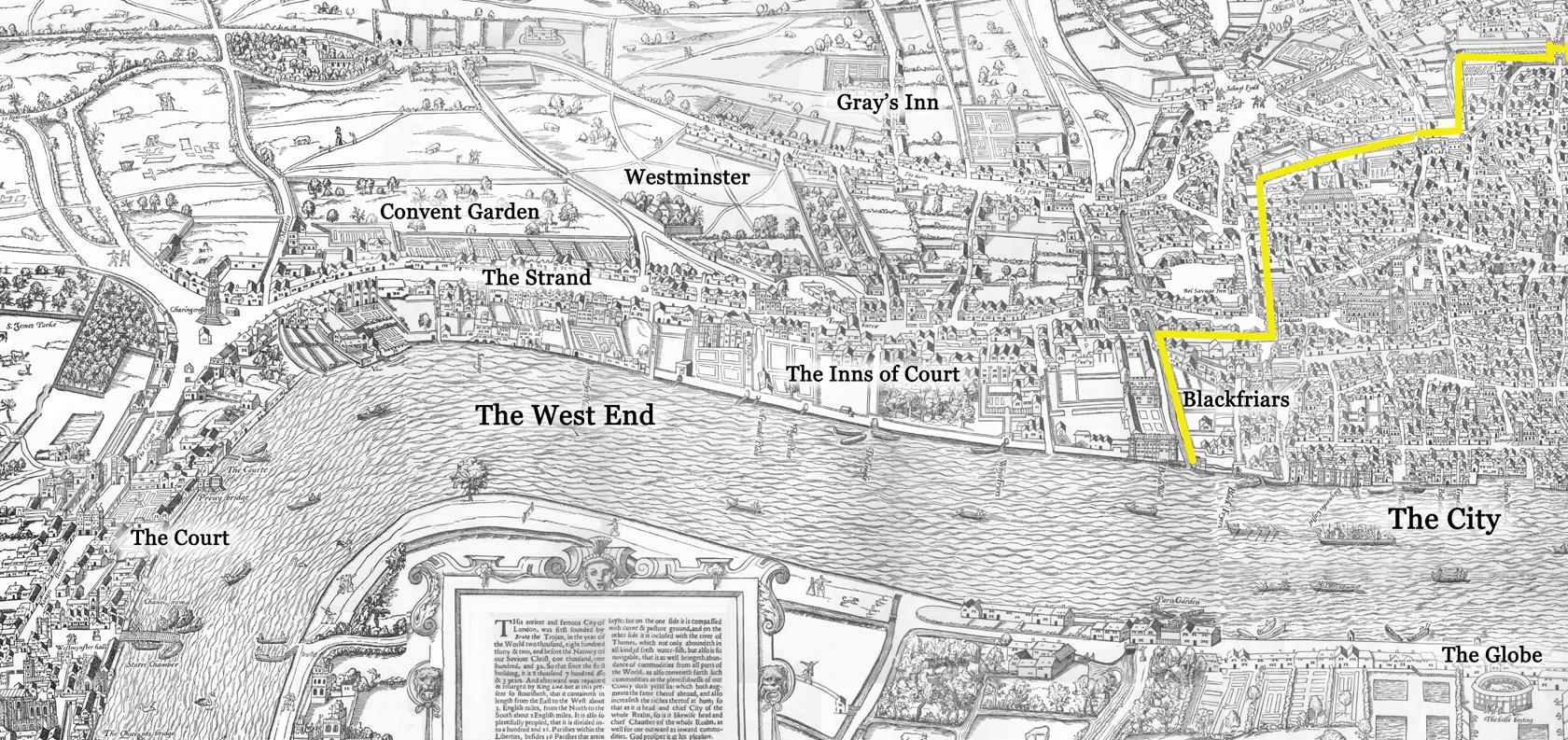
Outraged at his banishment from Court and by the way he and his men were being threatened by his lover’s relatives as Elizabeth sat by and did nothing, Oxford wrote nothing for the Court for the two years that he was ostracized (1581-’83), turning instead to his favorite audience, the “gentlemen of the Inns of Court.”  For them he could unfurl the full power of his rhetoric on the kind of issues that would never have passed the Court censors.  The West End (more accurately the city of Westminster) was where the legal colleges, the Inns of Court, were located.  Further west, between the Strand and the Thames, stood the great City mansions where the most prestigious courtiers and government officials lived.

For Oxford and his patrons, this was the most important audience in London, particularly during the relatively infrequent moments when Parliament gathered to vote on a subsidy for the Queen.  Once we can begin to focus on details, it will be helpful to use these times as moments when he was most intent on reaching this audience with plays relevant to current issues, for it was then that the most influential men in England gathered together at one time and in one place.  Plays that deal with national issues, like treason (Julius Caesar), colonization (The Tempest), or the Law (Merchant of Venice) are most likely to have been first written for this audience, and the only possible stage where they would have produced these plays was at the little stage in the chorister’s school at Blackfriars.   The big public theaters were located in suburbs far from Westminster, while the Blackfriars stage was a mere hop and a skip to the west along Fleet Street, or, if coming by water from one of the mansions on the Strand, just footsteps from the elegant old Blackfriars watergate.
Happy finally to be writing for adult actors (no more little eyeases!) I believe that it was for this audience that he produced the first version of  Timon of Athens, the first version of Troilus and Cressida (written before he discovered that Ann Vavasor was not the Cressida he had so unkindly assumed), of Romeo and Juliet (after discovering that she still loved him), of Julius Caesar and Coriolanus (written to explain his urge to desert England and fight for Spain), and of The Spanish Tragedy and Hamlet (written out of anguish at the death of his patron, the Earl of Sussex, and suspicion that he’d been poisoned by his enemy, the Earl of Leicester).  The only one of these that we have today in anywhere near the original version is The Spanish Tragedy (attributed to Thomas Kyd); all the others were rewritten for the Lord Chamberlain’s/King’s Men during Oxford’s final Shakespeare period (1593-1608).

The public plays

Last, and in many ways least, at least so far as his personal interest was concerned, there was the public audience that, through their far greater numbers would make his works “popular” as neither the Court nor the Inns of Court ever could, something that gave a great deal of power to the company that produced them.  When Oxford first began producing plays at Court in the late 1560s and early ’70s, the various children’s companies that performed them were allowed to supplement their sparce Court stipends by performing the plays they’d rehearsed for the Court a few times at the little theater at Paul’s Cathedral school for choristers.  These early comedies migrated rapidly to both the public and private theaters.  Because their subjects were popular and easily understood and no deep knowledge of history or philosophy was required to enjoy them, they pleased the public, and because any satires of known Court personalities would be lost on a public audience, there was no reason for the Privy Council to get in the way.

By 1583, with the creation of the Crown company known as the Queen’s Men, Oxford found himself writing for the provincial audiences that, as McMillin and Maclean show, were the new company’s primary focus.  It’s possible to see in these early plays, most of them termed as “apocryphal,” his attempts to deal with local or at least popular issues as in Arden of Faversham, Friar Bacon and Friar Bungay, The Birth of Merlin, James IV and Edmond Ironside.  Responding to Walsingham’s desire to teach the provincials something about their history, he also wrote the early versions of what, as Shakespeare, he would turn into the great history plays: The Famous Victiories turning into Henry V, the Contention between York and Lancaster into the Henry VI series, and so forth.

Early in James’s reign, towards the end of the Shakespeare period, perhaps in exchange for stewardship of the Forest of Waltham, Oxford consented as his share of the bargain to provide updated versions of what early Court plays remained for the now royally established King’s Men, versions that would make them one of the most successful commercial enterprises of the Stuart period.  It seems he was embarrassed about this.  Feeling called upon to explain to his community why he was turning plays that they regarded as theirs into public works,  he produced at a great welcoming get-together for King James at Wilton or Salisbury the summer of  1603 a new version of As You Like It in which, as Touchstone, he explains his need to marry the provincial and unpoetic public audience he personalizes as Audrey (audire, Latin for to listen).  A man must marry and a playwright must have an audience.

Of course many plays migrated across these boundaries and although not everyone could see a play at Court nor could a poor apprentice afford one of the expensive indoor private theaters, members of the first two audiences could always see a play at one of the public theaters should they wish, and probably did quite often––all but the Queen, that is. It’s so unlikely as to be impossible that she ever ventured outside her Court confines for any purpose; every venture from one arena to another was in the nature of a state occasion.  Her dignity could not be impeached by being seen in anything less, and her person had to be protected from the lunatics and drunks that were constantly threatening to do her in.  In Tudor and Stuart times, the theater came to the monarch, not the monarch to the theater.

This of course was a boon for Oxford and his patrons, for they could trust that some of the material would never reach her ears.  We know what happened a few times when that occurred.  She would never come to them, and no one in his or her right mind would tell her things that might stir her anger enough to allow the theater’s many and determined enemies to “pluck it down.”  It also made it easy for him to hide from her how much of what came from his literary circle came directly from him.  Those darn secretaries, always publishing things behind his back!

The Scenario that works!

Readers new to the Authorship Question will quickly see that the Shakespeare story as I tell it is considerably different from the one told in school and from the one told (or, more precisely, clumsily and obscenely aimed at) by the movie Anonymous.  So perhaps this is a good place to restate why I believe in the scenario I outline here.

First, I agree with the majority of those who can see from the utter impossibility of the Stratford biography that the best candidate for what came to be called the Shakespeare canon is Edward de Vere, Earl of Oxford.  While the rest may have a credential or two, he has them all.  But after 20 years of studying the matter I can no longer think of myself as just an Oxfordian––I’m an authorship scholar, by which I mean that I now question the authorship of (almost) every single work of the imagination published during the Elizabethan era!  To stop with Shakespeare gives the impression that he was an anomaly at a time when everything else was normal (according to today’s view of the world).  That’s simply not the case.  By today’s world of theater, writing and publishing, everything then was an anomaly.  He was only part of it.

Second, when you read Shakespeare here, understand that I mean the poet, not the man who sold him the use of his name.  Because it was de Vere, not William of Stratford, who made the name famous, de Vere’s the one who deserves it.  If I sell you my house, even if I rent you my house, if you make it famous as the place where something of great human significance occured, historically it becomes your house, not mine.

The third thing I began to realize as I dug more deeply was how little evidence there was, not just for Shakespeare, but for anything relating to the origins of the English Literary Renaissance.  There’s no argument about this; all scholars of the period are aware of the holes in their story, even if they don’t see how deeply or widely the lack of evidence extends beyond their particular focus.  So if I was going to figure anything out, I was going to have to cast a much wider net than those who concentrate just on Shakespeare, or Sidney, or Marlowe, or the history of the London stage.  Sooner or later I thought, I’ll find out what happened to all that evidence.  And I have.  I can’t prove it, not in the way it would take to overturn the Stratford monolith, not all by myself, but perhaps someday somebody will.

Of course the answer was there all the time, the Baconians were the first to see it, parts of it, but finding out exactly how and when it happened has proven to be the final, central, determining piece in the scenario.  As forensic scientists know, everything that happens leaves a network of clues that extend around it in time and space, so however much hard evidence is missing, there will be clues in the mainstream history, in biographies of those involved and of similar phenomena from other times and cultures.  Current studies like that of the psychology of creativity have added important insights.

And there are always the dates, that is confirmed dates, that function as linch pins for the sequences of events that create the network of clues that must take the place of the missing evidence.  Dates of events seen as “coincidental”––events within a particular circle that occur at the same time or close to it but are otherwise unrelated––are just about impossible in the small world that was the 16th-century London stage, periodical press, and Royal Court.  That such events are unrelated is so unlikely as to be impossible.

Fourth, I came to realize how very different life was then from what it is today.  While the subliminal backdrop to our view of literature and entertainment today is of hundreds of writers publishing hundreds of thousands of books by thousands of publishers and thousands of films made by hundreds of filmmakers written by hundreds of screenwriters, whose names change on a weekly basis as tens to dozens join the ranks or fall by the wayside, most of whose names mean nothing to anyone but their close associates (think of the long roll of credits that follows every film)––we must force our imaginations to provide a scenario where where there were two or three playwrights, six or seven professional-level actors, and seven or eight printers and publishers, all of whom knew each other or were at least very aware of each other’s existence over many years.

In other words, the illusion that Philip Sidney existed apart from Christopher Marlowe, Bacon apart from Nashe, Mary Sidney apart from Bacon, or any of these apart from the man considered by one of orthodoxy’s favorite supports, Francis Meres, to be “best for comedy” during the 1590s is just that, an illusion created by a lack of evidence.  If I live two blocks from a bakery, do we need an affadavit to prove where I buy my bread?  These people knew each other, had relationships with each other, relationships that drove the story of the blaze of literary splendor that was the English Literary Renaissance.  What was that story?  And why is it so obviously missing from the record?

The one and only Shakespeare

As an historian, I can’t go beyond the constraints imposed by these limits.  There were very few individuals during the early years of the English Reformation who could write engagingly in the 1560s and 70s, even fewer could or even wanted to get their own work produced or published, and as for those who could put on a risque and satirical play for the public and get away with it, the list narrows to one, however difficult it may have been all these centuries to identify him.  As for style, themes, and subject matter, biographies of other geniuses require that there be one Shakespeare and only one.  Just as no two people could have painted the Mona Lisa and no two people could have conquered Asia in the 3rd century BC, no two writers could have written (or co-authored) Romeo and Juliet or Julius Caesar.  There was, there had to be, only one da Vinci, only one Alexander, and only one Shakespeare.

Since all the other world-creating geniuses were leaders who left their arenas of endeavor permanently altered, causing those who came after them to imitate them, so the author of the Shakespeare canon must have been a man of great respect and high standing in the small literary circles of his time, and he had to have been born early enough that lesser writers who dealt with similar themes and subjects and whose styles show similarities to his, were his followers, and not he theirs.  That Shakespeare could possibly have imitated the lesser writers of his day, that he rewrote their works, is a cart-before-the-horse fantasy created by left-brainers who simply do not understand the nature of the thing they write about.

Yet it’s also true that great peaks in artistic endeavor are almost always driven by groups.  To develop, artists must have an audience on a level equal, or almost equal, to their own, colleagues who appreciate them, rivals who challenge them, enemies who drive them to retaliate.  Think of the French Impressionists, the Scribblerus Club, Bebop, Motown.  The films Ocean’s Eleven and The Seven Samurai have plots based on a group of talented individuals that come together to accomplish some goal.  But there’s always, there has to be, one or sometimes two, central figures.  The problem for the Elizabethan era is that the central figure is missing.  Some have tried to make it Sidney; others have tried to make it Bacon, or Marlowe, or even Mary Sidney, but in every case, while a few things may click, too many do not.  Those clicks are important, but it’s the collegial relationship with Shakespeare that they represent, not the poet himself.

With Oxford at the center, they all fall into place: Philip Sidney, a great writer, four years his junior, his first and most challenging rival, who refused (or was simply unable, largely for political reasons)  to follow him into the theatrical arena, and whose own achievements pushed  him more than once to go beyond himself; his cousin Francis Bacon, his partner in many ways and the second most important figure in the story, who eagerly followed him until he (Bacon) got the Court job he’d been striving for from the beginning, defended him during his hard times, and helped to edit his collected works after death; Stephen Gosson, an early neophyte who, like Marlowe later, betrayed him early on, selling out to the Bishops who were trying to shut him down; Lord Strange who, egged on by Leicester, was trying to replace him as the Prospero of the London stage;  Mary Sidney, who in his life loved and hated him, and after his death, helped save his work for posterity; and Christopher Marlowe who studied with him, adopted his style, rebelled against him, and foolishly refused to listen to his warning.

With Oxford as author the lives of the others involved at that early stage in the English Literary Renaissance also fall into place: the actor Edward Alleyn, whom he trained to play his youthful protagonists, and who deserted him to work with Marlowe; the secretaries whose names got attached to his early works: Anthony Munday, John Lyly, and Thomas Kyd; his friends from college days: the Catholic apologist Richard Rowlands, aka Richard Verstegen, and George Pettie, whose name he borrowed for two of his early works; the Bassanos, the Court musicians whose talents graced his early productions; their sister, the poet Emilia Bassano Lanier whom the world knows as the first feminist in English Literature and sees as the Dark Lady of the Sonnets (and most certainly Cleopatra); the patrons whose protection allowed him to continue to write under increasingly difficult circumstances: the Earl of Sussex, Sir Francis Walsingham, Lord Hunsdon, Lord Admiral Charles Howard, the Earl of Southampton, the Earls of Pembroke, and (to some extent) both monarchs.

Also clear are the enemies who appear in several plays as villains: his cousin Henry Howard, later Earl of Northampton, who trashed his reputation, and his brother-in-law, Robert Cecil, later Earl of Salisbury, who used the power bequeathed him by his father, Lord Burghley, to destroy the evidence of his leading role in the great literary revolution that the Cecils were so determined to quash.  With Oxford as author, no falsification of evidence, no forced rearrangement of dates, no ignoring of documents, no overblown imagined scenarios, are required for all of these to fall easily into place around him.

The biographies of other great literary lights lead to the conclusion that despite what they may pick up here and there from their reading, all great writers, particularly poets, draw primarily from their own experiences for their major works.  Writers, great writers, write as a means of emotional catharsis, to explore an issue that affects them deeply, a philosophical dilemma that demands resolution, a situation that demands the truth.  Theirs are the pearls of literature, surrounded by the art of a creature irritated into self-protection.  The themes that they explore, particularly those they explore repeatedly, will always connect to something in their biographies.  The fact that so much of what Shakespeare wrote about fits the life of the Earl of Oxford requires either that he was someone very close to Edward de Vere, or, pace Bishop Ockham, that he was Edward de Vere!  Further, the fact that nothing in any of his works suggests the scenario crudely attempted by the film Anonymous demands that the real story, involving all these writers, a story far closer in nature to a spy thriller than this absurdly ahistoric soap opera, get its day in the court of public opinion.

Missing the fun factor

Punning is a harmless addiction, however annoying.  Puns are fun if the conversation is light-hearted, but infuriating if it’s serious, where they come off as a kind of verbal sabotage.  Habitual punners seem unable ever to let a serious conversation develop.  The best puns elicit nothing but groans, the better the pun the louder the groan.  Most of us remember the childish puns in silly book titles like “Under the Grandstand” by I.C. Butts, or the States song: “How did Wiscon sin boys, how did Wiscon sin?  She stole a New brass key, boys, she stole a New brass key,” and so forth.

As I dug ever deeper into the culture that produced Shakespeare, I realized that puns and word play of all sorts lie at the heart of the English Renaissance, that the rebirth of poetry that it initiated brought this kind of wordplay with it, possibly even rode in on a wave of this kind of wordplay.  Certainly Shakespeare himself was addicted to puns.  As Samuel Johnson noted:

A quibble is to Shakespeare what luminous vapours are to the traveller!  He follows it to all adventures; it is sure to lead him out of his way, sure to engulf him in the mire.  It has some malignant power over his mind, and its fascinations are irresistible.

Like other obsessions, words were both Shakespeare’s virtue and his vice.  Identifying an anonymous or questionable play as early Shakespeare (Oxford) is fairly easy if it contains one or more wit battles, a string of one liners in meter exchanged between two friends or potential lovers that form a series of rhyming couplets.   When this accompanies certain other traits, you can be fairly sure it’s his.  It’s also a way of distinguishing his early works from those of Francis Bacon, whose mind, however much it delighted in anagrams and codes, was simply too pragmatic (too Johnsonian) to be attracted to punning, at least to the extent that Shakespeare’s was, (though Piers Penniless was probably meant to be heard as Purse Penniless).

How interesting then to realize that none of the academics who have taken Shakespeare as their life’s work realize, or at least acknowledge, the fact that his very name is a pun; a pun of exactly the same order as Doll Tearsheet.  Will Shakespear––like Smokey Stover’s dentist, Howie Hertz­­––describes the playwright’s purpose: Have wit, will shake spear!  The word spear, or rather the image, suggests a relationship to both the Stage––where “spear-carrier” was, and still is, a slang term for a “walk-on” who simply “swells a scene or two” without having to speak lines––and the Pen, which we recall, is and was then, “mightier than the sword.”  Nor could it have passed his notice that sword is a palindrome for words.

Could the pun Will Shake-spear be, perhaps, no more than a happy coincidence?  Sometimes pun names arise naturally, but rarely where they have such a direct bearing on their owner’s role in life, and, we might add, probably never where the subject is, as Johnson pegged him, a writer addicted to puns.  Does Robin Graves become a grave robber because his parents had a tin ear for puns?  Did Armand Hammer make his living selling baking soda?  Besides, there’s considerable evidence that William and his family pronounced the name very differently than did the readers of the plays that bore his name, closer to how we might pronounce the French name Jacques-Pierre, one of the many English names from the north of England where the Norman diaspora left so much anglicized French in the names of people as well as things.

When with much digging it became clear that the entire period was rife with puns, double entendres, and all the linguistic horseplay that wordsmiths like Oxford and John Donne delighted in, the possibility that the name Shakespeare was a pun meant to hide the author’s true identity, while suggesting to those attuned to such wordplay that it was merely a cover, brought me what had been merely a possibility as close to a certainty as it’s possible to get.

Again, as with issues such as Oxford’s eight years with a tutor, or his instruction from the age of four, such a pun name turns out to be nothing unusual.  Martin Mar-Prelate was just such a pun name, conjured up to describe the writer’s purpose (i.e., to mar, or humiliate, the leading prelates, or bishops).  The name Tom Nashe comes suspiciously close to his purpose, as he gnashes his literary teeth at the fools and devils that people his pamphlets.  Robert Greene was less obvious, although to those aware that green in French is vert (pronounced vair) it sounded enough like Vere (pronounced Vayer) that Oxford’s friends could make the connection.

That Thomas Nashe and William Shakespeare were real men, and Robert Greene surely one of several from the period (though no one can be sure exactly which), creates an extra dimension to the question of whether or not these names were legitimate or intentional tricks to hide identities.  While Doll Tearsheet was fictional, and Marprelate obviously a pseudonym, the reason why Oxford, Bacon, Raleigh and Mary Sidney used the names of real persons was more complex.  First the published name had to hide the writer’s identity; second it had to show a community of insiders that it was a mask and, if possible, suggest the true author’s identity; and finally it had to provide a living being who would affirm, if questioned, that he was indeed the author.  Without this last the cover might not last past one or two publications, but it generally required that the standin live some distance from London.

The men who read these works with the greatest attention, and who would have been the ones to question their authorship, tended to congregate in the northern and eastern edges of the Westminster community, today’s West End.  This is where so many writers lived because this is where there was secretarial work for lawyers, councillors, and members of Parliament.  Travelling was not something that everyone did then with the ease we have today.  Roads were rough and dangerous, inns were expensive, Londoners had to rent horses––so although there was always the chance that someone might brave the elements to track down a putative writer two days ride from London, it was not so likely (at least not until 1597 when the you-know-what hit the fan with the publication of Richard III.

What is likely is that only men of some influence could get away with such a ploy.  They had to be able to pay the proxy enough to keep his silence, while the proxy had to feel for them the kind of respect that would prevent him from giving up his secret even for a fairly lavish bribe.  Most important, the community that was most involved with writing and publishing would have been aware that such a ploy could only be engineered by someone from the highest social levels, so it was surely the better part of valor to be discreet.

Finding a standin who met all three qualifications could not have been easy.  It took Francis Bacon upwards of ten years to find a cover for his early works (Edmund Spenser), and when he did it lacked the pun factor, though it more than made up for it by being located so far from London that the danger of discovery was minimal.  Having published first under what was obviously a pseudonym (Immerito), he was limited to distributing successive versions of the Faerie Queene and other works among members of his Court community via manuscript.  Since none of these manuscript versions have ever surfaced, Bacon must have kept them to a minimum, perhaps calling them in when he finally published in print in 1590.  With an elegant print version with which to replace the old manuscript, this could not have been too difficult, particularly if he’d kept track of how many there were and who had them.  By the time he’d found a proxy for his early stuff he was probably already on the lookout for a new name, one he could use for the voice he’d adapted from Martin Mar-prelate’s rant.  The one he found (Tom Nashe, sizar at Pembroke during Bacon’s early years at Cambridge) may not have lived as far from London as Ireland, but his name couldn’t have been better.

People who get addicted to puns, who listen for them or for opportunities to make them, generally get the habit during a childhood spent hearing their elders banter.  Having had such a childhood myself, I was amazed to discover as an adult that a lot of people don’t hear puns, that they simply can’t understand what’s so funny about them.  Oxford discovered this early on, and used it to hide his meaning from the unenlightened.  That he would use the same ploy with the name he needed to get published is simply another instance of this basic approach to the two audiences he addresses, one that separates the dull-witted sheep from the clever goats.

Of course the deaf ear that fails to hear, or at least to acknowledge, the clue that for us punners lurks in the name William Shakespeare is hardly the major factor in the authorship debate, but it is significant, for it turns on something that truly defines every aspect of the controversy.  Oxford and Bacon and the University Wits at Fisher’s Folly, Philip and Mary Sidney at Wilton, John Harington and John Donne in the West End, were having fun!  Struggling to free themselves from the gloom and doom of the threats of Hellfire, Sin, and Damnation that dominated them as children, they sought the joy that comes with laughter, then ways to share it with a community hungry for love and light.  “When I am gone,” wrote Donne, “dreame me some happiness.”

No, William Shakespeare was not the author’s real name; the necessary pun was found in another man’s name, an illiterate provincial who was generously compenstated for the use of it.  But if it’s not the name he was born with, it’s the name that describes him, the spear-shaker who­­––despite the rage of a generation of humorless puritans and envious in-laws out to shut him up––WILL be heard.

Review: “The Shakespeare Guide to Italy”

Review of The Shakespeare Guide to Italy: Retracing the Bard’s Unknown Travels, by Richard Paul Roe.

Friends, those of you who love Shakespeare and who also know, or would like to know, Italy, do not miss this opportunity for one of the great literary adventures of all time!  Travel with my dear friend Richard Roe as he voyages through 20th-century Italy in search of the truth about the Italian plays.  One at a time, on trip after trip, he tracks down the places where things happened in Shakespeare: the window where Juliet called to Romeo (no balcony, folks; Shakespeare said “window”); the penthouse in Venice where Shylock lived, Portia’s Belmont, the forest where Proteus and Valentine are united in the final act of Two Gents, and the very place where Peter Quince and friends meet to rehearse their hilarious version of Pyramis and Thisbe.  Those of us who were lucky enough to hear Dick Roe’s lectures at conferences at Concordia University in the ’90s will rejoice with me at the publication, finally, of the book we’ve waited for for so long.

Much of the book is devoted to how Shakespeare got from one place to another.  Based on the locations of the plays, this is fairly easy to trace on the many maps from the period that Roe provides.  Specific names suggested to him that Shakespeare had particular locations in mind when he created his characters and their adventures.  Often these will be repeated twice or more, suggesting to Roe that Shakespeare was giving clues to readers in his educated and well-travelled inner circle who knew Italy, so they could visualize the action.

Orthodox Shakespeare scholars, aware of how unlikely it is that William of Stratford could possibly have seen these places and therefore assuming that he made them up, either ignored these specific descriptions or dismissed them as the products of ignorance.  Most amusing to the experts have been his suggestions that his characters travelled between inland cities by water, to them the fantasies of an ignorant man.  But, as Roe shows with this as with every other clue, Shakespeare knew what he was talking about.  A true forensics scholar, Roe travelled far and often, dug long and deep in libraries and archives, to locate what bits are left today of the extensive network of canals and waterways that connected these towns in the sixteenth century and what information he could find about those parts that are gone.

Written as a travel journal, Roe’s book takes us with him on this exciting adventure.  From town to town, insight to insight, revelation to revelation, we keep him company, fascinating to lovers of Shakespeare, doubly, triply, fascinating to those who also know Italy.   As a way of promoting what I believe to be an extremely important piece of literary forensics, and also show some of his photographs in a larger format, I’ve created a preview where you can get a taste of what’s in store for those who buy this book.  I hope he wouldn’t mind that I couldn’t resist adding some thoughts of my own, and where it seemed helpful, links to online sources, something that a book with all its virtues can’t provide.

Do get this book for yourself, and for those friends and family members who might be willing to take seriously a genuinely well-written and compelling argument for Oxford as Shakespeare.  It’s far and away the best book on the authorship question published since 2009 when Verlag Uwe Laugwitz of Germany provided us with Peter Moore’s The Lame Storyteller, Poor and Despised, and the most important in terms of new information and insights into the authorship question since Diana Price’s Shakespeare’s Unorthodox Biography (2000) laid out the argument against William of Stratford.  You couldn’t find a better holiday gift for that demanding friend or relative you’ve long hoped to convince, but never yet found the right book.  This is it, I assure you. (Also available for Kindle.)

Sadly Richard Roe is no longer with us.  He died a few months ago, just as his book was being published.  But he will continue to live in the pages of this important and entertaining work as long as scholars and readers continue to debate the authorship question.  Should it ever be resolved in favor of genuine history and good old-fashioned common sense, this legal brief and travel journal will hold a high place among those arguments that helped decide the case in favor of our noble plaintiff.

Who’s afraid of the Big Bad Boar?

One of the major problems in getting the world to take Oxford seriously as Shakespeare is his bad reputation with historians.  Sure it came from his enemies, Henry Howard and Robert Cecil, who, no matter how notorious they were themselves, managed to make their character assassination stick, largely because, apart from their dirty deeds, their public roles haved tended to supercede the crimes they commited, while Oxford’s public role has remained hidden.  All his money, his imagination and his energy went into creating the London stage and the London periodical press, something he could not take the credit for at the time, something for which his worst enemy, Robert Cecil, made certain that he would never, ever, get the credit.  Even today, the academics who have (ironically) inherited his story, seem determined to hand his accomplishments over to his actors, co-authors, publishers and editors.

So were they wrong about Oxford?  Was he the ungrateful bastard that Alan Nelson loves to flog, or the saint that some would have Shakespeare, gentle, kind and good?  Have they never read the biographies of geniuses of the stage and press?  What about Diagliev or Balanchine, the manipulative obsessives who created the world’s greatest ballet companies, or the world’s greatest dancers, Nijinsky and Michael Jackson?  What about those brilliant bisexuals, Leonard Bernstein and Lord Byron, neither of whom made any effort to hide their sexual relationships with their sisters?  And how about the genius whose level of influence over the world we live in is the only one of any of these that reaches to the level of the man we call Shakespeare––what about Steve Jobs?

Here’s what Malcolm Gladwell says in his recent review in The New Yorker of the book Steve Jobs by Walter Isaacson, who interviewed his friends and associates at length:

“Jobs, we learn, was a bully. ‘He had the uncanny capacity to know exactly what your weak point is, know what will make you feel small, to make you cringe,’ a friend of his tells Isaacson. Jobs gets his girlfriend pregnant, and then denies that the child is his.  He parks in handicapped spaces. He screams at subordinates.  He cries like a small child when he does not get his way.  He gets stopped for driving a hundred miles an hour, honks angrily at the officer for taking too long to write up the ticket, and then resumes his journey at a hundred miles an hour.  He sits in a restaurant and sends his food back three times.  He arrives at his hotel suite in New York for press interviews and decides, at 10 P.M., that the piano needs to be repositioned, the strawberries are inadequate, and the flowers are all wrong: he wanted calla lilies. (When his public-relations assistant returns, at midnight, with the right flowers, he tells her that her suit is “disgusting.”)

“‘Machines and robots were painted and repainted as he compulsively revised his color scheme,’ Isaacson writes, of the factory Jobs built, after founding NeXT, in the late nineteen-eighties. ‘The walls were museum white, as they had been at the Macintosh factory, and there were $20,000 black leather chairs and a custom-made staircase. . . . He insisted that the machinery on the 165-foot assembly line be configured to move the circuit boards from right to left as they got built, so that the process would look better to visitors who watched from the viewing gallery.’

“Isaacson begins with Jobs’s humble origins in Silicon Valley, the early triumph at Apple, and the humiliating ouster from the firm he created.  He then charts the even greater triumphs at Pixar and at a resurgent Apple, when Jobs returns, in the late nineteen-nineties, and our natural expectation is that Jobs will emerge wiser and gentler from his tumultuous journey.  He never does.  In the hospital at the end of his life, he runs through sixty-seven nurses before he finds three he likes.  ‘At one point, the pulmonologist tried to put a mask over his face when he was deeply sedated,’ Isaacson writes: ‘Jobs ripped it off and mumbled that he hated the design and refused to wear it.  Though barely able to speak, he ordered them to bring five different options for the mask and he would pick a design he liked. . . .  He also hated the oxygen monitor they put on his finger. He told them it was ugly and too complex.’”

Now there’s the real McCoy, not the Santa Claus of childish dreams.  And who doesn’t love him?  As a Mac user since 1995 who used his technology to create The Oxfordian and who uses it every day to run this blog, I did, and do, and always will.  And my kids and grandchildren who are addicted to their ipods and iphones do too.  Just as you and I love Shakespeare.

No, Edward de Vere was not a saint.  He used people.  He complained (see his letters).  He was cruel to his wife and to Gabriel Harvey.  He wasted his patrimony on profitless theatrical projects (profitless to himself and his family, though immensely profitable to the Kings Men).  He ratted on his cousin and friends, sending them into confinement.  He created deathless stage portraits of his family members and associates as fools and villains.  That historians have followed his enemies in accusing him of pederasty, plotting to murder his Court rivals, and most foul, ingratitude to his in-laws, well, perhaps it’s no more than such a wretch deserved.

But it’s more than we deserve!  As humans we deserve to know the truth about ourselves.  Surely the geniuses who have given us our greatest art, our greatest advances in science, medicine, and technology, are just as important as all the other things we study.  “Know thyself,” said Socrates.  To know the truth about the great English humanist who, according to one of the academics who knows and loves him most, invented us, is to know ourselves.

Let’s get all this nonsense about other candidates and sick relationships with the Queen and others out of the way and find out all we can about the real human being who created the language we speak.  Surely it’s time.

The real authorship conspiracy

Yes, there was a conspiracy connected with the authorship of the Shakespeare canon, but its major impetus came from a very different source than the author himself or his patrons.

As I keep repeating, one of the important factors to consider while attempting to recreate the missing portions of the history of this period is the very small size of the community we study.  Accustomed as we are today to vast numbers of writers, actors, theater companies, publishers, agents, and so forth, we find it hard to see clearly the truth about a time when the commercial stage consisted of a single public theater, then two, then three; of a single indoor private theater, then two, then none, even, at the very beginning, a single playwright and a mere handful of actors anywhere close to what we mean today by “professional.”

This blindness of historians to the implications of the small size of the theater community and of the “authorities” who fought its inception and growth contributes to the way they miss what may have been the most basic reason for this long struggle for control, which was not merely the fear of sin or epidemics or riots, but the power of the stage to communicate a message to thousands at one sitting, a power the authorities did not want in the hands of unreliable poets and actors.  How new was this power, how astonishing to both those who wielded it and those who feared it, can be seen from the preface to the posthumous pamphlet published under the intitials “B.R.”:

I am the spirit of Robert Greene, not unknown to thee (I am sure) by my name, when my writings, lately privileged on every post, hath given notice of my name unto infinite numbers of people that never knew me by the view of my person.

The printing press was becoming a powerful tool in the hands of those who knew how to use it.  Not only did it give access to “infinite numbers of people,” but by rendering text in an anonymous type, it could obliterate the trail that led to the hand of the author, or his secretary.  At the same time, from a public stage that reached thousands at a sitting, too many for anyone to locate individual listeners, a message could be broadcast with a speed and a volume never known before, and none but a handful of worried officials would have cared who wrote it.

We’ve described how the London Stage came to fill the empty place left by the Reformation’s destruction of the Church calendar, causing the holiday entertainments created for the Court to migrate to the new commercial theaters and acting companies.  We’ve examined the reasons why this was seen as a threat by both the City fathers and the Church authorities, why they tried so hard to stop it from the start, and why they kept trying long after it was obvious that the theaters were there to stay.  But we haven’t seen much to show why and how, in the face of so much opposition, the stage managed to survive.

There were four faces to the English establishment in London: the Crown, the City, the Church, and the People.  The Crown and Privy Council held sway in the then separate community of Westminster; the City fathers ruled within the old walls that defined Central London; and the Church, that is the bishops, chief among them the Archbishop of Canterbury and the Bishop of London, had a voice in both arenas.  As for the people, however disorganized and without representation, they made their needs felt through the threat of riots at the ancient turning points of the year, the traditional moments for feasts, toasts, plays, music, dancing and physical competitions, that is, for the kind of merry-making that led to satires, pranks and, in times of duress, riots.  Since the Reformation had terminated this form of social release, the stage became the focal point for popular discontent.  Any move to close it for anything but the plague was sure to meet with trouble.

From the first appearance of the London commercial stage in 1576, while the Church and the City fathers were against it, the balance remained (precariously) with the actors and the people.  This was due to the influence of certain patrons on the Privy Council whose mandate it was to provide entertainment for the Queen, and who saw the power that the stage was gaining with their suburban constituencies.  (Howard was Lord Lieutenant of Surrey, where the Bankside theaters––the Rose, the Swan, and the Globe––were located.)  During the 1580s, under the patronage of Privy Councillors Secretary of State Walsingham, Lord Chamberlain Henry Hunsdon and Lord Admiral Charles Howard, the commercial press was born while the commercial stage continued to expand by leaps and bounds.  Towards the end of the decade, both stage and press shot beyond what the conservatives on the Privy Council considered safe.  The alarming excitement aroused first by the anti-establishment play Tamburlaine, then by the anti-clerical Mar-prelate pamphlets, threatened their heretofore close to total control of what London, and the nation, saw and read.

Once past the crisis of the confrontation with the Spanish enemy in 1588, the attention of the “authorities” turned to the enemies within, the Catholics, the Protestant dissidents, and the pesky actors and pamphleteers.  With the death of Walsingham in 1590, the aquisition of his agencies by Lord Burghley and his son Robert Cecil put the Cecils in a position to to eliminate these through a series of strikes, that, due to their almost complete control over the record, they were able to portray as unconnected to themselves or to their agenda.  This campaign to eliminate the connection between cause and effect has left the close relationship between the newborn media, the stage and press, and the politics and issues of the day so blurred that historians ever since have failed to see them.

Orthodox historians are fond of mocking our efforts to clear up the history of this period, deriding the questioning of the authorship of the Shakespeare canon as a “conspiracy.”  Yes, there was a conspiracy, but it wasn’t the hiding of the author, it was this campaign by the Cecils, working underground and sometimes “at a distance” via agents, to destroy the genius of Oxford and his actors.  That was the real conspiracy.  Had they left the record intact, the native curiosity of historians would have put together the true scenario long since.

Blogging or slogging?

If I’ve been slow with blogging lately, it’s because I’ve been slowly slogging through the histories of the period seeking patterns in events and dates to complete the puzzle of when and why the authorship question first arose.  Now that I have it, I have to find a way to present it as a narrative, which is a thing that takes time and a lot of thought.  Rather than hold off any longer, I’ve decided to post as pages what I’ve come up with so far.  This means I will risk contradicting or repeating myself, but if I don’t, life being what it is, I may never get around to it at all.

There’s no hard evidence for the story I’m at pains to tell, but then there wouldn’t be.  First, they didn’t keep evidence of this sort of thing back then; no one who was close enough to the action to know the truth would have mentioned it openly either in a letter or a published work.  Second, this was the very thing that, once he had control of the national archives, was erased from the record by the man who made the coverup necessary.  Obsessed with making it go away, he made it appear that the English Literary Renaissance had never happened.  If it weren’t for the hundreds of published works that were beyond recalling or burning, he would have gotten away with it.  He did get away with erasing all evidence of how it came to be.

Literary historians like E.A.J. Honigman, Andrew Gurr and Scott McMillin have seen the truth.  McMillin and Mary Beth Maclean, for instance, see the truth about Walsingham, unlike their mainstream  colleagues who still see the great Secretary as little more than the Queen’s spymaster.  But without the chief protagonists it’s all just a collection of shadows on a wall.  Without the authorship question and the answers it provides about the principals, there’s no dynamic, no thrust; it’s Yalta without Churchill or Stalin.

For years I’ve felt that it was impossible that no one seriously questioned Shakespeare’s identity until the mid-19th century.  If there was a problem with revealing it, and if William of Stratford was hired to stand in for the real playwright to resolve this problem, then it must be because at some point the question of who was writing the plays demanded an immediate response.

A man who created something so popular as the plays that made the Lord Chamberlain-King’s Men the most successful acting company of its day and perhaps of all time, would not have gone unnoticed, unrecorded, without commentary, in London or in his own home town as Ramon Jiménez has so clearly and succinctly shown was in fact the case.  That there is so little, really next to nothing, in the record about the author as a person, not just a name, cries out for an explanation and this cry would not have waited until the late 19th century.  It would have been immediate.

In fact, it was immediate, as Andrew Gurr shows in his studies of the creation of the Lord Chamberlain’s Men, though he can’t get to the heart of it without knowing the principals and the stakes involved.   No doubt questions were asked throughout the 1580s, but the author wasn’t quite Shakespeare yet.  Not until the 1590s, with his quantum leap in style from “Robert Greene” to “Shakespeare,” would theater buffs begin asking with increasing emphasis: “Who is writing this stuff?”  (Of course there were theater buffs then as there are now and always have been, particularly when the commercial Stage was so new. )

Although they didn’t use the name Shakespeare right away, the company must have purchased it from William at some point in 1594-95.  The first (and only) appearance of the name William Shakespeare on a Court warrant as payee for the Lord Chamberlain’s Men is dated March 1595, so the deal must have been done by then.  Why then was the name not used on any of the 15 Shakespeare plays published between 1594 and some point in 1598?  It would seem that not everyone in a position to make policy was enthusiastic about using a standin, or at least, not William.  Were they waiting for a better solution?  And what was it that caused them to begin using it in 1598?

As we might have suspected, as in Hamlet, “the play was the thing” that caused the question of the author’s identity to rise to such a pitch that a response had to be forthcoming and as soon as possible.

That play was Richard III.

Stay tuned.

London riots: 1592 to 2011

If we’re horrified by the violence that broke out this past week in London, we can take whatever comfort history offers in realizing that London riots are nothing new.  In fact, just such a riot took place in South London, not far from the scene of the present violence in Croydon, that kicked off the trouble that led to the deaths of Christopher Marlowe and his patron, Lord Strange, the dispersal of the group of writers known (today) as the University Wits, the formation of the second royal acting company, the Lord Chamberlain’s Men, and the (necessary) coverup of their playwright under the (revised) name of one Willm Shagspyeer (one spelling) from a far off market town in Warwickshire.  Right from the first it was the fear of such riots that caused the City fathers to launch their long ongoing battle to keep the public theaters out of London.

In 1592 the City was facing many of the same problems that it’s facing today.  Today the rioters are immigrant youths who, having fled oppression at home in Africa and the Middle East, have found shelter in England––shelter, but no work and no understanding of English life.  In 1592 the problem was caused by gangs of poor English soldiers and sailors, many of them in the same age group as today’s rioters, who had been hired or impressed for duty against the Spanish and then, following the defeat of the Armada, ended up in the London stews with nothing to do but hang about and cause trouble.  We don’t know exactly what particular thing set off the riots in Southwark in June of ’92, but from the fact that the Privy Council reacted by shutting down the theaters it seems likely that it had something to do with what was playing nearby at Henslowe’s Rose.

On February 19, 1592, the Lord Strange’s Men, the company that in 1587 had made Marlowe’s Tamburlaine a hit, opened at the Rose with a string of plays, among them Marlowe’s Jew of Malta.  Though not recorded, also performed must surely have been Tamburlaine.  The passage of time has weakened our perception of what it was about this play that might have caused a riot.  However, that it was considered dangerous is clear from the way the fake verse libel that initiated the sting that brought Marlowe to his fate a year later, referred to the play, used iambic pentameter, the meter that made him famous, and was signed “Tamburlaine.”

Except for a few preformances when allowance was made by special petition to the Privy Council to perform at Newington Butts, the theaters remained closed until August.  Something happened during this period to cause Oxford to quit publishing his Robert Greene and Tom Watson pamphlets––The “Second Letter” was published in August, Groatsworth was published in September, and Greene and Watson were listed as dead by the end of the month.  Having reopened in August, an outbreak of the plague in September closed the theaters again until late December.

The theaters reopened for the 1592-93 holidays when Marlowe’s last play, The Massacre at Paris, was performed.   With the revival of the plague in February, they closed again, not to reopen until the following December.  With the streets empty and the Court away at Greenwich, agents who worked for Walsingham when he was alive who were now in Robert Cecil’s employ launched the sting that finally silenced the troublesome playwright by June.  Was the Massacre at Paris the straw that broke the camel’s back?  The play as we have it doesn’t give any clues to what that could have been, but it’s only half as long as most 16th-century plays, with a fragmented and incoherent plot.  With the stews being decimated by the plague, it’s unlikely that anyone left in town was in any mood to riot, but of course the disease would die away, as it always had, and there would be other hot, restless Junes.  The following June saw the elimination of Marlowe’s patron, Lord Strange, newly become one of England’s most powerful earls, and, sadly for himself, dangerously in line for the throne, dead from what Ian Wilson reports as a single massive dose of arsenic (172).

The story of the London Stage in the 1590s has always been about the arrival of Shakespeare and the dawn of perhaps the most dazzling era in English literature, certainly the most formative.  Unfortunately the history of that arrival has remained little more than a handful of unconnected incidents, held together only by their dates (where we have them) and lacking anything like a coherent plot.  I’m happy to say it’s finally beginning to come together.  We have the central characters, their motivations, the major events and turning points, and even the reason why so little remains to tell us what these were.

The fact is that the London Stage and its creators and patrons are central to understanding the politics of Elizabeth’s final decade, so it’s not only the identity of its greatest writer and publisher that got buried, but almost everything else about it as well.  Once these are brought to light, the role played by the painful birth of the modern media will bring a new understanding, not just to the history of the modern media, but to the history of the entire period, that is, for that handful who still care about history.  Stay tuned.

Today the British Establishment is battered by the same forces that led to Marlowe’s death and the permanent burial of Shakespeare’s identity, on the one hand the restless, harried downtrodden, on the other, the electronic media as today’s version of the London Stage and pamphlet press.  In recent months the  Establishment has reacted exactly as it did then, by imprisoning and attempting to destroy the modern Marlowes like hacker Julian Assange, and beating and imprisoning the rioters.

The press is too entrenched, too powerful today for the facts to get buried as they did in the 1590s, but the question remains, where is the right, where the wrong of this tension?  Surely the government is mandated to use its powers to enforce social calm, just as whistleblowers like Marlowe and Assange are doing theirs by publicizing government  repression and corruption.  What’s wrong, what’s right depends on where you stand.  If you stood with the barmy-coated groundlings at the Rose in 1592, you saw it one way; if you sat at the table with your fellow privy councillors you saw it another.

Maybe what today’s English authorities could do with their unhappy immigrants is take a leaf from Oxford and Walsingham’s book, and create a free theater (theirs was so cheap it was almost free) that teaches them English history, one that feeds them, if not with social relevance and paying work, at least with stories of heroism and, what’s actually more potent when it comes to creating solidarity, stories of proud defeat; one that brings them together in a room with a stage, where there’s the kind of human interaction that’s lacking in front of a telly screen, no matter how big it is.  Who knows, that crowd of window breakers and thieves may contain born performers who, like Marlowe, given the proper tools, will find a way to tell the English, and their fellows, their own stories.  For Man liveth not by bread alone, but by oft-told tales of human suffering and heroism.

Was John Shakspere a dissident nonconformist?

In a book titled Shakespeare, Puritan and Recusant, published in 1897, author Thomas Carter makes a convincing argument that the apparent troubles brought on the Shakspere family beginning around 1576 were due neither to Catholicism nor debt, but to John Shakspere’s adherence to the radical Protestant line.  In other words, John Shakspere was what in the 1590s would be described as nonconformist or dissident.  In other words, he was the opposite of what we’ve been told.  Although this may leave a few problems unresolved, it makes a lot more sense than the Catholic theory.

Certain that Shakspere’s son was the great playwright, Carter also believes that John must have been literate, and even holds that certain fees paid him were to send him to London to observe a session of Parliament.  We needn’t go this far; greater certainty would lie with evidence from other towns of the literacy of men like Shakspere Sr. during this period of rapid change in levels of literacy.  The most likely may be the middle view, that the glover’s mark he used as a signature was an artisan’s tradition, not a symptom of illiteracy, so that Shakspere Sr. could read enough to manage his affairs, something according to Carter he did well enough throughout.  As for John’s son William, it’s evident that, whether or not he could read at any level, he was unable to write his own signature with ease, which would seem to put him out of the running as the author of Hamlet.

From the beginning, John Shakspere’s career path followed that of the rise of Protestantism and fell with the rise of government anti-Puritanism.  He came to Stratford in 1551, possibly on a wave of Protestantism when John Dudley, Earl of Warwick, Warwickshire’s Protestant overlord, came to supreme national power.  Dudley lost it when the Catholics came back in in 1553, but then in 1558, with the pendulum of power swinging back to the reformers, came Shakspere Sr.’s first steps up in Stratford town government.  His lifelong friend Adrian Quiney was the town’s first Bailiff under Elizabeth, while in 1564 “Chamberlains” Shakspere and friend Robert Wheler were paid to rid the town chapel of its Catholic symbols, the cross, the rood screen, and the images and pictures of the saints (69).

For twenty years John Shakespeare and his friends continued to serve in one capacity or another as leaders in the Stratford Council until the mid ’70s when it appears he lost interest in civic service, either from debt or recusancy.  Although his recusancy is a matter of record, Carter shows that Shakspere was neither bankrupt nor was he even in serious debt.  The land transaction that scholars have interpreted as a sale by a desperate bankrupt were, as Carter explains, standard moves made by recusants to shift ownership of land to a friend or family member to avoid having their property confiscated should they be condemned by the Ecclesiastical High Commission (94-106).

The word recusant is usually taken to mean Catholics who refused to conform, but in fact it simply means one who abstains from attending church out of protest.  It’s true that the majority of recusants were Catholic, but right from the start it was clear that for the Queen and many others, the complaint was less with the Catholic service than it was with Catholic politics.  As for religion, once the Armada was defeated and the Crown was no longer so worried about Spain, Elizabeth’s attention turned to the English dissidents who, if anything, were even more offensive to her personally in their demands, whether for a reformed Church or the freedom to worship as they pleased.

Having been made the Head of the Church by the actions of her father, Elizabeth took seriously the Act of Uniformity passed by Parliament shortly after her coronation that demanded allegiance to the (once again) reformed Service and Book of Common Prayer.  Seeing the empty churches as a personal affront, she put her “little black husband” Archbishop Whitgift in charge of forcing them back to church and the machinery of repression under the High Commission swung around toward the dissidents.  Thus was the Church of England born.  Shorn by the Star Chamber of opposition at both ends of the religious spectrum, it settled into what the proto-Presbyterians, Methodists, Quakers, etc., saw as a Catholic service in every respect but that Latin was replaced by English and the clergy were allowed to marry.

Carter sees this wave of repression, sparked by the uproar caused by the Queen’s threat to marry the Catholic French prince and her brutal treatment of John Stubbes for writing against it, as sweeping through Stratford in 1579, bringing strict reprisals from Westminster and forcing Shakspere Sr. and his reformist friends to retreat from the kind of involvement in civic affairs that could lead to serious trouble for them and their families.  As the records show, John was willing (and apparently able) to pay a heavy fine for not taking Episcopalian communion (118).  That John Shakspere retired from public life for twenty years, not because he was a Catholic, but because he was a dissident, makes a good deal of sense in almost every respect.

One issue that it doesn’t resolve is the matter of the Catholic handbook found by roofers in the eaves of the Henley Street house in 1757 (Schoenbaum 41).   This has been taken as evidence that John was a devout Catholic who hid the book out of concern that it might be found by some delegation of church commissioners.  Surely we can let go of this one.  It doesn’t affect the authorship thesis in any direct way.  Anyone could have hidden the book, such as an apprentice with rooms in the attic, concerned that his Master find him with such a dangerous item.  Another issue is the reason why William’s daughter Susannah was listed in 1606 by an ecclesiastical commission as a recusant (234-5) which Schoenbaum attributes to her being “popishly affected,” though it can just as easily be interpreted as an attempt to keep track of persons who failed to show up for communion so that they could be fined.

It does resolve other things.  There’s the problem of why John Shakspere’s neighbor, tanner Henry Field, clearly a staunch Protestant (having placed his son as an apprentice with the Huguenot printer Thomas Vautrollier), would name a devout Catholic in his will to act as his executor.  When seen as fellow Protestants, Shakspere and Field’s relationship makes better sense (even if John did take Henry to court once over a debt).

But the best proof comes from the plays, where advocates of a Catholic Shakespeare have a hard row to hoe.  Some of Shakespeare’s many Biblical references could have come from any Bible, but the prevalence of quotations, some almost word for word, from the 1560 Geneva Bible far outnumber them.  The very fact that there are so many Biblical quotes in Shakespeare while the Inquisition taught that it was a sin for a layman, not just to read the Bible, any bible, but even to own one, should be enough to quash the Catholic Shakespeare theory.  (The ability of theorists to cling to a notion, no matter how utterly it’s been proven false, never ceases to amaze.)

This prevalance in Shakespeare of quotations from the Puritan Bible, as Carter calls it, helps him with his Puritan Shakespeare theory, but not nearly so much as it helps Oxfordians with ours, for the Earl of Oxford spent the first eight years of his school career being tutored by one of England’s leading reform theologians, one who helped to create the also frequently quoted Book of Common Prayer, while the very Geneva Bible that Oxford purchased when he was nineteen, when presumably he was off on his own and no longer reliant on the books in his guardian’s library, is still to be found in the Folger Shakespeare Library in Washington D.C.