Why was Shakespeare never at Court?

So many things about Shakespeare make no sense.  Droeshout bloggie-2Constantly repeated in the traditional history of the British Stage is the notion that he showed no interest in his plays once they were performed.  That his name appears nowhere in any record of publication apart from title pages, that there’s no record that William of Stratford was even in London for almost a decade before his death in 1616, suggests to those attempting to explain this unique behavior on the part of a theatrical impresario that he was somehow “above” dealing with publishers.

In fact, as more recent studies have emphasized, nothing could be further from the truth.  As one of the literary giants of all time, Shakespeare understood very well the importance of getting his work published.  The idea, put about by biographers, that he took no interest in the publication of his plays, or by Walter Greg and company that they were utterly dependent on the whims of various actors and reporters who rewrote them for publication, violates common sense.

First, all but one or two of Shakespeare’s plays as published, whether in quarto or in the collected works known as the First Folio in 1623, are much longer than could be easily fitted into the traditional two hours “traffic” on the stage.  Why write so much more than what can be produced?  The answer is simple: while actors may have had no more than two hours, readers had as much time as they required.  From 1594 on, Shakespeare had two venues for his stories, the stage and the press, and prepared for both according to their differing requirements; if all we have are what he prepared for publication, in some cases with changes added by later editors), well, that’s the nature of publishing (some of the so-called “bad quartos” may in fact be the texts that the actors used).  If the print quality of Venus and Adonis and The Rape of Lucrece are far beyond that of most of the quartos, it simply argues that he had more control over the publishing of his poetry than he did over his plays.  It does not mean he sat back while––per Greg and countless editors––the actors rewrote and published his writing.

Second, the commonsense explanation for the many differences between the quartos, or pamphlet versions of his plays published between 1594 and 1619 and between them and the 1623 Folio versions, is that the varying qualities of the quartos testify to the period when they were written, the worse the earlier, the better the later.  Why replace this commonsense explanation with elaborate theories of reprehensible printers and unidentified spies and actors?  Because the dating scheme forced on the academy by the Stratford biography won’t allow for texts that reflect styles as early in some cases as the 1570s.

This is not to say that no play text was ever pirated or rewritten by later playwrights.  The effort by intelligent scholars like Brian Vickers to prove that other hands are to be found in a few of the plays can’t be discounted.  But it should be noted that none of these are among Shakespeare’s best, or even his better plays.  If the explanation for the variations in style in Titus Andronicus are due to later revision, not by the author but by some other writer, well, so what?  The importance of Titus has little to do with its value as a performable play, more in what it tells us about where Shakespeare began, a question for literary history based on text and publication, not on whether or not we would enjoy seeing it performed today.  While Vickers suggests that Shakespeare collaborated with George Peele, his evidence works equally well as the later addition to an early original once Shakespeare was gone to his ancestors.  There’s no need to think, as he seems to, to see them sitting down together and discussing who will write what scene.

The same is true of Two Noble Kinsmen, what value it may have coming chiefly from the fact that Shakespeare’s name appears on its title page.  That TNK tells the same story from Chaucer’s The Knight’s Tale as was told by a play titled Palamon and Arcite performed for the Court at Oxford University in 1566 (during which Oxford got a Master’s degree), and that a (lost) play by the same name was performed by the Admirals’s Men at Henslowe’s Rose Theater several times in the fall of 1594, the first time labeled “ne” for “newly emended,” are facts that to someone under no pressure to conform to the Stratford dates might suggest point to a single play, one written in 1566, revised by its author in 1594, and again in 1613 by John Fletcher, rather than three separate plays based on the same source.   This desire to break up a work based on a particular story involving the same cast of characters into a series of works by a series of early (unnamed) writers is based, not on any hard evidence of such a process ever having actually taken place, but purely on the need to limit Shakespeare’s terminus a quo to the 1590s before which time William of Stratford was simply unavailable.

The importance of the Court

Another impression we get from traditional histories of the English Literary Renaissance is that it had only a marginal connection to the Court, and that the Stage that played so important a role in the language that emerged from Shakespeare and Marlowe grew solely out of the efforts of working class entrepreneurs like Jame Burbage and Philip Henslowe, the Court and courtier patrons stepping in to protect them only that the Queen might have her “solace” over the Christmas holidays.  According to this scenario, plays performed at Court by the adult companies were, as are plays today, written for the public as commercial ventures, some enjoyed by the Queen and her minions, but none written specifically with them in mind.

Why this should be true of the adult companies when it’s obvious that plays were being written specifically for the children’s companies to perform for the Court isn’t addressed.  It’s clear from the Revels accounts that what the Queen preferred for her solace were comedies performed by her young choristers.  Eight of these survive, written for the chorus boys from Paul’s Cathedral and attributed to John Lyly.  For the dozen or more plays performed by other boy companies throughout this period we have but one text and no authors.  The Court was also the souce for a great deal of poetry that if the academics are to be believed, developed in a vacuum apart from what Shakespeare and Marlowe were writing.  Prof. Stephen May’s 2002 The Courtier Poets ignores the fact that London was a small city and that the plays of both poets were not only popular with the public, but were also frequently performed at Court.

Common sense should also tell us that in a culture like the England of the sixteenth century, nothing could prosper without noble patronage, certainly nothing on the scale of the three-story theaters that dominated the landscape and that faced the kind of violent opposition that Book IV of E.K. Chambers’s The Elizabethan Stage describes.  The idea that Burbage and Henslowe could build their theaters where they did and keep them going for as long as they did without more assistence from their Privy Council patrons than simply the occasional letter of support is absurd.  That the obvious battle over the London Stage was connected with a similar battle within the Court community and the Privy Council over its identical twin, the Court Stage, should be obvious, and would be if the English Departments who are supposed to be the guardians of truth about our literary past kept so much as half an eye on its history.

Accompanying this astigmatism is the even bigger blind spot relating to the close proximity of the Blackfriars theater to the politically influential West End.  With the perfectly located public theater on the major thoroughfare into and out of Central London, one might think that this location too was the result of careful planning.  But such gaps are endemic in a study that either cannot or will not see the connection between the works of Shakespeare and the politics of Elizabeth’s Court.  Literary critics continue to chase their tails around Stratford while evidence of Shakespeare’s connection to the Court lies unobserved in open view.

That Shakespeare’s company, the Lord Chamberlain’s Men, whose patron was the Queen’s Lord Chamberlain, Baron Hunsdon, whose job it was to oversee Court entertainment, next to the Queen and the Principal Secretary, the most powerful man on the Privy Council, his fingers in every political pie, his hand close to if not actually on the rudder of the Ship of State, that this was just another acting company, its popularity the only factor in its importance, is the result of Hunsdon’s efforts and those of other powerful men and women, to keep his company’s connection to the Crown as hidden as possible for political reasons should be obvious to anyone with any grasp of the history of the period.

However modest its origins were made to appear, the Lord Chamberlain’s Men was in fact England’s Crown company, following the dissolution of the Queen’s Men in 1589, the second ever to be created, its official status reaffirmed when, following Elizabeth’s death and the accession of King James, it was renamed the King’s Men.   Their sharers included James Burbage head of the first company ever to get a license, his son, plus the top players from both leading companies of the time.

How can the so-called critics be so obtuse as to miss the connection between the most celebrated plays of the day and the politics that raged around them and their audiences?  How can they fail to understand that the London Stage was the sixteenth century equivalent of America’s John Stewart and Stephen Colbert, England’s Chris Morris?   Forced by the Stratford bio to date the plays ten to fifteen years out of sync with events, they continue the mystification that was first conceived by men like Hunsdon and Burbage, Howard and Henslowe, to hide the connection between the London Stage and the Crown.  How can they fail to see that the elimination of Marlowe was the act of an angry Crown towards one who brazenly and wantonly violated its unwritten agreement to treat the Crown and its religion with respect.  If not the English Departments, who will write the true history of this period during which poets, one in particular, stood at the forefront of a groundswell moving inexorably towards not just talking about, not just demanding, but actually getting, freedom of speech.

While Moliére was the intimate friends of the French King’s brother, a member of French Court society; while the Poet Ronsard was born into French Court circles, the intimate of three French kings; while the Italian poet Tasso, a nobleman at the Courts of the Princes of Urbino and Ferrara, was the familiar of their highest circles; while the playwright Ariosto was the familiar of the Cardinal d’Este and the Duke of Ferrera; while the playwright Machiavelli was the familiar of the Medici; the orator Cicero the colleague of Caesar and Mark Antony; the poets Ovid and Virgil known at the the Court of Caesar Augustus; Lord Byron the intimate of the highest members of Regency society––why was the great Shakespeare never seen at Elizabeth’s Court?  Why was he never even introduced?

Why does Spenser who wrote about the Court and clearly wrote primarily to entertain it, never appear at Court?  Yes, there are Court figures who feature in the story of the birth of modern English literature: Sidney was an important writer as was Raleigh and Bacon, Harington and Donne.  But what about Spenser?  Wouldn’t it make sense that he was brought to Court, like these others, and not left to suffer the slings and arrows of outraged Irish kerns in the wilds of County Limerick?

And what about the great master, the greatest of all, Shakespeare, whose plays were performed at Court for decades?  Why is Shakespeare never found at Court?

The Authorship argument in a nutshell

First there’s the name

Yes, Shakespeare was a real name; yes it belonged to a real man who had ties of some sort to the Lord Chamberlain’s Men, the company that produced the plays and had them published.  But what must strike someone first who knows nothing about the myth is that the name is a pun, a classical play on words.  Not only is it a pun, it was often spelled with a hyphen on the title pages of plays, a standard way of spelling pun-names for comic characters like that female of easy virtue, Doll Tear-sheet.  In fact, the first time it was used on the title page of a play, it was spelled with a hyphen (the 2nd edition of Richard III, published in 1598, was the first play to bear the name William Shake-speare).

Not only is Shake-spear a pun, but, also like Doll Tear-sheet, it describes his vocation.  This author used the drama, as have so many before and after, to shake a spear at stupidity and evil.  Whether you see spear as metaphor for stage prop or pen, it works as a symbol for what he was doing.  How he, or more to the point, how those who published his plays managed to find a real person with a name that works as a pun and who was also willing to let them use it, is a separate issue.  What’s important at first glance is that the name that first became known as the author of the plays that were so popular in London in the early 1590s were ascribed to a man with what appeared to be a pun-name, a clear indication to those who could read that the publishers were not using the author’s real name.

There’s the content of the plays

At least half are based in Italy, many derived from Italian stories.  There’s no evidence that William of Stratford was ever in or could have been in Italy.  At the same time it’s clear that some of the Italian stories whose plots he adapted were not available then in English, which means that whoever wrote them was able to read Italian.  Academics attempt to bypass this by disdaining his knowledge of Italy, yet over time it’s been gradually proven, most recently and effectively by Richard Roe of Pasadena California, that Shakespeare knew Italy better than they did.   He knew it so well that he could place his characters with total accuracy in particular places in particular cities, while using Italian terms that only someone with personal experience could possibly have known.  He had to have been to Italy.

The plays are all about Court life and the lives of courtiers, kings and the nobility, written from the perspective of one who knew that life and those people intimately.  There’s his knowledge of games and sports, demonstrated partly by including them in his plays, partly by his use of their terms, partly by their use as metaphors, games and sports that were limited by law and expense to members of the Court community.  So knowledgable was Shakespeare about the intricacies and details of Court life that German Chancellor Otto Von Bismarck, Duke of Lautenberg and creator of the German Empire inherited by Kaiser Wilhelm, commented upon it.  Bismarck’s biographer notes that he wondered how someone,

however gifted with the intuitions of genius, could have written what was attributed to Shakespeare unless he had been in touch with the great affairs of state, behind the scenes of political life, and also intimate with all the social courtesies and refinements of thought which in Shakespeare’s time were only to be met with in the highest circles. (Whitman 135)

Yet no trace of a William Shakespeare has ever appeared in any record that shows that he was ever at Court for so much as a single moment.  Why, when earlier playwrights like John Hayward, later playwrights like Ben Jonson, composers like William Byrd, musicians like the Bassano brothers, actors like Richard Tarleton, all leave paper trails of Court involvement; why when individuals with names he used for his characters like Spinola or Petruccio, appear in Court records, why is Shakespeare himself absent?

There’s his knowledge of the Law, of Medicine, of Astrology, of Pharmacology, all displayed throughout his works, sometimes by direct description, many times by uses of their particular terms or by metaphorically comparing them to a host of otherwise unrelated situations.

There’s his obvious knowledge of languages other than English

Even if the Stratford grammar school did provide sufficient Latin, which, though likely, is still an assumption; and even if William did attend, which is not proven, nor provable, since so far the only writing in his hand that has turned up in 400 years of research are wobbly signatures on six legal documents, none of them related in any direct way to the London Stage, it doesn’t explain his knowledge of French, Italian and Greek.  Reseach into the sources of his plays, their plots and characters, shows knowledge of works in these languages, French and Italian stories, ancient Greek tragedies, that were not yet translated into either Latin or English in his time, and if translated, could not be found anywhere but in the libraries of educated noblemen.

There’s the lack of evidence of important patrons

In Shakespeare’s time, no writer from Shakespeare’s background ever got established without support from a wealthy patron, yet apart from his homage to the Earl of Southampton in the dedications of Venus and Adonis and The Rape of Lucrece, there’s no third party evidence that Southampton, or any other noble patron, ever did anything to help someone named William Shakespeare with his career as a writer or an actor.

The major share of evidence that he was an actor comes from five documents spawned by the Company that published works under that name: 1) 1595: when his name is listed once, and only once, as one of three payees for a production at Court; 2) 1603: in the official warrant for the establishment of the King’s Men; 3) 1604: in several yards of cloth given to all who marched in the coronation procession of King James; 4) 1605: in the will of one of the sharers of receipts from the Globe theater; 5) 1616: in a list of actors in two plays published by Ben Jonson; and 6) in a line that same year added to his own will bequeathing money for rings for the Company managers .  This is all there is; it’s limited to this one small group of men dependent on the fortunes of the Lord Chamberlain’s/King’s Men; and it isn’t enough to take for granted that William of Stratford was, in fact as well as official fiction, a playwright and an actor.

There’s the lack of evidence of a training period in the theater

Four hundred years of research has failed to turn up any indication that William of Stratford worked with a theater company as either an actor or a writer before he suddenly began turning out hits with the Lord Chamberlain’s Men in the 1590s.   Scott McMillin and Mary Beth Maclean note that the Queen’s Men performed early versions of Richard III, King John, and Henry V, which suggests to them that Shakespeare must have been a member of their company, but though they have many of the actors from that Company, no trace of his name has ever appeared as working in any theatrical capacity in the 1580s.

There’s the lack of evidence of a life lived in London

No great playwright ever spent much time away from the center of his creative life, the Stage, yet there’s no evidence that William Shakespeare spent more than a few weeks away from Stratford.  As Ramon Jiménez has detailed at length, no one who should have known him as a writer and an actor ever mentioned him.  What great artist ever left no record of his relationships with the other great artists and patrons of his time?  The record of his life in London consists of measly accounts of tax evasion and a period of residence of an indeterminate length with a family of theatrical costumers.  No evidence of friendships with other writers and artists; nothing that comes close to what we know about Ben Jonson, Christopher Marlowe, or even Shakespeare’s own (supposed) illegitimate playwright son, William Davenant.

There’s the lack of evidence that he owned theater shares

Along with the strange lack of any books in William’s will, the fact that neither he nor his wife, nor either of his daughters could write anything more than a legal signature, is the fact that he left no theater shares in his will.  The basis for believing that his financial success in Stratford was due to his shares in the receipts of two theaters where the Lord Chamberlain’s/King’s Men performed, derives from his name on warrants for the second, and references to him as a sharer in documents generated by the Company.  Despite these, the fact that he left no shares in his will, and that in the litigation that attended the success of the King’s Men in the seventeenth century, where the fate of shares was the subject of lawsuits, no mention is made of what happened to his shares, suggests that he was recompensed for whatever it was that he did for the Company in some other way.

Finally, there’s the way his biography skews the dates

Most problematic may be the way the biography of William of Stratford, with its late placement in the story of the English Literary Renaissance, forces on scholars too narrow a window of time into which to fit his career.  It forces them to hunt for clues to his development where they simply cannot be found.  To limit the start of his career to the early 1590s, or the late 1580s at the earliest, forces them to see him beginning to produce works at or close to genius level with no apparent period of training.  It forces them to interpret the early quartos of his plays as the work of earlier unnamed playwrights and others to a strange habit on the part of such an innovative genius to imitate later, lesser writers.  It forces them to see the plays as written immediately before publication, putting them way out of sync with their natural placements in time, for instance, placing Henry V with its clear connection to the effort to prepare for the Spanish invasion to sometime after the Armada, when there would be no point in the stirring call to arms of the King’s  St. Crispian’s Day speech.

One or two of these issues might be accounted for by the attempts of academics to arrrange the facts to fit the biography, but not all.  From the pun-name used to publish his plays, his obvious knowledge of the Court, Italy, foreign languages, the Law, Medicine, Astrology and Pharmacology, all things that he could not possibly have learned from casual reading; his lack of patrons, of any evidence of a life lived in London, of an early training period, of any real evidence of acting or earning a living through the Stage, of any books, theater shares, or relationships with other artists.  And finally there’s the way his dates have forced unnatural and strained interpretations of the plays and their place in the timetable of Elizabethan history.

Taken together, these loudly proclaim the obvious, that William Shakespeare of Stratford was hired by the Lord Chamberlain’s Men for the use of his punnable name so that they could profit by the publication of his plays while allowing the educated and sophisticated courtier who wrote them to maintain his image as nothing more dangerous to the status quo than a genial and harmless patron of the arts and sciences.

Another piece of the puzzle falls in place

The name Shakespeare emerges for the first time in connection with the London Stage on the title page of the second edition of Richard III, published in 1598, shortly after the first, anonymous, edition of 1597.  After several years of anonymous publication, why did the name appear at just that time and on that particular play?  We’ve been examining the phenomenon of Richard III from a political viewpoint, that of the war waged by Secretary of State Robert Cecil on the London Stage.  What about the play itself?  What can we learn from that?

Albert Feuillerat, writing in the 1940s and into the early 1950s, made an exceedingly close study, word by word, phrase by phrase, of Richard III and several of the other earliest plays in the canon: Richard II, Romeo and Juliet, Titus Andronicus, and Henry VI parts Two and Three.  The earliest to be published, they were also the first to bear the name Shakespeare.  Feuillerat’s close attention to detail, to the meter and vocabulary of these plays, should command more respect than it does.  That one hears his name so little is probably due to the fact that the results of his study tend to point in a direction uncomfortable for the Stratford biography, cornerstone of the academic cult.

One of the things Feuillerat brings out that should be a central point in Early Modern literary studies is the obvious fact that the repertory companies had to revise their plays every so often to keep their audiences coming back, a logical perception that should put paid to the academic nonsense about “bad quartos.”  Anyone with money can build a theater.  Anyone with a little chuzpah can grab a cloak and spear and do a turn on stage.  But not just anyone can write a play that holds an audience’s attention, particularly one that brings them back for a second or a third time.  So the plays had to be refurbished from time to time so that the producer could advertise them as “newly augmented” and thus continue to use them to bring the audiences in.

Of the six plays examined by Feuillerat, the three history plays have a further interest in that they’re closely related to a handful of anonymous plays known as the First and Second parts of The Contention between the houses of York and Lancaster, and The True Tragedies of Richard III and of Richard Duke of York.  So perfectly do these fit the plots, characters, and much of the language of  Shakespeare’s Richard III, Richard II, and the last two parts of Henry VI, that avoiding the inevitable conclusion that they are Shakespeare’s own early versions has required the kind of intellectual contortions that we’ve come to expect from the university English Departments.

The simplest and easiest and most likely explanation would be that Shakespeare wrote them himself; where else in literature do we find early versions of works by anyone but the individual who wrote the final version?  But because the Stratford biography has Shakespeare placed too late for that, some other explanation had to be found.  It was in search of this that Feuillerat spent 30 years deconstructing these plays, both the early versions and Shakespeare’s.  Feuillerat’s close attention to the language, meter, tropes, archisms, etc. of these plays, reveals that they display four separate and definite styles, each, according to him, easily distinguished from the others, and all of them most relevant to our thesis.

Feuillerat calls the three styles, or hands, as he terms them, that preceded Shakespeare’s versions: authors A,  B, and C; author A is the creator of the first version of the history plays while author C is the creator of the first versions (now lost, though traces remain) of Titus Andronicus and Romeo and Juliet.  Author A’s originals were revised at some point by author B, whose work he calls “Marlowesque” and whose job it was to regularize the uneven verse patterns of A into a tight iambic pentameter.  This version was then updated in the early 1590s by Shakespeare, who added humanistic touches,  Shakespearean imagery,  further refinements to the meter––and what Feuillerat sentimentally and not very accurately calls his “sober sweetness”––to the versions published under his name in the 1590s.  (Where is there any “sober sweetness” to be found in Richard III?)

Although Feuillerat makes no effort to affix dates to the originals by A and C, his descriptions suggest that those parts written by C may go as far back as the 1560s and 70s, while A fits better with the early 80s.  And although he claims at the outset that he’s able to discern where author B has overwritten A, and Shakespeare all three, he confesses in several places that he’s not all that clear where Shakespeare and C are concerned, as both are fond of similar tropes.  Nor does he make the slightest effort to identify any of the three, a significant ommission considering that he published several books and articles on Philip Sidney and also on John Lyly, whose dates, one would think, would make him a prime candidate for at least one of these hands.

One problem with Feuillerat’s scenario is that he’s forced to cast Shakespeare in the role of “play-patcher,” a ringer brought in in the ’90s to update old plays, who quickly works his way up to the role of Company playwright.  So once again the workaround created to deal with problems caused by the Stratford biography forces Shakespeare into a role not befitting the most creative force in English letters.  If Shakespeare didn’t write these plays, if he merely updated them, what about all the others?  What about Henry V, which is so obviously a rewrite of The Famous Victories?  Flatly dismissing the obvious connection between Thomas of Woodstock and Richard II, as “of no significance,” he never addresses any of these issues.  What about all the plays that don’t have previous versions by earlier phantom writers?  When did Shakespeare begin writing his own plays?  Apparently such questions are also “of no significance.”

Worse than this is the problem his scenario creates of identifying authors A and C, whose plays were so dramatically sound that, despite their questionable versification and awkward archaisms, rather than let them go, the actors saw to it that they were consistently revised over time, with improvement to the language, but rarely to the structure, placing them first among the plays to be upgraded with the formation of the Lord Chamberlain’s men.  It would seem that these two original authors deserve a place in English letters close to Shakespeare himself, if only we knew who they were.  But of course we know who they must have been!

One of the things that struck me when I first began studying these matters was the immense disconnect between the fantasy Stage of the orthodox imagination and the limited reality of the times.  The size of the community that produced these first works of genuine literature does not allow for all the ghostly figures conjured up, first by the courtiers who used one phony name after another to get published, then by later historians who, like Feuillerat, have filled the record void with any number of brilliant if nameless writers.  The earliest days of the Stage, and of the popular Press that published its plays, was an outgrowth of what the Elizabethans called May Games, the mummings and disguisings of the Middle Ages that turned a few weeks in the heart of the winter into a fantasy world of feasting, masquing and role-playing.  The writers were simply distilling the ancient May Games into books, entertainment via plot and character compacted into little back marks on white paper, bound into a small package that could be taken on trips and read alone at night by candlelight, that is, by people who could read.

May Games, mumming and disguising, were means by which a community trapped in its own hard reality could transport themselves into another world.  Transformed by mask and costume into Faeryland, the Middle East, Africa, or, most often, Illyria, where, as Greek shepherds and nymphs they sang and played the lute surrounded by gods and goddessses.   But when the party ended, and the mummers were unmasked, whom did they see but their same old neighbors?  When Shakespeare’s audience demanded that the playwright be revealed, who was there to reveal?  Let the names without biographeis, the authors A, B, and C, fade into the shadows whence they came.  Let the masks come off.

Of course authors A and C were the same individual who, having turned 40 and, faced by the need to provide another Crown company with modish material, perfected his own earlier plays, the earliest in the style Feuillerat calls author C, the history plays by the one he calls author A.  And of course the “Marlowesque” author B could have been no one but Christopher Marlowe himself, who, brought to Fisher’s Folly by Walsingham in 1584, had been given the task of regularizing the meter of the Contentions and the True Tragedies for the benefit of his new company, the Queen’s Men, “the jigging mother wits” he scorned in Tamburlaine, with unrhymed iambic pentameter (aka blank verse) which had become, in the intervening decade, the industry standard.

Thus, thanks to Albert Feuillerat, French Professor at Yale in the 1930s and 40s, we have another and extremely important piece to add to that puzzle, the Birth of the London Stage, of the Popular Press, of the Fourth Estate, of the British Media, call it what you will.  Thanks to Feuillerat we have expert and thoughtful descriptions of Oxford’s voice from the early 70s, his voice from the early 80s, and Marlowe’s from the mid-80s.  At some point we hope to take a closer look at his description of these voices.

Those with a taste for intelligent word studies will find Feuillerat’s book of interest:  The Composition of Shakespeare’s Plays, 1953.  Some parts are available online for free, but there is a downloadable version for $10.

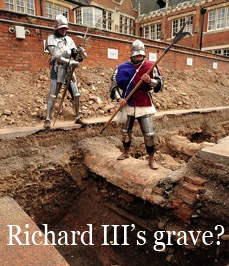
Note:  Archaelogists may have discovered the skeleton of Richard III beneath a car park in Leicester.  Wounds to the back and skull are relevant to those suffered by the King at Bosworth field.  The spine shows evidence of scoliosis, though not of a hunchback.  They hope to get an answer from its DNA.

How old is the Authorship Question?

The standard answer to this is the late nineteenth century, when Delia Bacon’s book, The Philosophy of the Plays of Shakespeare Unfolded, claimed that the Shakespeare canon was not written by William of Stratford, but was the result of a collaboration of a team of courtly writers led by Francis Bacon.  This, however, was only the moment when the issue was opened to the reading public at large, for the issue itself has been there ever since the first peeps of Shakespeare criticism.  As Albert Feuillerat explains in his Composition of Shakespeare’s Plays (1953), the question of the authenticity of the Shakespeare canon

has been raised with more or less insistence ever since the eighteenth century. . . .  Pope conjectured that in Love’s Labor’s Lost, the Winter’s Tale, The Comedy of Errors, and Titus Andronicus there was nothing authentic except a few scenes and some characters (1725). . . .  Similar doubts were expressed by Theobald regarding Henry V (1734), by Hanmer regarding the Two Gentlemen of Verona (1744), by Samuel Johnson regarding Richard II (1765), and by Farmer regarding The Taming of the Shrew (1767).  Ritson found some disparities so evident that in The Two Gentlemen, Love’s Labor’s Lost and Richard II he claimed he could distinguish Shakespeare’s hand as easily as one could recognize the brilliant brush strokes with which a Titian might have sought to touch up a mere daub.  Malone in 1790, in his often quoted dissertation on Henry VI, did not recognize Shakespeare’s hand except in some passages of the second and third parts and thought that the first part came entirely from one of Shakespeare’s predecessors. (32)

The difference between these early questioners and Delia Bacon is that they never disputed the existence of a William Shakespeare as author, however sparing his touch.  As lawyers and doctors began openly questioning the Stratford biography, Frederick Fleay and the so-called disintegrators got ever more severe in limiting the evanescent Shakespeare’s involvement in the production of the canon.  Clinging like drowning survivors of shipwreck to that crumbling bit of flotsam, the name itself, academics and their groupies continue to defend what, if one takes the long view, never really existed.  The first public attribution, by Francis Meres in 1598, is hardly solid since it stands alone while the book that introduces Shakespeare’s name to the reading public  was his only connection with the world of poetic literature.  The other attribution, that found in the First Folio of 1623, is fragile in the extreme, and nothing since has done anything to solidify it, quite the reverse.  We’re left with Authority’s age-old pronunciamento: “It’s so because I say it’s so.”

That someone wrote the magic and that during the 1590s the name William Shakespeare got attached to it along with a good deal else that’s questionable is all we can be certain of, and all that anyone could be certain of for a very long time.  Beginning with Delia, the search began to replace the name with that of a writer whose biography made more sense, keeping Shakespeare only to identify the canon, as in A.W. Pollard’s article of 1917: “Shakespeare’s fight with the Pirates,” in which by Shakespeare he meant, not the author, but the Lord Chamberlain’s Men and their precious playbook.

The questioning has taken new turns over the years.  At the beginning it must have been about who was writing the plays that began to be performed in the early 1590s.  This was answered in 1598 when three of the most popular plays were published as by William Shake-spear (Richard III) or Shakespeare (Richard II and Romeo and Juliet), the same time that it (the name) was introduced to the reading public via the Meres book as the author of several other plays as well, no doubt popular plays, and of  certain “sugar’d sonnets.”  Some readers were already familiar with the name from the title pages of two narrative poems published four and five years earlier, Venus and Adonis and The Rape of Lucrece.

Thus towards the end of the 1590s, long after the first versions of some of the plays had been seen by audiences (the Contentions and True Tragedies), they had a name for the author, but they never had the man himself.  The lack of any solid history of William’s presence in London, of letters to him from other writers or from him to other writers or from anyone to anyone else about him, suggests that the questioning must have continued, which the ambiguous wording of the front material in the First Folio was intended to put to rest.  That this wording continued through later editions suggests that the questioning continued until, as Feuillerat reports, the emphasis began to shift to questions about what seemed to be other hands of far less ability.

Long story short: the authorship question has been around from the beginning, it has simply shifted focus repeatedly from one aspect to another.  Where it rests at the moment, on which of several candidates actually wrote the works attributed to the Stratford money-lender, is only one stage in the long ongoing question of who actually wrote the canon, and, perhaps most important, why it’s taking so long to come up with an answer.

What is Shakespeare?

A word can mean more than one thing: a can can hold beer while to be canned can mean you can be fired from your job; you can be canned for driving with an open can in your hand.  By the word can alone we can’t know which of these is the intended meaning; that can only come from the context.  The meaning of “I’ve been canned” (I’ve been fired) as opposed to “it’s been canned” (what’s happened to my tomato) can only be determined by a pronoun.  Can, spelled differently, can even be a place on the French Riveria and or a film festival.

Language is a tricky thing.  It can hide as well as reveal.  It can hide while appearing to reveal.  Which is the case with the word Shakespeare.  First, it can mean the great poet and playwright; second the uneducated man from Stratford-on-Avon who was born with a similar name, though not pronounced the same; third, the body of work produced by the first; and fourth, a pun involving the shaking of a spear.  Which is the desired meaning can be understood by context: Shakespeare wrote Hamlet; Shakespeare was born and died in Stratford; I’ve read all of Shakespeare; the playwright shook a spear.  Our problem lies with an inability to distinguish among the first three: “I thought Shakespeare wrote Shakespeare.”

Writer vs. author

One good thing that came out of the semiotic mess of the mid-twentieth century is the understanding that while an author is always a writer, a writer is not necessarily an author.  A writer becomes an author only when his or her writing gets published and his or her name gets printed on the title page.  The two may be identically spelled, or they may not,  they may not even be the same name.  Mary Ann Evans was a writer, as an author she was George Elliot.  Daniel Nathan and Manfred Lepovsky wrote mysteries together, as authors they were both Ellery Queen.  When writing the Federalist Papers, Alexander Hamilton, James Madison and John Jay were PubliusMark Twain was really Samuel Clemens.  Lewis Carroll was really Charles Dodgeson.  And so forth.  The list of writers cum authors is long and would probably be even longer were all clearly identified.

From the very beginning of writing there’s been an issue over the author’s name.  Writing is one way of getting a message out that can’t be expressed any other way, so a large percentage of written material has come from sources that were unable to disseminate it directly through word of mouth.  Notes passed in class, anonymous letters, demands for ransom, are the result of situations where the writer can’t speak without fear of retaliation.  The Pentateuch, the first five books of the Old Testament, was probably written by priests at a time (or times) of stress when it was feared that what until then had been an oral tradition might vanish should none of those who held it in memory survive.  During the Reformation and the period leading up to it it was worth a man’s life to publish the Bible or any of its parts in anything but the official Latin.  With the invention of printing came two great and powerful instruments: first, the ability to disseminate writing to a far greater readership at almost a single stroke, and second, the power to hide its source.

Literature originated as speech.  The rules that governed self-expression back in ancient times, known as rhetoric, were created to help orators communicate verbally with crowds in public arenas.  It took centuries before these rules were altered to fit the needs of communications created solely for publication.  Shakespeare, who wrote most obviously for speakers but also, as Lukas Erne makes clear, for readers as well, represents a transition between the two.

With printing, suddenly a few hours of labor by a compositor and a pressman, and there were hundreds of copies ready for distribution.  With this also came the ability to cleanse the writing of the tell-tale handwriting that could lead angry authorities to the author of a manuscript, or to his secretary.  No sooner were presses imported from the Continent than laws were passed and rules created to make such mystification difficult: printers were licensed, printshops were limited to a fixed number and location, censors were appointed, the name of the printer and the author had to be published on the title page.  And of course as rules were created, methods were found for circumventing them, many of them used as often by the Crown as by its enemies, and far more successfully.  Which brings us back to Shakespeare.

It should be obvious that Shakespeare (meaning the author) was closely connected to the Crown, that is the central government of the nation.  The name William Shakespeare is not to be found on anything relating to the Stage or the theater until 1595 when it appears on a warrant for payment for a Court performance by the recently-formed Crown company, the Lord Chamberlain’s Men.  From then on the only reliable records connecting the name William Shakespeare to theatrical matters will come from this same source, the Lord Chamberlain’s Men––later the King’s Men, sanctioned, licensed, and protected by patrons who were, if not the monarch himself or herself, leading members of the Privy Council, responsible for all matters of Crown policy and its dissemination.

Shakespeare an instrument of the Crown

The fact that from the first the Lord Chamberlain’s Men were in every respect a Crown company is rendered ambiguous by their name, which deflects, probably on purpose, their roots as a part of the Court establishment, but the name does reveal the fact that, as an instrument of the Queen’s Lord Chamberlain of the Royal Household, their primary purpose was to entertain the Court and otherwise do the Court’s bidding in terms of what plays they put on and where, the Lord Chamberlain being the second most powerful member of the Privy Council, the Queen’s cabinet.  As second in power only to the Secretary of State, he was a major instrument of Crown policy, both creating it and enforcing it.

Shakespeare’s Company was preceeded by the first Crown company, the Queen’s Men; for whom the earliest versions of some of his plays were written.  Following the death of Elizabeth, the Company was more formally acknowledged by the incoming monarch as the King’s Men.  Their first actors and managers included some who had been entertaining the Court since Elizabeth first took the throne, first under her favorite, Robert Dudley, as Leicester’s Men, their manager and the creator of the first purpose built stage in London, James Burbage and his sons.

That from their organization by the Lord Chamberlain Hunsdon in 1594 until 1611 or thereabouts, their company playwright was one William Shakespeare is a fact known and accepted by all theater historians.  Towards the end of the 1590s they began to perform works by other writers, but that Shakespeare was their mainstay throughout their entire history until the Civil War shut them down, is evident from the history of publishing throughout that period and from what bits of evidence have accrued from other sources.

How strange is it then that no evidence that a William Shakespeare was ever recorded as having been seen or introduced at either Court, Elizabeth’s or James’s?  Ben Jonson, who took on the role that Shakespeare played earlier as leading author for the King’s Men was the Poet Laureate of the Court of both James and Charles I with clear ties to the King’s Lord Chamberlain, William Herbert, Earl of Pembroke.  Milton and Dryden were both Poets Laureate, and as such, instruments of the Crown, purveyors of Crown policy.  Molière, whose plays were written as much for the Court of Louis the Fourteenth as Shakespeares’were for Elizabeth’s, was a well-known member of the French Court community as was the poet Ronsard earlier to the Court of two French kings, and as were Ariosto and Tasso to the Court of the Princes of Este in Italy.

But at Elizabeth’s Court?  Nary a trace of William Shakespeare.

Why Burghley defended Oxford

Much has been made, by Alan Nelson and other Burghley appologists, of the seemingly kindly treatment by the Lord Treasurer of his reprehensible son-in-law.  I believe that William Cecil did love Edward de Vere, insofar as he was capable of loving anyone, at least at first, but there is a political side to this that must be acknowledged.  Nothing Cecil ever did, whether good or bad, was without political implications.

First, it seems most likely that Cecil was the major instrument in removing de Vere from wherever he was being cared for in 1554 to the household of Sir Thomas Smith.  Although Smith was a loyal constituent of the sixteenth Earl, the Smith family having been longtime residents of Saffron Walden in Essex, a short ride from the Oxford stronghold at Hedingham Castle, it was Cecil who was in a position to make the necessary arrangements, not his father the Earl, or his uncle Arthur Golding, nor Smith.  As his tutor at Cambridge, Cecil knew Smith well enough to know that he would make the perfect caretaker for the precious heir to the great Oxford earldom.  It was a firm belief of those reformers who instilled in Cecil the Reformation mantra that good government would occur only when young peers were raised as Protestants.

Smith was honest, honorable, sexually chaste (i.e., no pedophile), a dedicated Protestant, a great humanist scholar, and possibly the most highly regarded teacher of his time.  He had no legitimate child of his own, and, most important, was essentially out of work having lost his position as Secretary of State during Somerset’s great fall, then with the return of Catholicism under Queen Mary, his place as Provost of Eton.  Since Cecil was the only member of Edward’s reform government to remain (unofficially) in office following Mary’s accession, he was in a position to know when the boy had to be moved, for safety’s sake, before the anti-reform storm struck Essex early in 1555.

Cecil was also in a position to offer Smith a juicy quid pro quo in exchange for a year or two of taking care of the boy [I don’t imagine they had any idea the arrangement would continue for eight years]: Cecil happened to be in a position to arrange Smith’s second marriage to the widow of a former colleague at Court, a marriage that brought with it an excellent estate at the northern edge of the Forest of Waltham, which meant that Smith would be back in Essex, not far from his family in Saffron Walden, at an easy commuting distance from both Cambridge and London.  Further, there was probably the understanding that as soon as possible, Cecil would see to it that Smith got returned to a worthwhile position on the Privy Council.

It’s very likely that Cecil, and many others, were aware from the start that Mary’s health was dicey, and that it was unlikely that she would live for more than a few years, giving him time to lay the groundwork for her younger sister to take the throne, at which point de Vere would be safe and Smith could return to his old place on the Privy Council.  There’s no record of such a deal, but then there wouldn’t be.  Where evidence is lacking we must go by the nature of events, human nature and common sense.  We do know that once Elizabeth was on the throne and Cecil was Secretary of State––while Smith got nothing but a bone, JP for his district in Essex––he and Smith had a falling out that lasted two years.  We also know that as soon as the sixteenth earl was buried, Oxford went to London while Smith went to France as the English Ambassador.

Foreign ambassador was not what Smith had in mind, but at least it meant he had a foot back in the government door.  France brought mixed results for Smith.  Although his embassy was a failure (as were most Elizabethan embassies) he saw some buildings that left a strong impression on him, which he explored when he returned to renovating his new home in Essex.  He also had the opportunity to add important books to his library and to send some to Cecil and Walsingham.

Whether or not he had anything to do with it, the death of Earl John in 1562 enabled Cecil, by then Master of the Court of Wards, to bring young Oxford to London where he could oversee the finishing touches to his Protestant education, and, not least, to arrange for his marriage to his daughter Anne.  However Oxford attempted to keep his “lewd” poems to himself, Cecil, the premiere spymaster, was probably well aware of his writing, but thought little of it so long as the boy kept it to himself.  It’s interesting that two of the works of imaginative literature that issued from that community in 1565, Golding’s translation of Ovid’s The Metamorphoses and Painter’s translations of the French and Italian tales in the Pallace of Pleasure, were dedicated to the Earl of Leicester.  Only scholarly works and sober works of Reformation dogma were ever dedicated to Cecil.

Cecil must have been pleased that Oxford turned out to be so popular at Court, and that his talent gave him access to the Court Stage.  With the advent of the Earl of Sussex as Lord Chamberlain in 1572, Cecil, now Burghley, saw the political advantage to his own interests when Sussex, under pressure to take control of Court entertainment away from his hated rival, the Earl of Leicester, opened the door to Oxford’s control of the Court Stage, as Sussex worked to remove it from Leicester’s control.  He may even have been party to the decision to let Oxford have a year in Italy to learn how to produce public theater from Francesco Andreini and theater building from Andrea Palladio.

Following Oxford’s return, Privy Council members Burghley and Leicester would have to know of plans being made by fellow Countil members Sussex, Hunsdon and Lord Charles Howard to create a public theater where the Court could control the kind of plays produced.  That Oxford took the moment of his return to break with the Cecils was unfortunate for Burghley, but while his heart remained bitter, politics demanded that he do everything he could to mend the breach, partly for his daughter’s sake, but also to have some say in the process as plans continued to create a channel between the Court Stage and the public.  Burghley pretty much had total control of the Press, which he had helped to create.  He wasn’t about to hand over control of the Stage to either Leicester or Sussex.

The first open breach between Burghley and his former ward came with Oxford’s banishment from Court in 1581 for impregnating the Queen’s maid of honor, Ann Vavasor.  Perhaps more disturbing than the insult to Burghley’s daughter, Oxford’s wife, were the plays that he was writing for the adult actors to perform at the little Blackfriars school stage, including an early version of Hamlet in which, as he heard from his sister-in-law, who lived near the theater, he himself was being parodied as Corambis (later Polonius) and that Oxford had dared to draw parallels between the recent death of Sussex and the infamous murder some years earlier of the Italian Duke of Urbino.  But again, political necessity overrode all else.  For the sake of Court solidarity as well as his family, Burghley had to do whatever he could to get Oxford back in the fold.  The Queen looked to him to keep his family in line.   He simply had no other choice.  Later he whined in one of his memos to posterity, “No enemy I have can envy me this match.”

Relief came with Walsingham’s plan to create a Crown company.  Oxford would return to the Court with a real and important task, to provide the new Crown company with plays that would promote understanding of England’s present danger by comparing the present stand-off with Spain to other times in history.  This allowed Walsingham to create a propaganda office made up of the crew of secretaries and musicians that hung out at Oxford’s manor, Fisher’s Folly, located just outside Bishopsgate, a few steps from his own residence, the Papey, just inside the gate.  With Oxford’s own credit stretched to the breaking point, Walsingham provided the funds to hire more secretaries, among them young Francis Bacon and even younger Christopher Marlowe.

These together with George Peele, Thomas Kyd, Thomas Watson, and Thomas Lodge (the so-called University Wits), provided plays for the children’s companies to entertain the Queen and her visitors while Oxford concentrated on writing for the Queen’s Men and other adult companies.  This is when The Famous Victories, The True Tragedies and The Contention plays were written that would be revised in the nineties as the Lancastrian history cycle (Richard II to Richard III), for the Lord Chamberlain’s Men, the second royal acting company.  Eventually Walsingham was able to persuade the Queen to pick up at least part of the tab by giving Oxford an annuity at the same time that she provided the Secretary with the money he needed to protect England from Spain.

Although Oxford agreed to the Queen’s demand that his return to Court depended on his return to his wife, it’s unlikely that he ever again shared any real home life with Anne.  He must have set up a situation where it could appear that they were a family once again, providing the Cecils with three more girls and a boy who died shortly after birth, while he continued to spend most of his time at Fisher’s Folly or one of the theaters.  Unable to tolerate the interference with his life that was simply part of Burghley nature, Oxford’s remorse over what this did to Anne, and to his daughters, is reflected in the plot or sub-plot of at least six plays, from Pericles to Othello.

Several events in the late 1580s to early ’90s caused the final rupture between Milord and the Cecils.  The first was the 1587 break between Christopher Marlowe and the Crown, when Marlowe and Edward Alleyn brought the anti-establishment play Tamburlaine to Henslowe’s Rose Theater on Bankside, where its popularity posed a threat to the social calm at a time of increasing political unrest.  As co-creators of the London Stage, both Walsingham and Oxford were doubtless blamed by Burghley and Whitgift for this breach of contract by two of their players.

The second was the death of Walsingham in 1590, and the immediate takeover of his office and his papers by Robert Cecil, who, with the help of his father, set to work immediately to put a stop to the escapades of the Fisher’s Folly crew.  Shortly after Anne’s death in 1588 Burghley had moved to end Oxford’s ability to get credit, forcing him to sell Fisher’s Folly in 1589, and Vere House at London Stone a year later (ironically to one of the major enemies of the London Stage).  University Wits Robert Greene and Thomas Watson were the first to go, “dying” on the same day in 1592.  Marlowe and John Penry, scapegoat for the crew that produced the antiestablishment Mar-prelate pamphlets, were eliminated within 24 hours of each other early in 1593.  The patron of the company that produced Tamburlaine, Lord Strange, was murdered the following year, just as the majority of his company was being reorganized into what would soon be the new Crown company.

If Burghley had any sentiment left for the golden-haired lad whose fate he had engineered almost from birth, it was gone.  Suffering from overwork, gout, and self-pity, he saw only the ungrateful son-in-law, who had fathered a fine bastard but failed to give him the heir he felt he deserved, and who had somehow managed it so that there was nothing left of the great Oxford earldom to pass along to his grandchildren.  If the final version of Hamlet reveals the truth about Anne Cecil’s final hours, Burghley’s bitterness is understandable.  As for Oxford, forced to work in silence and secrecy, his identity and true meaning masked by pun-names and ambiguous wording, the poet yet had one great weapon, the truth, and his actors.

It was when Cecil attacked the Company that the break flared into open warfare.  Too many people cared about the Stage to let Robert Cecil destroy it.  Lord Hunsdon, by then Lord Chamberlain of the Household, together with his son-in-law, Lord Admiral Charles Howard, stepped forward to save it, but when Cecil, finally having acquired the power of the Secretary of State, shut down their new theater in advance of the Parliament of 1597, leaving them with no stage of their own, with the following deaths in rapid succession of both manager Burbage and patron Hunsdon, the company itself, and its playbook were on the ropes.  Out came the spear (his pen), up went the curtain, out came Richard Burbage, dressed like Cecil, his back hunched over, his imitation spot on; out came the first edition of the play for those who missed the performance; and Cecil’s reputation was done for.  He still had his power, but without a good name he was helpless to accomplish anything important.

Halted in his villanous progress by the 1597 production and publication of Richard III, with its obvious portrayal of himself as the evil Lancastrian King, having chased Oxford into hiding in the Forest, he did whatever he could to erase any connection between his brother-in-law and the London Stage.  Having achieved the ultimate in political power, though he survived him by only three or four years, that was enough time to burn almost everything that connected Oxford directly to the world of English literature, and everything that connected himself and his family to any of the characters in Oxford’s plays.  Oxford had destroyed his good name, but he got the last laugh, destroying any connection between his hated brother-in-law and the English Literary Renaissance.

Did Oxford translate some of Plutarch’s Lives?

Can the crossovers between North’s Plutarch and Shakespeare’s Coriolanus be explained by Oxford translating this section of North’s book?

It’s a set piece of literary history that for the Greek and Roman plays, Timon of Athens, Julius Caesar, Antony and Cleopatra, and Coriolanus, Shakespeare’s main source was Sir Thomas North’s English translation of Amyot’s French version of Plutarch’s Greek Lives of the Noble Greeks and Romans.  Having found similar repetitions in other supposed sources and apocryphal works where the likelihood is that Shakespeare, i.e., Oxford, was not stealing, but was simply repeating what he himself had written earlier, when years ago I read that in certain places, Shakespeare repeated North’s language word for word, it struck me that he might have prepared himself to write these plays by reading and translating Amyot’s Plutarch into English, then publishing it as someone else’s who could use the money.

We know from Burghley’s records that Oxford owned a copy of Amyot’s French translation since it’s one of the books he bought from Seres in 1569. He would have been well-acquainted with Plutarch even then, from eight years with his tutor’s library where it’s listed in both the original Greek and Latin translation.  In all probability, Smith followed standard procedure by using Plutarch to teach young de Vere good language use and ancient history.  Himself a Platonist, Plutarch’s Platonism would have been another plus for Smith.  Geoffrey Bullough, in his chapter on Coriolanus, includes the ancient Titus Livius and Dionysius of Halicarnasus as possible sources, both on Smith’s library list: Livy in the original Latin and Dionysius in the original Greek as well as Latin translation.  Because there was no English version of the latter in Shakespeare’s time, Bullough has to dismiss it as a direct source except as it influenced Plutarch, though he does include it, I suppose for that reason.  He attributes Shakespeare’s knowledge of Livy to a 1600 translation by Philemon Holland.

Plutarch was one of the major voices for the European Renaissance.  As the Encyclopedia Britannica puts it:

His Lives of the Noble Grecians and Romanes, translated in 1579 from Jacques Amyot’s French version of Plutarch’s Parallel Lives, has been described as one of the earliest masterpieces of English prose.   Shakespeare borrowed from North’s Lives for his Roman plays—Antony and Cleopatra, Julius Caesar, Timon of Athens, and Coriolanus—and, in fact, he put some of North’s prose directly into blank verse, with only minor changes.  (2006)

And as North’s ODNB biographer puts it:

North’s fame, since Samuel Johnson’s contention that Shakespeare had read Plutarch in North’s translation . . . has rested in the dramatist’s having, among very much else, thrown “the very words of North into blank verse.”  Shakespeare’s acquaintance with North’s translation probably derived from the printing house of Richard Field, whose presses may have been at work on a 1595 edition of [North’s] Plutarch at the same time that they were printing Shakespeare’s Lucrece in 1594 . . . . North’s translation influenced profoundly not only the larger narrative structures of Shakespeare’s Roman plays but innumerable local shapings of their language . . . .

Jacques Amyot’s 1559 translation of Plutarch came from studying manuscripts in the Vatican.  North’s English translation, published by Vautrollier in 1579, was based on Amyot’s third edition, published in 1574.  Richard Field, Vautrollier’s former apprentice, published the second edition of North’s verson in 1595, and a third in 1603.  As we know, it was Field, whose print shop was spitting distance from Oxford’s Blackfriars theater school, who, two years earlier, had published Venus and Adonis, the first published work to bear the Shakespeare name.

Nothing directly connecting Oxford with North has come readily to light (although it’s clear the author of his ODNB bio found their names linked in a 1591 document with that of Sir Julius Caesar).  The younger brother of the first Baron North, Thomas North (his knighthood came later) appears to have struggled throughout his life with that bane of a second son, poverty, which is not to say that he wasn’t a genuine translator, though according to the author of his ODNB bio, his influential 1557 English translation of de Guevara’s Diall of Princes did have some authorship issues:

It seems likely, . . . from comments made by North in the second, revised, edition of The Diall (1568), that the first edition was not altogether well received for more literary reasons: “detracting tongues,” he wrote, had given out that the translation “was no work of mine, but the fruit of others’ labor.” (Lockwood)

If North was not the real  or sole translator of Diall of Princes, published in 1557, the real author could not have been Oxford, who at age seven was still living with Smith in Buckinghamshire.  (If nothing else this comment shows the kind of suspicions that were rampant at that time about the authorship of so much literature of the imagination.)  During the period that the Diall of Princes was translated, North was enrolled at Lincoln’s Inn, where he remained until sometime before 1568, where, like so many other Inns of Court gents, he may have crossed paths with Milord during Oxford’s years at Cecil House (1562-68).  Oxford’s senior by 15 years; North’s nephew, Lord North’s son John, was Oxford’s contemporary, but he died before his father so the title passed to his son, North’s grandson, in 1600.

Lord North was a client of Leicester’s, and therefore not likely to have been particularly concerned with the young Earl of Oxford’s interests or welfare, but that’s not to say that his relations followed suit.  His grandson, Dudley, 2nd Baron North, was a member of the literary circle surrounding Prince Henry.  It’s worth mentioning that, during the Elizabethan era, Lord North owned the most gorgeous of all Chaucer manuscripts, the Ellesmere Chaucer, created in the 14th century as a gift for the 12th Earl of Oxford.

Shakespeare and Coriolanus

One of the Plutarch biographies from which Shakespeare borrowed most heavily, Coriolanus was probably written originally for the winter holidays, late 1582 to early 1583, the period when Walsingham and Sussex were engineering Oxford’s return to Court.  This required that he make amends to the Queen and his in-laws, for which the story of Coriolanus must have seemed ideal, providing a graceful mea culpa for the Court while for the public it functioned as a moral tale addressing the current civil unrest over rising food prices and the increasingly harsh punishments being meted out to followers of the Old Faith.

This would not be the first time Oxford had used Plutarch.  Following his return from Italy in 1576, freaked out by the realization of just how much trouble he was in financially, he had turned to Plutarch’s biography of Timon of Athens, pouring his bitter disillusionment with the Court and his fair-weather courtier friends into the earliest version of what someday would be known as “Shake-spear’s” most angry protagonist.  Then, following his banishment, aware that some were still contented to believe he was a two-faced traitor, he turned again to Plutarch to explain himself via Coriolanus.

Because Oxford’s enemies wanted him seen as a traitor, they promoted the story that he had been planning to run away and fight for Spain.  Coriolanus is evidence that this may be true, or at least, that he had talked rather recklessly about doing it.  Recall that following the untimely birth of his son, he was stopped on the road to Dover in an obvious attempt to flee the country.  To Spain, they said, where he intended to take advantage of an offer to lead a contingent of the Spanish army.  Though not in exactly the same situation as Coriolanus, he too was being charged with treason, something that, unlike the ancient Roman general, he had no means of confronting openly.  Like Hamlet and Hieronymo in The Spanish Tragedy (both first written about the same time) a play was his way of explaining himself to the Court and his West End community, with the onstage murder of the protagonist in the final act a form of symbolic suicide.

In the inevitable effort to place Coriolanus as late as possible, Bullough tries to connect public unrest in Republican Rome with that of 17th-century England, not all that convincing, public unrest having been endemic throughout the reigns of both Elizabeth and James.  Because the time period he’s chosen, 1605, falls just when England finally made peace with Spain, Bullough makes no effort to make the most obvious connection, namely the similarity of the threat to England from Spain  throughout the 1580s and ’90s to the fears of the ancient Roman authorities over the threat from the Volscians.  He also ignores the startling relevance of the martyrdom of the aristocratic Coriolanus at the hands of the hoi polloi to the calls for more freedom of speech from puritan members of Parliament.  The skewed dating forced on historians by William’s biography won’t permit even the most logical and obvious questions to be given consideration.

It struck me long ago that the role of Menenius could easily be one of Oxford’s more benign depictions of Burghley, while the realistic family scenes with Volumnia and Virgilia just might be snapshots of life at Cecil House.  If the militant Volumnia was meant to represent Mildred Burghley, it reinforces Peter Moore’s take on Oxford’s relationship with his mother-in-law.  Perhaps she represents a combination of all four of the Cooke sisters, including the ferocious Elizabeth Russell, whose proximity to the little Blackfriars theater school gave Lady Russell the power to torment Oxford during the period he was fighting to keep the little stage going, the same period when this play was probably written.

All of this is just the most cursory glance at what seems to me to be an important area of inquiry.  Has some scholar compared North’s biographies with each other to see if they display the same high level throughout?  Are some better than others, those perchance that were the ones used by Shakespeare?  Has anyone capable of the French involved compared the French of Amyot with the English of North to see how much North’s skill depends on Amyot, and how much was his alone?  We’re told the 1595 edition varies in some respects from the 1579 original.  In what way ?  What has been added, and to which of the biographies?  Shakespeare refers to incidents in a number of the Lives in his works, but only these four were the basis for individual plays.

Finally, there are two prefaces to North’s Plutarch, both signed Thomas North, January 1579, one dedicating it to the Queen, the other the traditional letter “To the Reader.”  Both sound for all the world like Oxford’s dedicatory letters, the one in English to Bedingfield’s 1573 translation of Cardanus Comforte, and the one in Latin for Bartholomew Clerke’s Latin translation of  Castiglione’s The Courtier.  The same kind of points are made, the same opinions about what is important in literature, even his daring use of the word love.  I’ve read an awful lot from this time––in my opinion, no one else writes like this:

To the Reader

The profit of stories and the praise of the Author are sufficiently declared by Amyot in his epistle to the reader, so that I shall not need to make many words thereof.  And indeed, if you will supply the defects of this translation with your own diligence and good understanding, you shall not need to trust him; you may prove yourselves, that there is no profane study better than Plutarch.  All other learning is private, fitter for universities than cities, fuller of contemplation than experience, more commendable in students themselves than profitable unto others.  Whereas stories are fit for every place, reach to all persons, serve for all times, teach the living, revive the dead, so far excelling all other books as it is better to see learning in noblemen’s lives than to read it in philosopher’s writings.  Now, for the author, I will not deny but love may deceive me, for I must needs love him with whom I have taken so much pain, but I believe I might be bold to affirm that he hath written the profitablest story of all authors.  For all other were fain to take their matter as the fortune of the countries where they wrote fell out; but this man, being excellent in wit, in learning, and experience, hath chosen the special acts of the best persons, of the famousest nations of the world.  But I will leave the judgement to yourselves.  My only purpose is to desire you to excuse the faults of my translation with your own gentleness, and with the opinion of my diligence and good intent.  And so I wish you all the profit of the book.  Fare ye well.  The four and twentieth day of January, 1579.

To the Most High and Mighty Princess Elizabeth
By the Grace of God, of England, France and Ireland
Queen, Defender of the Faith, etc.

Under hope of Your Highness’ gracious and accustomed favor, I have presumed to present here unto Your Majesty, Plutarch’s Lives translated, as a book fit to be protected by Your Highness and mete to be set forth in English.  For who is fitter to give countenance to so many great states than such an high and mighty Princess?  Who is fitter to revive the dead memory of their fame than she that beareth the lively image of their virtues?  Who is fitter to authorize a work of so great learning and wisdom than she whom all do honor as the muse of the world?  Therefore I humbly beseech Your Majesty to suffer the simpleness of my translation to be covered under the ampleness of Your Highness’ protection.  For, most gracious Sovereign, though this book be no book for Your Majesty’s self, who are meeter to be the chief story than a student therein, and can better understand it in Greek than any man can make it English, yet I hope the common sort of your subjects shall not only profit themselves hereby but also be animated to the bettter service of Your Majesty.  For among all the profane books that are in reputation at this day there is none (Your Highness best knows) that teacheth so much honor, love, obedience, reverence, zeal and devotion to princes as these Lives of Plutarch do.  How many examples shall your subjects read here, of several persons and whole armies, of noble and base, of young and old, that both by sea and land, at home and abroad, have strained their wits, not regarded their states, ventured their pesons, cast away their lives, not only for the honor and safety, but also for the pleasure of their princes.

Then well may the readers think, if they have done this for heathen kings, what should we do for Christian princes?  If they have done this for glory, what should we do for religion?  If they have done this without hope of heaven, what should we do that look for immortality?  And so adding the encouragement of these examples to the forwardness of their dispositons, what service is there in war, what honor in peace, which they will not be ready to do for their worthy Queen?

And therefore that Your Highness may give grace to the book and the book may do his service to Your Majesty, I have translated it out of French and do here most humbly present the same unto Your Highness, beseeching Your Majesty with all humility, not to reject the good meaning but to pardon the errors of your most humble and obedient subject and servant, who prayeth God long to multiply all graces and blessings upon Your Majesty.

Written the sixteenth day of January, 1579.
Your Majesty’s most humble and obedient servant,
Thomas North.

The Murder of Shakespeare’s Identity: Acts I through III

One of the reasons why it’s been so hard to convince the world that the Stratford story is a sham is that no one’s ever come up with a single strong reason why the true author’s identity had to be hidden.  Those who first drew the public’s attention to the subject in the 19th century pointed to his obvious knowledge of Court life, claiming that courtiers of stature would have hidden their involvement in the then déclassé public stage.  Certainly this is true, but for most it doesn’t explain why the cover-up had to continue so long after the author’s death.  Sir Philip Sidney’s work was in print, over his name, six years after his death.  Oxford’s uncle, the “Poet Earl” of Surrey, was similarly published over his within ten years of his death.  So why not Oxford’s?

Most of the bigger things in life occur for more than one reason.  If you look at your own life, you’ll see that you went to college for more than one reason, that you picked a particular college for more than one reason, that you married a particular person for more than one reason, changed jobs, bought a house, divorced, always for more than one reason.  Nations go to war for more than one reason, and resist going to war for more than one reason.  Just so, the Shakespeare authorship got hidden for more than one reason.

Had this not been the case, had it not been first to one person’s advantage (his own), then his tutor’s advantage, then to his guardian’s advantage, then to an entire community’s advantage, and ultimately to the advantage of the company he started, one that initiated an industry that has come to be seen as the fourth branch of government, the voice of the people, the truth would surely have been revealed somewhere.  But it wasn’t, it didn’t, and some of these reasons have not faded with time.  For the fact is, that there never was, during Oxford’s lifetime, any advantage to him, to his family, to the theater companies he created and those who profitted by them on into succeeding centuries, for the truth to be revealed to the public; never any advantage to any of these, and plenty of disadvantages.

Not everyone who knew the secret knew it in its entirety, that is, some knew one thing, some another, but the likelihood is that no one knew all that he was writing, or later, all that he had written.  Even to this day there is disagreement over what was his and what was by some other writer or editor.  The committee that produced the First Folio could collect versions of the plays from the various friends, actors, and printers who held them, but how sure could they be of what was and wasn’t his?   Nothing was signed, and because like most men of his class, he dictated to secretaries, nothing was in his own handwriting.

Certainly the Queen knew that particular plays were his, at least since 1598, when the Meres book was published, at least of those plays named by Meres and most likely a dozen more, but it is very likely that of the 38 accepted plays and the 15 to 20 suggested early plays, there were some that she knew nothing about, and those she knew may very well have differed from the versions we know, because it was not advisable that she know the versions played for the West End audience, or on the road, or for a particular private gathering.

As Secretary of State, Oxford’s guardian (then his father-in-law) William Cecil/Ld Burghley had oversight over the press, so he knew all  about using both the stage and the press for propaganda; it’s a fact that he made use of both in his early years as Elizabeth’s first Secretary of State.  Burghley was instrumental in bringing printers over from the Continent to publish those works he considered essential to a reformation education.  Though unfortunately his biographer, Conyers Read, does not elaborate, he refers to the press as “the weapon Cecil knew best.”  Since Oxford lived with Cecil during the years he first began to publish, years when Cecil was doing his own propaganda, it was from him that he learned how to publish on the sly.  Knowing him as well as he did, he also learned how to work around him.

ACT I: Hidden in plain sight

When he first began to write, no one, including the boy himself, had any idea where it would take him or how important his work would turn out to be.  In fact the field in which he would flourish so luxuriously, English literature, hardly existed before he began transforming it.  Given the intense, bustling environment at Cecil House, surrounded by poets and translators in that important age group for a young artist, six to ten years his seniors; then in his late teens at Court, with a ready-made audience hungry for sophisticated, educated entertainment; what would end as the most important body of work since Chaucer two and a half centuries earlier began simply as a lark, a folie, a bit of “pickle herring,” something to entertain the lads at Cecil House, then the ladies at Court.

The authorship issue was never about writing anyway, it was always about publication.  So long as he wrote just for the Court community via the traditonal handwritten manuscript exchange there was no problem.  But creating hundreds of printed copies for sale to all comers meant making public what the Court saw as its own private pleasure, making it available, if to a far smaller public than today’s where almost everyone can read, yet it meant revealing it to the same 15 to 20 percent of the population most eager to pry into Court secrets.  And it was publishing that interested Oxford.

Writing was no big deal, everyone he knew did it.  It was creating books that fascinated him; books, those magical vehicles of culture, that could carry a man’s life and reputation for hundreds, thousands of years into the future so that readers would come to know someone like Alexander the Great, or even the mythical Achilles, as though they had lived with him; knowing him better in some ways than they knew their own families. Publishing was also the best means of hiding his identity as author.  While handwritten manuscripts could be traced back, if not to directly to himself, then to someone who knew who wrote it, typeset print was anonymous.  All that identified the author was the name on the title page, or registered with the Stationers, and that could be faked a lot more easily than handwriting.

Taking advantage of the traditions of his class as patrons of the arts, Oxford began a long career of publishing what he regarded as important works, some by  his friends, some his own, some translations of famous foreign works, , some about science, or music, or psychology, or  but mostly works of the imagination, stories and poems.

In this he was also following in his guardian’s footsteps, although most of what he considered worth publishing differed considerably from Burghley’s view of what was important.  Reformation ideologues, William Cecil and his in-laws occupied the legal and social center of a deadly serious, extremely repressive Reformation culture that saw adherence to Protestant beliefs as paramount.  They also saw sex as filthy and satire as rebellion.  So Oxford’s first step in what would become the long and complex process of hiding his authorship began by persuading pals like George Gascoigne and his uncle Arthur Golding to let him use their names so he could get his plays and poems published without Burghley’s permission, possibly even without his knowledge of their source.

Though not aware of everything Oxford wrote, William Cecil must have been aware of his ward’s talent.  That would have been impossible to hide, and, as a propagandist himself, he probably saw the boy’s gifts as something he might put to future use.  The ward, however, was destined to take a different path in life, one he wanted his guardian, and his guardian’s wife, and her family (and perhaps even his own wife), to know as little about as possible.  In his teens, his writing was just a lark, something to entertain his friends before settling down to––as he would often term it––“a graver labour.”

By his late teens, when he was more or less on his own at Court, there was no need to hide from the other members of the Court things like his madrigals and interludes written for holiday performance.  On the other hand, satires or poems that touched dangerously on intimate matters, however discreetly distributed within his own circle, must inevitably have spread further, raising eyebrows along with the question of their authorship.  So long as none of this escaped the confines of the Court community there was no real harm in it.  But when, just before taking off for a year on the Continent, in a first of many anthologies, he published along with love poems by himself and his friends, a “tale” that dwelt too obviously on the sex lives of certain courtiers, it released a firestorm of furious retribution.  This did nothing to prevent him from publishing, but it did help to make him more cautious about what and how he published.

ACT II: Birth of a professional

Then in 1572, when the Earl of Sussex came on board as Lord Chamberlain of the Royal Household, what had begun as a lark began turning serious.  At that time it was still the Earl of Leicester who ran the Court Stage, but Sussex, who hated Leicester, was determined to get the oversight of Court entertainment back where it had been for centuries, in the Lord Chamberlain’s hands, that is, under his own control.  And unlike Leicester, whose taste ran to more old-fashioned stuff, Sussex understood how important the Court Stage could be in winning hearts and minds, not only at Court, but with the influential West End community that lived and worked within walking distance of Whitehall.  Quickly bored by the constraints of what he could and could not produce at Court, it was this audience he was most eager to reach.  Thus it was that the choristers at Paul’s Cathedral, known to theater history as Paul’s Boys, began performing Oxford’s plays, first at Court, then for a week or two after, at the little theater connected to the Cathedral.

If a professional is defined as someone who works to a schedule, who provides for a public demand, who competes successfuly with others in the same line, as opposed to someone who merely hangs out a shingle, frames a certificate, and earns a living wage, then by age 25 Oxford was functioning as a professional dramatist.  Not that that was his ambition; not at all.  His ambition from childhood had been to follow his ancestors as his nation’s foremost military leader.  Fate, however, had other plans.  The times were not right for someone of his station to risk his life in dubious battle––not while the British Media was straining to be born.  Paul’s Boys were only one of a number of companies that sprang into being at that time, foremost among them the men who wore Leicester’s livery, but who were free to play for anyone who could pay.

As competition for space at the theater inns became intense, trouble with the City officials increased.  For them it was one thing to deal with the rowdy holiday crowds for a few weeks in December and January,  a tradition too old and too ingrained to stop, even for determined Reformation puritans, which is what most London mayors were at that time––but to allow it to continue on into the spring and summer was, so far as they were concerned, simply out of the question.  Their escalating demands to “pluck down” the theaters drove the Privy Council to seek solutions.  Thus it may well have been Sussex who persuaded Burghley and the Queen to finally let Oxford have his much desired tour of the Continent, particularly to Italy where he could see at first hand how the Italians did it.

To Sussex and his relatives on the Council, Lord Hunsdon and Lord Charles Howard, the Stage as a factor in English society was obviously not going to be suppressed.  Rather than fight it, they must join it, regulate it, and use it to promote Crown policy.  That this was in any way the motivation for Oxford’s trip would have to be kept to themselves, since any sign to the City or the Clergy that the Council’s interest in the burgeoning London theater went beyond the Queen’s right to her “solace” would cause even more trouble than was already the case.  For Burghley this may have seemed like a way to keep his wayward son-in-law in the fold.  For enemies like Leicester and Hatton it meant getting him out of the way, at least for awhile.

Oxford had a lot of reasons for wanting to visit Italy.  Not only was it the source of the Italian Renaissance, of the western world’s most dazzling art and architecture, home to painters like Titian, scholars like Jerome Cardan and poets like Tasso, it was also where the immensely popular comedia dell’arte troupes were performing on the streets and in the halls of princes, and where the great architect Andrea Palladio was constructing experimental theaters of the sort that he and Sussex and Hunsdon thought might be the answer to their greatest need.  They had the actors, with Oxford they had the scripts, they certainly had the audiences, and in James Burbage they had both an actor and a builder who had already built one public theater that, unfortunately, had failed.  What they needed were better locations and better theater designs.   It may be that while Oxford was in Italy, they were already at work on plans for these.

That this was one of the most important reasons for Oxford’s trip seems obvious by how the first two commercially successful, yearround, purpose-built stages in England (possibly in all of Europe) began taking shape within weeks of his return.  With two theaters, several adult companies and three companies of boy choristers hungry for scripts, Oxford was now a fully fledged theater professional, duty bound to keep them satisfied, and desperately in need of assistance.  This came with his acquisition of the manor known as Fisher’s Folly located in the heart of the theater district.  With the financial assistence of patrons like the Italian banker Benedict Spinola, the music of artists like the Italian Bassano brothers, and the transcription skills of secretaries like John Lyly, Anthony Munday, Thomas Watson, Thomas Kyd, and eventually Francis Bacon, Oxford was off and running.

It’s hard to see where he found time to write the first two novels in English history, Zelautoand Euphues, the Anatomy of Wit.  With these he performed the first of his great upward leaps in style.  What we call euphuism may already have been a fad at Court by the time that he both raised it to an art form and dealt it its death blow, for having taken it to its peak, there was nothing left but to turn it to satire, some of it his own.  It does give us an idea of what some of his plays from this period were like.  In any case, now that he had secretaries he no longer had to beg the use of their names from friends or family members.  And since no one at that time saw any point in publishing playscripts, the issue of their official authorship had yet to appear.

ACT III: Banished: The second leap

Court life was never easy for Oxford.  He tended to drink more than was healthy and spend more on clothes and luxuries than was wise.  He got caught up in dangerous intrigues and overreacted to the rivalries that surrounded him.  Young and handsome, the temptations of sex and the hungers of his heart got him involved with too many women, none of them his wife.   His Catholic cousins played on his sympathies and on his bitterness towards Burghley and Leicester for their use and misuse of his estates.  Believing himself to be in love with one of the Queen’s Maids of Honor, he dreamed of escaping with her to Spain where he’d been promised military action and a decent income.  It all came crashing down when the dishonored Maid gave birth to his bastard in the Queen’s chamber, and he found himself in the Tower for two months, then banished from Court indefinitely.

However wounded his pride, exile gave him the space he’d been craving and rage gave him the impetus to take the second of the three great quantum leaps in self expression that would ultimately place him in the pantheon of the world’s top creators.  No longer bound to produce lighthearted comedies for the Court, he turned to writing tragedies for the West End, both the classic Greek and bloody Senecan varieties.  With Sussex dead and Walsingham pressing for history plays for the newly formed Queen’s Men, he took refuge in the familiar preoccupations of his childhood, studying the papers that Richard Field and others were preparing to publish in Holinshed’s name, some of which came from his old tutor Smith.  Reading and translating Roman poets and Greek plays, his style deepened.  Trimmed of euphuistic artificialities, the old fourteeners replaced by iambic pentameter, the most natural rhythm for English, he spoke more simply, directly, and powerfully to the audience he cared most about.

Although by June of 1583 he’d been accepted back at Court and had returned at least to the appearance of living with his wife, he was by then too deep in the production of the works that meant something to him, and to the lifestyle that allowed him to produce them, to ever go back to full attendance on the Queen.  She craved a return to the early days when he was always around, dancing attendance and producing the kind of entertainment he’d taught her to prefer, but there was no privacy at Court, and he had to have privacy to write.  So there developed a neverending tug of war between them, him straining for freedom, which she would continue to dangle before him but with no intention of giving him anything that might mean losing him.  He was the goose that laid the golden eggs that made her Court so popular, and at so little cost to herself.

Restless, seeking new outlets, it was during this period (1582-92) that Oxford launched the English periodical press with the series of pamphlets he published as by Robert Greene.  After 1589, when Bacon joined him with their joint attacks, first on Martin Mar-prelate, then on Marlowe and Alleyn, they kept the fun going with a phony pamphlet war in which Bacon’s fictional persona, Thomas Nashe, and Oxford’s fictional version of poor Gabriel Harvey (very much alive but in no position to do any kicking), taunted each other with hilarious abandon, thus establishing the first audience for what would evenually become the British tabloid press.  Unfortunately for the lads, neither the Cecils nor the Bishops saw the humor in this, and with Robert Cecil approaching an age where he could enter the fray, the stage was set for the final act in the birth of the English Stage, the creation of the fictional author, William Shake-speare, poet, playwright, actor and sharer.

Coming:  Act IV: Shakespeare: The third and final quantum leap

Theatrical birth pangs: 1776 to 1584

Early in April 1576, following a year of exciting adventures on the Continent, the Earl of Oxford arrived back in England to a sea of troubles.  During his final days in Paris, someone from home had prepared him for the gossip he’d encounter on his return.  Rumor had it that his daughter, born during his time away, was another man’s child.  Worse, it was even rumored that that other man was his wife’s own father, Lord Burghley, who, concerned that after five years of marriage there was still no Cecil heir to the Oxford earldom, had taken matters into his own hands.

This of course was nothing more than foulest, cruelest rumor, and Oxford would have cause to work different versions of the dreadful story into six plays over the years, but in his hot youth, when touched where he was most vulnerable, he was all too easily roused to unthinking fury.  Brooding on this and other worries, his mood was hardly improved when the ship that carried him accross the Channel was boarded by pirates and all he had with him was lost.  Ignoring his well-intntioned brother-in-law, Thomas Cecil, who had come to meet him at Dover, he returned to London with one of the “lewd friends” that Burghley so disliked.  Refusing to have anything to do with either his wife or her father, he rented rooms at the Savoy and turned his attention to plans already in progress to create the suburban theaters that he and Sussex and Burbage agreed were the only way to accommodate the burgeoning London theater audience in a way that would stop the constant interference by the Mayor and other London officials.

Once Oxford calmed down, the truth about his daughter must have been obvious, but by then he also realized how important it was that he break off as completely as he could with Burghley, whose habit of prying into everything he did or said was driving him mad.  He was not in love with Anne, never had been, and although he was sorry for her, stuck as she was between her husband and her father, he had his life to live.  If Burghley wouldn’t let her go, then let him keep her, “for there, “ he wrote, “as your daughter or her mother’s, more than my wife, you may take comfort of her, and I rid of the cumber thereby.”  The future Shakespeare was never one to mince words when he was sore.

Within days of his return a huge new theater began taking shape in the outskirts of northeast London.  Based on temporary stages he had seen in Siena built by Palladio and on plans for theaters in the ancient Latin tract on architecture he borrowed from his tutor, the innovative yearround theater, the first of its kind in England (and possibly in all of Europe) was built to hold somewhere between two and  three thousand paying customers at a time.  Meanwhile plans were in progress to turn one of the apartments in the Revels section of the Blackfriars compound on the Thames into a school for the Queen’s boy choristers, where the little stage meant for their rehearsals could be used from time to time to entertain the audience that meant the most to Sussex and his vice Chamberlains, the lawyers, scribes, and parliamentarians of Westminster.

The summer of 1576 saw audiences flock to the big round public theater in the East End, where herds of apprentices and tradesmen and their wives and sweethearts were eager to pay their pennies to see plays they were told had been performed for the Queen.  Burbage and his crew grew bold as they collected the money that had always escaped them at the theater inns, where they could only pass the hat at intermission.  That winter those residents of the West End who could afford it were charmed by the boys at the little stage at Blackfriars where they paid a substantial fee to see, by candlelight, richly furnished early versions of A Comedy of Errors, Titus Andronicus, and Timon of Athens.

The residents surrounding the new theaters were not so thrilled by the litter, the noisy crowds and late hours––but with powerful privy councillors like the Earl of Sussex and Lord Hunsdon as patrons (Hunsdon now living next door to the little theater), and the Earl of Rutland, whose City manor stood a few yards from Burbage’s stage on land that until recently had been his family’s heritage, and where he still held rights––there was little the neighbors could do, at least, not right away.

For six years, all went relatively smoothly for the newborn London Stage and its patrons. Then in 1581 Oxford got himself bounced from Court for impregnating a Queen’s Maid of Honor.  Furious at how he was being treated by the Queen and the Court; fearful for his life and the life of his retainers at the hands of his mistress’s angry relatives; bitter at his mistress for what he saw as her willingness to drop him for a better prospect––he refused to continue to write for the Court and began turning out plays filled with personal passion and aimed at the West End audience.  This probably meant using the little theater at the Blackfriars school, probably with adult actors from Burbage’s and Worcester’s Men, and probably fairly late into the night.

These were not the kind of plays that he could have written for the Court.  Angry at Ann Vavasor for what he believed was her perfidy in taking up with another man, he rewrote one he’d written earlier about the Trojan war, lavishing it with irony, and pouring all his pain over his mistress into the plot and characters in Troilus and Cressida.  Furious at his cousins for accusing him publicly of treason, he dramatized the assassination of Julius Caesar, with Brutus in a situation similar to his own, and Cassius, whose “lean and hungry look” identified him as his cousin Henry Howard.  Frightened by the determination of his mistress’s male relatives to kill him, he wrote another in which he portrayed himself as already dead, observing from above as an imaginary father takes bloody revenge on his killers by means of a play within a play (The Spanish Tragedy).  Then, with the discovery that his mistress still loved him, he poured his lonely heart into a blazing new version of Romeo and Juliet.  Finally, as his patron and surrogate father, the Earl of Sussex, sickened and died, he accused the Earl of Leicester of poisoning him by drawing parallels between him and King Claudius and between Elizabeth and Queen Gertrude in a first version of Hamlet.

Since the Blackfriars theater was cheek by jowl with the City manors of Lady Russell, Mildred Burghley’s termigant younger sister, and of Sir William Brooke Ld Cobham, longtime supporter of Ld Burghley and Robert Cecil’s future father-in-law, that it wasn’t long before they became aware of what sort of plays were now taking place next door should go without saying, as should the probable fact that this was the real reason why the Blackfriars landlord, Sir William More, began petitioning the privy council to shut down the school, for Sir William, determined to rise at Court, would never have taken on councillors as powerful as Sussex and Hunsdon had he not had some hefty backing of his own.

The War with Spain and the rise of the Stage

As the threat of attack from Spain took center stage at Whitehall, Secretary of State Francis Walsingham moved quietly ahead of Burghley, Sussex, and Leicester as Privy Councillor with the most important duties.  Then, as Lord Chamberlain Sussex’s health began to fail, Walsingham moved, again quietly, to take his place as major patron of the Court Stage.  Although not in his job description, the Secretary, whose shoulders bore the responsibility of preparing for the inevitable attack from Catholic Spain, had a vision whereby a Crown company made up of the leading actors from Burbage’s and other companies could bring the kind of plays that Oxford was capable of writing to the hinterlands, plays that mixed entertainment with English history and anti-Spanish propaganda.

Himself a student of history, Walsingham understood that nothing binds a people together like a shared past.  What past was being shared then by his largely uneducated countrymen were stories from the middle east, told in the Bible.  Rouse their emotions with English stories, whether proud or bitter, and they’d be British first, Catholics second.  That this was clearly the mandate for the creation of the Queen’s Men can be seen by their travel itineraries for the years 1582 through 1588.  These show that the company spent more road time than anywhere else in towns along the southeastern and western coasts where the Spanish were most likely to attack (McMillin 175-78).

It should be clear that plays like The Famous Victories of Henry V and Edmond Ironside were written for the same reason that, during WWII, when little was being filmed in England due to the stringent economies forced on the British by the war, the government made it possible for Laurence Olivier’s Henry V to be lavishly costumed and filmed in expensive color.  During the war the American military did the same thing, enrolling director Frank Capra and others to produce propaganda films, while giving movie stars like Humphrey Bogart and Paul Heinreid deferments so they could continue to play roles in anti-Nazi films like Casablanca.

As a close friend and colleague of Oxford’s tutor, the former Secretary of State, Sir Thomas Smith, Walsingham understood that Smith’s former student badly needed something useful to do, something to keep him from continuing to cause trouble for the Court.  Writing for the Queen’s Men would keep him busy in a worthy cause.  It also made use of his knowledge of English history, knowledge stored in the papers and manuscripts he inherited from his father, passed down from one earl of Oxford to the next, papers that he kept closely guarded, allowing only those closest to him to know what they were.  No one was in a better position to turn the story of England’s past into exciting drama, an argument that helped him get the majority of the Privy Council behind the Queen’s Men, and finally, to get the Queen to fund Oxford’s crew at Fisher’s Folly, as neither he nor the improvident earl could continue to fund the stage on their own for much longer, now that Sussex and his wealth were gone.

For the adult actors this was a major step forward.  In previous years they had to share the Court stage with the children’s companies.  More recently they suffered from the heavy competition from the other companies that were springing up like mushrooms to meet the public demand for more plays.  So although they couldn’t have been pleased by the prospect of so much travelling, the fact that they were guaranteed first place at Court with fees, props and costumes supplied, was a terrific boost.  Also, when in London, no longer to be confined to the little school stage at Blackfriars, but as the Queen’s own company, to be guaranteed the Belle Sauvage Inn as their primary winter venue meant they were guaranteed London’s best holiday audience, the gentlemen of the Inns of Court.

Since Francis Bacon, too, was without a job, and since he too was a gifted writer who was already successfully entertaining the Court with installments of his Faerie Queene, Walsingham put him to work writing the holiday comedies for the choristers that Oxford no longer cared to bother with.  These had to be written by a courtier steeped in Court gossip, one who knew how to amuse without offending the great ones in the audience, how to tease without wounding their equally great and touchy egos.   It was this last factor that Walsingham failed to consider well enough when he brought young Christopher Marlowe on board as an apprentice to Oxford and Bacon.  Talented he certainly was, and a quick learner, but, to everyone’s grief, including his own, Marlowe turned out to have a very different agenda than what Walsingham and Oxford had in mind for him.

Shortly before the beginning of this turbulent period (December 1580), Richard Farrant, the school master in charge of the children’s school at Blackfriars, died, leaving his wife with the boys to care for, and nowhere near enough money for them or her own family.  As More continued to press for the power to close down the Blackfriars theater through 1581, ’82, and ’83, its lease got passed around, from Farrant’s widow to Henry Evans, assistant master in charge of the boys; then from Evans to Oxford, who by then was back at Court; from Oxford to his secretary, John Lyly; and from Lyly to Lord Hunsdon, who joined with Walsingham to keep the school, or the theater at least, from going under.

Officially the school came to an end in April 1584 when the court decided in favor of the landlord, though proxy data suggests that the little stage may have been allowed to operate as a private theater until Hunsdon’s leases were up in 1590.   It’s hard to believe that this important space, which for most of its existence over the past fifty years had been used to rehearse or store props for Court revels, would have continued to stand silent and empty for the first six of the ten most important years in the birth of the London Stage: from 1584 to 1590, most particularly from November 1584 to March 1585, when the West End was crammed with important men from all over England, gathered for Elizabeth’s fifth Parliament.  Oxford, Hunsdun, Charles Howard, Rutland, Bacon, Beale, and Raleigh, were all present and took part, as is shown by the journals of the houses of Lords and Commons in the records online. (Comes Oxon. Magnus Camererius, means Earl of Oxford, Lord Great Chamberlain.)

Parliament’s holiday break that year lasted from Dec 21 to Feb 4.  This would have been the ideal time for plays aimed at the visiting members to receive their greatest attendance.  The Revels accounts show that the Queen’s Men produced four plays at Court that winter, so we would assume that these were performed later at the Belle Sauvage.  Oxford’s name is unusually prominent in the Revels account for this holiday season,  along with the traditonal “activities” (acrobatics), he’s listed as patron for two plays, one by his “servants,” the other by his “boys,” who produced, on St. John’s Day, December 27th, a play titled The History of Agamemnon and Ulysses, which E.T. Clarke suggests was probably an early version of Troilus and Cressida.

These, or others not appropriate for the Court, would, like the plays performed by the Queen’s men, have been performed somewhere handy to the West End during the same time period.  That “somewhere” would either have been the little stage at Blackfriars, or in a hall in one of the waterfront mansions on the Thames, the most likely being Somerset House.  Then the primary London residence of Lord Hunsdon, it was located directly across the Strand from Cecil House.

“King of Shadows”

Like the anthropologist who spends thousands of hours sifting through tons of rubble beneath a cliff-side, seeking bits of bone no bigger than the end of a thumb that she hopes will fit the skeleton she’s piecing together of a proto-human aboriginal, so we sift through the texts of the period and, at second hand, through modern critical texts, seeking evidence of things that we have no other means of accessing as we strive to piece together the truth about a great artist.  The bits of bone we seek are often no more than a single word, one that bears a particular significance.  In our search for the truth about Shakespeare, one such word is shadow.

The word shadow meant more things in the sixteenth century than it does today.   Besides a term for the patch of darkness created by blocking the sun’s rays, or a slang term for someone who sticks too close to someone else, or a 1930s Hollywood verb for a spy technique, in Shakespeare’s time it was a metaphor for any kind of reflection.  You saw your shadow in a mirror; painters created shadows on canvas: in his 1579 diatribe School of Abuses, Stephen Gosson wrote: “Cooks did never show more craft in their junkets [desserts] to vanquish the taste, nor painters in shadows to allure the eye, than poets in theaters to wound the conscience.”  Some uses may reflect Plato’s vision of human beings as mere shadows on the wall of a cave, reflections of multi-dimensional spiritual realities in a three-dimensional world.

Shakespeare used the word shadow for all of these; the account in Schmidt’s lexicon of the specific uses in his works fills well over a full page in very small type.  He was especially fond of the biblical phrase shadow vs. substance, which for him expressed a world of meaning.  In A Midsummer Night’s Dream he uses shadow several times to refer to plays or actors.  Replying to Hippolyta’s description of Pyramus and Thisbe as “the silliest stuff that ever I heard,” Theseus opines: “The best [plays] are but shadows, and the worst are no worse if imagination amend them.” When Puck bids adieu to the audience after the last act he uses the term to refer to the characters created by the actors: “If we shadows have offended, think but this and all is mended, that you have but slumbered here while these visions did appear. . . .”  Twice Puck calls Oberon, “King of Shadows.”  Years earlier, the True Tragedy of Richard III, the first version of Shakespeare’s play, opens with:

Enter Truth and Poetry. To them appears the ghost of George, Duke of Clarence.
POETRY:    Truth well met.
TRUTH:     Thanks, Poetry; what makes thou upon a stage?
POETRY:    Shadows.
TRUTH:     Then will I add bodies to the shadows.  Therefore depart, ………………and give Truth leave
 to show her pageant.

In his prefatory letter to Thomas Bedingfield’s 1573 translation of Cardanus Comforte, Oxford uses the word to mean the reflection of a patron or friend if mentioned in a work of literature that lives for generations long after the friend himself is departed.

Again we see, if our friends be dead we cannot show or declare our affection more than by erecting them of tombs, whereby when they be dead indeed, yet make we them live as it were again through their monument.  But with me it happenth far better,  for in your lifetime you shall see how noble a shadow of your virtuous life shall hereafter remain when you are dead and gone.

“That shadow of thine”

One of the thousand and one smoking guns provided by authorship forensics is the handwritten note in the Cecil papers from one Thomas Vavasor to the Earl of Oxford, insulting him and taunting him to a duel.  Dated January 19, 1585, it’s the final piece in the record of assaults on Oxford and his men by members of the Howard, Vavasor, and Knyvett circle in retaliation for Oxford having “ruined” their cousin, sister, niece and former Queen’s Maid of Honor, Ann Vavasor, who, in March 1581, gave birth to Oxford’s illegitimate son in one of the royal bedchambers.

Following two months in the Tower and many more under house arrest, Oxford and his retainers were subjected to a year of attacks in the streets of London by Ann’s uncle, Thomas Knyvett, and his men.  There were four of these “frays” that reached the record, the first March 3, 1582, the final February 21, 1583, three months before Oxford’s reinstatement at Court.  Several on both sides were killed, and Oxford himself was seriously wounded in the first.  There may have been other lesser incidents that escaped the record, but once milord was back in the Queen’s favor it’s unlikely the Knyvett faction would have dared to continue their vendetta.

The note, now in the Lansdowne collection in the British Library, was found among Burghley’s papers.  If the date added (in Burghley’s hand), January 1585, is anywhere near the date it was written, this puts it almost two years after the last recorded street fight and Oxford’s reinstatement at Court.  But in fact it could have been written at any point from 1582 on, having come into his possession at any time after that.  Perhaps the answer can be found in the note itself.  Here’s the text (spelling modernized) as reproduced by Alan Nelson in his fact-filled if negative biography:

If thy body had been as deformed as thy mind is dishonorable, my house had been yet unspotted and thyself remained with thy cowardice unknown.  I speak this [because] I fear thou are so much wedded to that shadow of thine that nothing can have force to awake thy base and sleepy spirits.  Is not the revenge already taken of thy vileness sufficient but wilt thou yet use unworthy instruments to provoke my unwitting mind?  Or dost thou fear [for] thyself and therefore hast sent thy forlorn kindred whom as thou hast left nothing to inherit so thou dost thrust them violently into thy shameful quarrels?  If it be so (as I too much [suspect]) then stay at home thyself and send my abusers.  But if there be yet left any spark of honor in thee or jot of regard [for] thy decayed reputation, use not thy birth for an excuse, for I am a gentleman, but meet me thyself alone and thy lackey to hold thy horse.  For the weapons, I leave them to thy choice, [since] I challenge, and the place to be appointed by us both at our meeting, which I think may conveniently at Newington or else where thyself shall send me word by this bearer, by whom I expect an answer. (Nelson’s brackets, 295)

Let’s have a close look at what Vavasor is saying:

If thy body had been as deformed as thy mind is dishonorable, my house had been yet unspotted and thyself remained with thy cowardice unknown.

According to Vavasor, if Oxford’s looks were as bad as his morals, his sister would never have been seduced; one more bit of evidence that he was considered good-looking; also testimony that he was not an instigator of the street brawls.

I speak this [because] I fear thou are so much wedded to that shadow of thine that nothing can have force to awake thy base and sleepy spirits.

In Vavasor’s view, Oxford is “base and sleepy” (cowardly and unresponsive) because he is “wedded” to (totally involved with) something he calls “that shadow of thine” that prevents him from doing his chivalrous duty as a nobleman and answering Vavasor’s challenge.  Nelson states as fact that by “that shadow of thine” this he means “an unnamed male relative of Oxford’s,” as he scrambles among the names mentioned in connection with Oxford for one that might fit.  This is a possibility because the use of shadow then did include such a use.  However, that he was unable to come up with a name suggests there wasn’t any such person in Oxford’s life at that time.  Having just recovered from two years of banishment and so most likely exhibiting extreme caution with regard to unseemly companions, “that shadow of thine” must be something else.

Is not the revenge already taken of thy vileness sufficient but wilt thou yet use unworthy instruments to provoke my unwitting [unknowing] mind?

The “revenge” taken of Oxford’s “vileness” must refer to the wound dealt him by Thomas Knyvett during the first recorded brawl three years earlier.  However unwilling to engage in street fights, Oxford has done something to provoke the “unwitting” Vavasor.  What might he mean by “unworthy instruments”?  Since this sentence follows directly on the reference to “that shadow of thine,” it seems most likely that the shadow and the unworthy instruments are connected.

Or dost thou fear [for] thyself and therefore hast sent thy forlorn kindred whom as thou hast left nothing to inherit so thou dost thrust them violently into thy shameful quarrels?  If it be so (as I too much [suspect]) then stay at home thyself and send my abusers.

This must refer to one of the recorded “frays” in which only Oxford’s retainers were involved, or to some other for which there is no record.  This also shows that his financial straits were already a matter of Court gossip.

But if there be yet left any spark of honor in thee or jot of regard [for] thy decayed reputation, use not thy birth for an excuse, for I am a gentleman, but meet me thyself alone and thy lackey to hold thy horse.  For the weapons, I leave them to thy choice, [since] I challenge, and the place to be appointed by us both at our meeting, which I think may conveniently at Newington or else where thyself shall send me word by this bearer, by whom I expect an answer.

It’s unlikely there ever was an answer.  Either Oxford handed over the threat to Burghley, as Nelson suggests, or more likely, whoever was supposed to deliver it thought better of it, and gave it directly to Burghley, either immediately or after holding on to it for some time.

What “unworthy instruments”?

If, as we believe, based on a great deal of evidence provided here and in other locations, that during the mid-1580s, Oxford was not only the playwright who in later life would publish under the name William Shakespeare, he was the primary creator of the London Stage, the author of most of the plays then being performed by the Queen’s Men, as well as the comedies performed by Paul’s Boys at Court in the 1570s, then what Vavasor meant by “that shadow of thine” must be the stage, which was certainly considered an “unworthy instrument” by many of their contemporaries, particularly by those who’d been publicly skewered by one of milord’s satires.

As for the more recent provocation mentioned by Vavasor, I believe this was the original production of Romeo and Juliet.  Written (I believe) during a rush of feeling following the realization that the silence and lack of response from his lover following her release from the Tower was not due to the perfidious change of heart he so angrily depicts in Troilus and Cressida, the first version of which (I believe) he wrote during the early days of his house arrest, as soon as he was back at Fisher’s Folly with his staff, musicians, and actors.

Most likely the play was ready for production by late 1584 for the audience then gathering in Westminster for the Parliament that would run until the following March.  With the 18-year-old Edward Alleyn as Romeo and the 16-year-old Richard Burbage as Juliet, the play would have been performed at the original Blackfriars Theater, located just above the fencing academy where Oxford and his friends were given to practising the routines demonstrated in the play (Richard Tarleton was reputed to be a genuine fencing master).  Impelled by the added passion of relief and a deep desire to make amends to Ann for having portraying her as Cressida, Romeo and Juliet expresses the love that got them both into so much  trouble, not so fatal as what doomed the Veronese lovers, but trouble nonetheless.  Such were the emotions contributing their force to what has been described as the “lyric rapture and youthful ecstasy” of one of the most loved plays in all the literature of drama.

Hardly anyone who writes about the close connections between Oxford’s biography and the plots of Shakespeare’s plays fails to connect the street brawls between the Oxford and Knyvett/Vavasor crews and that between the Montagues and the Capulets, or Oxford’s wound with Mecutio’s death.  The strong resemblance between Friar Lawrence and Oxford’s tutor, Sir Thomas Smith, is another important link.  Less strong but still relevant are others such as the fact that Arthur Brooke, author of the narrative poem that served as a basis for Shakespeare’s play,was a nephew of George Brooke, Lord Cobham, Burghley’s close friend and his neighbor during Oxford’s years at Cecil House in the 1560s.  Unlike Romeo and Juliet, neither Edward nor Ann died, they were not married, and Ann was pregnant as Juliet was not (or she died too soon to know), in any case, these unromantic differences aside, there’s too much that’s similar between the play and the events of 1581-’85 to brush off the similiarities as mere coincidence.

As for Ann, exactly where she was at this time we don’t know, but following her release from the Tower, the most likely place, based on what usually happened in such cases, would have been to stay with an older, dependable relative, closely connected to the Court, where she would be under surveillance (as her poem reports) until the Queen could decide what should be done with her.   At some point she ended up with Sir Henry Lee, the Queen’s champion, perhaps as a sort of prize for his years of service.

For Ann’s view of the situation, we have her poem, written to explain why she was behaving as she was.  Other interpretations and attributions have been placed on this poem, but why not follow the most natural?  Poetry is always the quickest path to the heart of a poet, and in those days, it was the path most often taken in matters of the heart, even by those who would have done better to stick to prose.  Oxford’s later attachment to another female poet, Emilia Bassano, the Dark Lady of the Sonnets, plus the witty female characters he created as Shakespeare, suggests that a clever tongue in a woman had a great attraction for him.

That the play was written for some other audience than the Court should be obvious, for there were lines in it that would have infuriated the Queen, had she heard them.  Or, if it was at some point produced for the Court, lines that remained in the First Folio, such as Juliet’s in Act II Scene 1, “O swear not by the moon, the inconstant moon,” or Romeo’s a little later:

But, soft! what light through yonder window breaks?
It is the east, and Juliet is the sun.
Arise, fair sun, and kill the envious moon,
Who is already sick and pale with grief,
That thou her maid art far more fair than she:
Be not her maid, since she is envious;
Her vestal livery is but sick and green
And none but fools do wear it; cast it off.

Elizabeth’s colors, as everyone knew, were green and white.  Words like these would have been cut for a Court performance.  Oxford was reckless at times, but he was not insane.