Evidence for Oxford’s childhood with Smith

Sometimes a single fact can become the key to an entire period in history.  Oxford’s childhood with Sir Thomas Smith is that sort of key, not just to complete our picture of Oxford’s life, but to complete the picture of Oxford as Shakespeare, and beyond that, of Shakespeare as central to the history of England during what may well have been the most crucial period in her history and absolutely the most crucial period in her literary history and the history of the London Stage.

By establishing Smith as Oxford’s surrogate father, the Aristotle to his Alexander, the Plato to his Aristotle, the Leopold Mozart to his Amadeus, we have the riches of Smith’s library where dozens of titles provide the sources for some of Shakespeare’s most valued works.  We have, through Smith, the source of Shakespeare’s legal and distilling metaphors, his ascetic attitude towards food, his lack of religious bias, his Platonic philosophy.  Through his years at Ankerwycke we have the source of his river, gardening, and hawking metaphors (as noted by Caroline Spurgeon), his sympathy for animals, the forest’s deer, the meadow’s rabbits and birds, the garden’s caterpillars and snails.  In Smith, we have four of Shakespeare’s most vital characters, Holofernes from Love’s Labour’s Lost, Thomas of Woodstock from Richard II Part One, Gonzalo from The Tempest, and, greatest of all, Friar Lawrence from Romeo and Juliet.

We also have a number of smaller though tighter connections, such as the metaphor of a haggard hawk for a wayward woman, something Smith touches on twice in the few quotes provided by his biographers, or, in the advice Polonius gives Laertes, the advice to noblemen written by Smith during the period that Edward was living with him (Strype 53-5).  With all of this securely in place, ipso facto: Oxford was Shakespeare––evidence that comes later is simply icing on the cake.  And with Oxford confirmed as Shakespeare we can also complete our puzzle of the entire period, of all of the missing literary history, and even much of the mainstream history, for Shakespeare and his works are as central to the history of the Elizabethan era as is Elizabeth herself, or Burghley, Bacon, Raleigh, or Drake.  Thus while Smith is the biggest missing piece of the Shakespeare puzzle, Oxford is the biggest missing piece of the Elizabethan Court puzzle.

This is what makes it crucial that we ground our view of Oxford’s childhood with Smith in provable facts.  It was largely my purpose when, driven by an offhand remark by Mary Dewar in her biography of Smith, I spent six weeks in England in 2004 (funded by a fellowship raised by Dr. Daniel Wright of Concordia University) to see three of Smith’s notebooks for myself.  These, two in the library at Queens’ College Cambridge and one in the archives at the Essex Record Office in Chelmsford, seemed at first to offer nothing.  I didn’t realize until later that one did in fact hold one of the clues that I was seeking.  Not all clues are of equal weight, but as it happens, this one’s a pip.

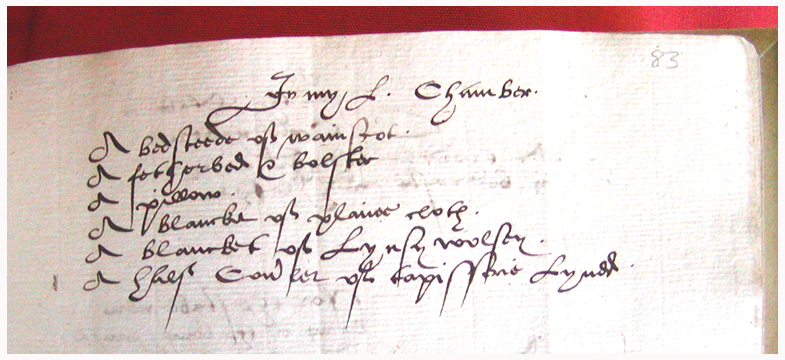
In each of the two notebooks at Queens’ College are inventories, the same except in minor wording, one written in 1561, one in 1569, in which he notes the 20 rooms at Ankerwycke, listing the contents of each.  In the first, #49, a room on the upper floor between his father’s room and the maid’s chamber is labeled “In my L. Chambre.”  In the 1569 inventory in notebook #83, page 123, a similar list is headed with the words: “In my Lorde’s Chambre.”

1561 inventory of Ankerwycke rooms, “In my L’s Chambre”

By “My Lorde” Smith must have meant de Vere, who, born “Viscount Bulbeck,” was considered a “lord” from birth.  Smith was punctilious about terminology, particularly where social distinctions were concerned, so he would never have made a mistake by called somebody a lord who was not, in fact, a lord.  Strype “supposes” that by “my Lorde” Smith meant the Duke of Somerset (170), but that’s impossible since Ankerwycke wasn’t finished until 1553, by which time Somerset was dead, nor would someone as self-righteous as Smith have wished to memorialize a master with whom he had had such profound differences.  It could not be Cecil, since from 1550 until Elizabeth’s accession Cecil kept his own household at The Parsonage at Wimbledon not far from Ankerwycke, nor did Cecil become a lord until 1571, long after Smith had drawn up these inventories.  Other than these, there is simply no lord other than de Vere who could possibly have had his own room in Smith’s home.

When we add this evidence to the phrase “brought up in my house” from the 1576 letter to Cecil, we should have enough to place Oxford with Smith for the better part of eight years, and in so doing, add to his story the riches of experience he gained as a child in a traditional country manor with all that that implies, as I’ve detailed in a number of blogs, pages, lectures, and articles.  Among many other puzzle fits, this scenario provides a reason for de Vere’s placement at Queens’ College for five months in his ninth year, Queens’ being Smith’s alma mater, and Smith needing that time to assist Cecil with preparations for Elizabeth’s accession, a hard fact for which we have more than enough evidence.

De Vere was still with Smith when the first list was written.  As for the 1569 inventory, although Oxford was no longer a member of Smith’s household, that Smith would continue to use his name for the room is seen by how he continued to call the room next to de Vere’s “my father’s chambre,” although Smith’s father died the summer of 1557.

By examining an actual document, its visual appearance can add to what its text and authorship have to tell us.  For instance, in the letter in which Smith finally turns to the issue of Oxford’s treatment of Burghley upon his return from Italy, that Smith was more emotional at the end than he was anywhere else in the letter is obvious from the condition of the paper at this point.  The pen was pressed so hard on the paper that the ink is darker here and the stroke thicker than anywhere else in the letter, so hard that the acid in the ink had eaten away the paper at that spot to a degree that it threatened to render a few of the words unintelligible.  I showed it to the librarian in the Manuscript Room at the British Library, suggesting they do something to preserve it before it crumbles completely.

Deconstructing Sonnet 107

My friend Hank Whittemore, with whom I differ on several key points, has asked about my take on the problematic Sonnet 107.

Over the four centuries that English speakers have been discussing Shakespeare, there have been many battles over the Sonnets, who they were written for, when they were written, and whether or not they were about something real or were just a literary exercise.  Although beautiful and important, I’ve tended to steer clear of discussing them partly because they’re so short on facts that nothing can be proven and, largely for that reason, because they’ve given rise to so many bizarre interpretations.

Then in 1999 I found myself preparing for an SOS Society conference where the Sonnets were a focal point, so I devoted several weeks to reading everything I could find on the subject going back to the 19th century. (An article I wrote later expanding on that lecture, The Story of the Sonnets, provides a good deal more detail for those who are interested.  There’s also a  Sonnets bibliography with comments on the books I found of most interest.)

Traditions of sonnet cycles

Some years ago I got into a fight with the usual coneheads on Hardy Cook’s listserv,  who eagerly pounced on my statement that the best writing comes from experience,  from enduring the emotions and insights that come from Life itself.  Isn’t this what Keats means with “truth is beauty, beauty truth, that is all ye know and all ye need to know”?  Keats was speaking to fellow artists and philosophers, of course––who else bothers about the relationship between Truth and Beauty?  Certainly not the coneheads that were dominating SHAKSPER.

Believing that most if not all the plays (the good ones) were written out of Oxford’s own experiences and emotions, of course I believe that the Sonnets were as well; that is, they were written at a time when he was going through experiences like those described in the Sonnets. That others in like case over the centuries have found solace in Shakespeare’s Sonnets attests to their power, a power that comes from how accurately, and with a thousand subtle details, they describe experiences common to many readers, which is, of course, why they’ve remained in print for centuries, and why we need to look to common experiences for reasons why he wrote them.

It was Petrarch who introduced sonnets to the West.  My guess is that like other sweets: stringed instruments, perfume, sugar, and Courtly Love, they originated in Persia (Iran), migrating to Italy via the cultural transfer from the Middle East to Venice in the 14th century.  Traditionally a sonnet cycle is a narrative of sorts, describing day by day, hour by hour, verse by verse, the progress of a passion from its dizzying enception to its final spasm.  We call these sonnets love poems in English, but the term the Elizabethans preferred was passion.

Love is too limiting a term for an experience that contains so many feelings, some anything but sweet––loneliness, loss, jealousy, envy, hurt feelings, remorse, disgust, even hate.  Poems written after the things they describe are over differ from those written as they happen.  Sonnet cycles, when they are genuine, are like raw footage, unedited, pungent, detailed, revealing themes through a process of repetition and insight  that’s closer to life itself than the reflection of life we call memoirs.

It’s part of the tradition of the sonnet cycle that the poet doesn’t reveal the true identity of the beloved.  An offshoot of the Courtly Love tradition, Petrarchan sonnets echo the yearning of a chivalrous knight for the beautiful but chaste wife of his lord.  Bound to him by oaths of fealty, this Courtly Love trope adds a further bond between lord and vassal, whose sacred passion for the lady can never fade because it’s never fulfilled; (the role the Virgin Queen demanded from her favorites).  Such poems are proofs of that love (“oblations, poor but free”), but only the lady herself is to know who is meant by “Stella,” or “Diana,” or “Phillis,” or “Caelica.”  For the Poet to let slip anything that reveals the source of his passion is to betray his Muse, another kind of romantic pose, but still one of great artistic authority by Oxford’s time.

And because, as a narrative in verse, a sonnet cycle is meant to follow such a passion as it unfolds, I believe that, following Oxford’s death, those published his sonnets saw to it that (for the most part) they were published in the order he intended.  Whoever had control of Oxford’s literary estate would have had great respect for it as literature.  Notions that when he died he was careless about leaving his papers where just anyone, including family members who cared more about their image than they did literature, might have gotten hold of them, shows a lack of understanding of how great artists feel about their work.  Having promised that he was going to leave a portrait of the Fair Youth for posterity to admire, he would certainly not have played fast and loose with their vehicle.  Whoever got his papers also got strict instructions on what to do with them.  This is simply common sense.

Oxford may have given up on Southampton himself (all passions must come to some kind of end), but he would never have given up on the poems that his love for him brought forth.  As he says in his farewell Sonnet, #126, Nature who has been so kind to Southampton, allowing him to keep his good looks well into his maturity, will have to cash him in sooner or later: “She may detain, but still not keep her treasure;/ Her audit, though delayed, answered must be,/ And her quietus is to render thee.”  In time the Fair Youth will cease to be both a youth and fair, but, as their author well knows, if properly published, the love poems he inspired will never lose either their beauty or their truth.

A great deal has been made of the fact that Shakespeare’s muse was a boy, not a lady.  To the shame-based society that the Reformation made of the English, that’s been an awful shocker.  However, if we pay attention to the poems it seems clear that the Poet’s desire is less sexual than emotional, the desire of a man for a son (Oxford was without an heir when he began writing them), and most important to an artist, for a muse whose charisma is potent enough to inspire his art.  Unfulfilled desire is the force that keeps it going.  It’s the number one Rule of Romance: fulfill the desire and the magic ends.  The question here being, desire for what?  My answer: a son-in-law whom he could love as though he were his own and, not least, a theater patron with solid credit.

Dating the sonnets

Back in 1999, I spent a good deal of time back seeking genuine scholarship on the dating of the Sonnets. I finally found it in a book titled Elizabethan Sonnet Themes and the Dating of Shakespeare’s Sonnets (AMS 1962, 1973). The author, Claes Schaar (writing for a Danish press, and so less constrained by hometown anxieties over identities), sticks strictly to the protocols of literary dating.  Basing his conclusions on the work of two scholars, one a German (pub 1884), the other an American (pub 1916) who apparently had no knowledge of his German predecessor (190).  Since these groundbreakers there have been others, all with similar results.

Ignoring the Stratford biography or any consideration of who the principles might have been, by comparing the language to that of Venus and Adonis and Lucrece, the only works by Shakespeare whose dates are solid, they place most or all of the Sonnets somewhere in the early 1590s: “. . . the vast majority of the sonnets we have examined seem thus to have been written between 1591-92 and 1594-95” (Shaar 185).  Their findings are corroborated by other scholars replicating their efforts, one being G.P.V. Akrigg, Southampton’s biographer, who gives an impressive list of scholars who agree that their language also places them close to the Folio versions of Love’s Labour’s Lost and Romeo and Juliet, which have been dated, by topical references and by language similarities to the two dated narrative poems, in the early 1590s (203).

Sonnet 107

All of this is by way of introducing Sonnet 107, which, although not considered one of his greatest, has probably caused the most discussion since it alone seems bent on revealing everything that he was so careful to hide in the other 125.  Not only does it go out of its way to identify the Fair Youth as the Earl of Southampton and to locate him, and by extension the surrounding sonnets, to 1603 when he was released from the Tower by King James, it’s also written in a different style.

As Schaar explains, most of the sonnets were written close in time, one after another.  Schaar et al see two bursts: 1591-92, and 1594-95.   These dates fit perfectly with what we know of Southampton, who really was a boy, that is, a teenager, in the early 1590s.  This scenario fits the first 17, the so-called marriage or procreation sonnets, with a known event, Burghley’s effort to get Southampton married to Oxford’s daughter, Elizabeth Vere.  In fact, the entire cycle fits perfectly with the biographies of Oxford (the Poet), Southampton (the Fair Youth), Essex (the Rival Poet) and Emilia Bassano (the Dark Lady).

All but a very few of the sonnets, including those that come just before and just after 107, are end-stopped throughout, that is, the expression of each thought is compressed into a phrase that pauses at the end of a line.  There are a very few (I counted four) in which enjambment  carries the thought  over from the first to the second line, though the basic iambic rhythm remains.  This style is one of the things that places the Sonnets early in Shakespeare’s career, as later he became much more relaxed about meter and enjambment.

But in 107 the opening expression ranges across not just two, or even three, but the entire first four lines!  Most unusually, the iambic rhythm is gone from those lines!  It’s a good strong poem, but located as it is surrounded by sonnets of a diffrent style, it sounds like someone else wrote it.  Frankly, it sounds like John Donne.  I’m not saying he wrote it, but that’s who it sounds like. So there are two big things that make this poem stand out in contrast to the rest of the sonnets, a violation of the tradition of secrecy, and also of a pattern adhered to throughout the entire rest of the cycle.

Cherchez le editor

My guess is that whoever published the poems inserted 107 for the very reason that it’s assumed such importance today, because it identifies the Fair Youth and it also locates the cycle at a particular point in time.  Since the author took obvious pains not to identify persons or events, this would have to have been done by the editor who prepared them for publication, and who probably was in harmony with the publisher.

I can’t say for certain who might have been Oxford’s literary executor, but a very good candidate would be William Herbert, Earl of Pembroke, who, by 1603, when Oxford was approaching the end of his life, was better-situated than anyone else to protect the poet’s valuable papers from those who might be anxious to see them disappear.  And who better to prepare them for the press than Pembroke’s own mother, Mary Sidney, who was probably already preparing another elegant edition of her brother’s works.  This scenario also helps to identify the Sonnets’ dedicatee, the mysterious “Master W.H.”

Why would the Pembrokes wish to make clear what Shakespeare had left ambiguous?

I can’t answer that, but I can point to something similar that occured in 1598 with the third edition of Philip Sidney’s The Countess of Pembroke’s Arcadia, edited and published by Mary, in which she included his sonnet cycle of the 1580s, Astrophil and Stella. She also included, for the first time, a sonnet that hadn’t been in any previous edition or in any of the manuscript versions that predated their publication in print back in 1591.  This sonnet, numbered 37, is the one that identifies Stella as Penelope Devereux.

It’s often assumed that #37 was left out of the cycle at first because it identified Stella, though that doesn’t explain why it then became necessary to make the identification.  True, by 1598 Penelope, though married, was openly living with her lover, Sir Charles Blount, Ld Mountjoy, so by then she had little reputation left to lose.  Even so, why stir the pot?  Could it be to direct suspicion away from Mary, who was suffering from the ususal rumors that followed women of celebrity, in her case that she and Philip had been lovers, that Stella was Mary, and that her brother was her son’s true father (Aubrey, Brief Lives, 140)?

That Mary (and her sons) might want to direct suspicion away from herself as the object of what could be seen as a shameful incestuous passion on Philip’s part would be altogether understandable, or that Penelope Devereux, already into her scandalous relationship with Mountjoy, would be willing to let her name be used to protect Mary  (Sidney makes it clear that the lust was all on his side, that Stella remained pure) is not only the stuff of romance, it’s the stuff of real life, that is, the real lives of romantic poets, who tend to take big emotional risks, much as astronauts, firemen and bullfighters take physical risks.

There was a close bond between the Devereux siblings and the Sidneys.  Philip and Mary were the children of Mary Dudley, sister of the Earl of Leicester.  Throughout the years while Leicester was hoping to marry Queen Elizabeth, Philip played the role of his uncle’s heir.  When Leicester finally gave up and married Lettice Knollys, widow of the 2nd Earl of Essex and mother of Robert and Penelope, Philip was forced to pass on the role of his uncle’s heir to Robert Devereux,Leicester’s new stepson.  As Philip lay dying of wounds in 1586 (suffered under his uncle’s command), he honored this rather mystical bond by ceremoniously handing on his sword to Essex, a bond that Essex then honored by marrying Philip’s widow.  (It was this sort of chivalrous behavior that made his friends love Essex.)  This bond between Essex and the saintly Philip then extended to their sisters, Mary Sidney and Penelope Devereux.

Why Oxford wrote the Sonnets

There was nothing improper about the way it started.  A marriage deal was in the works to unite his daughter and Burghley’s ward, the young Earl of Southampton, so the first 17 sonnets were written in the kind of passionate terms that fathers of marriagable daughters did back then.  (See Burghley’s wooing of the saintly Philip in letters to Sir Henry Sidney.)  Not every father could put such sentiments into verse, but as with all such social conventions, those who could certainly would.  So that’s all that was at stake with the first group, known as the marriage or procreation sonnets, in which he simply urges the youth to marry, coyly playing on his teenage narcissism.  That there were 17 in the first group suggests that they were nicely copied and bound as a gift for Southampton on his 17th birthday, Oct. 6, 1590.

With the 18th sonnet the tone changes abruptly.  What was fatherly affection fast becomes something much more personal and intimate.  So what happened?

When Oxford met Southampton, probably after the gift of the sonnets brought them together, he was at what may have been the lowest point in his life.  Now in his 40s, suddenly feeling “beated and chopped with tanned antiquity,” the boy must have represented all the things that he felt he’d lost or never had: his own vanishing youth, the son and heir he never had, the beloved friend he lost “in death’s dark night” when Rutland died in 1587, and not least, the angel he so desperately needed to continue to stage plays.

To the 17-year-old youth, Oxford may have seemed what he too had lost or maybe never had, a loving father, and one besides with the kind of access to backstage at the theater that teenagers dream of.  Teenagers need love and will respond to it wherever they find it.  Had this occured when Oxford was not at such loose ends the moment might have passed, but things being what they were, it threw him for a loop, as they say, and as was his habit, he turned for solace to pen and ink.

My guess is that at some point, for Oxford the passion became less about Southampton and more about the poetry.  My God, this was it!  This was what he’d been striving for!  This was what Sidney meant so long ago when he began his own sonnet cycle by quoting his Muse: “Fool, look in thy heart and write!”  The exhilaration, the loneliness, the jealousy, the empty hours, all were grist for his poet’s mill.  The original emotion became less important than how to express it.

The passion passed, as all things must, but like a beautiful shell on a beach after a great wave rushes back to sea, it left something precious in its wake, the language of Shakespeare.  For it was in the crucible of his love for Southampton and the combined happiness and pain it brought him, that he found the voice he’d been seeking through all the years of translating and listening and experimenting, the language we speak today, the language of modern English.

******************************************************************************

A different take on Sonnet 107 can be found in an article by Eric Miller, a poet and independent scholar from California, published in The Oxfordian, vol 9, 2005.

******************************************************************************

For comments click here.

More nine-inch nails in the Stratford coffin

Much of the overwhelming evidence for Oxford as Shakespeare can be found in the eight years he spent with his tutor, Sir Thomas Smith, from age 4 to 12.  Not only did Smith own most of the important works that scholars tell us were Shakespeare’s sources, but his personal interests, the passions that drove him, appear in Shakespeare in depth, astonishing knowledge for a poet and playwright, whatever his class, knowledge he throws about with abandon in allusions, similes and metaphors.  This is an approach to a subject that can only be taken by one who’s been steeped in a subject from earliest days so that it permeates all his thinking.

Smith’s interests form the major part of Shakespeare’s arsenal of metaphors, but there are five areas in particular that are worth noting, because they’ve often been singled out for comment by scholars.

Entire books have been written in efforts to prove that in two of these subjects: the Law and Medicine, Shakespeare was so deeply versed that he must have been a professional!  The same thing would be true of astrology cum astronomy (the two were the same back then), it being as much of a profession then as the first two, for he reveals his knowledge of this arcane science through metaphors and the use of esoteric terminology just as he does with law and medicine.  Smith had been named by Henry VIII the first Regius Professor of Civil Law at Cambridge when he was still in his twenties, and was a dedicated practitioner of Paracelsian medicine his entire life.  He was sufficiently schooled in astrology to draw up horoscopes, something that required a fair amount of mathematics then, plus all the necessary ephemerides, which he also had.

As for gardening and horticulture, these Oxford would certainly have learned from eight years of living with Smith, whose enthusiasm for gardening is revealed in his letters and also in the fact that wherever he lived (at Ankerwycke and Hill Hall), or taught (at Eton and Queens’ College), he planted gardens.  As Caroline Spurgeon shows in her book Shakespeare’s Imagery, the author had the kind of knowledge of gardening that could only have been acquired through living with it for years.  (I’ll make a page on the gardening connections soon.)  And the same is true of hawking, in fact, in one of his treatises Smith himself uses Shakespeare’s favorite hawking metaphor, comparing a haggard, or badly trained hawk, to a wayward woman.

If still thirsty for more information on the Smith-Oxford-Shakespeare connection, check out the page on how Shakespeare immortalized Smith in his plays.

And so we hammer on.  How many nails is it going to take?

What, can the Devil speak true?

As you no doubt are aware by now, my scenario for the authorship of the Shakespeare canon is not the standard view.  The standard view is the one most people have grown up with, the one that sees William of Stratford as the author of the works of Shakespeare, the view backed by university academics, even more so by their supporters, the ones who write most of the articles in response to our questions, and most of all by pop biographers, who, lacking anything substantive, garnish theirs with what they hope are zesty details of life in 16th-century Warwickshire and London.

Ours is so much a better story, why won’t they listen?

For the most part, academics are a very different strain from the artists that they study.  If the facts as they are presented don’t add up, they don’t see it because they don’t understand what makes their subject tick.  Focused on the trees,  they hardly know there is such a thing as the forest.  And once having arrived at the pinnacle of Shakespeare studies, the very button on the cap of the Humanities, they are not about to question what lies (pun intended) beneath that pinnacle.   One recent literary “historian” got, so we’re told, a million dollar advance on his glossy version of the Stratford myth.

There’s nothing strange about this.  In every area of human endeavor there are those who more or less blindly follow tradition and its rules without allowing themselves (or anyone else) to question them.  As for Shakespeare, most academics don’t really care who he was; it’s the text that interests them, not the author; as far as they’re concerned, the less about him the better. When, after 300 years of ignoring him, the universities finally accepted his plays as worthy of their attention, they were perfectly happy with the author as presented to posterity by Ben Jonson, the lifeless woolman stuffed into artist clothing, stuck on a pole, his propped arm pointing towards Stratford.

Academics get to the positions of authority they occupy by being well-behaved  all through school, getting good grades by giving their mentors the answers they want to hear, then getting them to sign on as advisors on their dissertation committees so they can get their PhDs and all that goes with it. Once tenured, they produce books in which they dedicate their examination of the symbolism of “eye of newt” to these same mentors.  By the time they’ve reached a point where thinking for themselves is no longer a threat, they’ve forgotten how, that is, if they ever knew.  And if the questions do begin to eat away at the edges of the Stratford myth, they’ve become too committed to Stratford through the books and articles they’ve published to allow them entry.  How ironic that Shakespeare’s “alms for oblivion” got nothing better for him than these latter day Holofernes.

They get away with it by ignoring the big arguments––like why there’s nothing in this supposed great writer’s handwriting but six clumsy legal signatures––while focusing on details. For instance they defend the Stratford story by saying, “contrary to authorship views, there’s more than enough evidence that William Shakespeare wrote the works.”  What they mean by this is that the name Shakespeare is on various title pages, while documents in Stratford testify that someone of that name lived and died there and sued his neighbors.  What they don’t tell you is that there is nothing solid to connect the title pages with the man who lived in Stratford. Or with the man who spent a few months in rented quarters in two different neighborhoods in London.  Or with Jonson’s Sogliardo.  Nothing times a thousand still equals nothing.

The ultimate irony of course is the obvious fact that we need the academics.  Or, perhaps I should say that we need authorship scholars in academia.  The excruciating amount of time, effort, and money it takes to track down documentation in the English libraries and archives requires that this be taken on by professionals, either backed by a university or by patrons who are not seeking some particular result.  How many archived references to the Earl of Oxford have academics ignored since the authorship question first raised its annoying head a century and a half ago?  How many during the century before that, since he was not the focus of their inquiry?  Until the universities open their doors to the question or enough disinterested, deep-pocketed patrons appear, we must struggle along with only our God-given common sense and what facts have slipped past, first the 16th and 17th-century censors, and now the Stratfordian defense.

We also have another sort of adversary.  Almost as much of a barrier as the academic who has no understanding of artists or interest in a realistic biography is the Oxfordian who has no understanding of history.  If we do not honor the truths of history, if we continue to be enchanted by soap opera fantasies that do violence to genuine historical and psychological truth, we will never gain the respect of the History departments, who realistically are the only ones in any position to do the necessary research, since the English departments simply don’t care.

How was it he put it?  “If circumstances lead me, I will find where truth is hid, though it were hid indeed within the center.”

Amen to that.

Crammed like a Strasbourg goose

In writing about the education of the nobility in Oxford’s time, American historian H.J. Hexter quotes Sir Thomas Elyot on the reasons for educating the nobility, “which is to have authority in a public weal,” adding, “Sir Humphrey Gilbert has a scheme whereby gentlemen’s sons will be crammed like Strasbourg geese with knowledge and skills, the better to serve in Parliament, in council, in commission and other offices of the Commonwealth” (1979, 63-4).  That this was Sir Thomas Smith’s aim in educating the future Earl of Oxford seems beyond dispute.  It should be added that Gilbert was one of Smith’s closest friends.

When I first began my study of the authorship issues many years ago, one of the first questions that I sought to answer was, what was Oxford doing before he was placed with William Cecil?  Back then, nothing that had yet been published dealt with Oxford’s early childhood.  I began putting it together from bits and pieces gleaned from a variety of sources: things said in passing by Smith’s biographers, a note in one of Smith’s household inventories, and, as always, by comparing the recorded timing of events, chiefly those surrounding his Cambridge stay at eight and his departure for Cecil House at twelve.  Since then much more has accrued that contributes to this scenario, with nothing so far to contradict it.

Now that his childhood with Smith has been revealed, our view of Oxford as creator of the Shakespeare canon has taken on new weight.  Revealed are: 1) the fact that those areas in which Shakespeare shows an unusual level of expertise are all areas in which his tutor was deeply interested; 2) Smith’s library contains most of the books that Shakespeare relied on as source material, often in the inexact way that we do when recalling early memories; 3) in his treatises, Smith often used dialogues so he could explore arguments on both sides of an issue, a form often found in the inner debates of Shakespeare’s soliloquies as well as the general form of all drama; and 4) Smith’s “lukewarm” attitude towards religion are echoed by Shakespeare’s seeming lack of adherence to a particular branch of Christianity.

For some weeks now I’ve been preparing essays on his education based on the information I’ve been collecting over the past fifteen years or so (much of it due to Dan Wright and the 40 or so Oxfordians who contributed to the fruitful six weeks I was able to spend researching in England in 2004).  These essays are up now as pages under OXFORD, and once I get some more up on Shakespeare’s sources, you should find it interesting to compare them in some detail.  The conjecture that Oxford may have attended several semesters at Christ Church College Oxford is something that hasn’t been discussed before.  There are several other new pages as well.  Their titles should appear on your screens in color.

The Rule of Law: Jude Law IS Hamlet

During a three month London adventure in 1999, I got (thanks to Dan Wright) the opportunity to see Jude Law in John Ford’s T’is Pity She’s a Whore at the Young Vic.  Impressed by Law’s ability to express the most intense anguish, I’ve been hoping ever since, first, that he’d do Hamlet (instead of one lame movie role after another) and second, that I’d be able to see him do it.  Both wishes just came true: not only has Jude Law done Hamlet, but (once again, due to the kindness of friends) I got to see him do it on Broadway!  And I was right.  What a Hamlet!

Hamlet is tricky, even for the best actors.  It’s become such a museum piece, there are so many famous sililoquies, every avid Shakespeare fan has a favorite performance to which they match each new approach, so that watching the play runs the risk of turning into a sort of Olympics of the Stage, where the actor playing Hamlet is not so much enjoyed as he is rated, in the same way that Olympic figure skaters get rated during their performance, feat by feat, by TV commentators.

Law sweeps this away with the utter naturalness of his style.  Sililoquies flow from him as easily as he greets his old school friends or rants at Ophelia.  Shakespeare’s 400-year-old language runs as trippingly off his tongue as if it were his own most natural form of expression, yet there’s none of that jack-hammer rat-a-tat-tat that some use when reciting Shakespeare, apparently in an effort to spew out the bloody awkward stuff the way they do their own native slang.

I think this is largely because Jude Law is as much a dancer as he is an actor.  He expresses the beautiful but strange language as much with his body as he does with his voice.  Together the two, the voice and the body, create a satisfyingly complete whole in a way that I can’t remember ever seeing before.  Anger possesses him utterly.  Anguish torments every fibre.  How perfectly Shakespeare has captured these emotions in words and how perfectly Law renders them, his gestures flowing, not from the words themselves, but from the emotions they are meant to express.  Today, thanks to television, we have all seen, over and over, how real people respond to disasters or the deaths of people they love, and so we can’t help but know how at such moments, words failing, it’s the body that reacts.  With his dancer’s sense of timing, Law also knows how to pause before reacting, something many actors either never learn or tend to forget in production.  It’s such an energetic performance, I can’t imagine how he can do it, not only night after night, but twice on matinee days.

Unfortunately there’s little good to be said for the rest of the production.  Law’s gutsy approach was not echoed by a single other member of the cast.  Apart from the King, who did prove a strong and convincing match to Hamlet’s energy, the rest simply entered, exited, stood or walked about as though waiting for something exciting to happen.  Horatio was particularly disappointing, less an antique Roman than a pool hall shark.  The set and lighting are good, providing some interesting accents to the action, but the costumes, modern suits in shades of gray, not only disappear into the gray walls and black floor of the castle set, but seem totally out of place. With no chairs or benches to relieve the need to stand, what group of twenty-first century people would choose to spend more than a minute or two in this cold, empty, castle foyer?

Now that my wishes have been fulfilled I have a new one, that Jude Law will repeat his performance on film, with costumes and sets that match, a Horatio whose body language speaks of his strength and dependability , a sober Gertrude who knows deep down right from the beginning that she’s damned, so that her son has only to remind her of it, and . . . and . . . oh, Michael Palin and Terry Jones as the gravediggers!   Hey, let’s shoot for the moon!

Unfortunately when it comes to Ophelia, it seems the role is unplayable.  Since it’s very likely that the Countess of Montgomery had a say in the publication of the First Folio, she could well have had something to say about the final version of her own mother’s unhappy fate and death.  For whatever reason it seems impossible for any young actress (or director) to actually bring her to life, at least, I’ve never seen it done. With Jude Law directing, maybe we could see an Ophelia who really cuts loose.  Wishes do sometimes come true.

Shakespeare’s patrons-who were they?

Born as the crest of two waves, the German Reformation and the Italian Renaissance, crashed into each other, the great poet and playwright blended these two often incompatible energies into the culture that has been England’s ever since.  Under the constraints of the Reformation, the passions that went into painting, sculpture, and architecture in the Southern European Renaissance, in England went into language: a bare stage, good costumes, superb actors, and the great human stories we know as Shakespeare, stories whose sources are to be found in the libraries where the Earl of Oxford spent his childhood.

Oxford’s development and survival as an artist was largely due to his patrons, surely among the best a writer ever had.  He sank low at times, but not so low that he ever had to quit writing, at least, not for long.  One of the most important research projects remaining to be done is on these patrons.  Burghley, Sussex, Walsingham, Hunsdon, Charles Howard, Southampton, the Pembroke brothers, are the leading figures, but there were others as well who contributed to his survival in various ways.  Even when they were disgusted with him, as Hunsdon must have been when the bum took up with his mistress, they kept him afloat because they knew his value.  For the great ministers of that time who had the dreams and aspirations of both Italian and Reformation humanism alive within, he was the great instrument of their policy, though this would be fully realized only when he was gone, as so well expressed by Ben Jonson in his dedicatory Ode in the First Folio.

Historically Oxford’s role in Early Modern theater is as a patron, a role that tends to get lost in the argument over his role as a writer, but his involvement as patron of the arts and sciences went a good deal deeper than what shows on the historical surface.  He patronized musicians and composers as well as other writers, and was praised by them as one of themselves.  When looking for a model for Oxford within our own times, the composer and pianist Leonard Bernstein comes to mind, an entertainment genius of the same all-encompassing nature, only, shall we say, considerably less fearful of recognition.

One question that hasn’t been dealt with yet, so far as I know, has to do with the company maintained by Oxford’s father.  Were they, perchance, the one we know as Leicester’s Men in the 1560s?  When Earl John died in 1562, Elizabeth gave Leicester control of the Oxford estates.   Though there’s no sign of it (so far) in the record, that could mean that he inherited what had been the sixteenth Earl’s acting company?  Unlike our world today, the arts community was very small.  Leicester’s Men were a handful of Court actors, some the same men who later became the core of the company that called themselves Hunsdon’s Men and operated out of Burbage’s Theater, just up the street from Fisher’s Folly.  Were some of these the same men who, decades earlier, had performed John Bale’s King Johan in Ipswich in 1561, just prior to the Queen’s entertainment at Hedingham Castle?  It’s worth considering.

Why we need a scenario

Recent questions have raised the enduring issue of fact vs. fiction.  I’ve been asked to make it (more) clear where I depart from a structure of known fact to fill in missing areas with a scenario in which areas can’t be supported by the kind of cited facts that historians rely upon, or are supposed to rely upon.  I’ve been considering how to deal with this ever since reading Ogburn’s The Mysterious William.  Deluged with facts, what was missing was the story.  Obviously Oxford was the true author, but how to perceive the living being within this mountain of argument and data?

The problem lies with the difference between facts and story, or truth and fiction, as this dichotomy is so often portrayed.  It’s almost impossible to mix them and come up with something that isn’t seen as untrue on the one hand, boring on the other, or both.  One touch of supposition and those interested only in so-called hard evidence toss the whole thing in the waste basket as unsupported theorizing.  Burden it with documentation and those in search of the story lose interest because it lacks drama.  Truth, however, is more than fact.  There’s truth in story that can never get relayed from just the facts alone.  No one knew this better than the author of the Shakespeare history plays.

At a certain point in researching the period it became clear that the lack of facts––not just on Shakespeare but on all the writers and works from that period––wasn’t simply due to entropy, the dictum that “things fall apart,” or any lack of interest in him in his own time.  Facts were missing on purpose, either burned in fireplaces or never exposed to begin with.  Confusion was not always due to missing data, but was often intentional.  The sources of information relied upon by scholars tracking the stories behind the literature of the period, title pages, entries in the Stationers Register, Revels records, etc., were either purposely ambiguous or flat out false.

Asking why, I began to see a pervasively phobic attitude towards literature, i.e. fiction, i.e. storytelling, that infected the entire culture.  Asking why again, it seemed that in rejecting the supersitions and folk tales of medieval Christianity, the reformers in power were doing all they could to throw the baby out with the bath, just as they were doing with the beauties of Renaissance Italian painting out of a Reformation mistrust of Italian sensualism.  Poetry was dangerous––the better, the more beautiful the language, the more dangerous.  And then there was the age-old threat of dissident voices, so often those of the best writers.

Just the facts, M’am.

None of this is new.  All of it has been mentioned, usually in passing, by literary historians, who may question the truth of a title page or two and then go right on repeating the standard account based by earlier historians on those very same title pages!  It’s as though archaeologists who discover the bones of a prehistoric human simply leave them lying in the order in which they find them, never making any effort to arrange them so they reveal the shape of a human being.  As a result, all we have is a pile of facts, no story, no humans struggling to make their way through the difficulties of their lives, loving and hating each other, just a bunch of names without connections to each other or to the stories told by their works.

When I say “not one” has tried to tell the story behind this pile of real and phony facts, that’s not quite true.  Those who’ve tried to make sense of it in human terms (I’m thinking in particular of T.W. Baldwin and Penny McCarthy) have been thrown off by the biggest falsification of all, the substitution of the true author of the primary works of the time with someone of an altogether different, even opposite, nature.

The archeology metaphor works well here, where two bodies having been buried together ages ago, their bones becoming mixed through some earth disturbance so that a pelvis, a set of shoulder blades and bits of both spines have gotten lost.  Later, when scientists attempt to sort them out, the result is a single two-headed monster with two sets of arms and legs which they then attempt to sell to an ignorant world as the missing link.  In Shakespeare’s case, the historians either doll up the monstrous Stratford grain hoarder cum literary genius with anecdotes and conjectures, or they ignore him and describe the flowers that “probably” grew in his garden.

At a certain point intelligent readers became sick of this paper monster and began to look for something a little more real.  They could just manage to make out a shape out there, moving around in the bushes, but it was hard to define. (Francis? Is that you?)  Eventually J.T. Looney gave it a name and Charlton Ogburn a wealth of detail, but we’re still stuck, first with the desire to pin the blame on a group, now with the nonsense that almost anyone alive at the time could have tossed off these erudite masterpieces.

My kingdom for a story!

By blogging there seemed the possiblity, finally, of having it both ways.  I could tell the story I had begun to perceive some time ago, with links to articles that provide the kind of citations that give at least a minimum of support.  With readers able to ask for specifics directly without waiting for an answer to a letter sent through the publisher or finding a booksigning somewhere within driving range, I could finally (I hoped) provide the key to the insight or the missing bit of information that would suddenly (perhaps) bring the scene to life, set the story in motion, for that reader and perhaps others as well.

I’ve only been at this blogging for a few months now and so the story, while complete in my mind, is far from complete here.  I’m still working on background material for the 1580s, the most difficult decade partly because there’s so little documentation, but also because it’s then that the heart of the story, the drama, begins to take shape.  Because I have to conjecture so much for that decade, I need more supportive material than was required for the 1570s or will be for the 1590s.

If it seems that much of what I write is directed to those readers who have already read the biographies (Anderson, Ogburn, Miller, Nelson), it’s because for you I don’t have to repeat so much, simply filling in a few areas that they ignored (chiefly Oxford’s childhood and education). This way I can concentrate on those areas that provide the reasons why he and the actors and their patrons, hid his authorship, reasons of culture, tradition, politics, and religion, and beyond these, the connections to the important figures of his time that he portrayed and satirized in his plays, points that can’t be made without showing why he would do such a thing and how he managed to get away with it.

If I can reach you, then together we can find ways to communicate the Authorship Issue, not just as a series of talking points, arguments, and facts, but as a story that, motivated by the life force that is our common heritage as humans, simply tells itself.  Surrounded as I am by all the stuff I’ve accumulated, it’s hard for me to see the forest for the trees.  By telling it this way in bits and pieces, and by answering your questions, it helps put things in perspective.

So please bear with me, and do ask for clarification of those points that, to you, seem little more than wild surmise.  My idea of support may be somewhat different than those historians who, when the paper is lacking, simply skip over the anomalies, but be assured, nothing I suggest is spun purely from thin air.

Why the cover-up continued after Oxford’s death

John Shahan pushed me hard in his comment on my response to Alex McNeil’s question. Sometimes an exchange that follows a blog gets lost in the drift, but this is too important to let that happen, so I’ll respond here to some of his more pertinent points.  If you missed it in full, it follows Alex’s question.

John: Why was the cover-up maintained after his death?  It’s a separate question that you haven’t answered.  It’s a good question, and one that many people ask when they come to the controversy for the first time.  We should have a good answer at the ready, and providing an explanation of why he would have kept hidden during his lifetime doesn’t cut it.  It sounds evasive to answer a question other than the one that was asked.

I wasn’t being evasive, I was being too general.  His authorship would have been kept a secret after his death for exactly the same reasons that it was kept a secret during his lifetime, the same reasons that all the covers he used throughout his life remained in place, the same reasons that Mary Sidney’s descendents never revealed all she wrote or that Francis Bacon never revealed himself as a “hidden poet.”  And for some of the same reasons that got Christopher Marlowe murdered or transported.

If I got lost providing background it’s because it’s so difficult for people today to understand the realities of Shakespeare’s time.  However, there is one that might stand out a little better than most: namely the fact that so many of his characters satirized respected and high ranking members of the Court community, some portrayed as buffoons, some involved in scandalous love affairs, some even accused of murder!  That they might possibly be identified with these infamous characters would have had these highly status conscious people, their retainers and descendants, in a real tizzy.

As long as William of Stratford was known as the author, the originals of these characters were protected, but had the Pembrokes and the Kings Men revealed the truth about the authorship they would have had an extremely serious situation on their hands.  This is one of the reasons why the publication of Oxford’s collected plays took as long as it did.  It had to wait until the Earl of Pembroke achieved  the Court position where he finally had the power to take the matter of its publication into his own hands, overpassing the wishes of some who would have preferred that everything Oxford ever wrote be destroyed.

Most agree that Polonius was a demeaning portrait of Lord Burghley, something that would certainly have been as obvious to members of the Elizabethan Court community as it is to us today.  If, as I believe, Hamlet, Julius Caesar, Romeo and Juliet, and other of his more serious and philosophical plays were written, not for the Court or the public, but for his Inns of Court audience, it could mean that Elizabeth never saw them, or if she did, not in the versions that we know from the First Folio.  Thus it’s possible that Burghley never saw himself derided as Polonius, or his daughter portrayed as a lunatic and a suicide.  For who would tell him?  There were no newspapers, so there were no reviews.  All publication was tightly controlled.  By whom?  By Lord Burghley.

Were it ever to become public that it was the Earl of Oxford who had created these popular characters––so popular that they made the Lord Chamberlain’s-King’s Men a fortune––how long do you think it would have taken the public audience to connect Oxford’s father-in-law with Polonius, his wife with Ophelia, his political adversary the Earl of Leicester with Claudius, or his Queen with Gertrude?  How long to connect Richard III with Robert Cecil, Mildred Burghley with Volumnia in Coriolanus, Southampton with the Fair Youth, Philip Sidney with Sir Andrew Aguecheek, Emilia Bassano with Cleopatra, and so forth.

Oxford’s own daughters were the daughters of Ophelia, the granddaughters of Polonius. That, plus the fact that his youngest had married a Pembroke, shows that however you look at the cover-up, by 1615 when Pembroke finally got the office of Lord Chamberlain of the Royal Household, putting him officially in charge of the Court Stage and the King’s Men, publication of the First Folio was as much a family affair as it was a literary event.  Pembroke wanted the plays published, but he also wanted to protect his family and his community from scandal and, not least, himself from the odium that would be inevitable were he to allow these connections to be revealed.

If it’s a good talking point you’re after, maybe this will do.  Yet even here we run into the problem of readers not understanding enough about the period to get it.  Again the main problem is our inability to grasp how small were these communities, and how static.  Where our communities today consist of thousands, many of whom are no more to us than names, theirs consisted of a dozen, two dozen names, in positions that may have changed only once or twice over a lifetime.  During Elizabeth’s reign the number of peers went from 60 to 25!  Our communities are in continual flux; as one worker, neighbor, merchant leaves for greener pastures, retirement, or intensive care., another takes their place.  The only way that things changed in Oxford’s time was through death.

We can say these things, but do they sink in?  Do we really understand what it meant to live in what to us would seem intolerable constriction while under the constant threat of death for ourselves, our children, our loved ones, whether by disease (no doctors) or by violence (no police)?  Added to the equation must be their ignorance of science, of medicine, even of their own history––a problem that Oxford’s history plays were intended to address.

The closest thing we have to their peers, their kings, queens, earls and countesses, knights and ladies, are celebrities.  Of these we have so many that, as happened a few days ago, I can see someone introduced to an audience on television, an audience of cheering thousands,  as one who has sold millions of platinum records and received a cartload of important awards, someone I’d never heard of before.  And while their handful of important persons changed only when one died and was replaced by another, ours are continually changing, usually simply by disappearing into anonymity, beauty queens into middle-aged matrons, sports stars into businessmen, some onto the pages of history, a history already jammed with names and faces.

The problem isn’t only of numbers and stasis, it’s one of attitude.  We have no respect for our celebrities.  Largely due to their numbers, their lack of background, the ephemeral nature of their importance, they seem to exist largely as vessels for our scorn.  Their very renown calls forth efforts to bring them down, to expose them, to show the world their weaknesses.  These Elizabethan celebrities had no photographers with telephoto lenses to catch them with their pants down, they were known to their people only from a dignified distance, dressed in crimson, ermine, and gold, or from copies of stately portraits. Descended from the heroes of past glories, they came as close to living gods and goddesses as humans could. Their lessers might hate them and blame them for hard times, but they did not, they simply could not, disrespect them.

When Shakespeare came along and revealed these gods and goddesses as human beings with problems and weaknesses like themselves and their neighbors it was fascinating, yet for all their speculation, they did not know, they could not know, how closely based they were on the real thing.  To have known who among those distant and admired figures were the real models of these fools and villains was simply more information than the culture could bear.  As a general statement, that may be putting it a little too strongly, but not by much.

John: Lots of authors use pseudonyms to conceal their identities during their lifetimes without the cover-up continuing after they die.  So why was Oxford different?

Lots?  Who?  Who of Oxford’s social stature?  Who in his time, or the time before his, or the time after his?  Not all statements have to be substantiated, but this is crucial.  Who else of his status in the Elizabethan era published works of the imagination under his (or her) own name?  I don’t know of a single one.

John: There’s a difference between knowledge and belief, and I think we do ourselves a disservice when we fail to make the distinction. That’s what Stratfordians do.

Having repeated this twice I assume you’re taking me to task for making unsupported statements.  I’ve made it clear from the start that my purpose with this blog is to provide a scenario that accounts for what facts we have, not just a few here and there, clustered around one or two circumstances (such as the writing of the Sonnets), but as many as possible.  I did a lot of substantiating of statements while I was editing The Oxfordian.  That was important, but this, however different, is just as important.

We’ve had most of the facts on Oxford for decades, and where have they gotten us?  Facts are to story as flour, water, salt and yeast are to bread; the ingredients, not the thing itself. We can eat bread, we can’t eat flour, water, salt and yeast.   Creating a story out of facts is like mixing, kneading, and finally, baking.  We are not inventing the bread, what form it takes depends solely on the ingredients.  All we’re doing is assembling them, giving them a thump or two, and letting them rise into a living story.

To be convinced, hearts must be touched as well as minds, something that can’t be be done without characters and a plot.  What’s most real about us are not the facts of our lives, but our stories.  To understand the past, we need more than dates of battles, we need heroes and villains, tyrants and underdogs, damsels in distress.  Without these, the audience leaves at intermission.  No one understood this better than Shakespeare.

There’s another reason for what I’m doing.  The Stratford bio as generated by Ben Jonson and others has sent generations of Shakespeare enthusiasts on an utterly fruitless 400-year-old wild goose chase through the archives in search of something that will reveal a believable Shakespeare story.  While true stories must be based on facts, it’s also the case that the search for facts will go off-track quickly if there isn’t a logical scenario in place directing it where to look.  How do we get such a scenario?  By doing what I’m doing, filling in the blank areas with informed guesswork.

Hopefully there will be some, or at least one, who’s located close enough to the relevant archives who gets sufficiently intrigued by what I’m proposing to begin looking where I’m pointing.  Centuries of investigators have read the letters of Burghley, Walsingham, Alleyn, Pembroke, and others, looking for something, anything, about Shakespeare.  Nothing anywhere near this scale has yet been done for Oxford.  Who knows what he or she will find once they begin to look?

The Fight for the Court Stage

The Court Stage fell under the jurisdiction of the Lord Chamberlain of the Household.  A sort of super-butler in charge of everything “above stairs,” he was important enough to be guaranteed a seat on the Privy Council.  Elizabeth’s  first Lord Chamberlain, Lord Admiral William Howard of Effingham, an inheritance from her sister’s reign, was not only kept on but was given several lucrative posts by the grateful Queen: a close relative, he had been her staunchest protector on Mary’s Privy Council.  Later, his oldest son, Charles Howard, would play an even more significant role at Elizabeth’s Court as Lord Admiral, Privy Councillor, and patron of the company that made Christopher Marlowe and Edward Alleyn superstars.

It was the Lord Chamberlain’s job to decide what kind of entertainment to provide for each event, great and small, daily or for grand occasions, and to make sure that they went off smoothly.  If properly used it could be a powerful political tool since it was the nearest equivalent to a Royal Public Relations office.  Such may not have been to Howard’s taste, however, for from her coronation, Elizabeth had allowed her favorite, Lord John Dudley, to have charge of it.

How much Dudley was actually involved with the entertainers, most of whom were also inherited from previous reigns, remains to be seen.  He was probably much more involved with the military aspects of his duties as Master of the Horse.  We can guage what kind of entertainments he favored while he was in charge by the bash he threw at Kennilworth in 1575 (the summer that Oxford was away in Italy)––lots of old-fashioned masking with skits where actors pretending to be spirits came out of the woods to sing or recite long dull poems to the Queen filled with lavish comparisons to goddesses along with the not so subtle suggestion that she ought to marry Leicester.

Oxford’s earliest contributions to Court entertainment most likely consisted of musical numbers and interludes, brief comic turns that led one song or dance to the next for the various children’s companies to perform on holidays.  These, the Children of the Windsor Chapel, the Children of the Queen’s Chapel, and Paul’s Boys, were the Queen’s favorite performers.  Each little troop consisted of eight to twelve boys whose chief job during Catholic times had been to sing the Royal Mass, but who were also taught by their masters to dance and enact “dumb shows” (pantomimes) and comic “interludes” for special occasions.  Both the London prep schools performed plays as well, sometimes for the Court.

Enter the Earl of Sussex

But Leicester’s (Dudley’s) control of the Court Stage was threatened when the Earl of Sussex took over as Lord Chamberlain.  History ignores this, as it ignores most of Stage history, but we can be certain that Sussex was determined to return jurisdiction over the Court Stage to his office, that of Lord Chamberlain, where it belonged by long tradition.  Leicester and Sussex had hated each other for years, and neither was going to let the other have any more power than he could help.  As noted by McMillin and Maclean: “What happened to Leicester’s Men after 1574, when they would seem to have had the future in their hands, is one of the mysteries of theater history.  Leicester’s Men lost their dominance at Court during the middle 1570s. . . .” (15).  I hope to take a close look at some point at the probable scenario behind this mystery.

In any case, to facilitate his effort to resume the office that was his by tradition, I believe that Sussex invited Oxford, well known to him from the 1569 war with the border earls, to expand his contributions to Court entertainment to include full scale plays and probably also concerts, dances, and poetry readings.  As a result, 1573-79 was certainly Oxford’s heyday at Court.  By 1579 he would have been writing for both the boys and for the adult actors who in five years would be heading the Queen’s Men.  They were termed Leicester’s Men in the record books, but in reality at this early time they were simply the actors who provided most of the adult entertainment at Court.

Literary historians have been limited by their adherence to the names of acting companies, derived from their patrons.  To see the reality it’s necessary, whenever possible, to look past the names to the individual actors, particularly the lead actors, their patrons, and the always changing circumstances.  The continual focus on the company names by historians has caused no end of confusion.  History is made by individuals, not names.

Enter Walsingham

In 1581, shortly after the winter holiday season, the Queen banished Oxford from her “Presence” for getting her Maid of Honor pregnant and (not least) attempting to escape to Spain.  This left no one to write the witty holiday plays that she had come to expect.  The various children’s companies, some from local schools, filled in that December with old plays and material by their masters––Gurr calls it “the quiet season of 1581-82” (Companies 175)––but everyone involved in Court entertainment knew something had to be done to improve the situation before the next holiday season rolled around.  Since that was about the time that Sussex began to fail, Walsingham, the Queen’s Principal Secretary, may have already have begun to consider a solution.

Walsingham was living at that time at The Papey, a manor just inside the Bishopsgate Wall and just around the corner from Fisher’s Folly on the other side of the City Wall.  Plans to create a Crown company, the Queen’s Men, came to light early in 1583, but, like most things, they would have originated earlier, possibly from conversations between  Oxford and Walsingham at The Papey, at Fisher’s Folly, or even at The Pye, the inn that lay between the two houses.

This was the period when Walsingham was beginning to get special funding for the anti-papist campaign he and Burghley were urging on the Queen and Parliament.  New funds would have enabled him to privide Oxford with money to hire secretaries and apprentices.  This would explain why these writers, later known to literary history as “the University Wits,” dedicated their works to Francis Walsingham, calling him their Maecenas, a traditional term for a patron.  From the Wits at the Folly Walsingham hoped would come plays both for the children’s companies to entertain the Queen, and for the Queen’s Men to take on the road as a public relations maneuver, winning hearts and minds in advance of the attack from Catholic Spain that he knew was coming (McMillin).

With fears of the newborn commercial theaters rising among Church and City officials, with the excitement surging through the acting community from the power this was giving them, Walsingham may have feared that he was about to ride the whirlwind.  A nervous man, in constant pain from an ulcer or other painful condition, his need to keep everything as hidden as possible has also hidden the courage with which, much like Churchill three centuries later, he faced one of England’s most crucial showdowns with Continental power.

Why was it so hard to protect the newborn commercial stage?  Why such need for secrecy?  Read on.