
Shake spear and Deep throat

Why on earth would any author as great as the one who called himself Shakespeare want to hide his true identity?

Those of us who’ve researched the issue hear this question all the time and find it hard to answer.   The clues left by Ben Jonson, the Pembrokes and John Hemmings, by Oxford and his family, show that they were good at disinformation.  Shakespeare’s patrons, friends and colleagues lived in a time when keeping secrets was a survival technique.  By hiding the truth about him, by turning the author into a working class entrepreneur with no connection to the Court or national politics, they protected him and themselves from a world of trouble, and left us with a world of confusion. How do we explain to 21st-century readers the bind they were in?  Perhaps a couple of fairly recent situations from American history can help make the point.

Watergate

For those readers who are too young to know more about it than just the name, suffice it to say that Watergate was a government scandal during the Nixon administration that took the nation by storm. So important was this in our history that it’s the reason that every cover-up of government malfeasance, however minor, now gets “-gate” attached to its name.  What caused this storm to break was the publication in The Washington Post of information derived from a series of clandestine conversations between two young reporters, Carl Bernstein and Bob Woodward, with an individual known to them only as Deep Throat.

Deep Throat was a joke-name used by someone in the White House to hide his identity.  Either he or someone from a level even higher than that of the American president, had decided to do what he could to topple the Nixon administration (possibly before some even more deadly secret got revealed).  He did this by systematically leaking clues to Woodward and Bernstein that they then followed up on, publishing the results in their newspaper.  In this way, Deep Throat’s clues eventually led to an investigation of the White House; the resignation of the president, and prison terms for several members of his staff.

If those of you who are too young to remember Watergate are wondering whether the name Deep Throat meant anything in particular, yes it did; it was the title of a well-known (if ridiculous) pornographic movie of the time.  But the important point is that until recently, not a single soul, not one willing to speak anyway, knew for certain the identity of the man who informed on the White House to The Washington Post and by so doing changed the course of history. Lots of people may have thought they knew, but the fact is that nobody (who would speak) knew for sure.

Several years ago I saw a round table discussion on television with a number of the players from that era.  There were a couple of Nixon’s key men, his attorney, Leonard Garment, the writer Gore Vidal, the journalist who broke the story, Bob Woodward, and some of the other journalists that made hay out of the story and wrecked, or almost wrecked, the careers of others present.  All of them old men, some facing the grave, they sat in a row on stage and before cameras to discuss the events that had torn their lives apart so long ago.

The discussion remained polite until the question of the identity of Deep Throat arose, and then it blew up.  Such wrath was roused by this question that the moderator could not keep order.  The old men shouted at each other, gesticulating fiercely and talking over each other so that none could be heard.  Suffice it to say, that so many years later, among those who were most intimately involved, there was still no agreement on the identity of Deep Throat; or, if someone did know at that time, no willingness to reveal it. (Since first writing this in 1997 his identity has finally been revealed.  We now know that he was William Mark Felt, number two man at the FBI.  Or at least, that’s the agreed-upon story.)

That said, let’s play around with this real scenario just a bit.  What if Felt had been a closet writer of fiction, a sometime playwright, so that when the time came to blow the lid off the White House, he chose to do so, not through phone calls to The Washington Post, but by means of the very popular television program, Saturday Night Live.  Knowing that practically the entire nation watched SNL every week, what if he wrote skits in which the president and his staff were satirized with names like Nixoff, Snitchell, Erlickplate, and Holdefort.

When these skits ultimately led to a government investigation of the White House, and the administration was successfully toppled, it was time for Deep Throat to let go of his false persona and return to the real world where he had an identity of importance.  But the popularity of his TV skits had made it inevitable that someone would publish them in book form.  By then the name Deep Throat had become so linked with the material that the publishers were forced to use it on the title page.  However, they still couldn’t let anyone know who had actually written it; indeed, most of them, perhaps all of them, were themselves still in the dark about the author’s true identity.  The joke name, Deep Throat, would have certainly led to questions, perhaps to a dangerous investigation, so they finally came up with the name William Diepthrote, unusual perhaps, but not impossible.

Then, when the book became so popular that talk shows wanted the author for interviews, they had to scratch around to find somebody named Deipthrote.  Luckily they found a community of Pennsylvania Dutch, several of whom were named Wilhelm Depthroot.  One of these proved amenable to trimming his Old Testament beard and to slightly altering the spelling and pronunciation of his name.  He was also capable of smiling and nodding and telling a few anecdotes in his funny accent which allowed him to pass as the slightly eccentric author on Johnny Carson and Dick Cavett.  But since William Diepthrote wasn’t nearly as entertaining in person as were his skits on SNL, soon he was no longer asked to appear on the talk shows.  He returned to his farming community, where he bought the biggest house in town and invested in real estate, with a profitable sideline in no-questions-asked high interest loans.

While we’re on the subject of pseudonyms and the U.S. government, here’s another scenario.  This one goes back a bit farther than Watergate.

The Hollywood Ten

During the 1950s a certain Senator Joseph McCarthy of Illinois, with the help, interestingly enough, of the central figure from the Watergate scandal, Richard Nixon, at the time just the junior senator from California, managed to get Congress worked up about the possibility that any number of American institutions were riddled with Communists and that consequently America and all it stood for was on the brink of collapse.  Finally, like the hubristic ancient Greek who flew too near the sun, McCarthy fell to earth when he tackled the army, but before he self-destructed he managed to do some terrible damage to the community of screenwriters who up until then had provided Hollywood with its best screenplays.  Ten of Hollywood’s top screenwriters went to prison, not because they were Communists, but because they refused to play McCarthy’s game and to tell under oath whether they were or ever had been a member of the Communist Party.

Some had been Communists for a time, but others who had never been party members also refused to answer, claiming that their rights as free Americans were violated by being forced to answer the question.  “The Hollywood Ten,” as they came to be known, lost their jobs, their six-figure incomes, and their careers, as did scores of other writers, actors and producers who, when asked by the House UnAmerican Activities Committee to name names of friends and colleagues whom they knew to be members of the Communist Party, refused to answer on principle.

Although McCarthy was thoroughly discredited, these writers remained on the studio blacklist for years, some for the rest of their lives, not so much out of any patriotic fervor on the part of the studios as out of greed, for as long as the writers were on the blacklist, the studios were able to hire them at a much cheaper rate than formerly, when they were free to bask in their true identities and high reputations.  In the end it backfired, for out of desperation to break free from this kind of oppression, when one group of actors and producers broke free and began hiring blacklisted artists, it spelled the beginning of the end for the studio system.

Point being: because of the blacklist, a writer who refused to give up writing, was forced either to write under a pseudonym, or to use standins; he simply had no choice. For years, standins accepted the applause, standins stood at the Academy Awards and received the Oscars that should have gone to the real writers of films like Bridge on the River Kwai, Spartacus, Exodus, and Lawrence of Arabia.

Neither of these examples are perfect fits to the problems that faced Oxford and the Lord Chamberlain’s Men.  Our times are very different and the forces that kept Oxford silent on his authorship are not the same.  After all, getting blacklisted wasn’t as bad as what happened to Christopher Marlowe.  But one thing is the same, writers have always had to use dodges to get the story out.  As Alec Wilder said in American Popular Song: “. . . theater has always dared.  It has troubled princes and prelates alike. . . . no other art has so consistently taken such extravagant  chances in provoking authority.”

Oxford had a choice, be open about his writing and be forced to stop, or play the game as it was played then, and keep on writing.  I think he made the better choice.  What do you think?
Shakespeare for snobs?

I pay attention to the blogs that mention the authorship question.  Those that rail against or make fun of it have two points they make consistently (and only two, repeating, like parrots, what they’ve heard from others), that Oxford died before “some of Shakespeare’s plays were written,” and that we’re snobs to think that only a nobleman could have the education.  Well, the first isn’t true, if they’d bother to do some easy research (like read this blog), and the second is true, as they would know if any of them knew anything at all about 16th-century England or the facts, the genuine facts, about William of Stratford.

Shakespeare is so much a part of our lives, only those who spend a lot of time reading or hearing his words realize how often the words and phrases in newspaper headlines, television interviews, and ordinary conversation are his. Reach for a phrase to express the highest thought, and it will usually be his.   He was the great flower of the English Renaissance, and our language and thinking is still permeated with the perfume of his poetic thought. Steeped in the aphorisms of the Greeks and Romans, he turned them into English, beautiful English, the kind only a poet can craft, and made them accessible to those who speak English for as long as English is spoken.

This kind of immersion in the literature of ancient wisdom and the beauties of poetry and rhetoric can’t be picked up in books along the way, even today.   It arises out of high level dinner table conversation with adults steeped in the subject, out of continual application to books that are ready to hand, by stimulating conversation with others who know and love poetry, by hearing beautiful prose and poetry read aloud, and it has to begin early.   In Shakespeare’s case it began with the removal of little Edward de Vere to the home of the great Greek scholar and statesman, Sir Thomas Smith, in 1554, with whom he would study Greek and Latin literature and history and English history for 8 years.

Smith didn’t care for music, so it wasn’t until de Vere came to live with William Cecil in London and was involved in Court activities that he heard live music by professional musicians on a regular basis and acquired training in and keyboard and stringed instruments himself.   Since later he was acclaimed as having enough musical skill to be considered a professional, it may be that Shakepeare’s poetry was the product of one who was at heart a musician, who, as a child was not yet able to make music with instruments, so made it instead replacing the sounds of music with the sound of words, through rhymes, alliteration, and meter.

In his dedication to Shakespeare’s Collected Works, Ben Jonson compared Shakespeare to a smith who must sweat to work the metal at white heat, hammering it into shape.   Those who take the craft of writing seriously know that it takes hours of thought to create prose that’s pleasing to both mind and ear, and although great poetry is sometimes born all of a piece (as was Robert Frost’s Stopping by Woods on a Snowy Evening or Coleridge’s Kubla Khan), it can only come from a mind continually steeped in poetic thought.

If there’s one thing that unites the Stratfordians who call us snobs (besides their ignorance), it’s their prejudice against aristocrats.   If it turned out that Shakespeare was a black African, would they call us anti-white?   Do they have some image of Bertie Wooster in mind, helpless without Jeeves?   What about the great aristocrats?  Henry V?  Or Oxford’s own ancestor, the 13th Earl, patron of the arts, the indefatigable warrior who survived an ignominious defeat, the execution of his heir, and imprisonment for ten years to defeat Richard III in battle, handing over the English throne to the Tudors?   What about Lord Byron, the immensely popular poet who sacrificed his life for the cause of Greek freedom?   What about Alexander the Great, son of King Philip of Macedon, who brought Greek civilization to half the world?  What about the painter, Henri de Toulouse-Lautrec?  What about Prince Siddhartha, the Buddha?

Oxford was only half aristocrat, anyway.  Although it’s true that his father was the direct descendant of a Norman aristocrat dubbed Earl by William the Conqueror, his mother was simple entry, while Smith, his surrogate father, was the son of a local farmer.   As an artist, Oxford was, in many ways, an outcast from his own tribe who preferred the company of other artists to members of his own class.   There are more reasons than one why his identity as Shakespeare was hidden, but surely the major reason was the way he portayed his aristocratic friends and relatives as characters in his plays, some with cruel satire.  He could satirize them because he knew them! And because they knew it, they would not, could not, allow his identity to be revealed.  Did this “torture” him, as some Oxfordians have held?  It may have caused him moments of frustration, but given the choice between continuing to write, or not, he chose to continue writing.

There was another potentially great poet, one from Oxford’s own class (though on a lower level) who, seeing what it meant to get a reputation as a poet, did choose to stop writing, or at least, to stop using his own name: Thomas Sackville, Ld Buckhurst.  His was the first voice that had anything like the sound that would later transform the language.  He wrote several of the scenes in the first modern play, Gorboduc, produced at Court in 1561, a year before de Vere came to London.  Had Sackville continued, it might have been he who won the glories reserved for Shakespeare (the Poet), but Sackville retired from the poetry arena early, explaining in a poem, Sackville’s Old Age, that such toys were not for him.  Did this have anything to do with Elizabeth’s willingness to promote him, lavishing him with promotions and perquisites that ended by raising him, as the Earl of Dorset, to Oxford’s level, allowing (some might say forcing) Oxford to slide into bankruptcy, giving him almost nothing he ever asked for?

Did the Lord Chamberlain’s Men choose to hide their playwright’s identity behind someone else’s name have anything to do with the fact that only months earlier the only other playwright close to his level, Christopher Marlowe, had been assassinated by government agents?

What do you think?

Once more into the breach, dear friends

Those of us who have spent enough time researching the authorship question to realize that it’s simply not possible that William of Stratford wrote the Shakespeare canon need to remember, when arguing the question with his defenders, that old saw: a good offense is the best defence.  Keep moving the argument back to the anomalies, back to the facts, back to the fact of the anomalies.

For instance, does it make sense that the most innovative writer of all time chose to rewrite the works of lesser writers rather than come up with his own unique plots?  Who else did that?  Not Milton.  Not Byron.  Not Keats, Shelley, Blake, none of them!  Not even other playwrights from Shakespeare’s own time.  Yet orthodox scholars have him copying Marlowe’s style, borrowing entire plots, characters and all, from Thomas Lodge and Robert Greene, stealing tropes from Samuel Daniel, one indigestible anomaly after another that, as per the White Queen’s advice to Alice, we’re to swallow without demur.  “Open wide!  Say ahhh!”

With Oxford, on the other hand, the only thing we have to swallow is the not nearly so absurd idea that he chose to hide his identity.  Taken with a few spoonfuls of literary history such as the exile of Ovid, the martydom of Cicero, the burning of Tyndale, the fatwa that kept Salmon Rushdie in hiding for years, one might conclude that hiding his identity during the repressive regime of the early English Reformation might have been a rather clever maneuver, one that kept him going well into his fifties while Marlowe never made it past his twenties.

Whenever they raise the issue of his dying before The Tempest was produced,  Roger Stritmatter and Lynne Kositsky now have their evidence of its early composition online, available to all to read, recommend, and pass along in emails to interested friends, including the rather amusing tale of how the Shakespeare establishment has been fighting to keep The Tempest in its little tiny teapot.  S&K have got a book on this at the publisher’s.  Hammer away at it, friends!  Don’t let it drop!

When they raise the issue of Oxford’s lack of obvious involvement in the Stage, relegating it to the brief appearances of companies like Lord Rich’s players or Lord Berkeley’s Men, point out the fact that, however minor his connections appear in the record, and however brief, they cover a longer period than any other patron or playwright except Ben Jonson.  Note how every momentous development in the history of the Stage seems to happen under the Earl of Oxford’s nose.  This, along with the published statements of his abilities in The Arte of English Poesie and Meres’s Wits Treasury, should be more than enough.  That is, it’s more than enough when taken together with the theory that he hid his identity!  Don’t let them divide and conquer by arguing the one issue without the other!  The reason why his name appears so infrequently is the same reason as his use of another man’s name!  They are part and parcel of the same argument.

Don’t let them use dating schemes like that put forth by E.K. Chambers, on which so many Stratfordian conjectures rely, all based on late dates like publication and the time constraints of the Stratford biography, or the one brought forth by Elliott and Valenza’s Claremont Clinic, in which we learn––quelle surprise!––that Shakespeare wrote Shakespeare (astonishing!).  The fact is, these word studies can’t possibly work in Shakespeare’s case.  Why?  First: because he rewrote so many of the plays, some more than once, over many years, so what date should we use?  And second: because his writing style changed so radically over the years, as did styles in general.  Every time they raise the issue of dates, hammer it home why there’s simply no way to date these plays.  That is, there’s no way unless we use Oxford’s biography.  For an example of how the biography, plus the history of the Court community, can help with dating, see Hamlet and The Spanish Tragedy and Dating the Shrew.

“I will find where truth is hid, though it were hid within the centre”!

“A golden mind stoops not to shows of dross”!

“Once more into the breach . . . “!

The Authorship: the Big Picture

What are we to think about Shakespeare?  Is he who he said he was, who Ben Jonson and the academics say he was, or was he someone else?  Have we been diddled by Jonson all these centuries, and if so, why?  And does it really matter?

Maybe it doesn’t matter, but then what does?  Does it matter who won Olympic gold this year, or who gets appointed to the Supreme Court?  How many people care about these things?  What percentage of the population gives a damn about almost any question you can think of, including who killed Jack Kennedy?

It’s said that when George Mallory was asked why he wanted to climb Mt. Everest, he replied, “Because it’s there”––actually another authorship question since some think that a journalist made it up, but no matter who actually said it, it’s a good answer and it works for Shakespeare too.  For Shakespeare looms as large in the history of English letters as Everest looms on the Himalayan horizon.  Why do we want to know  the answer to the question of who actually created the language we speak?   Because it’s there.

Why “the big picture”?

If we knew who wrote the works we wouldn’t need anything but a little background along the edges, but not knowing, not knowing for sure, we must go to the background, for the truth leaves clues wherever it occurs.  As I got deeper into the story it began to expand, from the works themselves to the life of the supposed author to the lives of other English authors and their works, both those with writer’s biographies and those without, to the lives of the patrons and of the Queen they served, their politics, alliances, relationships and beliefs.

It spread to the story of the Continental poets and playwrights, to the history of the Reformation and beyond that of the European Renaissance.  From the works it spread to their sources (which, it turned out, were often in languages other than English), to the kind of education available to the writers, to the ancient and Continental works that inspired them,  and on to the realities of literature itself, how it gets created and by what kind of artist.  And finally to questions of freedom of speech and freedom of enterprise.  A big picture indeed.

Ultimately we’ll never be able to tell Shakespeare’s story in a convincing way without telling the whole story, if only in bits and pieces, from the historical and psychological angles as well as the literary.  Not only will the big picture bring illumination to the history of the period, it may help to bring understanding to something that’s in danger of being lost, the important and true purposes of Art, the nature of artists––as different from other human creatures as are butterflies from bees.

To put it as simply as possible, Shakespeare’s identity got hidden because he was so closely involved with the history of his time and with its movers and shakers, those in a position to hide the things they wanted hidden, that his identity became one of those things.

Why Oxford hid his identity

Perhaps the hardest question that Oxfordians have to answer is why the author hid his identity.  No answer will satisfy a modern reader, who understands, quite rightly, that for today’s author, getting one’s name known is essential to success.  Was his anonymity forced on him by his rank?  By his family?  By the need to escape his enemies?  By the Lord Chamberlain Men as a business decision?  I believe all of these are true, but beyond all of these I also believe that right from the start, de Vere was an extremely private person.  Had he not had a reclusive streak from the start, he would not have been so easily erased from history.

This doesn’t mean that he was a recluse!  He had both a public face and a gregarious nature that enjoyed time with friends and admirers, but there was a shadow side to his nature, a hidden side, and he worked all his life to keep this side free from interference of any kind, as a child from Smith, as a teenager from Cecil, as a youth from the Queen, as a husband from his wives, as a man from various enemies and lovers, as a writer from tiresome grammarians, and as a genius, from everyone but persons with whom he was (briefly) in love or who provoked his interest in some way.

Raised in solitude, he was used to the kind of privacy that few Elizabethans enjoyed, so that when he entered the mainstream of public life at age twelve, and lost it, he became desperate to get it back.  To go from the solitude of Hill Hall to the hullaballoo at Cecil House, where he was viewed by all as the Lord Great Chamberlain of England and where his every move was monitored by Cecil’s household spies, must have been a profound shock, particularly to a budding writer whose greatest need was time alone.  Why was Cecil so quick to cover up the stabbing of the undercook in 1567?  Could it be because Oxford had freaked out at being spied upon, and like a lot of teenage boys, unused to the dangers of a deadly weapon,  he lashed out at one of these household spies in sudden fury?

Throughout his life we can see that he did everything he could to keep and protect his privacy.  Like the deer, the hare, and the snail, for whom Shakespeare had unusual sympathy, hiding was his most basic, gut-level response to life.  We see it reflected in many of his protagonists, who either hide, like Romeo, Timon, Duke Vincenzio, old Belarius, Orlando and the others who hide in the forest in As You Like It, or who, like Prospero, have been hidden through exile.  It may be that our lack of documentation of Oxford’s childhood is due to his having been virtually hidden by the Protestant community when placed with Smith during the period when Queen Mary’s ministers were about to begin their reign of terror.  Surely, like little Arthur in King John, he would have been aware fairly early that there was some kind of threat hanging over him.

What is the secret of successful hiding?  Never let anyone know where you are or what you’re doing.  In Oxford’s case, since he already had a persona handed to him at birth, it meant never letting the public know that he was responsible for what they were watching or reading.  It also meant never letting the Court community know exactly what he was up to.  Many knew something about him and what he did, but few had his entire confidence, perhaps only one.  That would have been Edward Manners, Earl of Rutland: Damon to his Pythias, Arcite to his Palamon, Valentine to his Proteus, Horatio to his Hamlet.  Among the few who knew him best would have been his “cousin Bacon”: Francis the Drawer to his Hal, Puck to his Oberon, Ariel to his Prospero.  Bitterest of his enemies would have been the friend who proved false, his cousin Henry Howard, Iago to his Othello, Iachimo to his Proteus, Edricus to his Ironside, Ateukin to his James IV.

Evidence for Oxford’s childhood with Smith

Sometimes a single fact can become the key to an entire period in history.  Oxford’s childhood with Sir Thomas Smith is that sort of key, not just to complete our picture of Oxford’s life, but to complete the picture of Oxford as Shakespeare, and beyond that, of Shakespeare as central to the history of England during what may well have been the most crucial period in her history and absolutely the most crucial period in her literary history and the history of the London Stage.

By establishing Smith as Oxford’s surrogate father, the Aristotle to his Alexander, the Plato to his Aristotle, the Leopold Mozart to his Amadeus, we have the riches of Smith’s library where dozens of titles provide the sources for some of Shakespeare’s most valued works.  We have, through Smith, the source of Shakespeare’s legal and distilling metaphors, his ascetic attitude towards food, his lack of religious bias, his Platonic philosophy.  Through his years at Ankerwycke we have the source of his river, gardening, and hawking metaphors (as noted by Caroline Spurgeon), his sympathy for animals, the forest’s deer, the meadow’s rabbits and birds, the garden’s caterpillars and snails.  In Smith, we have four of Shakespeare’s most vital characters, Holofernes from Love’s Labour’s Lost, Thomas of Woodstock from Richard II Part One, Gonzalo from The Tempest, and, greatest of all, Friar Lawrence from Romeo and Juliet.

We also have a number of smaller though tighter connections, such as the metaphor of a haggard hawk for a wayward woman, something Smith touches on twice in the few quotes provided by his biographers, or, in the advice Polonius gives Laertes, the advice to noblemen written by Smith during the period that Edward was living with him (Strype 53-5).  With all of this securely in place, ipso facto: Oxford was Shakespeare––evidence that comes later is simply icing on the cake.  And with Oxford confirmed as Shakespeare we can also complete our puzzle of the entire period, of all of the missing literary history, and even much of the mainstream history, for Shakespeare and his works are as central to the history of the Elizabethan era as is Elizabeth herself, or Burghley, Bacon, Raleigh, or Drake.  Thus while Smith is the biggest missing piece of the Shakespeare puzzle, Oxford is the biggest missing piece of the Elizabethan Court puzzle.

This is what makes it crucial that we ground our view of Oxford’s childhood with Smith in provable facts.  It was largely my purpose when, driven by an offhand remark by Mary Dewar in her biography of Smith, I spent six weeks in England in 2004 (funded by a fellowship raised by Dr. Daniel Wright of Concordia University) to see three of Smith’s notebooks for myself.  These, two in the library at Queens’ College Cambridge and one in the archives at the Essex Record Office in Chelmsford, seemed at first to offer nothing.  I didn’t realize until later that one did in fact hold one of the clues that I was seeking.  Not all clues are of equal weight, but as it happens, this one’s a pip.

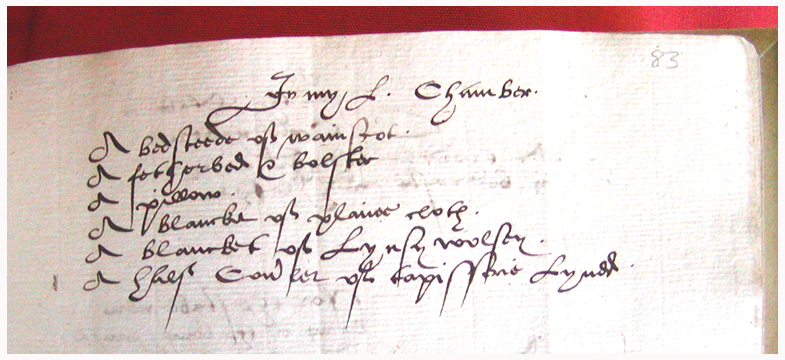
In each of the two notebooks at Queens’ College are inventories, the same except in minor wording, one written in 1561, one in 1569, in which he notes the 20 rooms at Ankerwycke, listing the contents of each.  In the first, #49, a room on the upper floor between his father’s room and the maid’s chamber is labeled “In my L. Chambre.”  In the 1569 inventory in notebook #83, page 123, a similar list is headed with the words: “In my Lorde’s Chambre.”

1561 inventory of Ankerwycke rooms, “In my L’s Chambre”

By “My Lorde” Smith must have meant de Vere, who, born “Viscount Bulbeck,” was considered a “lord” from birth.  Smith was punctilious about terminology, particularly where social distinctions were concerned, so he would never have made a mistake by called somebody a lord who was not, in fact, a lord.  Strype “supposes” that by “my Lorde” Smith meant the Duke of Somerset (170), but that’s impossible since Ankerwycke wasn’t finished until 1553, by which time Somerset was dead, nor would someone as self-righteous as Smith have wished to memorialize a master with whom he had had such profound differences.  It could not be Cecil, since from 1550 until Elizabeth’s accession Cecil kept his own household at The Parsonage at Wimbledon not far from Ankerwycke, nor did Cecil become a lord until 1571, long after Smith had drawn up these inventories.  Other than these, there is simply no lord other than de Vere who could possibly have had his own room in Smith’s home.

When we add this evidence to the phrase “brought up in my house” from the 1576 letter to Cecil, we should have enough to place Oxford with Smith for the better part of eight years, and in so doing, add to his story the riches of experience he gained as a child in a traditional country manor with all that that implies, as I’ve detailed in a number of blogs, pages, lectures, and articles.  Among many other puzzle fits, this scenario provides a reason for de Vere’s placement at Queens’ College for five months in his ninth year, Queens’ being Smith’s alma mater, and Smith needing that time to assist Cecil with preparations for Elizabeth’s accession, a hard fact for which we have more than enough evidence.

De Vere was still with Smith when the first list was written.  As for the 1569 inventory, although Oxford was no longer a member of Smith’s household, that Smith would continue to use his name for the room is seen by how he continued to call the room next to de Vere’s “my father’s chambre,” although Smith’s father died the summer of 1557.

By examining an actual document, its visual appearance can add to what its text and authorship have to tell us.  For instance, in the letter in which Smith finally turns to the issue of Oxford’s treatment of Burghley upon his return from Italy, that Smith was more emotional at the end than he was anywhere else in the letter is obvious from the condition of the paper at this point.  The pen was pressed so hard on the paper that the ink is darker here and the stroke thicker than anywhere else in the letter, so hard that the acid in the ink had eaten away the paper at that spot to a degree that it threatened to render a few of the words unintelligible.  I showed it to the librarian in the Manuscript Room at the British Library, suggesting they do something to preserve it before it crumbles completely.

More nine-inch nails in the Stratford coffin

Much of the overwhelming evidence for Oxford as Shakespeare can be found in the eight years he spent with his tutor, Sir Thomas Smith, from age 4 to 12.  Not only did Smith own most of the important works that scholars tell us were Shakespeare’s sources, but his personal interests, the passions that drove him, appear in Shakespeare in depth, astonishing knowledge for a poet and playwright, whatever his class, knowledge he throws about with abandon in allusions, similes and metaphors.  This is an approach to a subject that can only be taken by one who’s been steeped in a subject from earliest days so that it permeates all his thinking.

Smith’s interests form the major part of Shakespeare’s arsenal of metaphors, but there are five areas in particular that are worth noting, because they’ve often been singled out for comment by scholars.

Entire books have been written in efforts to prove that in two of these subjects: the Law and Medicine, Shakespeare was so deeply versed that he must have been a professional!  The same thing would be true of astrology cum astronomy (the two were the same back then), it being as much of a profession then as the first two, for he reveals his knowledge of this arcane science through metaphors and the use of esoteric terminology just as he does with law and medicine.  Smith had been named by Henry VIII the first Regius Professor of Civil Law at Cambridge when he was still in his twenties, and was a dedicated practitioner of Paracelsian medicine his entire life.  He was sufficiently schooled in astrology to draw up horoscopes, something that required a fair amount of mathematics then, plus all the necessary ephemerides, which he also had.

As for gardening and horticulture, these Oxford would certainly have learned from eight years of living with Smith, whose enthusiasm for gardening is revealed in his letters and also in the fact that wherever he lived (at Ankerwycke and Hill Hall), or taught (at Eton and Queens’ College), he planted gardens.  As Caroline Spurgeon shows in her book Shakespeare’s Imagery, the author had the kind of knowledge of gardening that could only have been acquired through living with it for years.  (I’ll make a page on the gardening connections soon.)  And the same is true of hawking, in fact, in one of his treatises Smith himself uses Shakespeare’s favorite hawking metaphor, comparing a haggard, or badly trained hawk, to a wayward woman.

If still thirsty for more information on the Smith-Oxford-Shakespeare connection, check out the page on how Shakespeare immortalized Smith in his plays.

And so we hammer on.  How many nails is it going to take?

What, can the Devil speak true?

As you no doubt are aware by now, my scenario for the authorship of the Shakespeare canon is not the standard view.  The standard view is the one most people have grown up with, the one that sees William of Stratford as the author of the works of Shakespeare, the view backed by university academics, even more so by their supporters, the ones who write most of the articles in response to our questions, and most of all by pop biographers, who, lacking anything substantive, garnish theirs with what they hope are zesty details of life in 16th-century Warwickshire and London.

Ours is so much a better story, why won’t they listen?

For the most part, academics are a very different strain from the artists that they study.  If the facts as they are presented don’t add up, they don’t see it because they don’t understand what makes their subject tick.  Focused on the trees,  they hardly know there is such a thing as the forest.  And once having arrived at the pinnacle of Shakespeare studies, the very button on the cap of the Humanities, they are not about to question what lies (pun intended) beneath that pinnacle.   One recent literary “historian” got, so we’re told, a million dollar advance on his glossy version of the Stratford myth.

There’s nothing strange about this.  In every area of human endeavor there are those who more or less blindly follow tradition and its rules without allowing themselves (or anyone else) to question them.  As for Shakespeare, most academics don’t really care who he was; it’s the text that interests them, not the author; as far as they’re concerned, the less about him the better. When, after 300 years of ignoring him, the universities finally accepted his plays as worthy of their attention, they were perfectly happy with the author as presented to posterity by Ben Jonson, the lifeless woolman stuffed into artist clothing, stuck on a pole, his propped arm pointing towards Stratford.

Academics get to the positions of authority they occupy by being well-behaved  all through school, getting good grades by giving their mentors the answers they want to hear, then getting them to sign on as advisors on their dissertation committees so they can get their PhDs and all that goes with it. Once tenured, they produce books in which they dedicate their examination of the symbolism of “eye of newt” to these same mentors.  By the time they’ve reached a point where thinking for themselves is no longer a threat, they’ve forgotten how, that is, if they ever knew.  And if the questions do begin to eat away at the edges of the Stratford myth, they’ve become too committed to Stratford through the books and articles they’ve published to allow them entry.  How ironic that Shakespeare’s “alms for oblivion” got nothing better for him than these latter day Holofernes.

They get away with it by ignoring the big arguments––like why there’s nothing in this supposed great writer’s handwriting but six clumsy legal signatures––while focusing on details. For instance they defend the Stratford story by saying, “contrary to authorship views, there’s more than enough evidence that William Shakespeare wrote the works.”  What they mean by this is that the name Shakespeare is on various title pages, while documents in Stratford testify that someone of that name lived and died there and sued his neighbors.  What they don’t tell you is that there is nothing solid to connect the title pages with the man who lived in Stratford. Or with the man who spent a few months in rented quarters in two different neighborhoods in London.  Or with Jonson’s Sogliardo.  Nothing times a thousand still equals nothing.

The ultimate irony of course is the obvious fact that we need the academics.  Or, perhaps I should say that we need authorship scholars in academia.  The excruciating amount of time, effort, and money it takes to track down documentation in the English libraries and archives requires that this be taken on by professionals, either backed by a university or by patrons who are not seeking some particular result.  How many archived references to the Earl of Oxford have academics ignored since the authorship question first raised its annoying head a century and a half ago?  How many during the century before that, since he was not the focus of their inquiry?  Until the universities open their doors to the question or enough disinterested, deep-pocketed patrons appear, we must struggle along with only our God-given common sense and what facts have slipped past, first the 16th and 17th-century censors, and now the Stratfordian defense.

We also have another sort of adversary.  Almost as much of a barrier as the academic who has no understanding of artists or interest in a realistic biography is the Oxfordian who has no understanding of history.  If we do not honor the truths of history, if we continue to be enchanted by soap opera fantasies that do violence to genuine historical and psychological truth, we will never gain the respect of the History departments, who realistically are the only ones in any position to do the necessary research, since the English departments simply don’t care.

How was it he put it?  “If circumstances lead me, I will find where truth is hid, though it were hid indeed within the center.”

Amen to that.

Crammed like a Strasbourg goose

In writing about the education of the nobility in Oxford’s time, American historian H.J. Hexter quotes Sir Thomas Elyot on the reasons for educating the nobility, “which is to have authority in a public weal,” adding, “Sir Humphrey Gilbert has a scheme whereby gentlemen’s sons will be crammed like Strasbourg geese with knowledge and skills, the better to serve in Parliament, in council, in commission and other offices of the Commonwealth” (1979, 63-4).  That this was Sir Thomas Smith’s aim in educating the future Earl of Oxford seems beyond dispute.  It should be added that Gilbert was one of Smith’s closest friends.

When I first began my study of the authorship issues many years ago, one of the first questions that I sought to answer was, what was Oxford doing before he was placed with William Cecil?  Back then, nothing that had yet been published dealt with Oxford’s early childhood.  I began putting it together from bits and pieces gleaned from a variety of sources: things said in passing by Smith’s biographers, a note in one of Smith’s household inventories, and, as always, by comparing the recorded timing of events, chiefly those surrounding his Cambridge stay at eight and his departure for Cecil House at twelve.  Since then much more has accrued that contributes to this scenario, with nothing so far to contradict it.

Now that his childhood with Smith has been revealed, our view of Oxford as creator of the Shakespeare canon has taken on new weight.  Revealed are: 1) the fact that those areas in which Shakespeare shows an unusual level of expertise are all areas in which his tutor was deeply interested; 2) Smith’s library contains most of the books that Shakespeare relied on as source material, often in the inexact way that we do when recalling early memories; 3) in his treatises, Smith often used dialogues so he could explore arguments on both sides of an issue, a form often found in the inner debates of Shakespeare’s soliloquies as well as the general form of all drama; and 4) Smith’s “lukewarm” attitude towards religion are echoed by Shakespeare’s seeming lack of adherence to a particular branch of Christianity.

For some weeks now I’ve been preparing essays on his education based on the information I’ve been collecting over the past fifteen years or so (much of it due to Dan Wright and the 40 or so Oxfordians who contributed to the fruitful six weeks I was able to spend researching in England in 2004).  These essays are up now as pages under OXFORD, and once I get some more up on Shakespeare’s sources, you should find it interesting to compare them in some detail.  The conjecture that Oxford may have attended several semesters at Christ Church College Oxford is something that hasn’t been discussed before.  There are several other new pages as well.  Their titles should appear on your screens in color.

The Rule of Law: Jude Law IS Hamlet

During a three month London adventure in 1999, I got (thanks to Dan Wright) the opportunity to see Jude Law in John Ford’s T’is Pity She’s a Whore at the Young Vic.  Impressed by Law’s ability to express the most intense anguish, I’ve been hoping ever since, first, that he’d do Hamlet (instead of one lame movie role after another) and second, that I’d be able to see him do it.  Both wishes just came true: not only has Jude Law done Hamlet, but (once again, due to the kindness of friends) I got to see him do it on Broadway!  And I was right.  What a Hamlet!

Hamlet is tricky, even for the best actors.  It’s become such a museum piece, there are so many famous sililoquies, every avid Shakespeare fan has a favorite performance to which they match each new approach, so that watching the play runs the risk of turning into a sort of Olympics of the Stage, where the actor playing Hamlet is not so much enjoyed as he is rated, in the same way that Olympic figure skaters get rated during their performance, feat by feat, by TV commentators.

Law sweeps this away with the utter naturalness of his style.  Sililoquies flow from him as easily as he greets his old school friends or rants at Ophelia.  Shakespeare’s 400-year-old language runs as trippingly off his tongue as if it were his own most natural form of expression, yet there’s none of that jack-hammer rat-a-tat-tat that some use when reciting Shakespeare, apparently in an effort to spew out the bloody awkward stuff the way they do their own native slang.

I think this is largely because Jude Law is as much a dancer as he is an actor.  He expresses the beautiful but strange language as much with his body as he does with his voice.  Together the two, the voice and the body, create a satisfyingly complete whole in a way that I can’t remember ever seeing before.  Anger possesses him utterly.  Anguish torments every fibre.  How perfectly Shakespeare has captured these emotions in words and how perfectly Law renders them, his gestures flowing, not from the words themselves, but from the emotions they are meant to express.  Today, thanks to television, we have all seen, over and over, how real people respond to disasters or the deaths of people they love, and so we can’t help but know how at such moments, words failing, it’s the body that reacts.  With his dancer’s sense of timing, Law also knows how to pause before reacting, something many actors either never learn or tend to forget in production.  It’s such an energetic performance, I can’t imagine how he can do it, not only night after night, but twice on matinee days.

Unfortunately there’s little good to be said for the rest of the production.  Law’s gutsy approach was not echoed by a single other member of the cast.  Apart from the King, who did prove a strong and convincing match to Hamlet’s energy, the rest simply entered, exited, stood or walked about as though waiting for something exciting to happen.  Horatio was particularly disappointing, less an antique Roman than a pool hall shark.  The set and lighting are good, providing some interesting accents to the action, but the costumes, modern suits in shades of gray, not only disappear into the gray walls and black floor of the castle set, but seem totally out of place. With no chairs or benches to relieve the need to stand, what group of twenty-first century people would choose to spend more than a minute or two in this cold, empty, castle foyer?

Now that my wishes have been fulfilled I have a new one, that Jude Law will repeat his performance on film, with costumes and sets that match, a Horatio whose body language speaks of his strength and dependability , a sober Gertrude who knows deep down right from the beginning that she’s damned, so that her son has only to remind her of it, and . . . and . . . oh, Michael Palin and Terry Jones as the gravediggers!   Hey, let’s shoot for the moon!

Unfortunately when it comes to Ophelia, it seems the role is unplayable.  Since it’s very likely that the Countess of Montgomery had a say in the publication of the First Folio, she could well have had something to say about the final version of her own mother’s unhappy fate and death.  For whatever reason it seems impossible for any young actress (or director) to actually bring her to life, at least, I’ve never seen it done. With Jude Law directing, maybe we could see an Ophelia who really cuts loose.  Wishes do sometimes come true.