Much of the overwhelming evidence for Oxford as Shakespeare can be found in the eight years he spent with his tutor, Sir Thomas Smith, from age 4 to 12. Not only did Smith own most of the important works that scholars tell us were Shakespeare’s sources, but his personal interests, the passions that drove him, appear in Shakespeare in depth, astonishing knowledge for a poet and playwright, whatever his class, knowledge he throws about with abandon in allusions, similes and metaphors. This is an approach to a subject that can only be taken by one who’s been steeped in a subject from earliest days so that it permeates all his thinking.
Smith’s interests form the major part of Shakespeare’s arsenal of metaphors, but there are five areas in particular that are worth noting, because they’ve often been singled out for comment by scholars.
Entire books have been written in efforts to prove that in two of these subjects: the Law and Medicine, Shakespeare was so deeply versed that he must have been a professional! The same thing would be true of astrology cum astronomy (the two were the same back then), it being as much of a profession then as the first two, for he reveals his knowledge of this arcane science through metaphors and the use of esoteric terminology just as he does with law and medicine. Smith had been named by Henry VIII the first Regius Professor of Civil Law at Cambridge when he was still in his twenties, and was a dedicated practitioner of Paracelsian medicine his entire life. He was sufficiently schooled in astrology to draw up horoscopes, something that required a fair amount of mathematics then, plus all the necessary ephemerides, which he also had.
As for gardening and horticulture, these Oxford would certainly have learned from eight years of living with Smith, whose enthusiasm for gardening is revealed in his letters and also in the fact that wherever he lived (at Ankerwycke and Hill Hall), or taught (at Eton and Queens’ College), he planted gardens. As Caroline Spurgeon shows in her book Shakespeare’s Imagery, the author had the kind of knowledge of gardening that could only have been acquired through living with it for years. (I’ll make a page on the gardening connections soon.) And the same is true of hawking, in fact, in one of his treatises Smith himself uses Shakespeare’s favorite hawking metaphor, comparing a haggard, or badly trained hawk, to a wayward woman.
If still thirsty for more information on the Smith-Oxford-Shakespeare connection, check out the page on how Shakespeare immortalized Smith in his plays.
And so we hammer on. How many nails is it going to take?
As you no doubt are aware by now, my scenario for the authorship of the Shakespeare canon is not the standard view. The standard view is the one most people have grown up with, the one that sees William of Stratford as the author of the works of Shakespeare, the view backed by university academics, even more so by their supporters, the ones who write most of the articles in response to our questions, and most of all by pop biographers, who, lacking anything substantive, garnish theirs with what they hope are zesty details of life in 16th-century Warwickshire and London.
Ours is so much a better story, why won’t they listen?
For the most part, academics are a very different strain from the artists that they study. If the facts as they are presented don’t add up, they don’t see it because they don’t understand what makes their subject tick. Focused on the trees, they hardly know there is such a thing as the forest. And once having arrived at the pinnacle of Shakespeare studies, the very button on the cap of the Humanities, they are not about to question what lies (pun intended) beneath that pinnacle. One recent literary “historian” got, so we’re told, a million dollar advance on his glossy version of the Stratford myth.
There’s nothing strange about this. In every area of human endeavor there are those who more or less blindly follow tradition and its rules without allowing themselves (or anyone else) to question them. As for Shakespeare, most academics don’t really care who he was; it’s the text that interests them, not the author; as far as they’re concerned, the less about him the better. When, after 300 years of ignoring him, the universities finally accepted his plays as worthy of their attention, they were perfectly happy with the author as presented to posterity by Ben Jonson, the lifeless woolman stuffed into artist clothing, stuck on a pole, his propped arm pointing towards Stratford.
Academics get to the positions of authority they occupy by being well-behaved all through school, getting good grades by giving their mentors the answers they want to hear, then getting them to sign on as advisors on their dissertation committees so they can get their PhDs and all that goes with it. Once tenured, they produce books in which they dedicate their examination of the symbolism of “eye of newt” to these same mentors. By the time they’ve reached a point where thinking for themselves is no longer a threat, they’ve forgotten how, that is, if they ever knew. And if the questions do begin to eat away at the edges of the Stratford myth, they’ve become too committed to Stratford through the books and articles they’ve published to allow them entry. How ironic that Shakespeare’s “alms for oblivion” got nothing better for him than these latter day Holofernes.
They get away with it by ignoring the big arguments––like why there’s nothing in this supposed great writer’s handwriting but six clumsy legal signatures––while focusing on details. For instance they defend the Stratford story by saying, “contrary to authorship views, there’s more than enough evidence that William Shakespeare wrote the works.” What they mean by this is that the name Shakespeare is on various title pages, while documents in Stratford testify that someone of that name lived and died there and sued his neighbors. What they don’t tell you is that there is nothing solidto connect the title pages with the man who lived in Stratford. Or with the man who spent a few months in rented quarters in two different neighborhoods in London. Or with Jonson’s Sogliardo. Nothing times a thousand still equals nothing.
The ultimate irony of course is the obvious fact that we need the academics. Or, perhaps I should say that we need authorship scholars in academia. The excruciating amount of time, effort, and money it takes to track down documentation in the English libraries and archives requires that this be taken on by professionals, either backed by a university or by patrons who are not seeking some particular result. How many archived references to the Earl of Oxford have academics ignored since the authorship question first raised its annoying head a century and a half ago? How many during the century before that, since he was not the focus of their inquiry? Until the universities open their doors to the question or enough disinterested, deep-pocketed patrons appear, we must struggle along with only our God-given common sense and what facts have slipped past, first the 16th and 17th-century censors, and now the Stratfordian defense.
We also have another sort of adversary. Almost as much of a barrier as the academic who has no understanding of artists or interest in a realistic biography is the Oxfordian who has no understanding of history. If we do not honor the truths of history, if we continue to be enchanted by soap opera fantasies that do violence to genuine historical and psychological truth, we will never gain the respect of the History departments, who realistically are the only ones in any position to do the necessary research, since the English departments simply don’t care.
How was it he put it? “If circumstances lead me, I will find where truth is hid, though it were hid indeed within the center.”
When we discover at age six or seven that it isn’t really Santa who provides the toys under the tree, but our parents, questions that were becoming ever sharper to our developing sense of reality––How can he get in when we keep all the doors locked? Why do they say he comes down the chimney when we’ve got no chimney? How can he possibly take care of all the children in the world in a single night? How come his reindeer can fly?––are suddenly resolved. A world that was becoming ever more mysterious in problematic ways returns to making sense. And so it is with one myth after another throughout life. And so it must be, eventually, with the Stratford biography.
Just as no fat man in a red suit could get himself down a million chimneys in a single night, no son of an impoverished, illiterate yeoman from a beer swilling market town two days ride from London could possibly have revolutionized English letters at a time when 90 percent of the population was illiterate. And just as Santa’s miracle is created by parents sneaking downstairs when the kids are asleep, so the English Literary Renaissance was (mostly) created by educated courtiers and their patrons working silently behind the scenes to provide a depressed nation with a replacement for the mummings and disguisings, the Church Ales and parades so harshly condemned by the Reformation.
The Renaissance, the rebirth of interest in Art and Science that began in Italy in the 14th century with the rediscovery of ancient texts and artifacts from the ancient civilizations of the Eastern Mediterranean, was delayed in reaching the northern and western areas of Europe by physical and cultural barriers. When it finally reached England in the late 16th century, it only did so because a politically weak monarch who desperately needed some inexpensive glamour to hide the fact that she had no wealth to speak of, was persuaded by some of her councillors to allow it to burst into life, first at Court, then in the public arena.
The English Literary Renaissance was not, uniquely, created by clever members of the working class any more than Christmas mornings are created by Santa’s elves. It was created by the same social group that created it in most of the southern nations of Europe, members of the Courts of kings, queens, and princes. In Spain, where a long connection with Islamic culture separated it from the rest of Europe, the “Golden Age” was largely created by men of a class much closer to that of William of Stratford, but this is an exception that can only prove the rule, for, unlike William (or Greene, or Nashe, or Watson, or, or, or), the two greatest Spanish writers of the period, the novelist Cervantes (born two years before Oxford) and the incredibly prolific genius Lope de Vega (born two years after Bacon) both show trustworthy and substantial paper trails that fit well with the dates and themes of their works and de Vega at least was assisted and supported by courtiers.
It’s been a year now since I began outlining this scenario, and although I’m still nowhere near getting even short versions of all the information that needs sorting out, a start has been made. Now that we are embarked on the great holiday season of the year, the one that started “Shakespeare” on his career, may you all find peace and relaxation in whatever form of “merry-making” brings you pleasure.
The Court Stage fell under the jurisdiction of the Lord Chamberlain of the Household. A sort of super-butler in charge of everything “above stairs,” he was important enough to be guaranteed a seat on the Privy Council. Elizabeth’s first Lord Chamberlain, Lord Admiral William Howard of Effingham, an inheritance from her sister’s reign, was not only kept on but was given several lucrative posts by the grateful Queen: a close relative, he had been her staunchest protector on Mary’s Privy Council. Later, his oldest son, Charles Howard, would play an even more significant role at Elizabeth’s Court as Lord Admiral, Privy Councillor, and patron of the company that made Christopher Marlowe and Edward Alleyn superstars.
It was the Lord Chamberlain’s job to decide what kind of entertainment to provide for each event, great and small, daily or for grand occasions, and to make sure that they went off smoothly. If properly used it could be a powerful political tool since it was the nearest equivalent to a Royal Public Relations office. Such may not have been to Howard’s taste, however, for from her coronation, Elizabeth had allowed her favorite, Lord John Dudley, to have charge of it.
How much Dudley was actually involved with the entertainers, most of whom were also inherited from previous reigns, remains to be seen. He was probably much more involved with the military aspects of his duties as Master of the Horse. We can guage what kind of entertainments he favored while he was in charge by the bash he threw at Kennilworth in 1575 (the summer that Oxford was away in Italy)––lots of old-fashioned masking with skits where actors pretending to be spirits came out of the woods to sing or recite long dull poems to the Queen filled with lavish comparisons to goddesses along with the not so subtle suggestion that she ought to marry Leicester.
Oxford’s earliest contributions to Court entertainment most likely consisted of musical numbers and interludes, brief comic turns that led one song or dance to the next for the various children’s companies to perform on holidays. These, the Children of the Windsor Chapel, the Children of the Queen’s Chapel, and Paul’s Boys, were the Queen’s favorite performers. Each little troop consisted of eight to twelve boys whose chief job during Catholic times had been to sing the Royal Mass, but who were also taught by their masters to dance and enact “dumb shows” (pantomimes) and comic “interludes” for special occasions. Both the London prep schools performed plays as well, sometimes for the Court.
Enter the Earl of Sussex
But Leicester’s (Dudley’s) control of the Court Stage was threatened when the Earl of Sussex took over as Lord Chamberlain. History ignores this, as it ignores most of Stage history, but we can be certain that Sussex was determined to return jurisdiction over the Court Stage to his office, that of Lord Chamberlain, where it belonged by long tradition. Leicester and Sussex had hated each other for years, and neither was going to let the other have any more power than he could help. As noted by McMillin and Maclean: “What happened to Leicester’s Men after 1574, when they would seem to have had the future in their hands, is one of the mysteries of theater history. Leicester’s Men lost their dominance at Court during the middle 1570s. . . .” (15). I hope to take a close look at some point at the probable scenario behind this mystery.
In any case, to facilitate his effort to resume the office that was his by tradition, I believe that Sussex invited Oxford, well known to him from the 1569 war with the border earls, to expand his contributions to Court entertainment to include full scale plays and probably also concerts, dances, and poetry readings. As a result, 1573-79 was certainly Oxford’s heyday at Court. By 1579 he would have been writing for both the boys and for the adult actors who in five years would be heading the Queen’s Men. They were termed Leicester’s Men in the record books, but in reality at this early time they were simply the actors who provided most of the adult entertainment at Court.
Literary historians have been limited by their adherence to the names of acting companies, derived from their patrons. To see the reality it’s necessary, whenever possible, to look past the names to the individual actors, particularly the lead actors, their patrons, and the always changing circumstances. The continual focus on the company names by historians has caused no end of confusion. History is made by individuals, not names.
Enter Walsingham
In 1581, shortly after the winter holiday season, the Queen banished Oxford from her “Presence” for getting her Maid of Honor pregnant and (not least) attempting to escape to Spain. This left no one to write the witty holiday plays that she had come to expect. The various children’s companies, some from local schools, filled in that December with old plays and material by their masters––Gurr calls it “the quiet season of 1581-82” (Companies 175)––but everyone involved in Court entertainment knew something had to be done to improve the situation before the next holiday season rolled around. Since that was about the time that Sussex began to fail, Walsingham, the Queen’s Principal Secretary, may have already have begun to consider a solution.
Walsingham was living at that time at The Papey, a manor just inside the Bishopsgate Wall and just around the corner from Fisher’s Folly on the other side of the City Wall. Plans to create a Crown company, the Queen’s Men, came to light early in 1583, but, like most things, they would have originated earlier, possibly from conversations between Oxford and Walsingham at The Papey, at Fisher’s Folly, or even at The Pye, the inn that lay between the two houses.
This was the period when Walsingham was beginning to get special funding for the anti-papist campaign he and Burghley were urging on the Queen and Parliament. New funds would have enabled him to privide Oxford with money to hire secretaries and apprentices. This would explain why these writers, later known to literary history as “the University Wits,” dedicated their works to Francis Walsingham, calling him their Maecenas, a traditional term for a patron. From the Wits at the Folly Walsingham hoped would come plays both for the children’s companies to entertain the Queen, and for the Queen’s Men to take on the road as a public relations maneuver, winning hearts and minds in advance of the attack from Catholic Spain that he knew was coming (McMillin).
With fears of the newborn commercial theaters rising among Church and City officials, with the excitement surging through the acting community from the power this was giving them, Walsingham may have feared that he was about to ride the whirlwind. A nervous man, in constant pain from an ulcer or other painful condition, his need to keep everything as hidden as possible has also hidden the courage with which, much like Churchill three centuries later, he faced one of England’s most crucial showdowns with Continental power.
Why was it so hard to protect the newborn commercial stage? Why such need for secrecy? Read on.
Ockham’s razor is a slang term for the simplification that takes place when the truth is finally located at the center of a mélange of clues and complicated hypotheses. We can be fairly certain we have the truth when whole cartloads of contradictions start vanishing, leaving a simply, believable story. But of course, first it’s necessary to stop ignoring the contradictions.
In the tiny community that was the English Literary establishment in the 1570s-90s, there were not a dozen different men (and/or women) who, over this 20 year period, wrote for a time and then ceased to write. There were two who for reasons of social propriety and privacy, used a number of different names, most of them the names of friends, family members, or retainers. These two, the pioneers, are Edward de Vere and Francis Bacon. The other two giants of Early Modern English Literature, Philip Sidney and Christopher Marlowe, who both died young, did not take pseudonyms, though for very different reasons. Raleigh probably makes a fifth, if we only knew which of the anonymous poems in the anthologies were his. (Raleigh wrote only for the Court community, he didn’t write pamphlets or dramas; his primary art was seamanship and adventure.) Mary Sidney is a transitional figure, carrying the torch from the first, gifted amateur generation to the following, which, if not totally professional in todays terms, was closer. And then came those who, again for different reasons, were far more free to write under their own names, writers like John Donne and Ben Jonson.
Why so much hiding of identities?
All that needs to be said here is that they did. Yes, we don’t have much hiding of identities today. Yes, it seems bizarre to us today that anyone would want to hide their identity when getting their precious work published. The reasons why these folks hid are complicated; I’ve covered some of them in other essays. Other scholars have also dealt with this. All that needs to be said here is that there is no doubt whatsoever that during this period the hiding of identities by poets, playwrights, satirists, writers of romance tales, novelists, and anyone who wrote any sort of imaginative literature was rampant. We may question this, but the readers, writers, and publishers of 16th and 17th-century England certainly did not.
How can we be certain that an identification is correct?
Well, we can’t. But we can come awfully close, much closer than any of the guesswork that’s gone into turning the handful of prosaic facts we have about William of Stratford into the lifeless biography that haunts us today. Our methods include the following:
Treating the information on title pages and front material with the same sort of rigor that we question anecdotes and rumors.
Understanding how very small were these early literary communities, and so realizing that there could only be a handful of writers involved in the beginnings of the commercial Stage and Press.
Locating repetitive styles and themes: There are habits and quirks that writers simply can’t eliminate and themes that they return to again and again. When both of these continue to appear together in a series of works––no matter what their title page attributions––chances are we’ve located a hidden writer. True, this was a period of experimentation, when styles came and went and when writers delighted in imitating the styles of others, either because they admired them or because they wished to satirize or annoy them. Nevertheless, if there’s enough congruence of style and themes, a general profile will appear that goes beyond names.
Locating connections between the names on title pages and the Court writers who had reason to hide their identities: Such connections include Oxford’s to John Lyly (secretary 1578-90), Anthony Munday (secretary, 1576?-1580), Thomas Watson (retainer 1583-92), Robert Greene (possibly Essex neighbor), Emilia Bassano(probably lover), William of Stratford (through Richard Field, his neighbor at Blackfriars), and Henry Evans (assistant); Mary Sidney to John Webster (her coachmaker, weak, but plausible) and to a fellow courtier (Fletcher); and Bacon to Spenser (fellow student at Cambridge), Nashe (student at Cambridge), Harvey (fellow at Cambridge), and Whitgift (tutor at Cambridge).
Locating the connections between the themes and subjects of the works in question with the lives of these Court writers: Most notably almost everything ever published under the name William Shakespeare can be connected rather neatly to persons and events in the life of the Earl of Oxford. Mary Sidney can be connected to Webster by the rather obvious reflection of her sons’ situation at Court in the events and characters portrayed in The White Devil and between her personal situation in 1601-1612 and the plot and characters of The Duchess of Malfi (and earlier by her personal knowledge of the events portrayed in Lady Jane, written for Philip Henslowe in 1602). Bacon’s authorship of Nashe by his financial straits and the theme of Pierce Penniless, his authorship of Spenser by his relationship with Gabriel Harvey from days at Cambridge University and (as Nashe) their pseudo-pamphlet duel, and so forth.
And by connecting them in time: It’s no coincidence that Robert Greene and Thomas Watson “died” just before Shakespeare appeared. It’s no coincidence that Webster’s plays appear only at times in Mary Sidney’s life when she isn’t busy with family stuff. It’s no coincidence that the works attributed to Spenser begin appearing just after Bacon arrives back in England but that Spenser’s name isn’t used for that or for The Faerie Queene until after Spenser departed for the distant wilds of Ireland. It’s no coincidence that Nashe appears for the first time during the ferocity of the Mar-Prelate dustup, or that he suffers nothing for the Isle of Dogs, while Court outsiders like Jonson, Shaa, and Spencer go to jail. The timing of these and scores of other events, set beside each other, form the pattern of a very interesting story, if we let them.
No single one of these points can stand on its own as evidence, but when we find that every item in every one of these categories points in a particular direction, we can be pretty sure we’re on the right track.
I don’t think so. Because if he did die on that day it would be one heck of a weird coincidence, almost as bizarre as the author of the canon being born with a name that perfectly fits his role as militant teacher and awakener––“I willshake a spear”; or that the first two successful yearround commercial theaters in England just happened to open both their doors within weeks of the Earl of Oxford’s return from theater-savvy Italy.
As I got more familiar with Oxford’s biography I became increasingly suspicious of this date. He could hardly have picked a more significant day to “pass on” than the day after the traditional summer solstice celebration in the pagan calendar, Midsummer’s Eve, or, in the Church calendar, on the Feast of St. John the Baptist. To die on such a day seems most suspiciously like another gesture from behind the curtain of his anonymity. But if so, what did it mean?
Suspicion increased upon noting that after being turned down for the Presidency of Wales in 1601, plus several other attempts to establish himself as something other than the bankrupt husband of Elizabeth Trentham, he drops all similar suits for properties, offices, and monopolies, setting his sights once again, as he has so often, on getting back his inherited rights in the Forest of Waltham.
Why the forest of Waltham? There was some income associated with these offices (keeper of the Forest and steward of Havering-atte-Bower), but there must have been something about these forest offices that kept him coming back to them every few years. For one thing the stewardship of the Forest was an office that had been his family’s for generations. His father had lost it to the Crown under Henry VIII, but as was true of many aristocrats who had similar inherited offices in other forests, he considered it his. Documents collected by Chris Paul make it clear that once he was given it back by James, he considered his role as forest official seriously. It’s also clear from his letters that he was suffering from physical problems in his final years, but that doesn’t necessarily mean that he was at death’s door. Some people live and continue to function for years with all kinds of disabilities and pain. After all, he was only fifty-four.
Letters of strange tenor
Months after his supposed death, eight Shakespeare plays are produced for the Court holiday season. One of these is Measure for Measure, in which a nobleman very like himself disappears on purpose. Duke Vincenzio has large executive powers over his constituents, much like those recently acquired by Oxford over the inhabitants of the Liberty of Havering. Six months after he was supposedly dead, Measure for Measure is performed for the Court the night his daughter marries Philip Herbert, brother of the Earl of Pembroke, leading patron of Shakespeare’s company.
The play is replete with philosophical thoughts on death, and also on the duke’s disappearance. Lucio complains, “It was a mad fantastical trick of him to steal from the state, and usurp the beggary he was never born to.” Later, contriving the scheme whereby Claudio is to be saved and Angelo hoist by his own petard, a monk (the duke in disguise) tells the prison provost that the duke is coming back, that “within these two days he will be here” a thing that “Angelo knows not; for he this very day receives letters of strange tenor; perchance of the duke’s death; perchance entering into some monastery.” Getting close to home here.
Another play produced for the Court that season was The Spanish Maze. That this was a version of The Tempest has been convincingly demonstrated by Roger Stritmatter and Lynn Kositsky. It portrays a great magician whose powers, limited to the creatures of a remote enclave, he voluntarily renounces upon the wedding of his daughter to a worthy nobleman to whom he gives his little kingdom as a wedding present. Again, awfully close to home.
Oxford’s powers have been demonstrated over the years by the all too obvious stage portraits of his contemporaries, some complimentary, some quite otherwise. As pseudo-Harvey put it in 1593 “all you that tender the preservation of your good names were best to please Pap-hatchet [Lyly], and fee Euphues [Oxford] betimes, for fear lest he be moved, or some one of his apes hired, to make a play of you, and then is your credit quite undone forever and ever, such is the public reputation of their plays.”
As far back as 1595 Oxford had announced to the Court, during the version of The Tempest he produced in January of that year for his oldest daughter’s wedding, “this rough magic I here abjure,” promising that as soon as he’s cleaned up certain problems, he’ll “drown” his “book.” He follows this by reopening his suit for Waltham Forest at some point before October (Nelson 351), and a month later Roland Whyte writes to his boss, Sir Robert Sidney, “some say the Earl of Oxford is dead” (354). So “Prospero-Vincenzio” may have tried to pull this disappearing stunt as early as 1595. Which suggests the real reason why the Queen wouldn’t let him have the forest. She knew how frustrated he was, but as long as he couldn’t get what he wanted she also knew that she kept him tied to her, a trick she used on many of her courtiers.
So what was he up to?
Leaving the historical evidence for another essay, let’s look at his plays. Here’s a writer whose protagonists, when stressed, tend to take off into the woods where they starve (Timon and Orlando), join up with bandits (Proteus and Valentine), take up with banished dukes (Orlando, Touchstone, and Jaques)––or, in happier times, chase girls (Lysander and Demetrius), pin valentines on trees (Orlando), get pinched by fairies (Falstaff) or control the inhabitants through their magic (Prospero and Oberon).
In Shakespeare, as in Oxford’s childhood, the forest, the wildwood, is never very far away. In the history plays and most of the wedding plays, it lies just outside the circle of light on the indoor stage. Although in Oxford’s time the great Forest of Essex that once blanketed all England was giving way to cottages and sheep farms, it happened that, of the largest portions that were left, Oxford spent his early childhood just across the Thames from the Forest of Windsor, and his later childhood at the northern edge of the Forest of Waltham. Who approaching the end of life doesn’t yearn to return to the summer scenes of childhood? Who wouldn’t do it if they could?
For Shakespeare, the Forest is the matrix, the ancient and still-living heart of the long history of his homeland that was the canvas of his art. In a world of change it remains the one place untouched by time. It’s where, as a child, stuffed by his tutor with classical learning and Reformation rhetoric, he discovered that there were books in running brooks and sermons in stones. The anger expressed in his January 1604 letter to King James about how Lord Grey was misusing the forest shows genuine anguish. His plans for it show no sign of an approaching death.
Where did he live in the forest?
My guess, drawn largely from evidence provided by Chris Paul’s extremely important article on the subject, is that he was living somewhere in or near Hainault Chapell Walk (6), roughly ten miles east of Hackney and a stone’s throw from Havering-atte-Bower. According to Paul’s research there was an old hunting lodge there, although it sounds a little too small and in too poor condition for a peer, even one whose only concern was peace and quiet (51). But as is clear from William Addison’s book on Epping Forest, there were plenty of hunting lodges in that area built by and for various members of the Court over the years. King James would have spent a good deal of time there since it was filled with homes of his courtiers, with opportunities for hunting a mere 14 miles from Greenwich Palace.
King James, Oxford’s patron
It’s obvious that King James had a more forgiving attitude towards Oxford than had the old Queen. Where she stalled him for years on his request for the Forest, James gave it to him as soon as he got to England, later referring to him as “great Oxford,” not a phrase that would ever have been heard from Elizabeth. This can be explained as simply another instance of the new King’s excessive largesse on taking the throne and Oxford’s exalted status as 17th in his ancient line, but it can also be seen as a desire to provide security to a great artist not sufficiently appreciated by the English (who are rarely good to their great artists).
Possibly in grateful response we see an outpouring of revised plays, eight alone (that we know of) for the winter holidays of 1604-05, and more to come in the months to follow. Would the King’s Men have dared to produce eight old plays for the first holiday season for their new patron, the first new English monarch in over forty years? Old plays might have pleased the royal newcomers, but there were also several hundred important courtiers, most of whom would have been well acquainted with earlier versions of all eight of these plays. From a theater entertainer’s point of view, that all of the plays presented to the Court that winter were produced without revisions or additions is unlikely.
Oxford’s other patrons
James was good to Oxford, but he could not have been acquainted with him at the time that he assigned him his forest rights, so there had to have been someone close to the King and with him on a regular basis who could present his case so persuasively that the royal ear would be impervious to contradictory reports from Oxford’s enemies.
Wm Herbert, Earl of Pembroke
Luck was finally coming Oxford’s way, for on his side now were not just one but two of the most influential men near James. These were the Herbert brothers, William, the 24-year-old Earl of Pembroke and his 18-year-old brother, Philip, sons of Mary Sidney, whose boyish charms had won the gay king’s heart.
Philip Herbert, Earl of Montgomery
William Herbert’s actions from this point on suggest that he was already considering how he was going to get his hands on the Court Stage. In fact, with his interest in the theater (doubtless engendered by his mother while he was in his impressionable teens) he may well have been the chief factor in persuading the King to give London’s top three acting companies the kind of royal support they could never count on from Elizabeth. With Shakespeare’s company well-set with the King, their playwright too had to be made secure.
The Devil and his Dam
Oxford had made a lot of enemies over the years, but two were now particularly dangerous. Most obvious was his cousin, Lord Henry Howard, termed by his wikipedia biographer “one of the most unscrupulous and treacherous characters of his age.” Oxford had plenty of reasons to loathe Howard whose libels (carefully saved by the Cecils) are still the major cause of the permanent blackening of his reputation with historians. While Elizabeth was alive, her dislike of Howard kept him from causing any real trouble, but by writing at length to James as she approached her final days, he succeeded in making himself indispensable to the insecure new King. Now, loaded with honors and powers, the new Earl of Northampton was a real threat, not only to Oxford but to any playwright who might dare to satirize him on the public stage. He could haul Ben Jonson into Star Chamber with impunity, but the Earl of Oxford required more subtlety.
Shakespeare’s most typical villain is a smooth-talker who takes pleasure in wooing then betraying his victims, the perfect image of Henry Howard. It was he who had been the most likely source of the rumors that broke up Oxford’s marriage in 1576. It was partly with his encouragment that his brother, Thomas, Duke of Norfolk, embarked on the insane plan to marry the Queen of Scots that cost him his head in 1572. Eight years later Howard almost succeeded in doing the same thing to Oxford. In another ten years his interference would be the direct cause of a heinous murder that would surely have destroyed him and his reputation forever, as it did a dozen others at Court, had he not conveniently died before the poisoned tarts hit the fan.
That Henry Howard was the inspiration for characters like Edricus (Ironside), Ateukin (James IV), Iachimo (Cymbeline), and finally, two of Shakespeare’s greatest villains, Iago in Othello, based on Howard’s destruction of Oxford’s marriage, and Lady Macbeth, based on the downfall of his brother, the Duke of Norfolk. Can we imagine that Howard, so paranoid about how he thought Jonson might have portrayed him, couldn’t see himself in these characters, and so wouldn’t have done everything he could to prevent the publication of Oxford’s plays?
Even more dangerous to Oxford was his own brother-in-law, Robert Cecil. Having played the same game with James as did Howard over the months before Elizabeth’s passing, and now equally loaded with offices, honors, and powers, it seems that Cecil gradually lost all moral restraint (Handover) . By 1604, with Marlowe dead (or transported), Lord Strange dead, and his brother-in-law Henry Cobham and the great Sir Walter Raleigh locked up tight under charges of treason, he’d managed to rid himself of all his major enemies. Freed from fear, and with the ugly network of spies and agents creating by Francis Walsingham at his disposal, his lower nature took over. By 1604 he was well on his way to becoming the most feared and hated man in the nation.
Oxford's enemies, Howard and Cecil
Oxford could not have had Cecil in mind when he wrote the original version of Richard III (The True Tragedy of Richard the Third) in (at least) the early 1580s, when Robert was still too young to be of any concern. (Ramon Jiménez has reason to believe the first version was written as early as the 1560s; Cecil was born in 1563.) But with his rise to power in 1603-04, that Shake-speare’s wicked, power-hungry hunchback was modelled on himself, or even more distressing, that everyone thought he was, could not help but heap his envious heart with coals of fire.
The enmity of one of these nasty characters would have been bad enough, but to have them working in partnership must have caused the aging playwright some concern. He pondered how to protect himself. And his papers.
But why fake his own death?
Oxford must have been tired of the rigamarole of life as an earl, something he had never been very fond of anyway. In a 1601 letter to Robert Cecil he refers to himself as a “hater of ceremonies” (=33). There was always something that had to be done, somewhere he had to put in an appearance.; someone was always after him, to pay a bill, to forward a suit, to ask his opinion; and to what end? He was in discomfort, possibly pain. He knew he didn’t have a whole lot longer to live. How was he to get the time he needed? And now this deadly duo had to be dealt with.
Plague struck the summer of 1603, just as King James was on his way south to take over the throne. It kept him away from London, at Pembroke’s in Wiltshire and other country estates until the winter. Plague mortality rates in Hackney were 88 percent, suggesting that if Oxford did decide to move to the Forest of Waltham, the plague of 1603 may have had something to do with it. Houses like King’s Place, made of wood beams and stone or brick, were not so likely to be infected as they did not have the kind of daub and wattle walls or thatched roofs that could so easily become infested with house rats, but of course at that time, no one knew that rats were to blame. Oxford was probably never very happy at Hackney. It was too close to the City to be peaceful and not close enough to the theaters to make up for the noise and congestion. In addition it was located in the kind of swampy area that anyone who suffered from recurring malaria would fear.
Oxford would have been aware of the long tradition offered by the medieval Church that had allowed his ancestor, Aubrey de Vere, to “die to the world.” By taking holy vows, a person gave up all worldly desires, contacts, and duties; from then on they were regarded by everyone, including their own families and friends, as legally dead. Unfortunately this tradition was no longer open to the 17th Earl; Henry VIII and Edward VI had brought it to a halt when they closed the monasteries and nunneries.
But with the help of the Earl of Pembroke and the King, like Measure for Measure’s “old fantastical duke of dark corners,” he could simply disappear, if not for good then at least long enough to get something finished. With so many doors now closed to him, guarded by his enemies, he still had one thing left that he could control––his exit.
Well-versed in property law, Oxford would have known how to fix it so his wife and son couldn’t be touched by the creditors that were e’en at him. Pembroke and Bacon would take care of the legal details. They could see to it that he was registered as buried at Hackney. It would be easy enough to have his name taken off the rolls at Parliament. The various legal procedures were simply pro forma, those in charge operating on whatever information was given them. His wife wouldn’t like it, but if she was to see her dynastic dreams bear fruit she would simply have to go along with it.
What a relief, simply to go off into the dark, silent forest with a bundle of paper, a pot of ink, a secretary to take dictation, a cook to provide simple meals, and a lutenist music meant he could look forward to the kind of uninterrupted peace and quiet that a writer needs more than food or drink. With the King, his friend, the sovereign of the Liberty of Havering, and a couple of “tall men” to ensure his safety, what a relief it must have been to be free to write and think from dawn to sundown, every day, with breaks for food and sleep and visits from only those he chose to see; no creditors to hide from, no suits to pursue, no begging letters to write to men whose guts he hated.
Who doth ambition shun, and loves to live i’ the sun,
Seeking the food he eats, and pleased with what he gets;
Come hither, come hither, come hither;
Here shall he see
No enemy
But winter and rough weather.
As they liked it
As Chris Paul tells us, Havering Park was unique in that it was a Liberty, “entirely independent of the ecclesiastical or civil jurisdiction of the county [of Essex],” having been so declared by Edward IV in the 15th century. No inhabitant could “be compelled or forced or bound to answer before any other justices, judges, or commissioners, but only in the Court of the said Manor” (18). The steward––Oxford in this case––had “full power and authority to hear and determine pleas, debts, accounts, covenants, trespasses.” Any interference by the Sheriff of Essex or JPs was “specifically forbidden.”
As if this weren’t sufficient, on April 4, 1604, King James reconfirmed the Havering charter, “including the provision that the tenants ‘shall have one fair every year at the village of Havering, the same to last three days, that is to say in the eve of the nativity of St. John the Baptist and two days then next and immediately following . . .’” (ERO Q/AX 1/1/2). Paul asks, “Could it have been, at least in part, because of these unique protections that the Earl of Oxford was determined to acquire the stewardship of Havering-atte-Bower?” (19). I would add, “protection from what”? The answer wasn’t long in coming.
What could have been the reason why someone felt called upon at that particular time, April 1604, to get the King to sign the charter stating that any celebration that took place in the Liberty of Havering on the 23rd of June would be legal and must not be disturbed? I suggest that, with Midsummer’s Eve parties taking place all over England, a special celebration took place that night in the Forest. There, surrounded by good company, entertained by the very best actors and musicians, Oxford, his patrons and close friends, without fear of disturbance, could gather around the traditional bonfire to toast the end of the Festival Year––and also, although most of them probably didn’t know it yet, the end of a great era in English letters.
The next day the word went out: the Earl of Oxford was dead.
Less than 24 hours later, government agents would collar Shakespeare’s “Fair Youth,” the Earl of Southampton, and five others, placing them under house arrest “at the King’s request.” Mark Anderson quotes the Venetian Ambassador in a letter sent back to Venice on June 26: “On Sunday night [June 24], by order of the King and Council, the earl of Southampton, Baron Danvers, and five others were arrested and each one confined in a separate house. Yesterday morning [June 25], after undergoing several examinations, they were set at liberty . . . .” (359). The reasons given were that charges had been made by unidentified persons that these former supporters of the Earl of Essex were plotting to slay several of the King’s Scottish attendants. A later historian of James’s reign (attributed to Sir Anthony Weldon c. 1650) blamed it on Robert Cecil, who had “put some jealousies into the King’s head.” (Anderson 360).
No further explanation was ever forthcoming, either from the no doubt embarrased King or anyone else. But dates don’t lie, and sometimes they reveal greater truths than on first glance. Like Hamlet, flushing out his uncle’s guilt with a play about the murder of a king, Oxford reveals––to himself and probably also to the King––what he’s suspected but needs to have proven, the dark nature of his brother-in-law’s intentions.
Why would Cecil have Southampton arrested on a trumped up charge (the other men were simply window dressing) the very day he learns his playwright brother-in-law is dead? Why, if not to dig through the Fair Youth’s papers in search of something––exactly what is anyone’s guess––but, with Oxford gone, something he suspects is now in Southampton’s possession? What else could it be than something that relates to the Earl of Oxford? How many coincidences does it take to make an educated guess?
Dates may not tell the whole story, but sometimes they can suggest its general outlines.
When did Oxford really die?
How long would Oxford have continued to live on out there in the woods, working on the final versions of his favorite plays, before death finally caught up with him? The best guess at this point is at least four more years, possibly five. Several things happen in 1609 that probably wouldn’t have were he still alive:, among them: his wife’s sale of King’s Place, and two of Shakespeare’s most personal and the publication of two of his potentially most damaging works, the Sonnets and Pericles.
How would his patrons, his family, and the actors react, once they know he’s gone for good?
My suggestion: led by the Earl of Pembroke, a core group of his supporters formed an ad hoc committee to see to it that both he and his works were treated with appropriate––if private––love and respect. He was buried without fanfare, possibly in the forest, but it’s accepted from the beginning that his final resting place will be somewhere in Westminster Abbey and that, as soon as is feasible, his collected works will be properly published.
Time drags on, but Pembroke can’t act until he’s secure in the office he seeks, which doesn’t happen until the end of 1615, by which time both Cecil and Howard are dead and he’s now, finally, Lord Chamberlain of the Royal Household, with authority over the King’s Men, their plays, and to a large extent, the London Stage as well.
An Abbey funeral could not have occured before the internment of Francis Beaumont in 1616 since Beaumont’s tomb is mentioned by Ben Jonson in the dedicatory Ode to the 1623 Folio. That it was no later than 1619 seems likely from his cousin Percival Golding’s tract on the Vere family wherein it states that the 17th earl was buried in the Abbey, written (according to Robert Brazil) during or before 1619.
What about his papers?
The burning question of what happened to the holograph versions of Shakespeare’s plays is one more of those things that remain a mystery. With his daughter married into the Pembroke family, it’s most likely that Oxford’s papers went to the Pembrokes, who were responsible for having them edited, for getting the best copies from whoever might be holding them, and for obtaining the rights to publish from the various publishers currently holding rights to their publication. As anyone knows who has followed the process of getting a controversial author’s papers published, this can take a very long time.
It’s most likely that Mary Sidney was the chief editor. Having spent years editing and publishing her brother’s works and her own as well, she had the credentials. Not just any scrivener would be allowed to tamper with the great man’s words, not even Ben Jonson. She also had an insider’s awareness of what would have to be cut or changed to satisfy her community’s anxieties about the possible revelation of family secrets. Most likely she had help in this from Francis Bacon, who would have stepped in to finish the job following Mary’s death. Both of their biographies fit well with the timetable of First Folio production. Ben Jonson was probably involved only in writing the front material.
As for the fate of the holograph versions of the plays, what makes the most sense is that, once the First Folio was finished and published, they were burned. To satisfy the many individuals who had been satirized in the plays, or whose parents had been satirized, there would have to have been some such agreement. Unfortunately for us, the rest, as Hamlet put it, has been silence.
There’s a great deal more to be said on the subject of Oxford’s death. For some of it, click here.
How does one go about creating a fact-based scenario when we have so few dependable facts? How do we “connect the dots” when the dots are so few and far between?
Coincidence? Naaah!
A coincidence of dates is the clue that what may appear on the surface to be a coincidence is really evidence that the events in question are connected at other points that may be hidden from view. Of course there are coincidences in life, but where there are so many anomalies, when matching dates suggest a connection, to assign such a connection to “coincidence” should be the solution of last resort. To name but three out of scores of such “coincidences” that pepper the pages of the authorship coverup scenario:
1576: Oxford’s return from Italy and the opening of both of London’s first successful commercial theaters: Burbage’s in time for the outdoor summer season, Blackfriars in time for the winter holidays . When we see that the opening of both of these theaters within the same time period, both starting within days or weeks of Oxford’s return, an event of immense importance to the history of both the Theater, the Media, and even Democracy, took place shortly after Oxford’s arrival home from Italy, home of Ariosto, Plautus, Terence, and the Comedia dell’Arte, we must conclude: of course Oxford was involved! We can argue about in what way or to what extent, but that he was crucial in some way to the opening of these theaters is simply too obvious to ignore.
1592-3: The death of Robert Greene, September 1592, and the advent of William Shakespeare on the dedication page of Venus and Adonis (May 1593). When we see that the name “Shakespeare” first appeared on a published work eight months after the purported demise of Robert Greene, whose later works so closely resemble early Shakespeare that, as Greene’s leading chroniclers all admit, they seem to have been written by the same hand, it suggests that, for various reasons, some of which become obvious once we fill in the historical background, the same author simply stopped using one name and began using another.
1623: The death of Anne (Hathaway) Shakespeare and the publication of the First Folio: When we see that after after waiting almost a decade following the death of William of Stratford, the collected works that it had taken so long to get published came out within weeks of her death, it suggests that for some reason the publishers did not want to publicize the connection between the works of Shakespeare and William of Stratford until both he and his wife were gone.
The entire history of the period is chock full of such coincidences. All it takes is looking for them. It is within the structure of dates like these that the expanded “theory of Authorship” (i.e., that hiding one’s identity behind that of a standin was a common practice among Court writers and not limited to Oxford-Shakespeare) has been constructed. But such a structure requires substantiation from other unconnected sources. These are of many types, but there are a few standard places to look for them.
Unities of place: Where?
If two Elizabethans resided within a few doors of each other at the same time for a certain length of time, or if their families came from the same village, or if they went to one of the universities for two or more years during the same time, were members of the Court community during the same period, resided in a foreign city during the same time period, and so forth, we can take it for granted that they knew each other. 16th century London was not 20th century New York City or London. It was more like 21st-century Peoria, Illinois.
Unities of relationship: Who?
The Court community consisted of roughly 200 souls altogether. The peerage that began with 60 at the beginning of Elizabeth’s reign was down to 25 by her death. The universities were much smaller than they are today, somewhere around 1,000 students plus faculty, about the size of a medium-sized high school, one with about 250 students in each grade, freshman to senior. Those who have attended such a high school know that by the third or fourth year, everyone knows just about everyone else, if not personally, at least by name and face.
However, though such connections make it more than likely that individuals knew each other,it does not guarantee that they were close. All too often claims are made by scholars that one writer was friends with another based solely on the fact that the one spoke well of the other in a publication. To assume actual friendship, more is required.
Similarly, if two Elizabethans were related through family or marriage, it makes sense that they knew each other, although it doesn’t necessarily mean that they got along or that they shared the same religious beliefs or political goals. Within the various communities of Elizabethans, almost everyone was related to some degree with everyone else. “Go far enough back and we’re all related to Adam”––but one doesn’t have to go back more than one or two generations in the English peerage and gentry of the 16th century to find a connection between just about everyone of rank.
Dating the plays: How?
As most readers are probably aware, we have no firm dates for any of the plays. The dates assigned by academics and routinely passed along by writers who haven’t studied the history of the period are nothing more than guesses based primarily on dates of publication, guesses for the most part made by E.K. Chambers back in the early 20th century. Limited by the lateness of the Stratford bio and hampered by acceptance of the idea that because Shakespeare was writing for money he wrote the plays more or less as they appear in the First Folio, when compared with the evidence from other sources, it becomes obvious that these commonly accepted dates are simply far too late, at least as dates of original composition. Lacking dates, other methods must be used. Here are some that haven’t often been considered:
If the central plot derives from a romance tale it must have been created originally before the mid to late 1580s when such plots went out of style.
If it deals largely with philosophical or ethical questions, jurisprudence, points of legal interest, Greek or Roman history, wars, or uses a fair amount of legal metaphors, examples from Latin texts, Latin quotes, etc., it was probably written originally for the Inns of Court audience of the West End.
If it’s a comedy that turns on witty conversations, puns, references to ancient rites of holiday merry-making, Greenwood rituals, forest adventures, fairies, elves, disguising or gender confusion, if it contains obvious openings for songs, dances, and feasting, we can be certain it was originally written for the Court community for Christmas, Twelfth Night, Shrovetide, Whitsuntide, May Day, Midsummer’s Eve, or for a wedding, many of which took place during one of these holiday intervals.
If it’s rich with classical references it was probably written either for the Court or for the Inns of Court (West End) audiences. If it’s rather sparce with these but contains a good deal of farce material, it was probably written originally in the 1580s for the Queen’s Men. (Probably the only totally new play after 1594 was King Lear, and even this was largely based on an earlier drama written for the Queen’s Men.)
Oxford’s life story as a dating device
One of the major reasons for the hiding of the Shakespeare authorship is how closely some of the plays reflect Oxford’s life and the lives of his associates. Since he wasn’t writing as a professional would, for money to pay the rent, his purposes in writing a particular play at a particular time must be connected to events and issues in his own life plus events and issues in the life of his community that one or more of his three audiences––Court, West End, and public––could relate to.
This is complicated by his revision of many of his old plays at least once during the 1590s when he was more or less compelled to provide the Lord Chamberlain’s Men with public entertainment, and the likelihood that he revised some of them more than once. This means that topical references from one period can be layered with references from another period, requiring an almost geological approach to the literary forensics involved in dating a particular play.
For instance, in plays other than the history or Roman plays, if there’s nothing in any plot or sub-plot that includes a situation reminiscent of Oxford’s breakup with his first wife, Anne Cecil, an original version may (or may not) be dated to before 1576, examples being A Comedy of Errors or Titus Andronicus. Where such a reference is essential to the central plot it was probably first written after 1576, examples being Cymbeline: Proteus’s suspicion of Imogen; or Alls Well that Ends Well: Bertram’s mistreatment of Helena. (Naturally this is of no use when dating either the history plays or the wedding plays where it wouldn’t be appropriate to deal with really serious issues.)
Plays that reflect Shakespeare’s style but that academics refuse to consider as his due to their demonstrably early dates, particularly those they have labelled his “sources,” can be dated using the same rubrics plus a knowledge of the peculiarities of his early style. Certain aspects of his style can be found in everything he wrote during his pre-Shakespeare period. If there are none of these, it’s a sure sign that the play was not one of his.
Shakespeare’s style
There is a style––perhaps better termed a “voice,” since his style kept evolving––that simply sounds like him. It may be possible to dissect this style through stylometrics or other word studies, but I’m beginning to doubt it. He experimented so with style, with meter, syntax, and vocabulary, coining words when he needed one that standard English didn’t provide (some he used only once), that to track him as one would an animal by the shape of his hoofprints simply doesn’t work. No animal changes the shape of its hoofprints. Even within the Shakespeare period, though his style is somewhat more jelled, there is still a wide variation, not only from early to late, but from genre to genre.
Voice is the best term, the best metaphor. People’s faces change as they age, their bodies change shape, their hair changes color (sometimes it vanishes), but unless they get very sick or age suddenly, their voices remain the same, each as unique to them as their fingerprints. How can we dissect a voice? It can’t be located in vocabulary or tone, it’s something apart from these, subtler, greater, more complex, yet more direct. I was so pleased when Amy Freed, author of the The Beard of Avon, in responding to the question, what was it about the Authorship Question that interested her, said something to the effect that it was the voice of Shakespeare that fascinated her, and that she wanted to find out all she could about where it came from.
Since voice is pretty much undefinable, we’re stuck with his style. What we call Shakespeare’s style is simply the final stage in a life-long development that began in the 1560s with the “galloping” fourteeners of Golding’s Ovid (The Metamorphoses); then moved through a decade focused chiefly on the Greek Romance or pastoral style. In the ’70s, this morphed into a developing enthusiasm for the tropes that came to be termed euphuism, a name derived from his Euphues novels (attributed to his secretary John Lyly). It was this style that he passed along to Marlowe in the mid-1580s.
Tiring of euphuism, which he then took great pleasure in satirizing, he began moving towards the style we know as Shakespeare. All throughout at times he would try different approaches, taking on a pseudo classic Roman style for Julius Caesar, taking personal biography to its limit with Hamlet, settling for something close to modern existentialism with Sonnet 130 and Measure for Measure, and finally ending with the Wagnerian impressionism of Lear.
What are the signs of Shakespeare in the early unattributed works?
gender reversals
characters who fall in love at first sight
buddy love
inordinate praise of a heroic protagonist by several other characters
women who can be won with little more than an invitation
witty servants and women
servants who speak in iambic pentameter
servants and women who decorate their speech with Latin mottos
disguised or switched identities causing characters not to recognize each other
characters who switch identities with servants or friends
ghosts or other supernatural occurances
a plot that hinges on an act of betrayal
witty exchanges in the form of rhyming couplets
exit speeches or otherwise important speeches that end with a rhyming couplet
A play that has more than one or two of these is likely to be an early Shakespeare play. Plays by other playwrights may have some of these, but never as many.
Everyone knows that he wrote Romeo and Juliet, Macbeth, Hamlet and (at least) 35 other plays.For many, his 400-year-old language is hard to read.Some even find it difficult to understand him in the theater.Yet every year scores of books roll off the presses about him or his works, year after year, decade after decade, century after century.What has made him so famous for so long?What besides write a few old plays? Continue reading “What Shakespeare did”→
Why should it matter who wrote Shakespeare’s works?The important thing is that we have them.
This is like saying, “What does it matter what makes the sky blue, plants grow, rain fall, humans live a certain length of time and then pass on? All we need to know is that it happens; we don’t need to know why.”
If this is a satisfactory response to you, Reader, pass on to the next ad or weblog.If your deepest and most immediate response isn’t, “Of course it matters!” I have nothing to say to you.This post is for those who care about the whys and wherefores of human life.Religion, Science, History, Politics, even the study of language itself, are all the result of a common desire to know why things are the way they are, and how things happen.The time we spend collectively on these issues probably explains the difference in size of the human brain compared with that of our nearest amphibian neighbors.There are many who shrink from using this much of their brain unless forced to use it, but they would probably not (still) be reading this.
Everything we learn in school is an approximation of the truth. It is possible to teach the truth, but only through inspiration.By the time the truth reaches the ordinary text book and the ordinary teacher, it has pretty much been drained of its color.Unfortunately, color is an important part of truth.Sometimes it’s the most important part, as it is for most artists.
Certainly it is in the case of the most sublime artist who ever spoke/sang the English language, the one we know only by the joke name, or rather joke phrase: Will shake spear!With his very name he vowed to shake a spear, which he did, and continues to do, that is, if the pen can be seen as a spear––or as the weapon brandished by Henry V at Agincourt.Think of the words of Winston Churchill, words that brought the English people, or more precisely, the English-speaking people,through a long and devastating war.When called “the Lion of Britain,” Churchill affected modesty, claiming only to have been “the roar”; but let us ask ourselves, who provided him with the language that gave that roar its meaning? It was Jesus who said, “Remember thy first things.”
Many individuals of many cultures have contributed to make the English language what it is, but if one individual is to be chosen to stand above the rest, it is this man, known to us as William Shakespeare, and not just by the millions of books published or the Phd’s awarded in his name. We can argue about by how much more, but I can’t imagine, even after twenty years of Lit Crit Deconstruction, that there would be any argument as to what single individual stands first in having the most influence on the English language.
If it doesn’t matter to us who created the language we all speak (if not as our native tongue, then the first we acquire as our second), that we use to communicate with each other, that we use to express our love, to argue issues, to learn about the world, to tell our jokes and stories, to describe a sunset, then what does matter?
If it doesn’t matter to us who wrote the works of William Shakespeare, then it seems fair to say that it doesn’t matter to us who we are.
In Act IV Scene 3, when pressed by the King to tell where he’s left the body of Polonius, Hamlet responds with seemingly pointless wordplay: The King deplores Hamlet’s criminal lunacy, but is Hamlet really nuts?Or is he only faking?His responses may be inappropriate, but maybe they have a meaning that he’s hoping the audiencesees, even if the King can’t.By worms he means the maggots who are “e’en at” Polonius, but why politic? Why convocation?
Most critics accept that Polonius was based on England’s Lord Treasurer, Lord Burghley, who was known to boast that he was born in 1521, the year the convocation of clerics and politicians known as the Diet of Worms collected in the little German town of the same name, where they proceeded to condemn Martin Luther for heresy, the moment in time often marked as the true beginning of the Reformation.
But why on earth does Shakespeare take the time to have his frantic hero make arcane jokes about the Reformation?Why, as numerous scholars have shown, is the whole play steeped in Reformation language and concerns?Why does Shakespeare choose for Hamlet’s university, Wittenberg, where Luther kick-started the Reformation when he nailed his 95 complaints to the door of the local church?
Although the Reformation began as a religious movement, the establishment of an English government based on Reformation policies was Burghley-Polonius’s lifelong goal.Does the author mean that as Burghley’s body is being dissected by maggots, his life is being dissected by historians and the politicans who will gobble up his wealth and his offices once he’s gone?Or is the play on the word worms simply one of those “quibbles” (puns) for which, as Samuel Johnson noted, Shakespeare was always willing “to stoop from his elevation.” Surely, as is so oftten true with Shakespeare, the answer is “both.”
Today, Authorship scholars like us are the politic worms who are “e’en at” Polonius-Burghley and all of Shakespeare’s characters, plots, and sources, dissecting the records so we can lay bare the bones of truth about the man who really wrote the Shakespeare canon, and why he and his constitutents thought it so necessary to hide his identity.



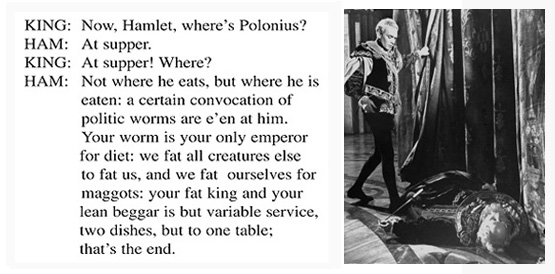 The King deplores Hamlet’s criminal lunacy, but is Hamlet really nuts?
 politicworm