Why Oxford hid his identity

Perhaps the hardest question that Oxfordians have to answer is why the author hid his identity.  No answer will satisfy a modern reader, who understands, quite rightly, that for today’s author, getting one’s name known is essential to success.  Was his anonymity forced on him by his rank?  By his family?  By the need to escape his enemies?  By the Lord Chamberlain Men as a business decision?  I believe all of these are true, but beyond all of these I also believe that right from the start, de Vere was an extremely private person.  Had he not had a reclusive streak from the start, he would not have been so easily erased from history.

This doesn’t mean that he was a recluse!  He had both a public face and a gregarious nature that enjoyed time with friends and admirers, but there was a shadow side to his nature, a hidden side, and he worked all his life to keep this side free from interference of any kind, as a child from Smith, as a teenager from Cecil, as a youth from the Queen, as a husband from his wives, as a man from various enemies and lovers, as a writer from tiresome grammarians, and as a genius, from everyone but persons with whom he was (briefly) in love or who provoked his interest in some way.

Raised in solitude, he was used to the kind of privacy that few Elizabethans enjoyed, so that when he entered the mainstream of public life at age twelve, and lost it, he became desperate to get it back.  To go from the solitude of Hill Hall to the hullaballoo at Cecil House, where he was viewed by all as the Lord Great Chamberlain of England and where his every move was monitored by Cecil’s household spies, must have been a profound shock, particularly to a budding writer whose greatest need was time alone.  Why was Cecil so quick to cover up the stabbing of the undercook in 1567?  Could it be because Oxford had freaked out at being spied upon, and like a lot of teenage boys, unused to the dangers of a deadly weapon,  he lashed out at one of these household spies in sudden fury?

Throughout his life we can see that he did everything he could to keep and protect his privacy.  Like the deer, the hare, and the snail, for whom Shakespeare had unusual sympathy, hiding was his most basic, gut-level response to life.  We see it reflected in many of his protagonists, who either hide, like Romeo, Timon, Duke Vincenzio, old Belarius, Orlando and the others who hide in the forest in As You Like It, or who, like Prospero, have been hidden through exile.  It may be that our lack of documentation of Oxford’s childhood is due to his having been virtually hidden by the Protestant community when placed with Smith during the period when Queen Mary’s ministers were about to begin their reign of terror.  Surely, like little Arthur in King John, he would have been aware fairly early that there was some kind of threat hanging over him.

What is the secret of successful hiding?  Never let anyone know where you are or what you’re doing.  In Oxford’s case, since he already had a persona handed to him at birth, it meant never letting the public know that he was responsible for what they were watching or reading.  It also meant never letting the Court community know exactly what he was up to.  Many knew something about him and what he did, but few had his entire confidence, perhaps only one.  That would have been Edward Manners, Earl of Rutland: Damon to his Pythias, Arcite to his Palamon, Valentine to his Proteus, Horatio to his Hamlet.  Among the few who knew him best would have been his “cousin Bacon”: Francis the Drawer to his Hal, Puck to his Oberon, Ariel to his Prospero.  Bitterest of his enemies would have been the friend who proved false, his cousin Henry Howard, Iago to his Othello, Iachimo to his Proteus, Edricus to his Ironside, Ateukin to his James IV.

Merkel’s view of Titus Andronicus

Hi Marie: Having promised to read your material online (The First Mousetrap) and consider your theory that Titus Andronicus is an allegory for the fate of the Howard family, I am half convinced that you’re right, even more than half.  I have to hold off a bit because I don’t see the kind of clearcut connections between the play and the Howards, the kind we can see with some of the other plays, but that doesn’t mean you’re not right, or at least on the right track.  An early version of the play may well have been more clear.  As with plays like Love’s Labour’s Lost and Romeo and Juliet, plots and characters were sometimes revised to fit later situations, so the version of Titus that ended up in the First Folio could also reflect such revisions, not necessarily by Shakespeare.

I don’t see that you claimed anywhere in your chapters or introduction that the author was the Earl of Oxford (did you and I missed it?).  In fact, you make a few comments that seem to connect its creation with William of Stratford.  Once Oxford is seen as the author, a possible connection with the Howards becomes much stronger.  They were his family, he was in their camp from his early 20s to his early 30s, and with Sussex and then Hunsdon as his patron (1572-’82) he had every reason to write in their defence.  Also, with Oxford as author, he would have had no need of Holinshed, for his primary source would be his Howard cousins, whose family history lay at the tips of their tongues.

You ask (rhetorically) if it’s possible to see Titus as Sir Thomas Smith.  Of course not, but it’s certainly possible to see in young Lucius’s notalgic wish to sit again on his grandsire’s knee a reference to how de Vere may felt at times during the five months he was left alone at Queens’ College.  In his first year or two with Smith, at age four and five he would still have been young enough to be taken onto his tutor’s lap for comfort or instruction.  I believe that the five months at Cambridge must have been a very lonely and stressful time for a little eight-year-old.  I think it’s entirely possible that when he wrote the part about Lucius he was recalling this moment.  I believe he was recalling this same period when, in King John, he visualized Prince Arthur living with a man who had been ordered to kill him, begging for his life, then trying to escape.  Not that de Vere’s Cambridge tutor, Thomas Fowle, had any such wicked intention, but it wasn’t his tutor he was recalling, only his own childish fears.  (It’s clear from Fowle’s biography that he was a hot-head.)

You point to the family relationships among the early patrons of the Court Stage, something worth repeating.  All three of the patrons who worked to get control of the Court Stage in the 1570s (and to keep it from then on) were direct descendants of the 2nd Duke of Norfolk, your candidate for Shakespeare’s Titus Andronicus.  To repeat: these were the Earl of Sussex, Ld Henry Hunsdon and Ld Charles Howard.  Howard relations of lesser rank were also the first and second Masters of the Revels, Edmund Tilney and Sir George Buc.  In short, almost everyone in charge of what got produced, both at Court and beyond, until the Pembrokes took over in 1615, were men descended from the 2nd Duke of Norfolk.

Most place Titus early, but in my view never early enough.  I’ve long seen it as the one early play that made it into the canon unrevised (at least, unrevised by Shakespeare).  We have other unrevised plays from that time, but they’re considered anonymous or are attributed to other writers.  The stilted, pompous language of much of it, the unreal female characters, the exceedingly  impressionistic treatment of history and use of Senecan horror tropes all suggest a very early origin.  These factors suggest that it was written by Oxford no later than his early 20s and possibly even in his late teens.  If written when he was 17 or 18, the reference to Lucius’s mother giving him Ovid would have been in time for Oxford’s mother to have seen the play.

It’s been suggested (by others?  by you?) that Tamora, Queen of the Goths, represents Mary Queen of Scots.  If this is about the Howards I don’t see how she could be anyone else.  Black Aaron could represent Bothwell and his baby represent the future James I.  Mary’s marriage to Darnley, the birth of James, the murder of Darnley, her marriage to Bothwell and flight to England all took place when Oxford was 17 and probably still spending most of his time at Cecil House where Mary was feared, hated and demonized, possibly to an extent that doesn’t come through in the records.  (English history is still confused about Mary;  as of now, the most detailed and trustworthy version of her life and fate is John Guy’s 2004 biography.)

It was what to do about Mary Queen of Scots that was the over-riding subject of political concern just as Oxford entered the adult world of Court politics and Inns of Court theater (The Supposes and Jocaste at Gray’s Inn 1566-’67).  So it makes sense that among his first attempts to entertain this community with something original would have been this effort to present the Howard case in Senecan technicolor.  That his close connection to Cecil House reflects William Cecil’s embroilment in Scottish affairs at this time, not only in Titus, but also in first versions of Macbeth and James I, also makes sense.

Other parts of the play may reflect later events.  Oxford’s writing for the Court and Inns of Court went into high gear in 1572 when Sussex took over as Lord Chamberlain and began his push to take the Court Stage away from Leicester.  A rewrite of Titus may show his reaction to the execution of  his cousin Thomas Howard, 4th Duke of Norfolk that same year.

In any case, his involvement with the play, and with the Howards, would necessarily have ended in 1580-’81 when he broke with Norfolk’s brother, Henry Howard.  This fight was no tiff between friends, but a deadly duel in which Oxford accused his cousin of treason and Howard accused Oxford of murder and pederasty.  Once Oxford saw his cousin as the Iago who had broken up his marriage and so deeply damaged his wife’s reputation, most of his nastiest villains would be based on Henry Howard, something that could not have escaped the man’s acute paranoia.  Even if we could somehow account for the old-fashioned style, it’s unlikely that ever again he’d write anything that might seem in any way to promote the family that seemed determined to destroy him throughout the early ’80s.  (The dedication of Robert Greene’s Tritameron of Love (printed 1587, but probably written two years earlier, may have been a deliberate effort to show that Philip was not included in Oxford’s blacklist.)

I do not believe this play was written for performance at Court.  If it was, then it was not about the Howards.  To have performed such a crudely violent play before the Queen, one that ripped open unhealed wounds, would have been sheer lunacy.  It is said that no one ever mentioned her mother in Elizabeth’s presence.  No one, least of all Oxford, would have dared to touch her deepest and most personal anxieties in this way.  Most likely he wrote it for his favorite audience, the “gentlemen of the Inns of Court.”  Many early versions of his best plays can be seen as pleading a particular case to this audience of lawyers.

I don’t agree that a great dramatist like Shakespeare would ever change character personas in midstream, with Titus representing Thomas Howard at one point and Henry VIII at another.  If this is what’s happening it must have been done by some later reviser.  No doubt Shakespeare did sometimes conflate historic noblemen with their descendants, not only for dramatic purposes, or because peers and their heirs were known by the same titles, but because, at that time,  men and women were still seen less as individuals than as limbs of a single ongoing entity, the Family.  In this way kings could be addressed as “England,” or “France.”  However, to conflate a character with his enemy  or his moral opposite would be to utterly lose the message, something no dramatist would ever do, not even one still learning the ropes.

The problem may be with rewrites.  In my view, Oxford would not have cared about this play after 1581, but anything by him would have been valuable later.  It may be that Henslowe had one of his writers do some surgery on it that left it making very little sense in terms of finding the original source.  If the original reflected the kind of political dynamite that you suggest, there would have been more than one reason for such a revision.

Your material is very well-written and easy to follow, difficult where such a complicated story is concerned.  I know how hard it is to make a complex narrative clear for readers.  Shakespeare turned to drama, but we can’t do that, can we?  My hope is that someday we’ll be able to see how and where every play fits into the true story, not only of Oxford, his tutors, patrons, and the other writers, but of the entire Elizabethan period.  So I’m happy to see that you are on the case.  More power to you.

Evidence for Oxford’s childhood with Smith

Sometimes a single fact can become the key to an entire period in history.  Oxford’s childhood with Sir Thomas Smith is that sort of key, not just to complete our picture of Oxford’s life, but to complete the picture of Oxford as Shakespeare, and beyond that, of Shakespeare as central to the history of England during what may well have been the most crucial period in her history and absolutely the most crucial period in her literary history and the history of the London Stage.

By establishing Smith as Oxford’s surrogate father, the Aristotle to his Alexander, the Plato to his Aristotle, the Leopold Mozart to his Amadeus, we have the riches of Smith’s library where dozens of titles provide the sources for some of Shakespeare’s most valued works.  We have, through Smith, the source of Shakespeare’s legal and distilling metaphors, his ascetic attitude towards food, his lack of religious bias, his Platonic philosophy.  Through his years at Ankerwycke we have the source of his river, gardening, and hawking metaphors (as noted by Caroline Spurgeon), his sympathy for animals, the forest’s deer, the meadow’s rabbits and birds, the garden’s caterpillars and snails.  In Smith, we have four of Shakespeare’s most vital characters, Holofernes from Love’s Labour’s Lost, Thomas of Woodstock from Richard II Part One, Gonzalo from The Tempest, and, greatest of all, Friar Lawrence from Romeo and Juliet.

We also have a number of smaller though tighter connections, such as the metaphor of a haggard hawk for a wayward woman, something Smith touches on twice in the few quotes provided by his biographers, or, in the advice Polonius gives Laertes, the advice to noblemen written by Smith during the period that Edward was living with him (Strype 53-5).  With all of this securely in place, ipso facto: Oxford was Shakespeare––evidence that comes later is simply icing on the cake.  And with Oxford confirmed as Shakespeare we can also complete our puzzle of the entire period, of all of the missing literary history, and even much of the mainstream history, for Shakespeare and his works are as central to the history of the Elizabethan era as is Elizabeth herself, or Burghley, Bacon, Raleigh, or Drake.  Thus while Smith is the biggest missing piece of the Shakespeare puzzle, Oxford is the biggest missing piece of the Elizabethan Court puzzle.

This is what makes it crucial that we ground our view of Oxford’s childhood with Smith in provable facts.  It was largely my purpose when, driven by an offhand remark by Mary Dewar in her biography of Smith, I spent six weeks in England in 2004 (funded by a fellowship raised by Dr. Daniel Wright of Concordia University) to see three of Smith’s notebooks for myself.  These, two in the library at Queens’ College Cambridge and one in the archives at the Essex Record Office in Chelmsford, seemed at first to offer nothing.  I didn’t realize until later that one did in fact hold one of the clues that I was seeking.  Not all clues are of equal weight, but as it happens, this one’s a pip.

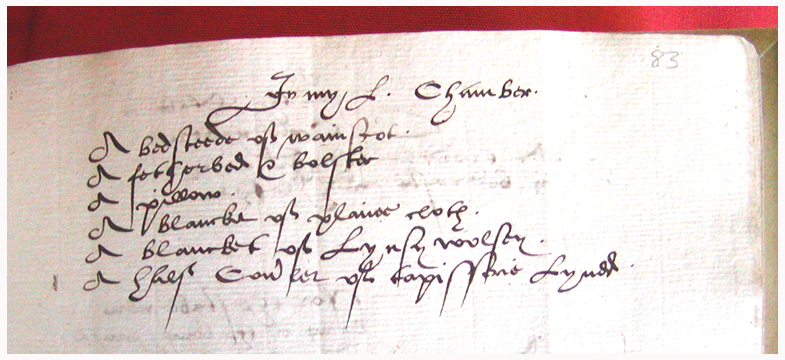
In each of the two notebooks at Queens’ College are inventories, the same except in minor wording, one written in 1561, one in 1569, in which he notes the 20 rooms at Ankerwycke, listing the contents of each.  In the first, #49, a room on the upper floor between his father’s room and the maid’s chamber is labeled “In my L. Chambre.”  In the 1569 inventory in notebook #83, page 123, a similar list is headed with the words: “In my Lorde’s Chambre.”

1561 inventory of Ankerwycke rooms, “In my L’s Chambre”

By “My Lorde” Smith must have meant de Vere, who, born “Viscount Bulbeck,” was considered a “lord” from birth.  Smith was punctilious about terminology, particularly where social distinctions were concerned, so he would never have made a mistake by called somebody a lord who was not, in fact, a lord.  Strype “supposes” that by “my Lorde” Smith meant the Duke of Somerset (170), but that’s impossible since Ankerwycke wasn’t finished until 1553, by which time Somerset was dead, nor would someone as self-righteous as Smith have wished to memorialize a master with whom he had had such profound differences.  It could not be Cecil, since from 1550 until Elizabeth’s accession Cecil kept his own household at The Parsonage at Wimbledon not far from Ankerwycke, nor did Cecil become a lord until 1571, long after Smith had drawn up these inventories.  Other than these, there is simply no lord other than de Vere who could possibly have had his own room in Smith’s home.

When we add this evidence to the phrase “brought up in my house” from the 1576 letter to Cecil, we should have enough to place Oxford with Smith for the better part of eight years, and in so doing, add to his story the riches of experience he gained as a child in a traditional country manor with all that that implies, as I’ve detailed in a number of blogs, pages, lectures, and articles.  Among many other puzzle fits, this scenario provides a reason for de Vere’s placement at Queens’ College for five months in his ninth year, Queens’ being Smith’s alma mater, and Smith needing that time to assist Cecil with preparations for Elizabeth’s accession, a hard fact for which we have more than enough evidence.

De Vere was still with Smith when the first list was written.  As for the 1569 inventory, although Oxford was no longer a member of Smith’s household, that Smith would continue to use his name for the room is seen by how he continued to call the room next to de Vere’s “my father’s chambre,” although Smith’s father died the summer of 1557.

By examining an actual document, its visual appearance can add to what its text and authorship have to tell us.  For instance, in the letter in which Smith finally turns to the issue of Oxford’s treatment of Burghley upon his return from Italy, that Smith was more emotional at the end than he was anywhere else in the letter is obvious from the condition of the paper at this point.  The pen was pressed so hard on the paper that the ink is darker here and the stroke thicker than anywhere else in the letter, so hard that the acid in the ink had eaten away the paper at that spot to a degree that it threatened to render a few of the words unintelligible.  I showed it to the librarian in the Manuscript Room at the British Library, suggesting they do something to preserve it before it crumbles completely.

Deconstructing Sonnet 107

My friend Hank Whittemore, with whom I differ on several key points, has asked about my take on the problematic Sonnet 107.

Over the four centuries that English speakers have been discussing Shakespeare, there have been many battles over the Sonnets, who they were written for, when they were written, and whether or not they were about something real or were just a literary exercise.  Although beautiful and important, I’ve tended to steer clear of discussing them partly because they’re so short on facts that nothing can be proven and, largely for that reason, because they’ve given rise to so many bizarre interpretations.

Then in 1999 I found myself preparing for an SOS Society conference where the Sonnets were a focal point, so I devoted several weeks to reading everything I could find on the subject going back to the 19th century. (An article I wrote later expanding on that lecture, The Story of the Sonnets, provides a good deal more detail for those who are interested.  There’s also a  Sonnets bibliography with comments on the books I found of most interest.)

Traditions of sonnet cycles

Some years ago I got into a fight with the usual coneheads on Hardy Cook’s listserv,  who eagerly pounced on my statement that the best writing comes from experience,  from enduring the emotions and insights that come from Life itself.  Isn’t this what Keats means with “truth is beauty, beauty truth, that is all ye know and all ye need to know”?  Keats was speaking to fellow artists and philosophers, of course––who else bothers about the relationship between Truth and Beauty?  Certainly not the coneheads that were dominating SHAKSPER.

Believing that most if not all the plays (the good ones) were written out of Oxford’s own experiences and emotions, of course I believe that the Sonnets were as well; that is, they were written at a time when he was going through experiences like those described in the Sonnets. That others in like case over the centuries have found solace in Shakespeare’s Sonnets attests to their power, a power that comes from how accurately, and with a thousand subtle details, they describe experiences common to many readers, which is, of course, why they’ve remained in print for centuries, and why we need to look to common experiences for reasons why he wrote them.

It was Petrarch who introduced sonnets to the West.  My guess is that like other sweets: stringed instruments, perfume, sugar, and Courtly Love, they originated in Persia (Iran), migrating to Italy via the cultural transfer from the Middle East to Venice in the 14th century.  Traditionally a sonnet cycle is a narrative of sorts, describing day by day, hour by hour, verse by verse, the progress of a passion from its dizzying enception to its final spasm.  We call these sonnets love poems in English, but the term the Elizabethans preferred was passion.

Love is too limiting a term for an experience that contains so many feelings, some anything but sweet––loneliness, loss, jealousy, envy, hurt feelings, remorse, disgust, even hate.  Poems written after the things they describe are over differ from those written as they happen.  Sonnet cycles, when they are genuine, are like raw footage, unedited, pungent, detailed, revealing themes through a process of repetition and insight  that’s closer to life itself than the reflection of life we call memoirs.

It’s part of the tradition of the sonnet cycle that the poet doesn’t reveal the true identity of the beloved.  An offshoot of the Courtly Love tradition, Petrarchan sonnets echo the yearning of a chivalrous knight for the beautiful but chaste wife of his lord.  Bound to him by oaths of fealty, this Courtly Love trope adds a further bond between lord and vassal, whose sacred passion for the lady can never fade because it’s never fulfilled; (the role the Virgin Queen demanded from her favorites).  Such poems are proofs of that love (“oblations, poor but free”), but only the lady herself is to know who is meant by “Stella,” or “Diana,” or “Phillis,” or “Caelica.”  For the Poet to let slip anything that reveals the source of his passion is to betray his Muse, another kind of romantic pose, but still one of great artistic authority by Oxford’s time.

And because, as a narrative in verse, a sonnet cycle is meant to follow such a passion as it unfolds, I believe that, following Oxford’s death, those published his sonnets saw to it that (for the most part) they were published in the order he intended.  Whoever had control of Oxford’s literary estate would have had great respect for it as literature.  Notions that when he died he was careless about leaving his papers where just anyone, including family members who cared more about their image than they did literature, might have gotten hold of them, shows a lack of understanding of how great artists feel about their work.  Having promised that he was going to leave a portrait of the Fair Youth for posterity to admire, he would certainly not have played fast and loose with their vehicle.  Whoever got his papers also got strict instructions on what to do with them.  This is simply common sense.

Oxford may have given up on Southampton himself (all passions must come to some kind of end), but he would never have given up on the poems that his love for him brought forth.  As he says in his farewell Sonnet, #126, Nature who has been so kind to Southampton, allowing him to keep his good looks well into his maturity, will have to cash him in sooner or later: “She may detain, but still not keep her treasure;/ Her audit, though delayed, answered must be,/ And her quietus is to render thee.”  In time the Fair Youth will cease to be both a youth and fair, but, as their author well knows, if properly published, the love poems he inspired will never lose either their beauty or their truth.

A great deal has been made of the fact that Shakespeare’s muse was a boy, not a lady.  To the shame-based society that the Reformation made of the English, that’s been an awful shocker.  However, if we pay attention to the poems it seems clear that the Poet’s desire is less sexual than emotional, the desire of a man for a son (Oxford was without an heir when he began writing them), and most important to an artist, for a muse whose charisma is potent enough to inspire his art.  Unfulfilled desire is the force that keeps it going.  It’s the number one Rule of Romance: fulfill the desire and the magic ends.  The question here being, desire for what?  My answer: a son-in-law whom he could love as though he were his own and, not least, a theater patron with solid credit.

Dating the sonnets

Back in 1999, I spent a good deal of time back seeking genuine scholarship on the dating of the Sonnets. I finally found it in a book titled Elizabethan Sonnet Themes and the Dating of Shakespeare’s Sonnets (AMS 1962, 1973). The author, Claes Schaar (writing for a Danish press, and so less constrained by hometown anxieties over identities), sticks strictly to the protocols of literary dating.  Basing his conclusions on the work of two scholars, one a German (pub 1884), the other an American (pub 1916) who apparently had no knowledge of his German predecessor (190).  Since these groundbreakers there have been others, all with similar results.

Ignoring the Stratford biography or any consideration of who the principles might have been, by comparing the language to that of Venus and Adonis and Lucrece, the only works by Shakespeare whose dates are solid, they place most or all of the Sonnets somewhere in the early 1590s: “. . . the vast majority of the sonnets we have examined seem thus to have been written between 1591-92 and 1594-95” (Shaar 185).  Their findings are corroborated by other scholars replicating their efforts, one being G.P.V. Akrigg, Southampton’s biographer, who gives an impressive list of scholars who agree that their language also places them close to the Folio versions of Love’s Labour’s Lost and Romeo and Juliet, which have been dated, by topical references and by language similarities to the two dated narrative poems, in the early 1590s (203).

Sonnet 107

All of this is by way of introducing Sonnet 107, which, although not considered one of his greatest, has probably caused the most discussion since it alone seems bent on revealing everything that he was so careful to hide in the other 125.  Not only does it go out of its way to identify the Fair Youth as the Earl of Southampton and to locate him, and by extension the surrounding sonnets, to 1603 when he was released from the Tower by King James, it’s also written in a different style.

As Schaar explains, most of the sonnets were written close in time, one after another.  Schaar et al see two bursts: 1591-92, and 1594-95.   These dates fit perfectly with what we know of Southampton, who really was a boy, that is, a teenager, in the early 1590s.  This scenario fits the first 17, the so-called marriage or procreation sonnets, with a known event, Burghley’s effort to get Southampton married to Oxford’s daughter, Elizabeth Vere.  In fact, the entire cycle fits perfectly with the biographies of Oxford (the Poet), Southampton (the Fair Youth), Essex (the Rival Poet) and Emilia Bassano (the Dark Lady).

All but a very few of the sonnets, including those that come just before and just after 107, are end-stopped throughout, that is, the expression of each thought is compressed into a phrase that pauses at the end of a line.  There are a very few (I counted four) in which enjambment  carries the thought  over from the first to the second line, though the basic iambic rhythm remains.  This style is one of the things that places the Sonnets early in Shakespeare’s career, as later he became much more relaxed about meter and enjambment.

But in 107 the opening expression ranges across not just two, or even three, but the entire first four lines!  Most unusually, the iambic rhythm is gone from those lines!  It’s a good strong poem, but located as it is surrounded by sonnets of a diffrent style, it sounds like someone else wrote it.  Frankly, it sounds like John Donne.  I’m not saying he wrote it, but that’s who it sounds like. So there are two big things that make this poem stand out in contrast to the rest of the sonnets, a violation of the tradition of secrecy, and also of a pattern adhered to throughout the entire rest of the cycle.

Cherchez le editor

My guess is that whoever published the poems inserted 107 for the very reason that it’s assumed such importance today, because it identifies the Fair Youth and it also locates the cycle at a particular point in time.  Since the author took obvious pains not to identify persons or events, this would have to have been done by the editor who prepared them for publication, and who probably was in harmony with the publisher.

I can’t say for certain who might have been Oxford’s literary executor, but a very good candidate would be William Herbert, Earl of Pembroke, who, by 1603, when Oxford was approaching the end of his life, was better-situated than anyone else to protect the poet’s valuable papers from those who might be anxious to see them disappear.  And who better to prepare them for the press than Pembroke’s own mother, Mary Sidney, who was probably already preparing another elegant edition of her brother’s works.  This scenario also helps to identify the Sonnets’ dedicatee, the mysterious “Master W.H.”

Why would the Pembrokes wish to make clear what Shakespeare had left ambiguous?

I can’t answer that, but I can point to something similar that occured in 1598 with the third edition of Philip Sidney’s The Countess of Pembroke’s Arcadia, edited and published by Mary, in which she included his sonnet cycle of the 1580s, Astrophil and Stella. She also included, for the first time, a sonnet that hadn’t been in any previous edition or in any of the manuscript versions that predated their publication in print back in 1591.  This sonnet, numbered 37, is the one that identifies Stella as Penelope Devereux.

It’s often assumed that #37 was left out of the cycle at first because it identified Stella, though that doesn’t explain why it then became necessary to make the identification.  True, by 1598 Penelope, though married, was openly living with her lover, Sir Charles Blount, Ld Mountjoy, so by then she had little reputation left to lose.  Even so, why stir the pot?  Could it be to direct suspicion away from Mary, who was suffering from the ususal rumors that followed women of celebrity, in her case that she and Philip had been lovers, that Stella was Mary, and that her brother was her son’s true father (Aubrey, Brief Lives, 140)?

That Mary (and her sons) might want to direct suspicion away from herself as the object of what could be seen as a shameful incestuous passion on Philip’s part would be altogether understandable, or that Penelope Devereux, already into her scandalous relationship with Mountjoy, would be willing to let her name be used to protect Mary  (Sidney makes it clear that the lust was all on his side, that Stella remained pure) is not only the stuff of romance, it’s the stuff of real life, that is, the real lives of romantic poets, who tend to take big emotional risks, much as astronauts, firemen and bullfighters take physical risks.

There was a close bond between the Devereux siblings and the Sidneys.  Philip and Mary were the children of Mary Dudley, sister of the Earl of Leicester.  Throughout the years while Leicester was hoping to marry Queen Elizabeth, Philip played the role of his uncle’s heir.  When Leicester finally gave up and married Lettice Knollys, widow of the 2nd Earl of Essex and mother of Robert and Penelope, Philip was forced to pass on the role of his uncle’s heir to Robert Devereux,Leicester’s new stepson.  As Philip lay dying of wounds in 1586 (suffered under his uncle’s command), he honored this rather mystical bond by ceremoniously handing on his sword to Essex, a bond that Essex then honored by marrying Philip’s widow.  (It was this sort of chivalrous behavior that made his friends love Essex.)  This bond between Essex and the saintly Philip then extended to their sisters, Mary Sidney and Penelope Devereux.

Why Oxford wrote the Sonnets

There was nothing improper about the way it started.  A marriage deal was in the works to unite his daughter and Burghley’s ward, the young Earl of Southampton, so the first 17 sonnets were written in the kind of passionate terms that fathers of marriagable daughters did back then.  (See Burghley’s wooing of the saintly Philip in letters to Sir Henry Sidney.)  Not every father could put such sentiments into verse, but as with all such social conventions, those who could certainly would.  So that’s all that was at stake with the first group, known as the marriage or procreation sonnets, in which he simply urges the youth to marry, coyly playing on his teenage narcissism.  That there were 17 in the first group suggests that they were nicely copied and bound as a gift for Southampton on his 17th birthday, Oct. 6, 1590.

With the 18th sonnet the tone changes abruptly.  What was fatherly affection fast becomes something much more personal and intimate.  So what happened?

When Oxford met Southampton, probably after the gift of the sonnets brought them together, he was at what may have been the lowest point in his life.  Now in his 40s, suddenly feeling “beated and chopped with tanned antiquity,” the boy must have represented all the things that he felt he’d lost or never had: his own vanishing youth, the son and heir he never had, the beloved friend he lost “in death’s dark night” when Rutland died in 1587, and not least, the angel he so desperately needed to continue to stage plays.

To the 17-year-old youth, Oxford may have seemed what he too had lost or maybe never had, a loving father, and one besides with the kind of access to backstage at the theater that teenagers dream of.  Teenagers need love and will respond to it wherever they find it.  Had this occured when Oxford was not at such loose ends the moment might have passed, but things being what they were, it threw him for a loop, as they say, and as was his habit, he turned for solace to pen and ink.

My guess is that at some point, for Oxford the passion became less about Southampton and more about the poetry.  My God, this was it!  This was what he’d been striving for!  This was what Sidney meant so long ago when he began his own sonnet cycle by quoting his Muse: “Fool, look in thy heart and write!”  The exhilaration, the loneliness, the jealousy, the empty hours, all were grist for his poet’s mill.  The original emotion became less important than how to express it.

The passion passed, as all things must, but like a beautiful shell on a beach after a great wave rushes back to sea, it left something precious in its wake, the language of Shakespeare.  For it was in the crucible of his love for Southampton and the combined happiness and pain it brought him, that he found the voice he’d been seeking through all the years of translating and listening and experimenting, the language we speak today, the language of modern English.

******************************************************************************

A different take on Sonnet 107 can be found in an article by Eric Miller, a poet and independent scholar from California, published in The Oxfordian, vol 9, 2005.

******************************************************************************

For comments click here.