The Authorship: the Big Picture

What are we to think about Shakespeare?  Is he who he said he was, who Ben Jonson and the academics say he was, or was he someone else?  Have we been diddled by Jonson all these centuries, and if so, why?  And does it really matter?

Maybe it doesn’t matter, but then what does?  Does it matter who won Olympic gold this year, or who gets appointed to the Supreme Court?  How many people care about these things?  What percentage of the population gives a damn about almost any question you can think of, including who killed Jack Kennedy?

It’s said that when George Mallory was asked why he wanted to climb Mt. Everest, he replied, “Because it’s there”––actually another authorship question since some think that a journalist made it up, but no matter who actually said it, it’s a good answer and it works for Shakespeare too.  For Shakespeare looms as large in the history of English letters as Everest looms on the Himalayan horizon.  Why do we want to know  the answer to the question of who actually created the language we speak?   Because it’s there.

Why “the big picture”?

If we knew who wrote the works we wouldn’t need anything but a little background along the edges, but not knowing, not knowing for sure, we must go to the background, for the truth leaves clues wherever it occurs.  As I got deeper into the story it began to expand, from the works themselves to the life of the supposed author to the lives of other English authors and their works, both those with writer’s biographies and those without, to the lives of the patrons and of the Queen they served, their politics, alliances, relationships and beliefs.

It spread to the story of the Continental poets and playwrights, to the history of the Reformation and beyond that of the European Renaissance.  From the works it spread to their sources (which, it turned out, were often in languages other than English), to the kind of education available to the writers, to the ancient and Continental works that inspired them,  and on to the realities of literature itself, how it gets created and by what kind of artist.  And finally to questions of freedom of speech and freedom of enterprise.  A big picture indeed.

Ultimately we’ll never be able to tell Shakespeare’s story in a convincing way without telling the whole story, if only in bits and pieces, from the historical and psychological angles as well as the literary.  Not only will the big picture bring illumination to the history of the period, it may help to bring understanding to something that’s in danger of being lost, the important and true purposes of Art, the nature of artists––as different from other human creatures as are butterflies from bees.

To put it as simply as possible, Shakespeare’s identity got hidden because he was so closely involved with the history of his time and with its movers and shakers, those in a position to hide the things they wanted hidden, that his identity became one of those things.

Merkel’s view of Titus Andronicus

Hi Marie: Having promised to read your material online (The First Mousetrap) and consider your theory that Titus Andronicus is an allegory for the fate of the Howard family, I am half convinced that you’re right, even more than half.  I have to hold off a bit because I don’t see the kind of clearcut connections between the play and the Howards, the kind we can see with some of the other plays, but that doesn’t mean you’re not right, or at least on the right track.  An early version of the play may well have been more clear.  As with plays like Love’s Labour’s Lost and Romeo and Juliet, plots and characters were sometimes revised to fit later situations, so the version of Titus that ended up in the First Folio could also reflect such revisions, not necessarily by Shakespeare.

I don’t see that you claimed anywhere in your chapters or introduction that the author was the Earl of Oxford (did you and I missed it?).  In fact, you make a few comments that seem to connect its creation with William of Stratford.  Once Oxford is seen as the author, a possible connection with the Howards becomes much stronger.  They were his family, he was in their camp from his early 20s to his early 30s, and with Sussex and then Hunsdon as his patron (1572-’82) he had every reason to write in their defence.  Also, with Oxford as author, he would have had no need of Holinshed, for his primary source would be his Howard cousins, whose family history lay at the tips of their tongues.

You ask (rhetorically) if it’s possible to see Titus as Sir Thomas Smith.  Of course not, but it’s certainly possible to see in young Lucius’s notalgic wish to sit again on his grandsire’s knee a reference to how de Vere may felt at times during the five months he was left alone at Queens’ College.  In his first year or two with Smith, at age four and five he would still have been young enough to be taken onto his tutor’s lap for comfort or instruction.  I believe that the five months at Cambridge must have been a very lonely and stressful time for a little eight-year-old.  I think it’s entirely possible that when he wrote the part about Lucius he was recalling this moment.  I believe he was recalling this same period when, in King John, he visualized Prince Arthur living with a man who had been ordered to kill him, begging for his life, then trying to escape.  Not that de Vere’s Cambridge tutor, Thomas Fowle, had any such wicked intention, but it wasn’t his tutor he was recalling, only his own childish fears.  (It’s clear from Fowle’s biography that he was a hot-head.)

You point to the family relationships among the early patrons of the Court Stage, something worth repeating.  All three of the patrons who worked to get control of the Court Stage in the 1570s (and to keep it from then on) were direct descendants of the 2nd Duke of Norfolk, your candidate for Shakespeare’s Titus Andronicus.  To repeat: these were the Earl of Sussex, Ld Henry Hunsdon and Ld Charles Howard.  Howard relations of lesser rank were also the first and second Masters of the Revels, Edmund Tilney and Sir George Buc.  In short, almost everyone in charge of what got produced, both at Court and beyond, until the Pembrokes took over in 1615, were men descended from the 2nd Duke of Norfolk.

Most place Titus early, but in my view never early enough.  I’ve long seen it as the one early play that made it into the canon unrevised (at least, unrevised by Shakespeare).  We have other unrevised plays from that time, but they’re considered anonymous or are attributed to other writers.  The stilted, pompous language of much of it, the unreal female characters, the exceedingly  impressionistic treatment of history and use of Senecan horror tropes all suggest a very early origin.  These factors suggest that it was written by Oxford no later than his early 20s and possibly even in his late teens.  If written when he was 17 or 18, the reference to Lucius’s mother giving him Ovid would have been in time for Oxford’s mother to have seen the play.

It’s been suggested (by others?  by you?) that Tamora, Queen of the Goths, represents Mary Queen of Scots.  If this is about the Howards I don’t see how she could be anyone else.  Black Aaron could represent Bothwell and his baby represent the future James I.  Mary’s marriage to Darnley, the birth of James, the murder of Darnley, her marriage to Bothwell and flight to England all took place when Oxford was 17 and probably still spending most of his time at Cecil House where Mary was feared, hated and demonized, possibly to an extent that doesn’t come through in the records.  (English history is still confused about Mary;  as of now, the most detailed and trustworthy version of her life and fate is John Guy’s 2004 biography.)

It was what to do about Mary Queen of Scots that was the over-riding subject of political concern just as Oxford entered the adult world of Court politics and Inns of Court theater (The Supposes and Jocaste at Gray’s Inn 1566-’67).  So it makes sense that among his first attempts to entertain this community with something original would have been this effort to present the Howard case in Senecan technicolor.  That his close connection to Cecil House reflects William Cecil’s embroilment in Scottish affairs at this time, not only in Titus, but also in first versions of Macbeth and James I, also makes sense.

Other parts of the play may reflect later events.  Oxford’s writing for the Court and Inns of Court went into high gear in 1572 when Sussex took over as Lord Chamberlain and began his push to take the Court Stage away from Leicester.  A rewrite of Titus may show his reaction to the execution of  his cousin Thomas Howard, 4th Duke of Norfolk that same year.

In any case, his involvement with the play, and with the Howards, would necessarily have ended in 1580-’81 when he broke with Norfolk’s brother, Henry Howard.  This fight was no tiff between friends, but a deadly duel in which Oxford accused his cousin of treason and Howard accused Oxford of murder and pederasty.  Once Oxford saw his cousin as the Iago who had broken up his marriage and so deeply damaged his wife’s reputation, most of his nastiest villains would be based on Henry Howard, something that could not have escaped the man’s acute paranoia.  Even if we could somehow account for the old-fashioned style, it’s unlikely that ever again he’d write anything that might seem in any way to promote the family that seemed determined to destroy him throughout the early ’80s.  (The dedication of Robert Greene’s Tritameron of Love (printed 1587, but probably written two years earlier, may have been a deliberate effort to show that Philip was not included in Oxford’s blacklist.)

I do not believe this play was written for performance at Court.  If it was, then it was not about the Howards.  To have performed such a crudely violent play before the Queen, one that ripped open unhealed wounds, would have been sheer lunacy.  It is said that no one ever mentioned her mother in Elizabeth’s presence.  No one, least of all Oxford, would have dared to touch her deepest and most personal anxieties in this way.  Most likely he wrote it for his favorite audience, the “gentlemen of the Inns of Court.”  Many early versions of his best plays can be seen as pleading a particular case to this audience of lawyers.

I don’t agree that a great dramatist like Shakespeare would ever change character personas in midstream, with Titus representing Thomas Howard at one point and Henry VIII at another.  If this is what’s happening it must have been done by some later reviser.  No doubt Shakespeare did sometimes conflate historic noblemen with their descendants, not only for dramatic purposes, or because peers and their heirs were known by the same titles, but because, at that time,  men and women were still seen less as individuals than as limbs of a single ongoing entity, the Family.  In this way kings could be addressed as “England,” or “France.”  However, to conflate a character with his enemy  or his moral opposite would be to utterly lose the message, something no dramatist would ever do, not even one still learning the ropes.

The problem may be with rewrites.  In my view, Oxford would not have cared about this play after 1581, but anything by him would have been valuable later.  It may be that Henslowe had one of his writers do some surgery on it that left it making very little sense in terms of finding the original source.  If the original reflected the kind of political dynamite that you suggest, there would have been more than one reason for such a revision.

Your material is very well-written and easy to follow, difficult where such a complicated story is concerned.  I know how hard it is to make a complex narrative clear for readers.  Shakespeare turned to drama, but we can’t do that, can we?  My hope is that someday we’ll be able to see how and where every play fits into the true story, not only of Oxford, his tutors, patrons, and the other writers, but of the entire Elizabethan period.  So I’m happy to see that you are on the case.  More power to you.

Evidence for Oxford’s childhood with Smith

Sometimes a single fact can become the key to an entire period in history.  Oxford’s childhood with Sir Thomas Smith is that sort of key, not just to complete our picture of Oxford’s life, but to complete the picture of Oxford as Shakespeare, and beyond that, of Shakespeare as central to the history of England during what may well have been the most crucial period in her history and absolutely the most crucial period in her literary history and the history of the London Stage.

By establishing Smith as Oxford’s surrogate father, the Aristotle to his Alexander, the Plato to his Aristotle, the Leopold Mozart to his Amadeus, we have the riches of Smith’s library where dozens of titles provide the sources for some of Shakespeare’s most valued works.  We have, through Smith, the source of Shakespeare’s legal and distilling metaphors, his ascetic attitude towards food, his lack of religious bias, his Platonic philosophy.  Through his years at Ankerwycke we have the source of his river, gardening, and hawking metaphors (as noted by Caroline Spurgeon), his sympathy for animals, the forest’s deer, the meadow’s rabbits and birds, the garden’s caterpillars and snails.  In Smith, we have four of Shakespeare’s most vital characters, Holofernes from Love’s Labour’s Lost, Thomas of Woodstock from Richard II Part One, Gonzalo from The Tempest, and, greatest of all, Friar Lawrence from Romeo and Juliet.

We also have a number of smaller though tighter connections, such as the metaphor of a haggard hawk for a wayward woman, something Smith touches on twice in the few quotes provided by his biographers, or, in the advice Polonius gives Laertes, the advice to noblemen written by Smith during the period that Edward was living with him (Strype 53-5).  With all of this securely in place, ipso facto: Oxford was Shakespeare––evidence that comes later is simply icing on the cake.  And with Oxford confirmed as Shakespeare we can also complete our puzzle of the entire period, of all of the missing literary history, and even much of the mainstream history, for Shakespeare and his works are as central to the history of the Elizabethan era as is Elizabeth herself, or Burghley, Bacon, Raleigh, or Drake.  Thus while Smith is the biggest missing piece of the Shakespeare puzzle, Oxford is the biggest missing piece of the Elizabethan Court puzzle.

This is what makes it crucial that we ground our view of Oxford’s childhood with Smith in provable facts.  It was largely my purpose when, driven by an offhand remark by Mary Dewar in her biography of Smith, I spent six weeks in England in 2004 (funded by a fellowship raised by Dr. Daniel Wright of Concordia University) to see three of Smith’s notebooks for myself.  These, two in the library at Queens’ College Cambridge and one in the archives at the Essex Record Office in Chelmsford, seemed at first to offer nothing.  I didn’t realize until later that one did in fact hold one of the clues that I was seeking.  Not all clues are of equal weight, but as it happens, this one’s a pip.

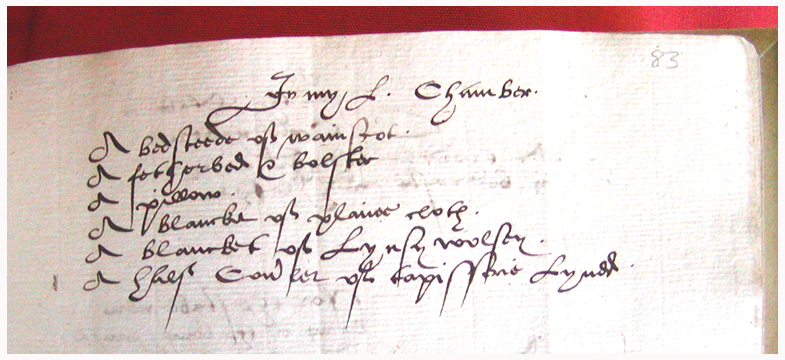
In each of the two notebooks at Queens’ College are inventories, the same except in minor wording, one written in 1561, one in 1569, in which he notes the 20 rooms at Ankerwycke, listing the contents of each.  In the first, #49, a room on the upper floor between his father’s room and the maid’s chamber is labeled “In my L. Chambre.”  In the 1569 inventory in notebook #83, page 123, a similar list is headed with the words: “In my Lorde’s Chambre.”

1561 inventory of Ankerwycke rooms, “In my L’s Chambre”

By “My Lorde” Smith must have meant de Vere, who, born “Viscount Bulbeck,” was considered a “lord” from birth.  Smith was punctilious about terminology, particularly where social distinctions were concerned, so he would never have made a mistake by called somebody a lord who was not, in fact, a lord.  Strype “supposes” that by “my Lorde” Smith meant the Duke of Somerset (170), but that’s impossible since Ankerwycke wasn’t finished until 1553, by which time Somerset was dead, nor would someone as self-righteous as Smith have wished to memorialize a master with whom he had had such profound differences.  It could not be Cecil, since from 1550 until Elizabeth’s accession Cecil kept his own household at The Parsonage at Wimbledon not far from Ankerwycke, nor did Cecil become a lord until 1571, long after Smith had drawn up these inventories.  Other than these, there is simply no lord other than de Vere who could possibly have had his own room in Smith’s home.

When we add this evidence to the phrase “brought up in my house” from the 1576 letter to Cecil, we should have enough to place Oxford with Smith for the better part of eight years, and in so doing, add to his story the riches of experience he gained as a child in a traditional country manor with all that that implies, as I’ve detailed in a number of blogs, pages, lectures, and articles.  Among many other puzzle fits, this scenario provides a reason for de Vere’s placement at Queens’ College for five months in his ninth year, Queens’ being Smith’s alma mater, and Smith needing that time to assist Cecil with preparations for Elizabeth’s accession, a hard fact for which we have more than enough evidence.

De Vere was still with Smith when the first list was written.  As for the 1569 inventory, although Oxford was no longer a member of Smith’s household, that Smith would continue to use his name for the room is seen by how he continued to call the room next to de Vere’s “my father’s chambre,” although Smith’s father died the summer of 1557.

By examining an actual document, its visual appearance can add to what its text and authorship have to tell us.  For instance, in the letter in which Smith finally turns to the issue of Oxford’s treatment of Burghley upon his return from Italy, that Smith was more emotional at the end than he was anywhere else in the letter is obvious from the condition of the paper at this point.  The pen was pressed so hard on the paper that the ink is darker here and the stroke thicker than anywhere else in the letter, so hard that the acid in the ink had eaten away the paper at that spot to a degree that it threatened to render a few of the words unintelligible.  I showed it to the librarian in the Manuscript Room at the British Library, suggesting they do something to preserve it before it crumbles completely.

More nine-inch nails in the Stratford coffin

Much of the overwhelming evidence for Oxford as Shakespeare can be found in the eight years he spent with his tutor, Sir Thomas Smith, from age 4 to 12.  Not only did Smith own most of the important works that scholars tell us were Shakespeare’s sources, but his personal interests, the passions that drove him, appear in Shakespeare in depth, astonishing knowledge for a poet and playwright, whatever his class, knowledge he throws about with abandon in allusions, similes and metaphors.  This is an approach to a subject that can only be taken by one who’s been steeped in a subject from earliest days so that it permeates all his thinking.

Smith’s interests form the major part of Shakespeare’s arsenal of metaphors, but there are five areas in particular that are worth noting, because they’ve often been singled out for comment by scholars.

Entire books have been written in efforts to prove that in two of these subjects: the Law and Medicine, Shakespeare was so deeply versed that he must have been a professional!  The same thing would be true of astrology cum astronomy (the two were the same back then), it being as much of a profession then as the first two, for he reveals his knowledge of this arcane science through metaphors and the use of esoteric terminology just as he does with law and medicine.  Smith had been named by Henry VIII the first Regius Professor of Civil Law at Cambridge when he was still in his twenties, and was a dedicated practitioner of Paracelsian medicine his entire life.  He was sufficiently schooled in astrology to draw up horoscopes, something that required a fair amount of mathematics then, plus all the necessary ephemerides, which he also had.

As for gardening and horticulture, these Oxford would certainly have learned from eight years of living with Smith, whose enthusiasm for gardening is revealed in his letters and also in the fact that wherever he lived (at Ankerwycke and Hill Hall), or taught (at Eton and Queens’ College), he planted gardens.  As Caroline Spurgeon shows in her book Shakespeare’s Imagery, the author had the kind of knowledge of gardening that could only have been acquired through living with it for years.  (I’ll make a page on the gardening connections soon.)  And the same is true of hawking, in fact, in one of his treatises Smith himself uses Shakespeare’s favorite hawking metaphor, comparing a haggard, or badly trained hawk, to a wayward woman.

If still thirsty for more information on the Smith-Oxford-Shakespeare connection, check out the page on how Shakespeare immortalized Smith in his plays.

And so we hammer on.  How many nails is it going to take?