
In Act IV Scene 3, when pressed by the King to tell where he’s left the body of Polonius, Hamlet responds with seemingly pointless wordplay:
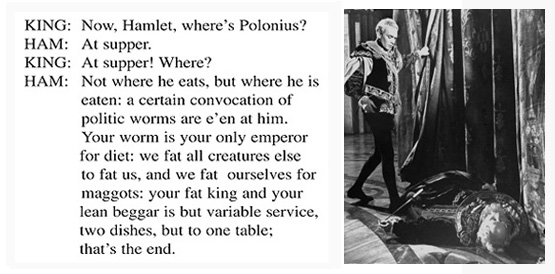 The King deplores Hamlet’s criminal lunacy, but is Hamlet really nuts? Or is he only faking? His responses may be inappropriate, but maybe they have a meaning that he’s hoping the audience sees, even if the King can’t. By worms he means the maggots who are “e’en at” Polonius, but why politic? Why convocation?
Most critics accept that Polonius was based on England’s Lord Treasurer, Lord Burghley, who was known to boast that he was born in 1521, the year the convocation of clerics and politicians known as the Diet of Worms collected in the little German town of the same name, where they proceeded to condemn Martin Luther for heresy, the moment in time often marked as the true beginning of the Reformation.
But why on earth does Shakespeare take the time to have his frantic hero make arcane jokes about the Reformation? Why, as numerous scholars have shown, is the whole play steeped in Reformation language and concerns? Why does Shakespeare choose for Hamlet’s university, Wittenberg, where Luther kick-started the Reformation when he nailed his 95 complaints to the door of the local church?
Although the Reformation began as a religious movement, the establishment of an English government based on Reformation policies was Burghley-Polonius’s lifelong goal. Does the author mean that as Burghley’s body is being dissected by maggots, his life is being dissected by historians and the politicans who will gobble up his wealth and his offices once he’s gone? Or is the play on the word worms simply one of those “quibbles” (puns) for which, as Samuel Johnson noted, Shakespeare was always willing “to stoop from his elevation.” Surely, as is so oftten true with Shakespeare, the answer is “both.”
Today, Authorship scholars like us are the politic worms who are “e’en at” Polonius-Burghley and all of Shakespeare’s characters, plots, and sources, dissecting the records so we can lay bare the bones of truth about the man who really wrote the Shakespeare canon, and why he and his constitutents thought it so necessary to hide his identity.
 politicworm