
John Shahan pushed me hard in his comment on my response to Alex McNeil’s question. Sometimes an exchange that follows a blog gets lost in the drift, but this is too important to let that happen, so I’ll respond here to some of his more pertinent points. If you missed it in full, it follows Alex’s question.
John: Why was the cover-up maintained after his death? It’s a separate question that you haven’t answered. It’s a good question, and one that many people ask when they come to the controversy for the first time. We should have a good answer at the ready, and providing an explanation of why he would have kept hidden during his lifetime doesn’t cut it. It sounds evasive to answer a question other than the one that was asked.
I wasn’t being evasive, I was being too general. His authorship would have been kept a secret after his death for exactly the same reasons that it was kept a secret during his lifetime, the same reasons that all the covers he used throughout his life remained in place, the same reasons that Mary Sidney’s descendents never revealed all she wrote or that Francis Bacon never revealed himself as a “hidden poet.” And for some of the same reasons that got Christopher Marlowe murdered or transported.
If I got lost providing background it’s because it’s so difficult for people today to understand the realities of Shakespeare’s time. However, there is one that might stand out a little better than most: namely the fact that so many of his characters satirized respected and high ranking members of the Court community, some portrayed as buffoons, some involved in scandalous love affairs, some even accused of murder! That they might possibly be identified with these infamous characters would have had these highly status conscious people, their retainers and descendants, in a real tizzy.
As long as William of Stratford was known as the author, the originals of these characters were protected, but had the Pembrokes and the Kings Men revealed the truth about the authorship they would have had an extremely serious situation on their hands. This is one of the reasons why the publication of Oxford’s collected plays took as long as it did. It had to wait until the Earl of Pembroke achieved the Court position where he finally had the power to take the matter of its publication into his own hands, overpassing the wishes of some who would have preferred that everything Oxford ever wrote be destroyed.
Most agree that Polonius was a demeaning portrait of Lord Burghley, something that would certainly have been as obvious to members of the Elizabethan Court community as it is to us today. If, as I believe, Hamlet, Julius Caesar, Romeo and Juliet, and other of his more serious and philosophical plays were written, not for the Court or the public, but for his Inns of Court audience, it could mean that Elizabeth never saw them, or if she did, not in the versions that we know from the First Folio. Thus it’s possible that Burghley never saw himself derided as Polonius, or his daughter portrayed as a lunatic and a suicide. For who would tell him? There were no newspapers, so there were no reviews. All publication was tightly controlled. By whom? By Lord Burghley.
Were it ever to become public that it was the Earl of Oxford who had created these popular characters––so popular that they made the Lord Chamberlain’s-King’s Men a fortune––how long do you think it would have taken the public audience to connect Oxford’s father-in-law with Polonius, his wife with Ophelia, his political adversary the Earl of Leicester with Claudius, or his Queen with Gertrude? How long to connect Richard III with Robert Cecil, Mildred Burghley with Volumnia in Coriolanus, Southampton with the Fair Youth, Philip Sidney with Sir Andrew Aguecheek, Emilia Bassano with Cleopatra, and so forth.
Oxford’s own daughters were the daughters of Ophelia, the granddaughters of Polonius. That, plus the fact that his youngest had married a Pembroke, shows that however you look at the cover-up, by 1615 when Pembroke finally got the office of Lord Chamberlain of the Royal Household, putting him officially in charge of the Court Stage and the King’s Men, publication of the First Folio was as much a family affair as it was a literary event. Pembroke wanted the plays published, but he also wanted to protect his family and his community from scandal and, not least, himself from the odium that would be inevitable were he to allow these connections to be revealed.
If it’s a good talking point you’re after, maybe this will do. Yet even here we run into the problem of readers not understanding enough about the period to get it. Again the main problem is our inability to grasp how small were these communities, and how static. Where our communities today consist of thousands, many of whom are no more to us than names, theirs consisted of a dozen, two dozen names, in positions that may have changed only once or twice over a lifetime. During Elizabeth’s reign the number of peers went from 60 to 25! Our communities are in continual flux; as one worker, neighbor, merchant leaves for greener pastures, retirement, or intensive care., another takes their place. The only way that things changed in Oxford’s time was through death.
We can say these things, but do they sink in? Do we really understand what it meant to live in what to us would seem intolerable constriction while under the constant threat of death for ourselves, our children, our loved ones, whether by disease (no doctors) or by violence (no police)? Added to the equation must be their ignorance of science, of medicine, even of their own history––a problem that Oxford’s history plays were intended to address.
The closest thing we have to their peers, their kings, queens, earls and countesses, knights and ladies, are celebrities. Of these we have so many that, as happened a few days ago, I can see someone introduced to an audience on television, an audience of cheering thousands, as one who has sold millions of platinum records and received a cartload of important awards, someone I’d never heard of before. And while their handful of important persons changed only when one died and was replaced by another, ours are continually changing, usually simply by disappearing into anonymity, beauty queens into middle-aged matrons, sports stars into businessmen, some onto the pages of history, a history already jammed with names and faces.
The problem isn’t only of numbers and stasis, it’s one of attitude. We have no respect for our celebrities. Largely due to their numbers, their lack of background, the ephemeral nature of their importance, they seem to exist largely as vessels for our scorn. Their very renown calls forth efforts to bring them down, to expose them, to show the world their weaknesses. These Elizabethan celebrities had no photographers with telephoto lenses to catch them with their pants down, they were known to their people only from a dignified distance, dressed in crimson, ermine, and gold, or from copies of stately portraits. Descended from the heroes of past glories, they came as close to living gods and goddesses as humans could. Their lessers might hate them and blame them for hard times, but they did not, they simply could not, disrespect them.
When Shakespeare came along and revealed these gods and goddesses as human beings with problems and weaknesses like themselves and their neighbors it was fascinating, yet for all their speculation, they did not know, they could not know, how closely based they were on the real thing. To have known who among those distant and admired figures were the real models of these fools and villains was simply more information than the culture could bear. As a general statement, that may be putting it a little too strongly, but not by much.
John: Lots of authors use pseudonyms to conceal their identities during their lifetimes without the cover-up continuing after they die. So why was Oxford different?
Lots? Who? Who of Oxford’s social stature? Who in his time, or the time before his, or the time after his? Not all statements have to be substantiated, but this is crucial. Who else of his status in the Elizabethan era published works of the imagination under his (or her) own name? I don’t know of a single one.
John: There’s a difference between knowledge and belief, and I think we do ourselves a disservice when we fail to make the distinction. That’s what Stratfordians do.
Having repeated this twice I assume you’re taking me to task for making unsupported statements. I’ve made it clear from the start that my purpose with this blog is to provide a scenario that accounts for what facts we have, not just a few here and there, clustered around one or two circumstances (such as the writing of the Sonnets), but as many as possible. I did a lot of substantiating of statements while I was editing The Oxfordian. That was important, but this, however different, is just as important.
We’ve had most of the facts on Oxford for decades, and where have they gotten us? Facts are to story as flour, water, salt and yeast are to bread; the ingredients, not the thing itself. We can eat bread, we can’t eat flour, water, salt and yeast. Creating a story out of facts is like mixing, kneading, and finally, baking. We are not inventing the bread, what form it takes depends solely on the ingredients. All we’re doing is assembling them, giving them a thump or two, and letting them rise into a living story.
To be convinced, hearts must be touched as well as minds, something that can’t be be done without characters and a plot. What’s most real about us are not the facts of our lives, but our stories. To understand the past, we need more than dates of battles, we need heroes and villains, tyrants and underdogs, damsels in distress. Without these, the audience leaves at intermission. No one understood this better than Shakespeare.
There’s another reason for what I’m doing. The Stratford bio as generated by Ben Jonson and others has sent generations of Shakespeare enthusiasts on an utterly fruitless 400-year-old wild goose chase through the archives in search of something that will reveal a believable Shakespeare story. While true stories must be based on facts, it’s also the case that the search for facts will go off-track quickly if there isn’t a logical scenario in place directing it where to look. How do we get such a scenario? By doing what I’m doing, filling in the blank areas with informed guesswork.
Hopefully there will be some, or at least one, who’s located close enough to the relevant archives who gets sufficiently intrigued by what I’m proposing to begin looking where I’m pointing. Centuries of investigators have read the letters of Burghley, Walsingham, Alleyn, Pembroke, and others, looking for something, anything, about Shakespeare. Nothing anywhere near this scale has yet been done for Oxford. Who knows what he or she will find once they begin to look?
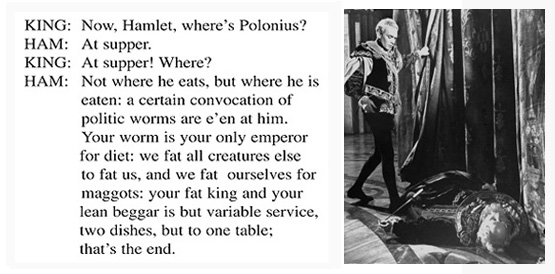 The King deplores Hamlet’s criminal lunacy, but is Hamlet really nuts?
 politicworm