
Shakespeare for snobs?

I pay attention to the blogs that mention the authorship question.  Those that rail against or make fun of it have two points they make consistently (and only two, repeating, like parrots, what they’ve heard from others), that Oxford died before “some of Shakespeare’s plays were written,” and that we’re snobs to think that only a nobleman could have the education.  Well, the first isn’t true, if they’d bother to do some easy research (like read this blog), and the second is true, as they would know if any of them knew anything at all about 16th-century England or the facts, the genuine facts, about William of Stratford.

Shakespeare is so much a part of our lives, only those who spend a lot of time reading or hearing his words realize how often the words and phrases in newspaper headlines, television interviews, and ordinary conversation are his. Reach for a phrase to express the highest thought, and it will usually be his.   He was the great flower of the English Renaissance, and our language and thinking is still permeated with the perfume of his poetic thought. Steeped in the aphorisms of the Greeks and Romans, he turned them into English, beautiful English, the kind only a poet can craft, and made them accessible to those who speak English for as long as English is spoken.

This kind of immersion in the literature of ancient wisdom and the beauties of poetry and rhetoric can’t be picked up in books along the way, even today.   It arises out of high level dinner table conversation with adults steeped in the subject, out of continual application to books that are ready to hand, by stimulating conversation with others who know and love poetry, by hearing beautiful prose and poetry read aloud, and it has to begin early.   In Shakespeare’s case it began with the removal of little Edward de Vere to the home of the great Greek scholar and statesman, Sir Thomas Smith, in 1554, with whom he would study Greek and Latin literature and history and English history for 8 years.

Smith didn’t care for music, so it wasn’t until de Vere came to live with William Cecil in London and was involved in Court activities that he heard live music by professional musicians on a regular basis and acquired training in and keyboard and stringed instruments himself.   Since later he was acclaimed as having enough musical skill to be considered a professional, it may be that Shakepeare’s poetry was the product of one who was at heart a musician, who, as a child was not yet able to make music with instruments, so made it instead replacing the sounds of music with the sound of words, through rhymes, alliteration, and meter.

In his dedication to Shakespeare’s Collected Works, Ben Jonson compared Shakespeare to a smith who must sweat to work the metal at white heat, hammering it into shape.   Those who take the craft of writing seriously know that it takes hours of thought to create prose that’s pleasing to both mind and ear, and although great poetry is sometimes born all of a piece (as was Robert Frost’s Stopping by Woods on a Snowy Evening or Coleridge’s Kubla Khan), it can only come from a mind continually steeped in poetic thought.

If there’s one thing that unites the Stratfordians who call us snobs (besides their ignorance), it’s their prejudice against aristocrats.   If it turned out that Shakespeare was a black African, would they call us anti-white?   Do they have some image of Bertie Wooster in mind, helpless without Jeeves?   What about the great aristocrats?  Henry V?  Or Oxford’s own ancestor, the 13th Earl, patron of the arts, the indefatigable warrior who survived an ignominious defeat, the execution of his heir, and imprisonment for ten years to defeat Richard III in battle, handing over the English throne to the Tudors?   What about Lord Byron, the immensely popular poet who sacrificed his life for the cause of Greek freedom?   What about Alexander the Great, son of King Philip of Macedon, who brought Greek civilization to half the world?  What about the painter, Henri de Toulouse-Lautrec?  What about Prince Siddhartha, the Buddha?

Oxford was only half aristocrat, anyway.  Although it’s true that his father was the direct descendant of a Norman aristocrat dubbed Earl by William the Conqueror, his mother was simple entry, while Smith, his surrogate father, was the son of a local farmer.   As an artist, Oxford was, in many ways, an outcast from his own tribe who preferred the company of other artists to members of his own class.   There are more reasons than one why his identity as Shakespeare was hidden, but surely the major reason was the way he portayed his aristocratic friends and relatives as characters in his plays, some with cruel satire.  He could satirize them because he knew them! And because they knew it, they would not, could not, allow his identity to be revealed.  Did this “torture” him, as some Oxfordians have held?  It may have caused him moments of frustration, but given the choice between continuing to write, or not, he chose to continue writing.

There was another potentially great poet, one from Oxford’s own class (though on a lower level) who, seeing what it meant to get a reputation as a poet, did choose to stop writing, or at least, to stop using his own name: Thomas Sackville, Ld Buckhurst.  His was the first voice that had anything like the sound that would later transform the language.  He wrote several of the scenes in the first modern play, Gorboduc, produced at Court in 1561, a year before de Vere came to London.  Had Sackville continued, it might have been he who won the glories reserved for Shakespeare (the Poet), but Sackville retired from the poetry arena early, explaining in a poem, Sackville’s Old Age, that such toys were not for him.  Did this have anything to do with Elizabeth’s willingness to promote him, lavishing him with promotions and perquisites that ended by raising him, as the Earl of Dorset, to Oxford’s level, allowing (some might say forcing) Oxford to slide into bankruptcy, giving him almost nothing he ever asked for?

Did the Lord Chamberlain’s Men choose to hide their playwright’s identity behind someone else’s name have anything to do with the fact that only months earlier the only other playwright close to his level, Christopher Marlowe, had been assassinated by government agents?

What do you think?
Once more into the breach, dear friends

Those of us who have spent enough time researching the authorship question to realize that it’s simply not possible that William of Stratford wrote the Shakespeare canon need to remember, when arguing the question with his defenders, that old saw: a good offense is the best defence.  Keep moving the argument back to the anomalies, back to the facts, back to the fact of the anomalies.

For instance, does it make sense that the most innovative writer of all time chose to rewrite the works of lesser writers rather than come up with his own unique plots?  Who else did that?  Not Milton.  Not Byron.  Not Keats, Shelley, Blake, none of them!  Not even other playwrights from Shakespeare’s own time.  Yet orthodox scholars have him copying Marlowe’s style, borrowing entire plots, characters and all, from Thomas Lodge and Robert Greene, stealing tropes from Samuel Daniel, one indigestible anomaly after another that, as per the White Queen’s advice to Alice, we’re to swallow without demur.  “Open wide!  Say ahhh!”

With Oxford, on the other hand, the only thing we have to swallow is the not nearly so absurd idea that he chose to hide his identity.  Taken with a few spoonfuls of literary history such as the exile of Ovid, the martydom of Cicero, the burning of Tyndale, the fatwa that kept Salmon Rushdie in hiding for years, one might conclude that hiding his identity during the repressive regime of the early English Reformation might have been a rather clever maneuver, one that kept him going well into his fifties while Marlowe never made it past his twenties.

Whenever they raise the issue of his dying before The Tempest was produced,  Roger Stritmatter and Lynne Kositsky now have their evidence of its early composition online, available to all to read, recommend, and pass along in emails to interested friends, including the rather amusing tale of how the Shakespeare establishment has been fighting to keep The Tempest in its little tiny teapot.  S&K have got a book on this at the publisher’s.  Hammer away at it, friends!  Don’t let it drop!

When they raise the issue of Oxford’s lack of obvious involvement in the Stage, relegating it to the brief appearances of companies like Lord Rich’s players or Lord Berkeley’s Men, point out the fact that, however minor his connections appear in the record, and however brief, they cover a longer period than any other patron or playwright except Ben Jonson.  Note how every momentous development in the history of the Stage seems to happen under the Earl of Oxford’s nose.  This, along with the published statements of his abilities in The Arte of English Poesie and Meres’s Wits Treasury, should be more than enough.  That is, it’s more than enough when taken together with the theory that he hid his identity!  Don’t let them divide and conquer by arguing the one issue without the other!  The reason why his name appears so infrequently is the same reason as his use of another man’s name!  They are part and parcel of the same argument.

Don’t let them use dating schemes like that put forth by E.K. Chambers, on which so many Stratfordian conjectures rely, all based on late dates like publication and the time constraints of the Stratford biography, or the one brought forth by Elliott and Valenza’s Claremont Clinic, in which we learn––quelle surprise!––that Shakespeare wrote Shakespeare (astonishing!).  The fact is, these word studies can’t possibly work in Shakespeare’s case.  Why?  First: because he rewrote so many of the plays, some more than once, over many years, so what date should we use?  And second: because his writing style changed so radically over the years, as did styles in general.  Every time they raise the issue of dates, hammer it home why there’s simply no way to date these plays.  That is, there’s no way unless we use Oxford’s biography.  For an example of how the biography, plus the history of the Court community, can help with dating, see Hamlet and The Spanish Tragedy and Dating the Shrew.

“I will find where truth is hid, though it were hid within the centre”!

“A golden mind stoops not to shows of dross”!

“Once more into the breach . . . “!

The Authorship: the Big Picture

What are we to think about Shakespeare?  Is he who he said he was, who Ben Jonson and the academics say he was, or was he someone else?  Have we been diddled by Jonson all these centuries, and if so, why?  And does it really matter?

Maybe it doesn’t matter, but then what does?  Does it matter who won Olympic gold this year, or who gets appointed to the Supreme Court?  How many people care about these things?  What percentage of the population gives a damn about almost any question you can think of, including who killed Jack Kennedy?

It’s said that when George Mallory was asked why he wanted to climb Mt. Everest, he replied, “Because it’s there”––actually another authorship question since some think that a journalist made it up, but no matter who actually said it, it’s a good answer and it works for Shakespeare too.  For Shakespeare looms as large in the history of English letters as Everest looms on the Himalayan horizon.  Why do we want to know  the answer to the question of who actually created the language we speak?   Because it’s there.

Why “the big picture”?

If we knew who wrote the works we wouldn’t need anything but a little background along the edges, but not knowing, not knowing for sure, we must go to the background, for the truth leaves clues wherever it occurs.  As I got deeper into the story it began to expand, from the works themselves to the life of the supposed author to the lives of other English authors and their works, both those with writer’s biographies and those without, to the lives of the patrons and of the Queen they served, their politics, alliances, relationships and beliefs.

It spread to the story of the Continental poets and playwrights, to the history of the Reformation and beyond that of the European Renaissance.  From the works it spread to their sources (which, it turned out, were often in languages other than English), to the kind of education available to the writers, to the ancient and Continental works that inspired them,  and on to the realities of literature itself, how it gets created and by what kind of artist.  And finally to questions of freedom of speech and freedom of enterprise.  A big picture indeed.

Ultimately we’ll never be able to tell Shakespeare’s story in a convincing way without telling the whole story, if only in bits and pieces, from the historical and psychological angles as well as the literary.  Not only will the big picture bring illumination to the history of the period, it may help to bring understanding to something that’s in danger of being lost, the important and true purposes of Art, the nature of artists––as different from other human creatures as are butterflies from bees.

To put it as simply as possible, Shakespeare’s identity got hidden because he was so closely involved with the history of his time and with its movers and shakers, those in a position to hide the things they wanted hidden, that his identity became one of those things.

Why Oxford hid his identity

Perhaps the hardest question that Oxfordians have to answer is why the author hid his identity.  No answer will satisfy a modern reader, who understands, quite rightly, that for today’s author, getting one’s name known is essential to success.  Was his anonymity forced on him by his rank?  By his family?  By the need to escape his enemies?  By the Lord Chamberlain Men as a business decision?  I believe all of these are true, but beyond all of these I also believe that right from the start, de Vere was an extremely private person.  Had he not had a reclusive streak from the start, he would not have been so easily erased from history.

This doesn’t mean that he was a recluse!  He had both a public face and a gregarious nature that enjoyed time with friends and admirers, but there was a shadow side to his nature, a hidden side, and he worked all his life to keep this side free from interference of any kind, as a child from Smith, as a teenager from Cecil, as a youth from the Queen, as a husband from his wives, as a man from various enemies and lovers, as a writer from tiresome grammarians, and as a genius, from everyone but persons with whom he was (briefly) in love or who provoked his interest in some way.

Raised in solitude, he was used to the kind of privacy that few Elizabethans enjoyed, so that when he entered the mainstream of public life at age twelve, and lost it, he became desperate to get it back.  To go from the solitude of Hill Hall to the hullaballoo at Cecil House, where he was viewed by all as the Lord Great Chamberlain of England and where his every move was monitored by Cecil’s household spies, must have been a profound shock, particularly to a budding writer whose greatest need was time alone.  Why was Cecil so quick to cover up the stabbing of the undercook in 1567?  Could it be because Oxford had freaked out at being spied upon, and like a lot of teenage boys, unused to the dangers of a deadly weapon,  he lashed out at one of these household spies in sudden fury?

Throughout his life we can see that he did everything he could to keep and protect his privacy.  Like the deer, the hare, and the snail, for whom Shakespeare had unusual sympathy, hiding was his most basic, gut-level response to life.  We see it reflected in many of his protagonists, who either hide, like Romeo, Timon, Duke Vincenzio, old Belarius, Orlando and the others who hide in the forest in As You Like It, or who, like Prospero, have been hidden through exile.  It may be that our lack of documentation of Oxford’s childhood is due to his having been virtually hidden by the Protestant community when placed with Smith during the period when Queen Mary’s ministers were about to begin their reign of terror.  Surely, like little Arthur in King John, he would have been aware fairly early that there was some kind of threat hanging over him.

What is the secret of successful hiding?  Never let anyone know where you are or what you’re doing.  In Oxford’s case, since he already had a persona handed to him at birth, it meant never letting the public know that he was responsible for what they were watching or reading.  It also meant never letting the Court community know exactly what he was up to.  Many knew something about him and what he did, but few had his entire confidence, perhaps only one.  That would have been Edward Manners, Earl of Rutland: Damon to his Pythias, Arcite to his Palamon, Valentine to his Proteus, Horatio to his Hamlet.  Among the few who knew him best would have been his “cousin Bacon”: Francis the Drawer to his Hal, Puck to his Oberon, Ariel to his Prospero.  Bitterest of his enemies would have been the friend who proved false, his cousin Henry Howard, Iago to his Othello, Iachimo to his Proteus, Edricus to his Ironside, Ateukin to his James IV.

Merkel’s view of Titus Andronicus

Hi Marie: Having promised to read your material online (The First Mousetrap) and consider your theory that Titus Andronicus is an allegory for the fate of the Howard family, I am half convinced that you’re right, even more than half.  I have to hold off a bit because I don’t see the kind of clearcut connections between the play and the Howards, the kind we can see with some of the other plays, but that doesn’t mean you’re not right, or at least on the right track.  An early version of the play may well have been more clear.  As with plays like Love’s Labour’s Lost and Romeo and Juliet, plots and characters were sometimes revised to fit later situations, so the version of Titus that ended up in the First Folio could also reflect such revisions, not necessarily by Shakespeare.

I don’t see that you claimed anywhere in your chapters or introduction that the author was the Earl of Oxford (did you and I missed it?).  In fact, you make a few comments that seem to connect its creation with William of Stratford.  Once Oxford is seen as the author, a possible connection with the Howards becomes much stronger.  They were his family, he was in their camp from his early 20s to his early 30s, and with Sussex and then Hunsdon as his patron (1572-’82) he had every reason to write in their defence.  Also, with Oxford as author, he would have had no need of Holinshed, for his primary source would be his Howard cousins, whose family history lay at the tips of their tongues.

You ask (rhetorically) if it’s possible to see Titus as Sir Thomas Smith.  Of course not, but it’s certainly possible to see in young Lucius’s notalgic wish to sit again on his grandsire’s knee a reference to how de Vere may felt at times during the five months he was left alone at Queens’ College.  In his first year or two with Smith, at age four and five he would still have been young enough to be taken onto his tutor’s lap for comfort or instruction.  I believe that the five months at Cambridge must have been a very lonely and stressful time for a little eight-year-old.  I think it’s entirely possible that when he wrote the part about Lucius he was recalling this moment.  I believe he was recalling this same period when, in King John, he visualized Prince Arthur living with a man who had been ordered to kill him, begging for his life, then trying to escape.  Not that de Vere’s Cambridge tutor, Thomas Fowle, had any such wicked intention, but it wasn’t his tutor he was recalling, only his own childish fears.  (It’s clear from Fowle’s biography that he was a hot-head.)

You point to the family relationships among the early patrons of the Court Stage, something worth repeating.  All three of the patrons who worked to get control of the Court Stage in the 1570s (and to keep it from then on) were direct descendants of the 2nd Duke of Norfolk, your candidate for Shakespeare’s Titus Andronicus.  To repeat: these were the Earl of Sussex, Ld Henry Hunsdon and Ld Charles Howard.  Howard relations of lesser rank were also the first and second Masters of the Revels, Edmund Tilney and Sir George Buc.  In short, almost everyone in charge of what got produced, both at Court and beyond, until the Pembrokes took over in 1615, were men descended from the 2nd Duke of Norfolk.

Most place Titus early, but in my view never early enough.  I’ve long seen it as the one early play that made it into the canon unrevised (at least, unrevised by Shakespeare).  We have other unrevised plays from that time, but they’re considered anonymous or are attributed to other writers.  The stilted, pompous language of much of it, the unreal female characters, the exceedingly  impressionistic treatment of history and use of Senecan horror tropes all suggest a very early origin.  These factors suggest that it was written by Oxford no later than his early 20s and possibly even in his late teens.  If written when he was 17 or 18, the reference to Lucius’s mother giving him Ovid would have been in time for Oxford’s mother to have seen the play.

It’s been suggested (by others?  by you?) that Tamora, Queen of the Goths, represents Mary Queen of Scots.  If this is about the Howards I don’t see how she could be anyone else.  Black Aaron could represent Bothwell and his baby represent the future James I.  Mary’s marriage to Darnley, the birth of James, the murder of Darnley, her marriage to Bothwell and flight to England all took place when Oxford was 17 and probably still spending most of his time at Cecil House where Mary was feared, hated and demonized, possibly to an extent that doesn’t come through in the records.  (English history is still confused about Mary;  as of now, the most detailed and trustworthy version of her life and fate is John Guy’s 2004 biography.)

It was what to do about Mary Queen of Scots that was the over-riding subject of political concern just as Oxford entered the adult world of Court politics and Inns of Court theater (The Supposes and Jocaste at Gray’s Inn 1566-’67).  So it makes sense that among his first attempts to entertain this community with something original would have been this effort to present the Howard case in Senecan technicolor.  That his close connection to Cecil House reflects William Cecil’s embroilment in Scottish affairs at this time, not only in Titus, but also in first versions of Macbeth and James I, also makes sense.

Other parts of the play may reflect later events.  Oxford’s writing for the Court and Inns of Court went into high gear in 1572 when Sussex took over as Lord Chamberlain and began his push to take the Court Stage away from Leicester.  A rewrite of Titus may show his reaction to the execution of  his cousin Thomas Howard, 4th Duke of Norfolk that same year.

In any case, his involvement with the play, and with the Howards, would necessarily have ended in 1580-’81 when he broke with Norfolk’s brother, Henry Howard.  This fight was no tiff between friends, but a deadly duel in which Oxford accused his cousin of treason and Howard accused Oxford of murder and pederasty.  Once Oxford saw his cousin as the Iago who had broken up his marriage and so deeply damaged his wife’s reputation, most of his nastiest villains would be based on Henry Howard, something that could not have escaped the man’s acute paranoia.  Even if we could somehow account for the old-fashioned style, it’s unlikely that ever again he’d write anything that might seem in any way to promote the family that seemed determined to destroy him throughout the early ’80s.  (The dedication of Robert Greene’s Tritameron of Love (printed 1587, but probably written two years earlier, may have been a deliberate effort to show that Philip was not included in Oxford’s blacklist.)

I do not believe this play was written for performance at Court.  If it was, then it was not about the Howards.  To have performed such a crudely violent play before the Queen, one that ripped open unhealed wounds, would have been sheer lunacy.  It is said that no one ever mentioned her mother in Elizabeth’s presence.  No one, least of all Oxford, would have dared to touch her deepest and most personal anxieties in this way.  Most likely he wrote it for his favorite audience, the “gentlemen of the Inns of Court.”  Many early versions of his best plays can be seen as pleading a particular case to this audience of lawyers.

I don’t agree that a great dramatist like Shakespeare would ever change character personas in midstream, with Titus representing Thomas Howard at one point and Henry VIII at another.  If this is what’s happening it must have been done by some later reviser.  No doubt Shakespeare did sometimes conflate historic noblemen with their descendants, not only for dramatic purposes, or because peers and their heirs were known by the same titles, but because, at that time,  men and women were still seen less as individuals than as limbs of a single ongoing entity, the Family.  In this way kings could be addressed as “England,” or “France.”  However, to conflate a character with his enemy  or his moral opposite would be to utterly lose the message, something no dramatist would ever do, not even one still learning the ropes.

The problem may be with rewrites.  In my view, Oxford would not have cared about this play after 1581, but anything by him would have been valuable later.  It may be that Henslowe had one of his writers do some surgery on it that left it making very little sense in terms of finding the original source.  If the original reflected the kind of political dynamite that you suggest, there would have been more than one reason for such a revision.

Your material is very well-written and easy to follow, difficult where such a complicated story is concerned.  I know how hard it is to make a complex narrative clear for readers.  Shakespeare turned to drama, but we can’t do that, can we?  My hope is that someday we’ll be able to see how and where every play fits into the true story, not only of Oxford, his tutors, patrons, and the other writers, but of the entire Elizabethan period.  So I’m happy to see that you are on the case.  More power to you.

Evidence for Oxford’s childhood with Smith

Sometimes a single fact can become the key to an entire period in history.  Oxford’s childhood with Sir Thomas Smith is that sort of key, not just to complete our picture of Oxford’s life, but to complete the picture of Oxford as Shakespeare, and beyond that, of Shakespeare as central to the history of England during what may well have been the most crucial period in her history and absolutely the most crucial period in her literary history and the history of the London Stage.

By establishing Smith as Oxford’s surrogate father, the Aristotle to his Alexander, the Plato to his Aristotle, the Leopold Mozart to his Amadeus, we have the riches of Smith’s library where dozens of titles provide the sources for some of Shakespeare’s most valued works.  We have, through Smith, the source of Shakespeare’s legal and distilling metaphors, his ascetic attitude towards food, his lack of religious bias, his Platonic philosophy.  Through his years at Ankerwycke we have the source of his river, gardening, and hawking metaphors (as noted by Caroline Spurgeon), his sympathy for animals, the forest’s deer, the meadow’s rabbits and birds, the garden’s caterpillars and snails.  In Smith, we have four of Shakespeare’s most vital characters, Holofernes from Love’s Labour’s Lost, Thomas of Woodstock from Richard II Part One, Gonzalo from The Tempest, and, greatest of all, Friar Lawrence from Romeo and Juliet.

We also have a number of smaller though tighter connections, such as the metaphor of a haggard hawk for a wayward woman, something Smith touches on twice in the few quotes provided by his biographers, or, in the advice Polonius gives Laertes, the advice to noblemen written by Smith during the period that Edward was living with him (Strype 53-5).  With all of this securely in place, ipso facto: Oxford was Shakespeare––evidence that comes later is simply icing on the cake.  And with Oxford confirmed as Shakespeare we can also complete our puzzle of the entire period, of all of the missing literary history, and even much of the mainstream history, for Shakespeare and his works are as central to the history of the Elizabethan era as is Elizabeth herself, or Burghley, Bacon, Raleigh, or Drake.  Thus while Smith is the biggest missing piece of the Shakespeare puzzle, Oxford is the biggest missing piece of the Elizabethan Court puzzle.

This is what makes it crucial that we ground our view of Oxford’s childhood with Smith in provable facts.  It was largely my purpose when, driven by an offhand remark by Mary Dewar in her biography of Smith, I spent six weeks in England in 2004 (funded by a fellowship raised by Dr. Daniel Wright of Concordia University) to see three of Smith’s notebooks for myself.  These, two in the library at Queens’ College Cambridge and one in the archives at the Essex Record Office in Chelmsford, seemed at first to offer nothing.  I didn’t realize until later that one did in fact hold one of the clues that I was seeking.  Not all clues are of equal weight, but as it happens, this one’s a pip.

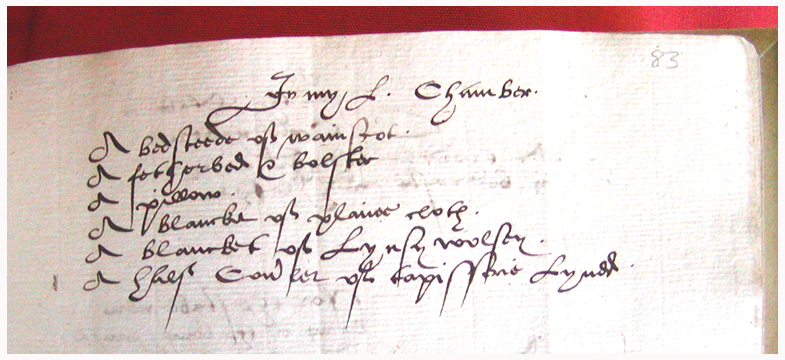
In each of the two notebooks at Queens’ College are inventories, the same except in minor wording, one written in 1561, one in 1569, in which he notes the 20 rooms at Ankerwycke, listing the contents of each.  In the first, #49, a room on the upper floor between his father’s room and the maid’s chamber is labeled “In my L. Chambre.”  In the 1569 inventory in notebook #83, page 123, a similar list is headed with the words: “In my Lorde’s Chambre.”

1561 inventory of Ankerwycke rooms, “In my L’s Chambre”

By “My Lorde” Smith must have meant de Vere, who, born “Viscount Bulbeck,” was considered a “lord” from birth.  Smith was punctilious about terminology, particularly where social distinctions were concerned, so he would never have made a mistake by called somebody a lord who was not, in fact, a lord.  Strype “supposes” that by “my Lorde” Smith meant the Duke of Somerset (170), but that’s impossible since Ankerwycke wasn’t finished until 1553, by which time Somerset was dead, nor would someone as self-righteous as Smith have wished to memorialize a master with whom he had had such profound differences.  It could not be Cecil, since from 1550 until Elizabeth’s accession Cecil kept his own household at The Parsonage at Wimbledon not far from Ankerwycke, nor did Cecil become a lord until 1571, long after Smith had drawn up these inventories.  Other than these, there is simply no lord other than de Vere who could possibly have had his own room in Smith’s home.

When we add this evidence to the phrase “brought up in my house” from the 1576 letter to Cecil, we should have enough to place Oxford with Smith for the better part of eight years, and in so doing, add to his story the riches of experience he gained as a child in a traditional country manor with all that that implies, as I’ve detailed in a number of blogs, pages, lectures, and articles.  Among many other puzzle fits, this scenario provides a reason for de Vere’s placement at Queens’ College for five months in his ninth year, Queens’ being Smith’s alma mater, and Smith needing that time to assist Cecil with preparations for Elizabeth’s accession, a hard fact for which we have more than enough evidence.

De Vere was still with Smith when the first list was written.  As for the 1569 inventory, although Oxford was no longer a member of Smith’s household, that Smith would continue to use his name for the room is seen by how he continued to call the room next to de Vere’s “my father’s chambre,” although Smith’s father died the summer of 1557.

By examining an actual document, its visual appearance can add to what its text and authorship have to tell us.  For instance, in the letter in which Smith finally turns to the issue of Oxford’s treatment of Burghley upon his return from Italy, that Smith was more emotional at the end than he was anywhere else in the letter is obvious from the condition of the paper at this point.  The pen was pressed so hard on the paper that the ink is darker here and the stroke thicker than anywhere else in the letter, so hard that the acid in the ink had eaten away the paper at that spot to a degree that it threatened to render a few of the words unintelligible.  I showed it to the librarian in the Manuscript Room at the British Library, suggesting they do something to preserve it before it crumbles completely.

More nine-inch nails in the Stratford coffin

Much of the overwhelming evidence for Oxford as Shakespeare can be found in the eight years he spent with his tutor, Sir Thomas Smith, from age 4 to 12.  Not only did Smith own most of the important works that scholars tell us were Shakespeare’s sources, but his personal interests, the passions that drove him, appear in Shakespeare in depth, astonishing knowledge for a poet and playwright, whatever his class, knowledge he throws about with abandon in allusions, similes and metaphors.  This is an approach to a subject that can only be taken by one who’s been steeped in a subject from earliest days so that it permeates all his thinking.

Smith’s interests form the major part of Shakespeare’s arsenal of metaphors, but there are five areas in particular that are worth noting, because they’ve often been singled out for comment by scholars.

Entire books have been written in efforts to prove that in two of these subjects: the Law and Medicine, Shakespeare was so deeply versed that he must have been a professional!  The same thing would be true of astrology cum astronomy (the two were the same back then), it being as much of a profession then as the first two, for he reveals his knowledge of this arcane science through metaphors and the use of esoteric terminology just as he does with law and medicine.  Smith had been named by Henry VIII the first Regius Professor of Civil Law at Cambridge when he was still in his twenties, and was a dedicated practitioner of Paracelsian medicine his entire life.  He was sufficiently schooled in astrology to draw up horoscopes, something that required a fair amount of mathematics then, plus all the necessary ephemerides, which he also had.

As for gardening and horticulture, these Oxford would certainly have learned from eight years of living with Smith, whose enthusiasm for gardening is revealed in his letters and also in the fact that wherever he lived (at Ankerwycke and Hill Hall), or taught (at Eton and Queens’ College), he planted gardens.  As Caroline Spurgeon shows in her book Shakespeare’s Imagery, the author had the kind of knowledge of gardening that could only have been acquired through living with it for years.  (I’ll make a page on the gardening connections soon.)  And the same is true of hawking, in fact, in one of his treatises Smith himself uses Shakespeare’s favorite hawking metaphor, comparing a haggard, or badly trained hawk, to a wayward woman.

If still thirsty for more information on the Smith-Oxford-Shakespeare connection, check out the page on how Shakespeare immortalized Smith in his plays.

And so we hammer on.  How many nails is it going to take?

Crammed like a Strasbourg goose

In writing about the education of the nobility in Oxford’s time, American historian H.J. Hexter quotes Sir Thomas Elyot on the reasons for educating the nobility, “which is to have authority in a public weal,” adding, “Sir Humphrey Gilbert has a scheme whereby gentlemen’s sons will be crammed like Strasbourg geese with knowledge and skills, the better to serve in Parliament, in council, in commission and other offices of the Commonwealth” (1979, 63-4).  That this was Sir Thomas Smith’s aim in educating the future Earl of Oxford seems beyond dispute.  It should be added that Gilbert was one of Smith’s closest friends.

When I first began my study of the authorship issues many years ago, one of the first questions that I sought to answer was, what was Oxford doing before he was placed with William Cecil?  Back then, nothing that had yet been published dealt with Oxford’s early childhood.  I began putting it together from bits and pieces gleaned from a variety of sources: things said in passing by Smith’s biographers, a note in one of Smith’s household inventories, and, as always, by comparing the recorded timing of events, chiefly those surrounding his Cambridge stay at eight and his departure for Cecil House at twelve.  Since then much more has accrued that contributes to this scenario, with nothing so far to contradict it.

Now that his childhood with Smith has been revealed, our view of Oxford as creator of the Shakespeare canon has taken on new weight.  Revealed are: 1) the fact that those areas in which Shakespeare shows an unusual level of expertise are all areas in which his tutor was deeply interested; 2) Smith’s library contains most of the books that Shakespeare relied on as source material, often in the inexact way that we do when recalling early memories; 3) in his treatises, Smith often used dialogues so he could explore arguments on both sides of an issue, a form often found in the inner debates of Shakespeare’s soliloquies as well as the general form of all drama; and 4) Smith’s “lukewarm” attitude towards religion are echoed by Shakespeare’s seeming lack of adherence to a particular branch of Christianity.

For some weeks now I’ve been preparing essays on his education based on the information I’ve been collecting over the past fifteen years or so (much of it due to Dan Wright and the 40 or so Oxfordians who contributed to the fruitful six weeks I was able to spend researching in England in 2004).  These essays are up now as pages under OXFORD, and once I get some more up on Shakespeare’s sources, you should find it interesting to compare them in some detail.  The conjecture that Oxford may have attended several semesters at Christ Church College Oxford is something that hasn’t been discussed before.  There are several other new pages as well.  Their titles should appear on your screens in color.

Shakespeare’s patrons-who were they?

Born as the crest of two waves, the German Reformation and the Italian Renaissance, crashed into each other, the great poet and playwright blended these two often incompatible energies into the culture that has been England’s ever since.  Under the constraints of the Reformation, the passions that went into painting, sculpture, and architecture in the Southern European Renaissance, in England went into language: a bare stage, good costumes, superb actors, and the great human stories we know as Shakespeare, stories whose sources are to be found in the libraries where the Earl of Oxford spent his childhood.

Oxford’s development and survival as an artist was largely due to his patrons, surely among the best a writer ever had.  He sank low at times, but not so low that he ever had to quit writing, at least, not for long.  One of the most important research projects remaining to be done is on these patrons.  Burghley, Sussex, Walsingham, Hunsdon, Charles Howard, Southampton, the Pembroke brothers, are the leading figures, but there were others as well who contributed to his survival in various ways.  Even when they were disgusted with him, as Hunsdon must have been when the bum took up with his mistress, they kept him afloat because they knew his value.  For the great ministers of that time who had the dreams and aspirations of both Italian and Reformation humanism alive within, he was the great instrument of their policy, though this would be fully realized only when he was gone, as so well expressed by Ben Jonson in his dedicatory Ode in the First Folio.

Historically Oxford’s role in Early Modern theater is as a patron, a role that tends to get lost in the argument over his role as a writer, but his involvement as patron of the arts and sciences went a good deal deeper than what shows on the historical surface.  He patronized musicians and composers as well as other writers, and was praised by them as one of themselves.  When looking for a model for Oxford within our own times, the composer and pianist Leonard Bernstein comes to mind, an entertainment genius of the same all-encompassing nature, only, shall we say, considerably less fearful of recognition.

One question that hasn’t been dealt with yet, so far as I know, has to do with the company maintained by Oxford’s father.  Were they, perchance, the one we know as Leicester’s Men in the 1560s?  When Earl John died in 1562, Elizabeth gave Leicester control of the Oxford estates.   Though there’s no sign of it (so far) in the record, that could mean that he inherited what had been the sixteenth Earl’s acting company?  Unlike our world today, the arts community was very small.  Leicester’s Men were a handful of Court actors, some the same men who later became the core of the company that called themselves Hunsdon’s Men and operated out of Burbage’s Theater, just up the street from Fisher’s Folly.  Were some of these the same men who, decades earlier, had performed John Bale’s King Johan in Ipswich in 1561, just prior to the Queen’s entertainment at Hedingham Castle?  It’s worth considering.

Why we need a scenario

Recent questions have raised the enduring issue of fact vs. fiction.  I’ve been asked to make it (more) clear where I depart from a structure of known fact to fill in missing areas with a scenario in which areas can’t be supported by the kind of cited facts that historians rely upon, or are supposed to rely upon.  I’ve been considering how to deal with this ever since reading Ogburn’s The Mysterious William.  Deluged with facts, what was missing was the story.  Obviously Oxford was the true author, but how to perceive the living being within this mountain of argument and data?

The problem lies with the difference between facts and story, or truth and fiction, as this dichotomy is so often portrayed.  It’s almost impossible to mix them and come up with something that isn’t seen as untrue on the one hand, boring on the other, or both.  One touch of supposition and those interested only in so-called hard evidence toss the whole thing in the waste basket as unsupported theorizing.  Burden it with documentation and those in search of the story lose interest because it lacks drama.  Truth, however, is more than fact.  There’s truth in story that can never get relayed from just the facts alone.  No one knew this better than the author of the Shakespeare history plays.

At a certain point in researching the period it became clear that the lack of facts––not just on Shakespeare but on all the writers and works from that period––wasn’t simply due to entropy, the dictum that “things fall apart,” or any lack of interest in him in his own time.  Facts were missing on purpose, either burned in fireplaces or never exposed to begin with.  Confusion was not always due to missing data, but was often intentional.  The sources of information relied upon by scholars tracking the stories behind the literature of the period, title pages, entries in the Stationers Register, Revels records, etc., were either purposely ambiguous or flat out false.

Asking why, I began to see a pervasively phobic attitude towards literature, i.e. fiction, i.e. storytelling, that infected the entire culture.  Asking why again, it seemed that in rejecting the supersitions and folk tales of medieval Christianity, the reformers in power were doing all they could to throw the baby out with the bath, just as they were doing with the beauties of Renaissance Italian painting out of a Reformation mistrust of Italian sensualism.  Poetry was dangerous––the better, the more beautiful the language, the more dangerous.  And then there was the age-old threat of dissident voices, so often those of the best writers.

Just the facts, M’am.

None of this is new.  All of it has been mentioned, usually in passing, by literary historians, who may question the truth of a title page or two and then go right on repeating the standard account based by earlier historians on those very same title pages!  It’s as though archaeologists who discover the bones of a prehistoric human simply leave them lying in the order in which they find them, never making any effort to arrange them so they reveal the shape of a human being.  As a result, all we have is a pile of facts, no story, no humans struggling to make their way through the difficulties of their lives, loving and hating each other, just a bunch of names without connections to each other or to the stories told by their works.

When I say “not one” has tried to tell the story behind this pile of real and phony facts, that’s not quite true.  Those who’ve tried to make sense of it in human terms (I’m thinking in particular of T.W. Baldwin and Penny McCarthy) have been thrown off by the biggest falsification of all, the substitution of the true author of the primary works of the time with someone of an altogether different, even opposite, nature.

The archeology metaphor works well here, where two bodies having been buried together ages ago, their bones becoming mixed through some earth disturbance so that a pelvis, a set of shoulder blades and bits of both spines have gotten lost.  Later, when scientists attempt to sort them out, the result is a single two-headed monster with two sets of arms and legs which they then attempt to sell to an ignorant world as the missing link.  In Shakespeare’s case, the historians either doll up the monstrous Stratford grain hoarder cum literary genius with anecdotes and conjectures, or they ignore him and describe the flowers that “probably” grew in his garden.

At a certain point intelligent readers became sick of this paper monster and began to look for something a little more real.  They could just manage to make out a shape out there, moving around in the bushes, but it was hard to define. (Francis? Is that you?)  Eventually J.T. Looney gave it a name and Charlton Ogburn a wealth of detail, but we’re still stuck, first with the desire to pin the blame on a group, now with the nonsense that almost anyone alive at the time could have tossed off these erudite masterpieces.

My kingdom for a story!

By blogging there seemed the possiblity, finally, of having it both ways.  I could tell the story I had begun to perceive some time ago, with links to articles that provide the kind of citations that give at least a minimum of support.  With readers able to ask for specifics directly without waiting for an answer to a letter sent through the publisher or finding a booksigning somewhere within driving range, I could finally (I hoped) provide the key to the insight or the missing bit of information that would suddenly (perhaps) bring the scene to life, set the story in motion, for that reader and perhaps others as well.

I’ve only been at this blogging for a few months now and so the story, while complete in my mind, is far from complete here.  I’m still working on background material for the 1580s, the most difficult decade partly because there’s so little documentation, but also because it’s then that the heart of the story, the drama, begins to take shape.  Because I have to conjecture so much for that decade, I need more supportive material than was required for the 1570s or will be for the 1590s.

If it seems that much of what I write is directed to those readers who have already read the biographies (Anderson, Ogburn, Miller, Nelson), it’s because for you I don’t have to repeat so much, simply filling in a few areas that they ignored (chiefly Oxford’s childhood and education). This way I can concentrate on those areas that provide the reasons why he and the actors and their patrons, hid his authorship, reasons of culture, tradition, politics, and religion, and beyond these, the connections to the important figures of his time that he portrayed and satirized in his plays, points that can’t be made without showing why he would do such a thing and how he managed to get away with it.

If I can reach you, then together we can find ways to communicate the Authorship Issue, not just as a series of talking points, arguments, and facts, but as a story that, motivated by the life force that is our common heritage as humans, simply tells itself.  Surrounded as I am by all the stuff I’ve accumulated, it’s hard for me to see the forest for the trees.  By telling it this way in bits and pieces, and by answering your questions, it helps put things in perspective.

So please bear with me, and do ask for clarification of those points that, to you, seem little more than wild surmise.  My idea of support may be somewhat different than those historians who, when the paper is lacking, simply skip over the anomalies, but be assured, nothing I suggest is spun purely from thin air.