
To understand a person, or a people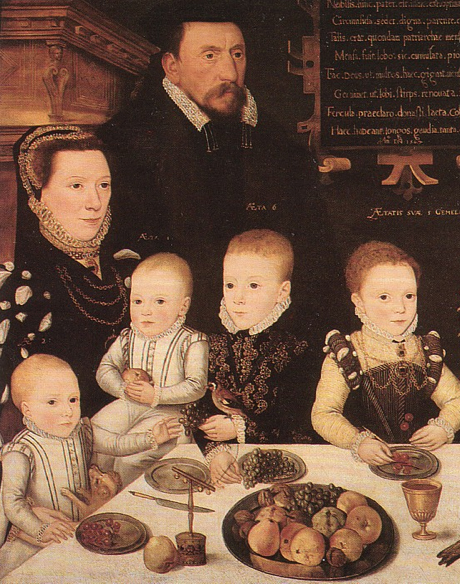
it helps to know what childhood was like for them and how family relationships were formed. According to Lawrence Stone, author of The Family, Sex, and Marriage in England, 1500-1800 (1977), 16th-century English family relationships tended to be weak, that is, weak in real relationships, bound by genuine love and affection. The social group of most importance was the extended family, the community. Personal relationships were submerged in this wider group to an extent we see today only in a few isolated communities like the Amish or the Hasidim. That these communities were often spread over a wide area, particularly on the higher levels, and considering the difficulties of travel then, that relatives might go years without seeing each other in person adds to the picture of a collection of emotionally cool relationships, connected by blood and self interest but little else.
If the Elizabethans were a hardy lot, withstanding the plague, malaria, wars, duels, the little Ice Age, and a diet that, except in summer, consisted of beef, bread and beer, it may be because the harsh treatment they recieved in infancy and childhood eliminated the weakest at the outset. The death rate among infants and children was so high that it was not unusual for a woman to have anywhere from eight to twelve children in hopes that two or three might live to maturity. If now and then this meant that so many lived that the parents went bankrupt raising, educating, and marrying them properly, it may have seemed less of a risk to dynastic-minded 16th-century parents than the disaster of leaving no progeny at all.
Birth was a dangerous passage for both mother and baby, due to the ever present threat of childbed fever, hemmorage, or both weakened by her poor diet and restrictive clothing. Once past that hurdle the infant had another series of trials to overcome before there could be any assurance of its survival. Immediately after birth it was placed with a wet nurse, often a poor woman who took in more than one baby. It would be she who would see to its care for the first year or two (81). Standard procedure was to keep the infant “swaddled,” that is, tightly wrapped in strips of fabric and bound to a board so it could not move its arms or legs (161). The board could be laid flat or hung up on a peg, where the poor creature remained until its nurse had time to feed or wash it.
Once weaned and potty-trained, it was returned to its parental home where it was consigned to a nursery along with its siblings or perhaps a cousin or two in the care of a nanny, most likely an unpaid member from a lower rung of the extended family rather than, as would be true in later centuries, a hired nurse or governess. Here the child had little more than a passing acquaintance with its parents, whose busy lives prevented them from anything more than an occasional visit during which the children were expected to perform as before a panel of judges.
At seven or eight they were considered too old for the nursery, and so would be placed outside the home, the boys with a tutor, or a family that provided a tutor, the girls with a family who used her like a little servant (167). While boys received some education, education for girls depended on the nature of the surrogate family. Both boys and girls so placed were expected to serve the household in some capacity, whatever their rank. The purpose of this placement was to enlarge the all important network of relationships with families higher on the social scale. This was meant to guarantee both children and parents some degree of social advancement.
This is not to say that these surrogate families were necessarily cruel, in fact, they might have been kinder than the child’s own parents, who, according to Stone, apparently thought it proper to present the sternest possible surface towards their offspring. Children were trained to give their parents almost idolatrous respect, addressing them with a ritual greeting, kneeling before them to ask their blessing (171). Nor was this something that parents were in any way ashamed of, since displays of affection were thought to give children the dangerous idea that they could do as they pleased. To this end they were flogged, sometimes brutally, on a regular basis, by governesses, parents, and schoolmasters, that the sins they were born with be driven out of them before they got too old for correction (163). The famous book, The Scholemaster, by Roger Ascham, was written following a discussion over a goup of boys who had recently run away from an over-zealous schoolmaster.
In families of property, the oldest boy, the one who would inherit the family titles and estates, got the most attention, with some going to the second oldest, in case the oldest should die. This hierarchy was impressed on the others, who were taught to give their oldest brother the same kind of respect they gave their parents, resulting in relationships fraught with jealousy and envy (156). If, as often happened, the father died before the heir reached maturity, he (or where there were no sons, she) became the property of the Court of Wards, to be sold to the highest bidder, who had full use of his estates until he came of age, by which time he or she often found themselves married, will they nill they, to their guardian’s son or daughter (182).
Although Stone ignores the possible connection between these behaviors and the policies and beliefs of the Reformation, we can’t help but wonder if the notion of original sin didn’t have a great deal to do with their harsh treatment of their children. Born in sin, it seems as though it was up to the little sinner whether or not he or she had the chutzpah to survive to adulthood. The beatings and constant lectures sound like one more outcome of the soul-deadening regime imported from Geneva. As much evidence shows, these processes left the nation’s children vulnerable to mistreatment of the worse sort, suggesting a society plagued by the kind of asocial griefs and horrors later dramatized by John Webster and John Ford.
When we contrast this with the childhood we envision for the Earl of Oxford, surrounded at birth and for the following four years by a community of adoring females, followed by eight years with a man who, if perhaps no more demonstrative than anyone else in his time, was clearly humane in his dealings with students and his own family, we have some ground for understanding the source of the joie de vivre, the sheer joy of living, that shines through his lighter works, and can better understand how gratefully audiences turned to his early comedies after the depressingly grim efforts of his immediate predecessors.
 politicworm
