
Sometimes a single fact can become the key to an entire period in history. Oxford’s childhood with Sir Thomas Smith is that sort of key, not just to complete our picture of Oxford’s life, but to complete the picture of Oxford as Shakespeare, and beyond that, of Shakespeare as central to the history of England during what may well have been the most crucial period in her history and absolutely the most crucial period in her literary history and the history of the London Stage.
By establishing Smith as Oxford’s surrogate father, the Aristotle to his Alexander, the Plato to his Aristotle, the Leopold Mozart to his Amadeus, we have the riches of Smith’s library where dozens of titles provide the sources for some of Shakespeare’s most valued works. We have, through Smith, the source of Shakespeare’s legal and distilling metaphors, his ascetic attitude towards food, his lack of religious bias, his Platonic philosophy. Through his years at Ankerwycke we have the source of his river, gardening, and hawking metaphors (as noted by Caroline Spurgeon), his sympathy for animals, the forest’s deer, the meadow’s rabbits and birds, the garden’s caterpillars and snails. In Smith, we have four of Shakespeare’s most vital characters, Holofernes from Love’s Labour’s Lost, Thomas of Woodstock from Richard II Part One, Gonzalo from The Tempest, and, greatest of all, Friar Lawrence from Romeo and Juliet.
We also have a number of smaller though tighter connections, such as the metaphor of a haggard hawk for a wayward woman, something Smith touches on twice in the few quotes provided by his biographers, or, in the advice Polonius gives Laertes, the advice to noblemen written by Smith during the period that Edward was living with him (Strype 53-5). With all of this securely in place, ipso facto: Oxford was Shakespeare––evidence that comes later is simply icing on the cake. And with Oxford confirmed as Shakespeare we can also complete our puzzle of the entire period, of all of the missing literary history, and even much of the mainstream history, for Shakespeare and his works are as central to the history of the Elizabethan era as is Elizabeth herself, or Burghley, Bacon, Raleigh, or Drake. Thus while Smith is the biggest missing piece of the Shakespeare puzzle, Oxford is the biggest missing piece of the Elizabethan Court puzzle.
This is what makes it crucial that we ground our view of Oxford’s childhood with Smith in provable facts. It was largely my purpose when, driven by an offhand remark by Mary Dewar in her biography of Smith, I spent six weeks in England in 2004 (funded by a fellowship raised by Dr. Daniel Wright of Concordia University) to see three of Smith’s notebooks for myself. These, two in the library at Queens’ College Cambridge and one in the archives at the Essex Record Office in Chelmsford, seemed at first to offer nothing. I didn’t realize until later that one did in fact hold one of the clues that I was seeking. Not all clues are of equal weight, but as it happens, this one’s a pip.
In each of the two notebooks at Queens’ College are inventories, the same except in minor wording, one written in 1561, one in 1569, in which he notes the 20 rooms at Ankerwycke, listing the contents of each. In the first, #49, a room on the upper floor between his father’s room and the maid’s chamber is labeled “In my L. Chambre.” In the 1569 inventory in notebook #83, page 123, a similar list is headed with the words: “In my Lorde’s Chambre.”
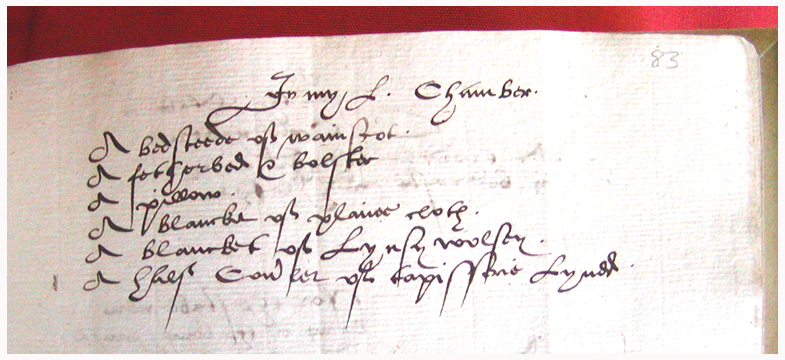
By “My Lorde” Smith must have meant de Vere, who, born “Viscount Bulbeck,” was considered a “lord” from birth. Smith was punctilious about terminology, particularly where social distinctions were concerned, so he would never have made a mistake by called somebody a lord who was not, in fact, a lord. Strype “supposes” that by “my Lorde” Smith meant the Duke of Somerset (170), but that’s impossible since Ankerwycke wasn’t finished until 1553, by which time Somerset was dead, nor would someone as self-righteous as Smith have wished to memorialize a master with whom he had had such profound differences. It could not be Cecil, since from 1550 until Elizabeth’s accession Cecil kept his own household at The Parsonage at Wimbledon not far from Ankerwycke, nor did Cecil become a lord until 1571, long after Smith had drawn up these inventories. Other than these, there is simply no lord other than de Vere who could possibly have had his own room in Smith’s home.
When we add this evidence to the phrase “brought up in my house” from the 1576 letter to Cecil, we should have enough to place Oxford with Smith for the better part of eight years, and in so doing, add to his story the riches of experience he gained as a child in a traditional country manor with all that that implies, as I’ve detailed in a number of blogs, pages, lectures, and articles. Among many other puzzle fits, this scenario provides a reason for de Vere’s placement at Queens’ College for five months in his ninth year, Queens’ being Smith’s alma mater, and Smith needing that time to assist Cecil with preparations for Elizabeth’s accession, a hard fact for which we have more than enough evidence.
De Vere was still with Smith when the first list was written. As for the 1569 inventory, although Oxford was no longer a member of Smith’s household, that Smith would continue to use his name for the room is seen by how he continued to call the room next to de Vere’s “my father’s chambre,” although Smith’s father died the summer of 1557.
By examining an actual document, its visual appearance can add to what its text and authorship have to tell us. For instance, in the letter in which Smith finally turns to the issue of Oxford’s treatment of Burghley upon his return from Italy, that Smith was more emotional at the end than he was anywhere else in the letter is obvious from the condition of the paper at this point. The pen was pressed so hard on the paper that the ink is darker here and the stroke thicker than anywhere else in the letter, so hard that the acid in the ink had eaten away the paper at that spot to a degree that it threatened to render a few of the words unintelligible. I showed it to the librarian in the Manuscript Room at the British Library, suggesting they do something to preserve it before it crumbles completely.
 politicworm